


Port Everglades in Fort Lauderdale is one of the busiest cruise ports in the world, and on Saturdays and Sundays it can feel like every ship in the Caribbean is turning around at once. Add thousands of rolling suitcases, airport shuttles, buses and private cars, and finding your Uber or Lyft can quickly become the most stressful part of your vacation. This guide breaks down how rideshare works at Port Everglades today, where to meet your driver, what kind of traffic to expect on cruise days, how pricing behaves in the apps, and when a good old-fashioned taxi is actually the easier move.
Get the latest updates straight to your inbox!
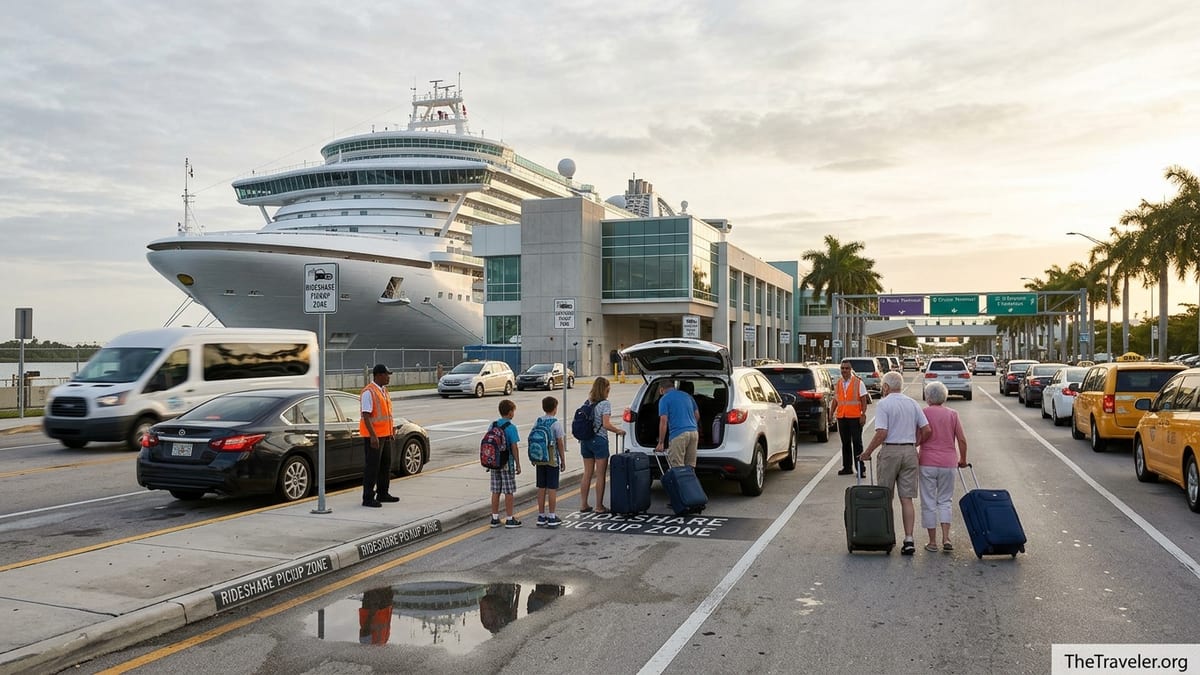
How Rideshare Works at Port Everglades Today
Port Everglades sits just south of downtown Fort Lauderdale, a short hop from Fort Lauderdale–Hollywood International Airport. In driving terms, the port and airport are practically neighbors: the distance is only a few miles and usually takes around 10 to 20 minutes in normal traffic. On heavy embarkation mornings, especially Saturdays in winter, that short trip can stretch by another 15 to 30 minutes as traffic backs up at the security checkpoints and terminal approaches.
Uber and Lyft are both widely available across Broward County and operate normally to and from Port Everglades. Drivers do not need to be specially licensed taxi operators, but they do need proper credentials to enter the secure port area. That means your driver may occasionally tell you they cannot go past the security gate; in that case you should cancel and request another ride that confirms they can enter the port, or move to a nearby hotel or shopping center pickup point just outside the gates.
Inside the port, movements are tightly controlled, with one-way flows, police officers directing traffic, and separate lanes for buses, taxis, private cars and rideshares. Port rules change from time to time, but the consistent pattern is that most cruise terminals now have clearly signed areas for app-based rides, separate from the main lanes used by tour buses and hotel shuttles. Think of these as mini airport-style pickup zones where your driver can wait briefly while you walk out with your luggage.
Because Port Everglades sprawls over multiple basins, with terminals clustered in different pockets, it is important to know which terminal your ship is using. Celebrity, Royal Caribbean, Princess, Holland America, Carnival and others all use different buildings, and you may not return to the same one you departed from. Always verify the terminal number on your cruise line app or on the port’s official terminal assignment list on the morning of sailing before you request a ride.
Pickup and Drop-Off: Zones by Cruise Terminal
There is no single, central rideshare lot for the entire port. Instead, each active cruise terminal has its own curbside area for drop-off and a nearby space or lane for pickups. In practice, this works a lot like a small airport terminal: your driver will follow signs for your terminal number, drop you right at the entrance doors on departure, and then on your return you will walk out of the baggage hall to a marked rideshare area slightly offset from the busiest bus lanes.
For example, Royal Caribbean and Celebrity often use Terminal 18 and Terminal 25. At both, vehicles loop in on dedicated access roads, with police or traffic staff waving them forward. Drop-off usually happens directly in front of the terminal doors, under a canopy. After your cruise, once you clear customs and walk outside, look for signs that mention app-based rides or rideshare, often with lettered or numbered zones painted on the curb. Your Uber or Lyft app may instruct you to choose a specific lettered pickup bay that your driver can see as they pull in.
Other terminals along the main spine of the port follow a similar pattern. At some, the rideshare zone is just to one side of the terminal exit, near a bright-colored administrative building or a side parking lot. In a recent season, travelers reported that Terminal 4 had its own clearly marked rideshare area that was only a short walk from the exit doors, with good sightlines to oncoming cars. The key is to keep walking past the first congested patch of buses and porters until you see signage indicating rideshare or app pickups.
Because layout can shift as construction and security arrangements evolve, you should expect some variation from ship to ship and season to season. The safest strategy is to follow the port’s overhead signs first, then double-check the pin in your Uber or Lyft app. If the app defaults to the wrong side of the building, drag the pin to where you are actually standing before you confirm your ride. This is especially important if you are in a parking garage across from your terminal rather than at the main curb.
Traffic Patterns on Cruise Days: Timing Matters
On peak cruise days, the roads in and around Port Everglades behave very differently from a normal weekday. Morning embarkation usually ramps up from around 9:30 or 10:00 a.m., peaks late morning to early afternoon as most ships take on new passengers, and tapers off by mid-afternoon. Disembarkation traffic starts early, with some self-assist passengers walking off at 7:00 or 7:30 a.m., and can be intense until around 10:00 a.m., when the last major wave clears customs and heads to the airport.
If you are arriving from Fort Lauderdale–Hollywood International Airport on the day of your cruise, that means the short 10-minute drive can be heavily delayed around 10:00 a.m. to noon, when outbound cruisers, inbound hotel shuttles and rideshares all converge on the same gates. Many cruisers flying into FLL schedule flights that land between 9:00 and 11:00 a.m., hoping to be onboard by early afternoon. As a result, if your flight arrives at 11:30 a.m. on a Saturday in January, you should expect possible congestion and budget at least 45 minutes from wheels down to terminal curb at your ship.
On the flip side, early birds often sail through. Travelers who arrived at the port around 8:30 or 9:00 a.m. after a nearby hotel stay have reported that an Uber from a hotel on 17th Street or near the airport reached the terminal in under 15 minutes, with minimal backup at the gate. Similarly, if your ship returns midweek during the slower shoulder seasons, the port can feel surprisingly calm, and a rideshare back to the airport may take only 10 to 15 minutes even at 9:00 a.m.
Major highway connectors also shape traffic. The Port Everglades Expressway and nearby interstates funnel vehicles quickly to the port entrance, but any crash or heavy rain on these corridors can spill delays directly into the port approaches. In summer, brief Florida downpours are common and can slow the entire system. On those mornings, rideshare drivers may be a bit more cautious and pickups can take longer than the map’s original estimate. Always build in extra time if you have a same-day flight, especially if it departs before noon.
What Uber and Lyft Really Cost: Price Ranges & Surge
Because the distances involved are short, rides between FLL and Port Everglades are usually not expensive outside of surge periods. Recent trip reports and published guides indicate that a standard UberX or Lyft ride from the airport to most cruise terminals typically falls in the region of about 15 to 25 dollars in normal conditions for one to four passengers, including airport pickup fees. On particularly busy embarkation mornings, or during strong demand spikes such as holiday Saturdays, prices can climb into the upper 20s or even low 30s for the same short journey as surge pricing kicks in.
From nearby hotels along 17th Street Causeway, such as mid-range chains facing the Intracoastal or properties slightly inland, base fares can be even lower. Many travelers report paying something in the low teens to reach their terminal from a hotel just outside the port. A couple staying two nights at a hotel on SE 17th Street, for instance, might see 9 to 15 dollars for a late-morning UberX, depending on how far they are from the main gate and how congested the cruise traffic is that day.
Bigger jumps appear when traveling between Port Everglades and Miami. Uber and Lyft trips from the port to PortMiami or Miami International Airport can range around 45 to 70 dollars or more depending on the time of day, congestion and surge. It is common to see prices at the lower end of that band during midday on weekdays, with higher fares if you are traveling at rush hour or right after multiple ships have disgorged thousands of passengers all seeking transport at once.
To avoid surprises, always open both Uber and Lyft before you commit and compare their real-time estimates. Check whether the price shown is due in part to an unusually high surge multiplier, and consider waiting ten minutes to see if it eases once the immediate crush passes. If both apps show unusually high prices for the short airport run, it is a sign that taxis and shared shuttles may offer better value in that moment.
Luggage, Families and Accessibility: Choosing the Right Ride
Cruise passengers do not travel light, and that matters when requesting a rideshare. A standard UberX or Lyft typically works for two people with two large checked suitcases and a carry-on each, but four adults with multiple big bags may find themselves struggling to fit everything into a compact sedan. In that case, it is smarter to select an UberXL or Lyft XL, which dispatches an SUV or minivan-style vehicle with more cargo space. The fare will be higher, but for a short hop between the airport and port, the difference often amounts to only an extra 10 to 15 dollars, which can be worth it to avoid cramped conditions or arguments at the curb.
Families with strollers, car seats and small children should pay special attention to both luggage volume and child safety rules. Florida requires appropriate child restraint devices for younger children, and while rideshare drivers may not supply them, some services in the area offer rides with car seats at a premium. If you prefer to keep things simple, booking a traditional taxi van at the airport, which may be better equipped to handle bulky gear and can sometimes provide child seats, can be the easiest route. Always confirm with the driver at the curb before loading in.
Passengers with mobility challenges or using wheelchairs should be prepared for mixed experiences with app-based rides. While some Uber and Lyft markets support dedicated accessible ride categories, availability around cruise ports can be uneven. If you require a ramp or lift-equipped vehicle, you may find it more reliable to pre-arrange a wheelchair-accessible van or rely on your cruise line’s recommended transportation partners. Within the port itself, sidewalks are generally wide, but curb cuts can be uneven and cross-traffic from buses is constant, so allow more time to move safely from baggage claim to your pickup point.
One underappreciated detail is the walk between terminal exits and the rideshare zones. In many cases it is short and level, but at very busy terminals you may be asked to continue a little farther along the curb to reach a calmer pickup area. After a long cruise with heavy bags, that extra five-minute walk in the Florida sun can feel longer than it is. If you or your traveling companions cannot manage that distance easily, flag down a port attendant and ask where the closest taxi stand or accessible pickup door is located.
Managing the Disembarkation Rush Without Losing Your Driver
The most chaotic rideshare moment at Port Everglades is usually disembarkation morning between roughly 8:00 and 10:00 a.m., when several large ships may be emptying simultaneously. At that time, curb space is at a premium, porters are hustling luggage carts, and hotel shuttles are circling repeatedly. Uber and Lyft drivers often receive one request after another, and if they cannot locate you quickly, they may cancel and accept an easier pickup nearby. Managing this period well is about timing and communication.
A good rule of thumb is not to request your ride until you physically have your luggage and are within a short walk of the designated pickup zone. If you call a car while still in the customs line or waiting for checked bags, you risk being delayed inside while your driver arrives outside to an empty curb. After five or ten minutes, many drivers will cancel, leaving you repeating the process in a crowded environment while prices potentially surge higher.
When you do request a ride, pay close attention to the terminal number and any zone indicators in the app. Some drivers unfamiliar with the port might follow their GPS only to be stopped at the wrong gate or misdirected down a service road. If you see your driver icon stalling on the map, send a brief in-app message: mention your terminal number, a nearby sign, and perhaps a distinguishing feature such as the color of the nearest parking garage or building. Short notes like “At Terminal 25, rideshare zone B, near the orange building” help drivers navigate port complexity much faster.
If lines for rideshare stretch too long or the apps show wait times above 20 to 30 minutes, consider walking out of the most congested zone. Some travelers simply cross to a quieter portion of the curb near the end of the terminal, or walk toward a neighboring parking lot that is still inside the secure area but less jammed with buses. If port staff are directing everyone to a specific queue for app pickups, follow their instructions but do not hesitate to ask whether taxis or shared shuttles have shorter waits at that moment.
When a Taxi or Shuttle Is Actually Easier
Although Uber and Lyft dominate many urban trips today, there are several specific situations at Port Everglades where a taxi or shuttle can be the better bet. One classic example is leaving the port at peak disembarkation time when surge pricing is high. If both apps are quoting 30 dollars or more for a ride to the nearby airport, but taxis are operating on a regulated meter or short flat fare and are plentiful just steps away, the taxi line may get you moving faster and for roughly similar or lower cost.
Broward County has long set guidelines for taxi rates that include minimum charges for trips originating at Fort Lauderdale airport and Port Everglades. In practice, this tends to keep taxi fares for the short port-to-airport ride within a fairly predictable band, even when demand spikes. A metered cab also removes the uncertainty of waiting for surge pricing to relax. For travelers who value simplicity over shaving a few dollars off the fare, walking to the taxi stand and taking the next available cab is often the least stressful approach.
Hotel and cruise line shuttles can also be strong options, particularly for families or groups. Many Fort Lauderdale hotels that market themselves as cruise-friendly offer complimentary or low-cost shuttles from the property to Port Everglades, especially along the main 17th Street corridor. A family of four staying two nights before sailing might find that a 20-dollar per-room shuttle fee to the port competes well with separate Uber rides. Similarly, some cruise lines sell transfers between the ship and airport that, while more expensive per person than a rideshare, bundle peace of mind and assistance with luggage and timing.
Shuttles show their weakness when delayed or oversubscribed. Cruise passenger surveys from recent seasons have noted frustration with long waits for hotel buses after disembarkation. If you are standing with your bags in the Florida heat while promised coaches fail to appear, check ride apps as a backup. Even a slightly pricier Uber or taxi can feel worth it compared with an extra 45 minutes sitting on a curb worrying about your flight.
Practical Safety and Security Tips Inside a Working Port
Port Everglades is a working seaport as well as a cruise gateway, which means heavy truck traffic, strict security and constantly shifting lane closures. When using Uber or Lyft here, always remember that you are in an industrial environment, not a pedestrian promenade. Stay on marked sidewalks as you move from the terminal to your pickup point, and avoid crossing active lanes of traffic to save a few steps.
Because law enforcement officers control access at the main gates, your driver must show appropriate identification and be cleared to enter. If a driver messages you saying they cannot get through security, do not attempt to walk out to the highway or meet them on a shoulder. Instead, cancel and rebook, or ask port staff where outside the secure zone it is safe and legal to meet a rideshare if necessary. In many cases this is not needed, but it is important to treat the security perimeter with respect.
Inside the port, speed limits are low but vehicles frequently jockey for position, especially around bottlenecks near terminal entrances. When you see your car approaching, resist the urge to wheel your suitcase between idling buses to shave off a minute of walking. Wait for a clear break, or ask your driver to loop once more and pull into the official pickup bay closest to you. The few extra minutes are worth avoiding a close call with a bus or shuttle cutting across lanes.
Finally, as with any app-based ride, verify the license plate and driver name before loading your bags. In the confusion of a busy curb with multiple black SUVs pulling up, it is easy to climb into the wrong vehicle, particularly when half the passengers have similar mid-morning airport destinations. Confirm the plate through the window, then place your luggage into the trunk only after you are sure you have the correct car.
The Takeaway
Using Uber or Lyft at Port Everglades is generally straightforward once you understand how the port is laid out and how cruise-day traffic behaves. Each terminal has its own curbside drop-off and a designated rideshare pickup area, and in normal conditions the short ride between the port and Fort Lauderdale–Hollywood International Airport stays reasonably priced. The hardest moments are the peak disembarkation windows on weekends, when thousands of passengers try to order rides at once and traffic near the gates becomes congested.
To keep your trip smooth, confirm your terminal number, wait to request your car until you have your luggage, walk to the correct rideshare zone, and stay flexible about using taxis or shuttles if the apps show long waits or high surge prices. Choose a larger vehicle if your group has lots of luggage, and plan extra time for mobility needs or families with small children. With those simple strategies, rideshare becomes just another uncomplicated step between the plane, the ship and your hotel, rather than the most stressful leg of your cruise vacation.
FAQ
Q1. How much does an Uber or Lyft from Fort Lauderdale airport to Port Everglades usually cost?
In normal conditions, most travelers see standard rides in roughly the 15 to 25 dollar range one way, depending on time of day, demand and the exact terminal.
Q2. How long does the ride from the airport to Port Everglades take on a cruise day?
The drive itself can be as short as 10 to 20 minutes, but on busy weekends you should budget at least 30 to 45 minutes from airport curb to cruise terminal entrance.
Q3. Where exactly do I meet my Uber or Lyft when my cruise returns?
After clearing customs, follow signs for rideshare or app-based pickups; each terminal has a marked area, often with lettered or numbered zones just beyond the busiest bus lanes.
Q4. Should I call my rideshare while I am still on the ship or in the customs line?
It is better to wait until you have all your luggage and are close to the pickup zone, otherwise your driver may arrive before you can reach the curb and cancel the trip.
Q5. Is it worth paying extra for UberXL or Lyft XL to the port?
If you have more than two large suitcases or four adults with multiple bags, choosing the larger vehicle can prevent luggage problems for only a modest extra cost on this short route.
Q6. Are taxis cheaper than rideshare at Port Everglades?
For very short trips like port to airport, taxi fares are usually predictable and sometimes similar to or lower than surge-priced rideshare, especially at peak disembarkation times.
Q7. Can rideshare drivers always enter the secure port area?
Most can, but occasionally a driver may lack proper access and be turned away; if that happens, cancel politely and request another ride that confirms they can reach your terminal.
Q8. What is the best time to leave the ship if I want an easy Uber or Lyft pickup?
Leaving either very early in the first wave or later in the morning after the main rush often means less curb congestion and slightly shorter waits in the apps.
Q9. Is rideshare a good option for travelers using wheelchairs or with limited mobility?
It can work, but accessible vehicles may be limited, so many passengers with mobility needs prefer pre-booked accessible vans or cruise-organized transfers instead.
Q10. How early should I schedule my flight from Fort Lauderdale after a cruise?
Many travelers choose flights at or after late morning; allowing at least three to four hours from scheduled ship arrival to flight departure gives a safety buffer for port traffic and airport lines.