


Porter Airlines is turning Toronto Pearson into a far more compelling gateway to the sun for winter 2026–2027, adding new nonstops to Aruba, Turks and Caicos, Los Cabos, Montego Bay and San José in Costa Rica. The carrier says its expanded winter sun program, which began on October 30, represents more than a 115 percent increase in capacity to warm-weather destinations, giving Canadian travelers additional options beyond the traditional big players.
Get the latest updates straight to your inbox!
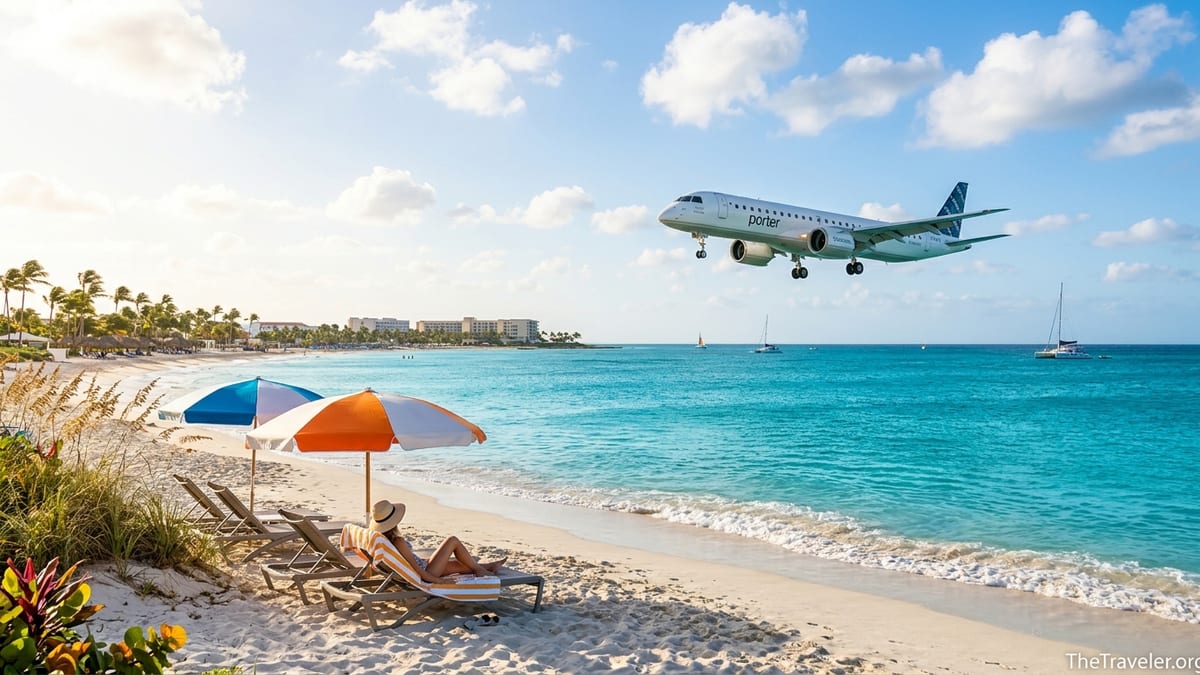
Porter’s biggest winter sun push yet
Porter formally kicked off its expanded winter sun schedule on October 30, 2026, with the inaugural Toronto Pearson to Oranjestad, Aruba flight. That launch marks the first of five new southern routes that will roll out through late fall and early winter, significantly broadening the airline’s Caribbean, Mexico and Central America footprint from Toronto. Executives describe this as the airline’s biggest sun season to date, building on initial international growth over the previous two winters.
The headline figure behind the announcement is striking: more than 115 percent additional capacity to sun destinations compared with the previous winter. While the exact seat counts are not publicly broken out by route, the overall increase comes from adding completely new destinations, layering in extra weekly frequencies on stronger performers, and using the 132-seat Embraer E195-E2 jet on all Toronto Pearson sun routes. For travelers, that translates into more choice in terms of days of the week and better odds of finding competitive fares during peak school holiday periods.
Porter is also emphasizing its distinct onboard product as part of the winter expansion. All E195-E2 flights feature a two-by-two seating layout, which means no middle seats anywhere on the aircraft. Complimentary beer and wine served in glassware, along with free premium snacks, remain part of the Porter brand. For flights to destinations such as Los Cabos and Costa Rica where travel times are longer, the airline highlights the availability of fresh, paid meals and high-speed Wi-Fi that is promoted as fast enough for streaming and video calls, potentially making the journey feel shorter and more productive.
From Toronto’s perspective, the new services arrive as Pearson actively promotes a broader mix of winter-sun options. Airport updates released in October note 18 new or expanded winter-sun routes across several airlines, with Porter’s Aruba, Los Cabos, Montego Bay, Turks and Caicos and San José flights among the headline additions. For travelers who might previously have felt locked into a single dominant carrier for southbound trips from Toronto, the new Porter schedule adds a meaningful layer of competition.
New Toronto–Aruba schedule and sample pricing
Aruba is the first of Porter’s new winter sun destinations to go live from Toronto Pearson. According to schedule information filed for the Northern winter 2026–2027 season, Porter’s Toronto–Aruba service officially begins on October 30, 2026, initially with three weekly roundtrips operated by Embraer E195-E2 aircraft. Later in December, the schedule increases to four weekly flights, giving travelers more flexibility when planning week-long or ten-day stays in the southern Caribbean.
A recent search of Porter’s booking engine for November and early December 2026 dates shows base one-way fares on Toronto–Aruba starting around 200 to 250 Canadian dollars on off-peak days, with higher prices on Saturdays and over holiday periods. For example, random midweek dates in late November display starting fares near the low-200-dollar range in the airline’s lowest economy category, before adding options such as seat selection or checked baggage. Travelers booking Christmas or New Year departures should expect significantly higher prices, often several hundred dollars more each way, reflecting strong seasonal demand.
Package pricing through Porter Escapes, the airline’s vacation-package arm, varies widely based on hotel category and length of stay, but recent sample packages for similar Caribbean destinations suggest that a one-week, flight-plus-hotel bundle for two adults at a midrange beachfront resort in Aruba can land in the approximate range of 3,000 to 4,500 Canadian dollars before add-ons. That sort of package typically includes roundtrip flights, seven nights of accommodation, shared airport transfers and the option to add travel insurance. Higher-end all-inclusive or luxury properties will push total costs upward, often into the 5,000 to 7,000 dollar range for the same duration.
When evaluating total vacation costs, travelers should factor in Aruba’s relatively high prices for food, drink and activities compared to some other Caribbean islands. For instance, a casual dinner with drinks at a resort-area restaurant can easily reach 80 to 120 Canadian dollars for two people, while popular excursions such as Jeep tours into Arikok National Park or catamaran sailing trips often price out in the 90 to 150 dollar per-person range. Combining these everyday costs with the flight and hotel bill helps set a more realistic budget, especially for families planning a stay over the December or March break windows.
Los Cabos: Mexico’s Pacific playground from Toronto
On the Pacific side of Mexico, Porter is introducing new nonstop service from Toronto Pearson to Los Cabos International Airport, serving the twin resort towns of Cabo San Lucas and San José del Cabo. Filed schedules indicate the route begins on November 16, 2026, with three weekly E195-E2 flights. The timing is designed to capture both Canadian snowbirds seeking longer stays on the Baja California peninsula and vacationers heading down for one- or two-week breaks during Canada’s coldest months.
Current fares for Toronto–Los Cabos on Porter, based on sample searches for January 2027 dates, show starting one-way prices in the range of roughly 260 to 350 Canadian dollars in economy on many non-peak days, though exact amounts shift as seats sell. Relative to established competitors on the route, these levels tend to be competitive, particularly when factoring in the onboard service perks and the absence of middle seats. Travelers with some date flexibility often find that flying on Tuesdays or Wednesdays produces lower prices than Saturday departures, which are in high demand with package-tour travelers.
Vacation-package options to Los Cabos through Porter Escapes and other tour operators typically cluster around large all-inclusive resorts spanning the corridor between Cabo San Lucas and San José del Cabo. For a realistic example, a couple traveling from Toronto for seven nights in mid-January at a well-rated, four-star all-inclusive resort might expect a total package price in the vicinity of 3,000 to 4,000 Canadian dollars, including flights, hotel, transfers and meals. Moving up to a five-star adults-only or luxury branded property can readily elevate the package price into the 5,000 to 6,500 dollar bracket, particularly for oceanfront or swim-up suites.
On the ground, Los Cabos offers a mix of accessible and premium experiences that influence overall budgeting. A basic shared airport shuttle into the hotel zone can cost the equivalent of 20 to 30 Canadian dollars per person, while private SUV transfers commonly run 80 to 150 dollars each way, depending on distance and provider. Day-to-day restaurant prices in tourist zones tend to be higher than in inland Mexican cities: it is common for a beachfront lunch with cocktails at a popular spot in Cabo San Lucas to reach 70 to 100 dollars for two. Excursions such as whale-watching cruises during the winter migration season or side trips to the artsy town of Todos Santos typically range from about 90 to 180 dollars per person, depending on inclusions.
Montego Bay and Turks and Caicos: New Caribbean choices
Porter’s Caribbean expansion from Toronto also includes new nonstop flights to Montego Bay, Jamaica, and Providenciales in Turks and Caicos. Montego Bay service is scheduled to begin on November 23, 2026, with four weekly flights that increase to five weekly departures from early December, according to published timetable information. Turks and Caicos, centered on the island of Providenciales, is part of a broader sun push that also touches Ottawa, with Toronto flights fitting into the carrier’s network of connections from other Canadian cities.
Montego Bay is among the most competitive Caribbean markets from Toronto, with multiple airlines offering nonstops and a deep catalog of all-inclusive resorts. Early fare snapshots for Porter’s January and February 2027 Montego Bay flights show one-way economy prices often starting around the mid-200 to low-300 Canadian dollar range on non-holiday dates, rising when demand spikes. Package holidays through Porter Escapes and other operators provide a benchmark for overall costs: a one-week all-inclusive stay for two adults at a midrange resort outside Montego Bay commonly appears in the approximate 2,800 to 4,000 dollar window, depending on brand, beach quality and room type.
Turks and Caicos positions itself at a more upscale level, and that reality is visible in both airfares and hotel prices. While exact Porter fare patterns will continue to shift as the inaugural season approaches, recent examples on comparable carriers show that roundtrip economy tickets from Toronto to Providenciales in January often total between 800 and 1,200 Canadian dollars per person when booked several months in advance, with higher figures around Christmas and March break. Once on island, Grace Bay and surrounding areas command some of the Caribbean’s highest per-night rates: even modest condo-style properties can reach 400 to 600 dollars per night in high season, while luxury beachfront hotels easily push beyond 1,000 dollars nightly.
For families eyeing Turks and Caicos on a Porter flight, this means a realistic one-week vacation budget for two adults and two children at a family-friendly resort can approach or exceed 8,000 to 10,000 Canadian dollars once flights, accommodation, meals and a few excursions are tallied. Beachfront dining, snorkeling tours and boat trips to nearby cays all tend to command premium pricing. Some travelers reduce costs by choosing self-catering condos, cooking a portion of their meals and prioritizing free beach time over organized excursions, but Turks and Caicos remains a higher-spend destination compared with more mass-market Caribbean islands.
San José, Costa Rica: Gateway to nature and adventure
The final new destination in Porter’s winter 2026–2027 sun rollout from Toronto is San José, Costa Rica. Flights are scheduled to begin on December 2, 2026, with four weekly E195-E2 departures from Toronto Pearson to Juan Santamaría International Airport, which acts as the main gateway to central Costa Rica. For many Canadian travelers, San José is more of a transit point than a beach destination in its own right, with onward travel to the Pacific coast, cloud forests or volcano regions forming the core of the itinerary.
Sample fares on comparable winter-season routes into San José indicate that one-way economy prices from Toronto frequently fall somewhere in the 260 to 380 Canadian dollar band outside peak holiday weeks, with higher roundtrip totals at Christmas, New Year and during March school breaks. Once Porter’s schedule matures, travelers can expect similar dynamics: booking several months ahead and being flexible with weekdays generally yields better deals, while last-minute departures in January or February often carry a premium.
Unlike traditional beach-package markets such as Cancun or Montego Bay, Costa Rica attracts a significant share of independent travelers who bundle flights, car rentals and eco-lodges on their own. A realistic example for a couple flying Porter into San José for ten days in February might include 900 to 1,200 Canadian dollars per person for flights, 500 to 800 dollars for a compact 4x4 rental, and 1,800 to 3,000 dollars for a mix of midrange lodges in areas such as La Fortuna, Monteverde and Manuel Antonio. Adding in national-park entrance fees, guided excursions like zip-lining or wildlife night walks, meals and fuel can bring the total trip budget into the approximate 5,000 to 7,000 dollar range.
Package options via Porter Escapes and other operators are beginning to appear that combine San José arrivals with beach stays in Guanacaste or on the central Pacific coast. These often bundle transfers, breakfast and several tours, resulting in one-week packages for two adults in the general vicinity of 3,500 to 5,000 Canadian dollars at midrange hotels. For travelers new to Costa Rica, such bundles can simplify logistics, though experienced visitors may still prefer to customize itineraries to focus on specific regions or activities such as surfing, birdwatching or hot springs.
Understanding schedules, aircraft and connection options
Across all five new routes, Porter is deploying its Embraer E195-E2 aircraft, a narrowbody jet configured with no middle seats and a cabin layout that closely resembles what many travelers associate with smaller, boutique-style airlines. Flight times from Toronto Pearson vary by destination: Aruba tends to be in the mid-five-hour range southbound, Los Cabos can approach six hours, Montego Bay and Turks and Caicos generally sit closer to four hours, and San José usually requires about five and a half hours, depending on winds and routing. Departures are spread across the week, with three to five weekly frequencies on each route instead of daily service.
Because many of these flights do not operate every day, travelers planning fixed-date holidays need to pay particularly close attention to the exact weekly pattern before locking in accommodation. For instance, a resort package that runs Saturday to Saturday may not align neatly with a three-times-weekly flight that operates on Mondays, Wednesdays and Fridays. Checking both departure and return days while searching helps avoid awkward gaps that might force an extra night in a city hotel or a more expensive one-way ticket on a different carrier.
Porter has built a notable domestic and transborder network feeding into Toronto Pearson, including routes from cities such as Ottawa, Halifax, Edmonton and Calgary. Many winter-sun travelers from outside the Greater Toronto Area will connect through Pearson onto the new Aruba, Los Cabos, Montego Bay, Turks and Caicos or San José flights. When pricing itineraries, these travelers should compare through-fares on a single Porter ticket with the cost of separate tickets on mixed carriers, bearing in mind that booking one through-ticket generally provides better protection in the event of a missed connection due to weather or delays.
For those based in the Toronto region itself, one practical distinction is that Porter’s sun flights operate from Pearson rather than the closer downtown Billy Bishop airport on the island. This may impact total travel time and transportation costs to the airport. A rideshare or taxi from central Toronto to Pearson can range from about 45 to 80 Canadian dollars each way depending on traffic and time of day, while public-transit combinations including the UP Express train offer a lower-cost option for travelers willing to manage luggage aboard trains and buses.
Packages, extras and the true cost of a Porter winter escape
While headline airfares often attract attention, the real cost of a winter escape on Porter’s new routes emerges once all extras and on-the-ground spending are accounted for. Porter’s lowest economy fares generally include a standard carry-on allowance and complimentary snacks and drinks, but checked baggage, advance seat selection and itinerary changes can add to the cost. For instance, paying for a checked bag each way, selecting preferred seats and choosing a fare type with lower change fees can collectively add more than 100 to 150 Canadian dollars per person to the roundtrip bill, depending on the route and options chosen.
Porter Escapes packages roll some of these elements together by bundling flights with hotels and often transfers. In some cases, choosing a package instead of booking flight and accommodation separately yields savings of several hundred dollars, particularly at high-demand resorts in Aruba, Montego Bay or Los Cabos. On the other hand, independent travelers who chase hotel promotions or loyalty-program redemptions may still come out ahead by assembling their own itineraries. Running side-by-side comparisons for your exact dates and preferred properties is essential in order to judge value accurately.
Local costs at the destination typically exceed the initial flight-or-package price over the course of a week-long stay. In Jamaica, for example, even at an all-inclusive resort, guests often spend extra on off-site excursions to Negril or Dunn’s River Falls, spa treatments, club-level upgrades or a round of golf, each of which can add 80 to 200 Canadian dollars per person. In Costa Rica, activities such as guided wildlife tours, whitewater rafting and national-park entrance fees accumulate quickly. Turks and Caicos and Aruba, meanwhile, are known for high restaurant tabs and premium-priced water sports, which can easily add 1,000 dollars or more to a couple’s total spend over seven days.
Travel insurance is another line item not to overlook. Porter Escapes partners with a major insurer to offer optional coverage for medical issues, trip interruption and cancellation. For a typical one-week Caribbean trip costing around 3,500 Canadian dollars for two people, a comprehensive policy can price out at roughly 150 to 250 dollars, depending on ages and coverage limits. While some travelers rely on credit-card insurance, it is important to verify conditions and exclusions before assuming that all potential issues are covered, particularly for destinations where out-of-country medical costs can be substantial.
How Porter’s new routes reshape winter options from Toronto
For Greater Toronto Area travelers, the arrival of Porter’s five new winter sun routes subtly reshapes the competitive landscape, especially in markets that were previously dominated by a small handful of carriers and package brands. Aruba, Montego Bay, Los Cabos, Turks and Caicos and San José are all markets where Canadian travelers already have choices, yet Porter’s entry adds more nonstops at varied times and a somewhat different onboard and booking experience than the traditional charter-style model.
One practical impact is in shoulder-season pricing. With additional capacity entering markets such as Los Cabos and Aruba in November, early December and late April, travelers willing to avoid the exact peak weeks may find more frequent sales or lower base fares as airlines work to maintain healthy load factors. This dynamic can be particularly helpful to retirees, remote workers or couples without school commitments, who can shift travel into these less in-demand periods and capture lower overall vacation costs without sacrificing weather quality.
Another influence lies in the growing integration between scheduled airlines and tour operators. Porter already partners with established vacation brands for some routes, and its new sun services are expected to appear across a range of packaged products, sometimes marketed under different trade names. For consumers, this means the same Porter-operated flight may be bundled into packages sold by various retail travel agencies, as well as via Porter’s own vacation arm. Comparing inclusions and cancellation policies across similar-looking offers can reveal significant differences in overall value, even when the underlying flight is identical.
Finally, the expansion serves as a signal of Porter’s long-term intention to be more than a niche regional carrier. By using its E195-E2 fleet to reach deeper into the Caribbean, Mexico and Central America from Toronto, the airline is positioning itself as a serious alternative for Canadians seeking sun vacations. For travelers, the key takeaway is straightforward: when planning winter 2026–2027 escapes from Toronto to Aruba, Turks and Caicos, Los Cabos, Montego Bay or San José, it is now worth including Porter’s schedules and package offerings in any thorough price and itinerary comparison.
Planning your winter 2026–2027 escape
With Porter’s expanded winter sun network now in place, travelers considering a warm-weather getaway between late October 2026 and spring 2027 can approach trip planning with a few practical steps. First, identify whether your preferred destination aligns with the new routes: Aruba and Turks and Caicos lean toward higher-end Caribbean experiences, Montego Bay and Los Cabos offer a wide range of all-inclusive resorts at varied price points, and San José opens the door to more adventurous, multi-stop Costa Rica itineraries.
Next, check the specific weekly flight pattern for your chosen destination before locking in hotel dates or nonrefundable arrangements such as wedding venues or cruise departures. Because routes such as Toronto–Aruba or Toronto–San José do not operate daily, aligning inbound and outbound flights with resort check-in and checkout times avoids extra hotel nights or awkward overnight stays. If your dates are inflexible, it may be worth building in an extra buffer day at the start of a trip, particularly during the heart of Canadian winter when storms can disrupt schedules.
Finally, construct a realistic door-to-door budget that includes not only Porter’s airfare or package price, but also airport transfers, baggage and seat fees, travel insurance, meals, excursions and discretionary spending. For many couples departing Toronto on one of Porter’s new sun routes, an honest tally often places a one-week vacation in the neighbourhood of 3,000 to 5,000 Canadian dollars for midrange options, and significantly more for luxury-focused trips or high-cost islands like Turks and Caicos. Having a clear figure in mind at the planning stage makes it easier to choose between room categories, dining plans and activities once you arrive.
As bookings for winter 2026–2027 gather pace, Porter’s newly expanded sun network offers Canadian travelers a richer set of choices out of Toronto, complemented by an onboard product that emphasizes comfort and a more boutique feel. Whether the appeal is Aruba’s steady sunshine, Jamaica’s all-inclusive strip, Mexico’s Pacific landscapes or Costa Rica’s rainforests and wildlife, the airline’s new routes give travelers one more reason to think beyond the traditional package playbook when escaping the Canadian cold.