


Portugal offers a relatively predictable institutional framework, but new and prospective residents encounter a bureaucracy that combines modern digital tools with significant procedural bottlenecks. Understanding how complex this system is in practice is essential for evaluating the feasibility and risk profile of relocation plans. This briefing explains a practical “bureaucracy complexity score” for Portugal, breaking down the main administrative dimensions that affect foreign residents and benchmarking them qualitatively against other European destinations.
Defining a Bureaucracy Complexity Score for Portugal
For relocation decision-making, a bureaucracy complexity score is a composite view of how difficult it is to complete essential administrative tasks after arrival. In the Portuguese context, this focuses on immigration case handling, civil registration, tax and social security registration, and everyday interactions with public agencies, rather than broader topics such as tax levels or healthcare benefits.
A practical way to structure this score is to examine five dimensions: procedural clarity, number of steps and actors involved, processing times and backlogs, predictability of outcomes, and digitalization of services. Each dimension can be assessed qualitatively on a low, medium, or high complexity scale, with Portugal displaying a mixed profile: relatively strong legal frameworks and digital channels coexisting with long delays and fragmented responsibilities.
Relocation stakeholders, including HR and mobility managers, typically translate this into risk categories. For example, a country where paperwork is heavy but predictable may be labeled "administratively demanding but manageable," whereas one with frequent rule changes and long delays is rated as "high operational risk." Current evidence places Portugal closer to the latter for immigration-related matters, although general public-service access is gradually improving with digital tools.
Because formal global indices may not isolate the post-arrival experience for foreign residents, this briefing relies on recent operational data, official modernization programs and qualitative feedback from migrants and advisors to derive a usable score rather than a purely theoretical ranking.
Core Administrative Landscape for New Residents
New residents in Portugal interact with several distinct layers of public administration. The most critical for foreigners is the Agency for Integration, Migration and Asylum (AIMA), which replaced the former immigration authority SEF in late 2023. AIMA is responsible for residence permits, renewals and related compliance, and it inherited a very large backlog of pending applications, estimated in multiple hundreds of thousands of cases at the time of transition and still significant in 2025 and 2026.
Alongside AIMA, new residents must register with tax authorities, social security, and often municipal offices. Tasks include obtaining a tax identification number, registering an address, and, for non-EU nationals, securing proof of lawful stay while residence cards are pending. Each of these interactions has its own procedures and online portals, meaning that overall bureaucracy is shaped not by a single institution but by the combined performance of several agencies.
The Portuguese government has been pursuing a multi-year digital modernization agenda, centralizing access to many public services through the gov.pt portal and, more recently, a unified mobile app. These tools allow users to manage documents, receive alerts and conduct various procedures online, improving the user experience particularly for citizens and long-term residents with digital credentials.
However, for newcomers, especially non-Portuguese speakers, the practical challenge is not just technical access but process navigation. Public-facing information can be fragmented or inconsistent across channels, and the interplay between local offices, national agencies and online platforms remains a key source of perceived complexity.
Procedural Clarity and Documentation Requirements
Portugal’s legal framework for migration and civil registration is relatively detailed, but the operational clarity perceived by users is often lower than the formal rules would suggest. One factor is the rapid policy change since 2023, including the dissolution of SEF, the establishment of AIMA and subsequent adjustments to immigration law and internal procedures. These shifts have led to transitional measures, such as temporary validity extensions for expired residence permits and interim documents, which can be misinterpreted or unevenly applied.
For residence permits and some other procedures, documentation requirements are formally specified in law and administrative guidelines. In practice, however, applicants and advisors report that local offices may request additional documents not mentioned in online checklists, or interpret requirements differently, leading to repeated appointments or supplementary submissions. This variability significantly increases the perceived complexity score for procedural clarity.
The government has taken steps to standardize and simplify communication, including publishing plain-language guidance for public services on gov.pt and increasing the use of digital notifications. Nonetheless, the combination of legal reforms, transitional rules and local-level discretion means that newcomers should expect a moderate to high level of complexity in understanding exactly what is required, particularly for first-time residence and certain status changes.
From a relocation planning perspective, this translates into the need for careful pre-arrival document preparation and buffer time in schedules. Organizations often treat Portuguese documentation lists as minimum baselines rather than exhaustive, anticipating that additional evidence may be requested.
Processing Times, Backlogs and Predictability
Processing times and backlogs are the single largest driver of Portugal’s bureaucracy complexity score. When AIMA took over from SEF in late 2023 it inherited hundreds of thousands of unresolved immigration cases. Various official and academic analyses in 2024 and 2025 continued to cite very high volumes of pending residence permit applications, and in early 2025 government figures indicated that the total immigration backlog across categories had approached roughly 900,000 files at one point before targeted clearing efforts.
By mid-2025, AIMA and a dedicated mission structure had reportedly processed several hundred thousand of these pending applications, and by mid-2026 there were signs of improvement in some permit categories. However, long waits remain common. Reports from advisors and applicants suggest that initial appointments for residence permits in major cities can still be scheduled many weeks or months after arrival, while some renewals and more complex cases may experience delays measured in one to two years in extreme situations.
Outcome predictability has also been affected by reforms. AIMA has introduced stricter completeness requirements, with incomplete applications more likely to be rejected rather than held in abeyance for missing documents. At the same time, the agency has started issuing interim "proof of approval" documents for cases where the residence application is approved but the physical card has not yet been produced, partly to mitigate the practical impact of production and delivery delays.
For individuals and employers, the operational reality is that even when a case is substantively straightforward, external timelines are difficult to forecast. This unpredictability raises the overall complexity score from a relocation-risk perspective, as it complicates employment start dates, family travel planning and access to certain services that depend on the physical residence card.
Digitalization and Access to Public Services
Digitalization is a positive counterweight to Portugal’s backlog challenges and slightly moderates the overall bureaucracy complexity score. The gov.pt portal consolidates information on thousands of services and indicates which can be completed fully online. The launch of the gov.pt mobile app in late 2024 further centralizes user access to public-service platforms, digital documents and alerts, with plans for expansion through 2025 and beyond.
A key tool in this ecosystem is the Digital Mobile Key, a secure digital identity that allows individuals to authenticate online and sign documents. Migrants with legal residence can obtain this credential and then use it to access multiple services, such as tax filings, social security statements and some licensing or certification procedures, without visiting offices in person. European-level reports describe this as a significant step in simplifying interactions with public administration.
Despite these structural improvements, digitalization presently coexists with legacy systems and fragmented platforms, especially in the immigration space. Many critical AIMA functions still require in-person appointments, and appointment booking systems have periodically been overloaded or reconfigured, contributing to frustration and perceptions of opacity. In addition, not all frontline staff across different agencies are consistently familiar with newer laws and digital documents, which can lead to confusion when, for example, an automatically extended residence permit or digital proof of approval is presented.
In comparative terms, Portugal can be rated as medium complexity for digital access: there is a strong national strategy and usable tools for those who are already registered in the system, but the onboarding journey for newcomers, particularly non-EU nationals, remains administratively intensive.
Interagency Coordination and On-the-Ground Experience
Interagency coordination is another relevant component of the bureaucracy complexity score. Foreign residents often need multiple identifiers and registrations, such as a tax number, social security number, municipal registration and, where applicable, professional registrations. Coordination between these systems has improved but is not seamless. For example, delays in updating residence status at AIMA can have knock-on effects for social security, employment contracts or banking, even if other identifiers are already in place.
EU-level monitoring and domestic assessments indicate that Portugal’s public services have been under pressure from a sharp increase in immigration combined with constrained administrative capacity. To address this, the government established temporary teams and action plans, particularly focused on clearing AIMA backlogs and training staff in new procedures. While these efforts have produced measurable progress in reducing pending files, they also underscore that the underlying system has limited shock-absorption capacity.
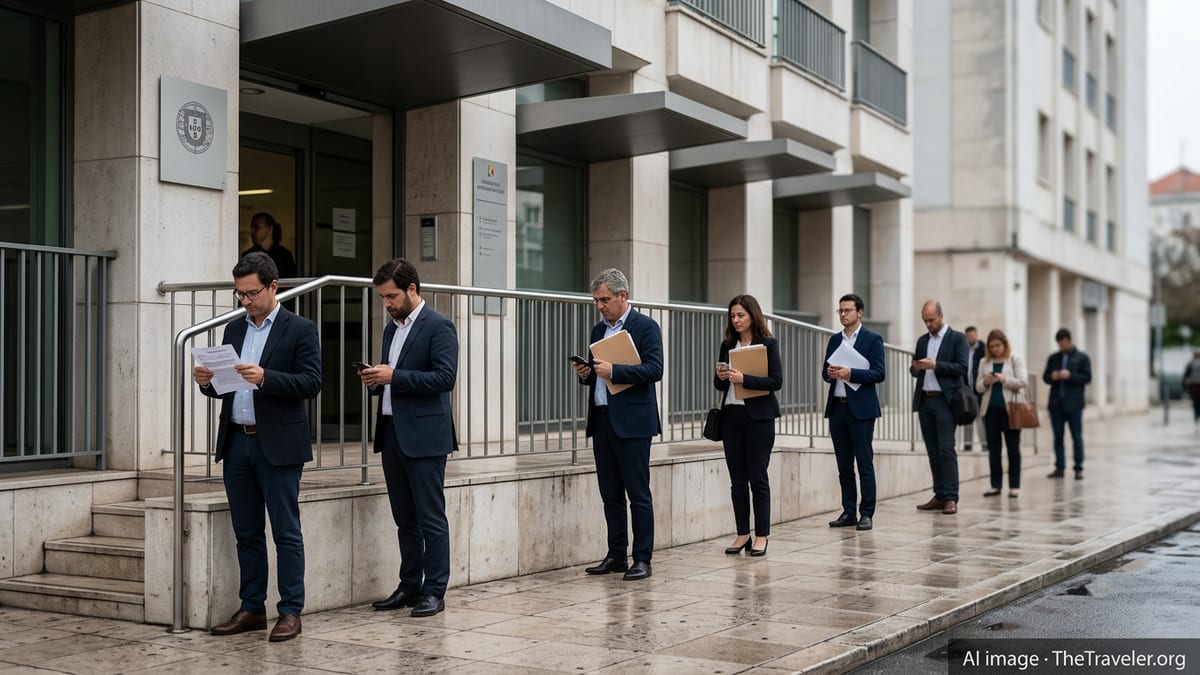
On-the-ground reports from migrants show a high variance in user experience depending on location and case type. In smaller cities or less congested regions, applicants may obtain appointments relatively quickly and experience smoother processing, whereas in Lisbon and Porto some applicants report repeatedly attempting to secure time slots, queuing outside offices and resorting to formal complaints or legal action to prompt decisions. This geographic unevenness adds another layer to the complexity profile.
Because of these divergences, a single national score masks substantial local variation. Relocation planners increasingly factor regional conditions into their risk assessments, sometimes steering new arrivals toward less congested jurisdictions when operationally feasible.
Indicative Bureaucracy Complexity Score for Portugal
Aggregating these dimensions, a qualitative bureaucracy complexity score for Portugal as of early 2026 can be summarized as "moderate to high" for foreign residents, with particular emphasis on immigration and residence-related procedures. The table below presents an indicative breakdown across the main components relevant to relocation operations.
| Dimension | Indicative rating | Key drivers |
|---|---|---|
| Procedural clarity | Medium / High | Frequent rule changes, variable local interpretation, transitional measures after SEF–AIMA reform |
| Processing times & backlogs | High | Very large immigration backlog in recent years, long waits for many appointments and decisions despite ongoing clearance efforts |
| Predictability of outcomes | Medium | Legal framework is defined, but stricter completeness rules and discretionary document requests increase uncertainty |
| Digitalization & access | Medium | Strong national digital portals and mobile app, but uneven integration with immigration workflows and frontline understanding |
| Interagency coordination | Medium / High | Multiple identifiers and agencies involved, with dependencies on AIMA decisions affecting other services |
In summary, Portugal’s bureaucracy is not disorganized in a legal sense, but capacity constraints and transitional reforms have materially increased the time and effort required for foreigners to secure and maintain status. Organizations should therefore treat immigration-related interactions as a high-complexity component of the country’s otherwise moderately structured administrative environment.
The Takeaway
For relocation planning, Portugal’s bureaucracy complexity score implies that administrative risk is concentrated in a few critical chokepoints rather than being uniformly high across the entire public sector. Most routine interactions, particularly for individuals who already possess a digital identity and stable residence documentation, are reasonably manageable through online portals and standardized procedures.
However, for new and prospective residents, especially non-EU nationals, the path from arrival to fully regularized status remains demanding. Long and sometimes unpredictable processing times at AIMA, evolving legal frameworks and uneven frontline implementation increase both timeline risk and the need for active case management. These factors should be fully internalized into relocation schedules, employment start planning and family mobility decisions.
Overall, Portugal’s bureaucracy can be characterized as medium to high complexity for foreign residents, mitigated but not fully offset by steady progress in digital public services. Those considering relocation should not expect a frictionless experience, but with adequate preparation, realistic time buffers and professional support where appropriate, the administrative burden can be managed. The key is to recognize the current constraints of the system and plan accordingly.
FAQ
Q1. Is Portugal’s bureaucracy considered more complex than in other Western European countries?
In immigration matters, Portugal is currently perceived as more complex than many Western European peers due to large backlogs, long processing times and transitional reforms, even though general public-service access is relatively modern.
Q2. How long should new residents realistically expect immigration procedures to take?
Timelines vary widely, but many applicants experience several months between initial application, appointment and receipt of a residence card, with some complex or legacy cases extending well beyond one year.
Q3. Has the replacement of SEF with AIMA reduced bureaucracy?
The transition aimed to modernize and streamline procedures, but in the short to medium term it has produced mixed results, with intensified efforts to clear backlogs but continuing delays and operational adjustments.
Q4. Do digital portals significantly reduce bureaucratic complexity in Portugal?
Digital portals such as gov.pt and the gov.pt app make many services easier once a person is fully registered, but they do not yet remove the need for in-person immigration interactions or fully resolve appointment bottlenecks.
Q5. Is the complexity mainly about paperwork or about unpredictability?
Both play a role, but unpredictability of timelines and the risk of unexpected document requests are currently more significant challenges than the sheer quantity of paperwork alone.
Q6. Are certain regions of Portugal less bureaucratically congested than others?
Yes. Reports indicate that smaller cities and less populated regions often have shorter waits for appointments than Lisbon and Porto, although the overall legal framework is the same nationwide.
Q7. Does knowing Portuguese reduce the bureaucracy complexity score in practice?
Language skills do not change formal rules, but they can substantially ease communication with officials, help clarify requirements and reduce the risk of misunderstandings during in-person interactions.
Q8. How important is professional assistance for navigating Portuguese bureaucracy?
Professional assistance is not mandatory, but for time-sensitive or complex cases many organizations and individuals use advisors to mitigate documentation errors, track developments and escalate issues when needed.
Q9. Is Portugal’s bureaucracy improving or getting worse over time?
Digital services and targeted backlog-reduction initiatives indicate gradual structural improvement, but high migration volumes and ongoing legal reforms mean that immigration-related complexity remains elevated in the short term.
Q10. What practical steps can reduce the impact of bureaucratic complexity when relocating to Portugal?
Key measures include preparing documents well in advance, allowing generous time buffers, monitoring regulatory changes, choosing appointment locations strategically where possible and leveraging digital tools once basic registrations are complete.