


More news on this day
Electricity has been restored to the domestic terminal at Johannesburg’s OR Tambo International Airport after a Friday morning power failure, but Airports Company South Africa and major carriers are warning passengers to expect residual delays and congested queues for the rest of the day.
Get the latest news straight to your inbox!
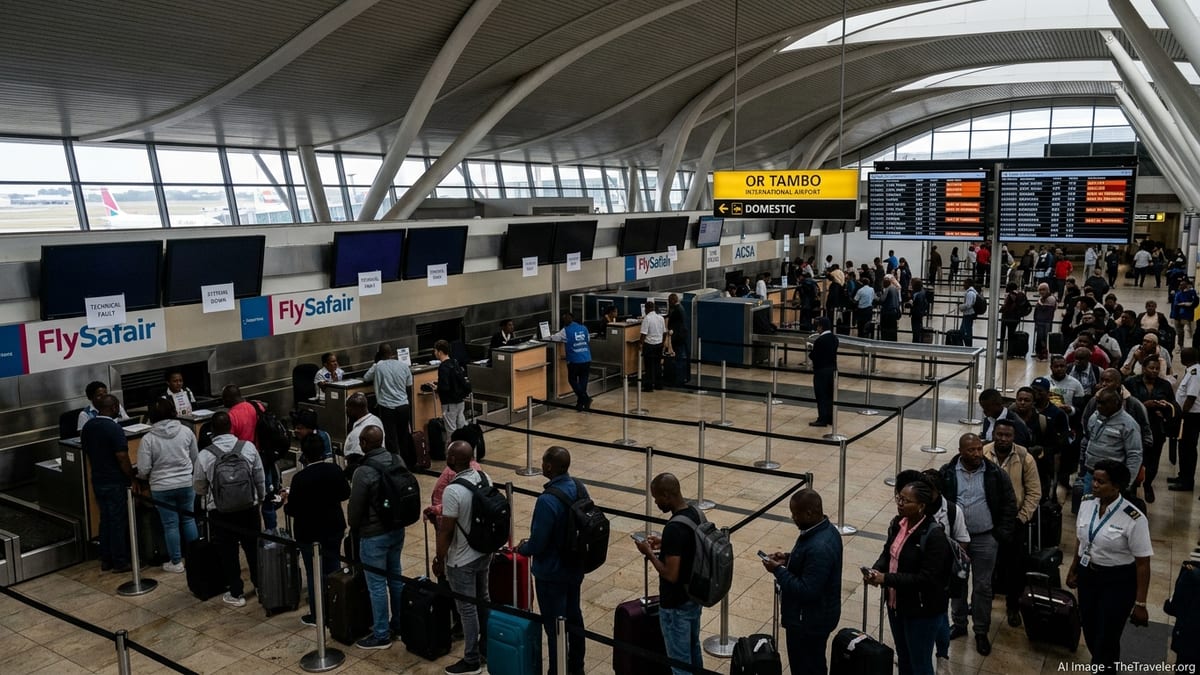
What happened at OR Tambo on Friday
The disruption began on the morning of Friday 27 November 2026, when a technical fault at Substation 9 cut power to large parts of OR Tambo International Airport’s domestic terminal. According to Airports Company South Africa (Acsa), the outage affected critical systems supporting check-in counters, security screening and boarding gates, forcing many processes to slow down or halt while backup arrangements were put in place.
Electricity was restored later in the morning, with Acsa confirming that its technical teams had stabilised the supply and begun normalising terminal operations. The restoration allowed electronic systems and conveyor belts to come back online, and some queues began to ease. However, large numbers of passengers were already waiting to be processed, and airlines were dealing with aircraft and crew that had missed their planned departure times, creating a sizeable backlog.
By early afternoon, live flight boards still showed a high proportion of delayed domestic services, and some arriving and departing flights were running significantly behind schedule. While many international departures from the separate international facilities continued on or close to schedule, the domestic disruption was substantial enough that both Acsa and airlines cautioned travellers to plan for longer processing times and potential missed connections within South Africa.
Impact on screening, baggage and flight schedules
The power failure’s most immediate effect was on passenger screening and baggage handling. With electricity cut at the domestic terminal, check-in systems were interrupted, baggage carousels and sorting equipment stopped moving, and security screening lanes were partially out of service. Airport staff resorted to contingency procedures where possible, but many steps that typically rely on automated systems had to be handled manually, extending processing times.
This slowdown quickly translated into long queues at check-in, security and boarding gates. Travellers reported waiting extended periods in line as Acsa and airline staff worked through the backlog. Even after power was restored, it took time for all systems to reboot, for bags already in the system to be reconciled, and for passengers who had been waiting to be cleared for their flights. As a result, numerous domestic departures left behind schedule, with delays ranging from modest to several hours, depending on aircraft rotation and crew duty limitations.
The disruption did not remain confined to Johannesburg. Because many domestic aircraft operate multiple sectors per day, a late departure from OR Tambo often led to late arrivals in cities such as Cape Town, Durban and other regional centres, and in turn delayed subsequent flights operating from those airports. Some later services remained on time where spare aircraft or re-timed schedules allowed, but live tracking data showed a significant proportion of South African domestic flights running late on Friday, with the situation unlikely to resolve fully until aircraft and crew could be brought back into their normal patterns.
How Acsa and airlines are responding
Acsa stated that its technical teams traced Friday’s outage to a fault at Substation 9, which feeds parts of the domestic terminal. The company said the problem had been rectified and that engineers were monitoring the system to prevent further disruption while terminal operations ramped back up. Acsa also indicated that it was coordinating closely with airlines to prioritise the processing of passengers already at the airport and to minimise additional schedule disruption where possible.
FlySafair, one of South Africa’s largest domestic carriers and a major user of OR Tambo’s domestic terminal, issued a specific advisory to its customers warning of delays through the day. The airline noted that power interruptions had slowed baggage sorting and passenger screening, emphasising that the resulting bottlenecks affected all carriers using the terminal rather than any single airline. It stressed that even flights from airports not directly affected by the outage could be delayed when aircraft or crew were scheduled to operate earlier sectors through Johannesburg.
Other airlines adjusted operations in line with available resources, in some cases swapping aircraft or retiming services to reduce knock-on disruption. Where flights were heavily delayed, airlines worked to re-accommodate affected travellers on later departures, subject to seat availability, while asking customers to monitor status updates closely. Acsa urged passengers to use its mobile app and other digital channels for real-time information on airport conditions, while reiterating that the underlying technical issue had been resolved and efforts were focused on clearing queues and stabilising the schedule.
What domestic and connecting travellers need to know
For passengers flying from OR Tambo on Friday and into the evening, the primary implication is the need to build in additional time at the airport. FlySafair has recommended that travellers departing from Johannesburg allow at least two hours to clear security on top of their usual check-in and baggage drop time. Given the residual queues at check-in and screening following the outage, arriving significantly earlier than usual may help reduce the risk of missing a flight, particularly during peak late-afternoon and evening departure banks.
Travellers are strongly advised to check their flight status directly with their airline before setting out for the airport. Many major carriers provide real-time information through their websites and mobile apps, and some also send push notifications or text messages when a flight’s departure time changes. Because aircraft delayed at OR Tambo earlier in the day may still be operating later legs, flights that appear unaffected in published timetables can nevertheless depart behind schedule, especially on high-frequency domestic routes.
Passengers with same-day connections within South Africa should pay particular attention to minimum connection times. A delay on a first domestic leg can leave little margin for a transfer, especially if a change of terminal or a re-check of baggage is required. Where possible, travellers with flexible plans may consider moving to later onward flights if their initial departure from OR Tambo is significantly delayed. Those connecting from domestic to international services should follow their airline’s guidance, as carriers typically prioritise passengers with onward long-haul connections and may be able to rebook if a misconnection becomes unavoidable.
Practical tips to reduce delays at the airport
As OR Tambo works through the backlog created by the morning outage, some relatively simple steps can help individual travellers move through the airport more quickly. Airlines and Acsa are encouraging passengers to complete online check-in where possible before leaving home or their hotel. Having a boarding pass already issued can shorten the time spent at check-in counters, particularly for those travelling with hand luggage only, who may be able to proceed directly to security when bag-drop lines are long.
Travelling with carry-on bags only, where practical, can also reduce the impact of slower baggage systems. Passengers without checked luggage avoid waiting at baggage drop counters before departure and do not face delays at baggage claim on arrival. For those who must check bags, consolidating items into a single suitcase per person and ensuring that luggage tags and documentation are in order can help speed processing at the counters that are open.
At security, having documentation and electronics ready before reaching the front of the queue can help keep lines moving. Using the correct lane for domestic departures, removing items that require separate screening when requested, and listening closely to staff instructions all contribute to smoother processing at a time when the system is under pressure. Families and groups can also save time by keeping boarding passes and passports together and nominating one person to coordinate documents through checkpoints.
Outlook for the rest of the travel day
With power restored and terminal systems functioning again, there is no indication at this stage of a prolonged infrastructure problem at OR Tambo beyond Friday’s incident. The main remaining challenge is operational rather than technical: airlines and the airport must work through the accumulated queues and reposition aircraft and crew after the morning’s disruptions. Given typical domestic flight patterns at OR Tambo, it may take the remainder of Friday’s schedule, and possibly the first rotations on Saturday morning, for operations to return fully to normal.
Travellers flying later in the evening on Friday are likely to see a mixed picture. Some flights may operate on time where aircraft have been turned around successfully and demand allows, while others will still be recovering from earlier delays or last-minute adjustments. Overnight and early-morning international departures are generally less exposed to the domestic terminal outage, but passengers connecting from delayed domestic sectors should stay in close touch with their airlines about any necessary rebooking.
For journeys booked over the coming days, there is currently no indication that Friday’s power fault will have a lasting effect on schedules once aircraft rotations are stabilised. However, as with any unplanned disruption, plans can change at short notice. Travellers heading through OR Tambo over the weekend and into next week should continue to monitor their booking details, enable alerts where available, and allow a sensible buffer for airport formalities. With the immediate technical cause identified and addressed, the airport and airlines are focused on restoring normal service levels and clearing the residual delays from one of southern Africa’s key aviation hubs.