


More news on this day
A fast‑deepening East Coast storm collided with the busiest US Thanksgiving air travel period in 16 years on Thursday 26 November 2026, disrupting flights across both coasts, cutting power to hundreds of thousands of households and forcing New York City’s 100th Macy’s Thanksgiving Day Parade to be postponed to Saturday for the first time in its history.
Get the latest news straight to your inbox!
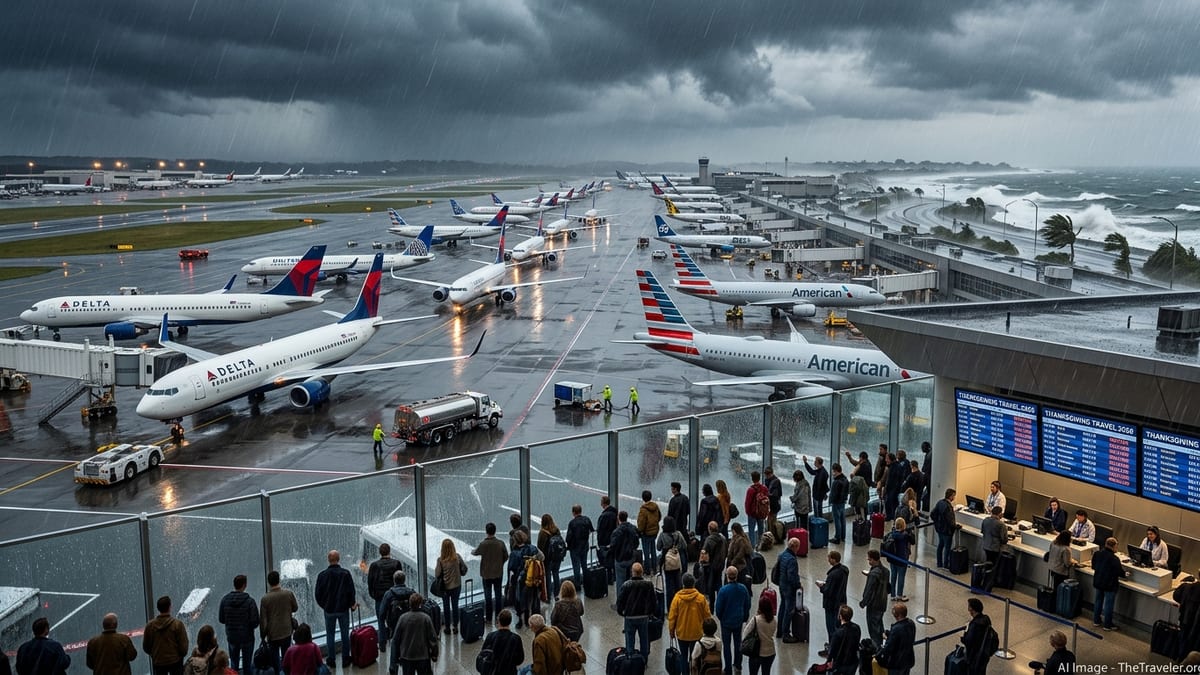
Record Thanksgiving flight volumes meet disruptive coastal storm
The Federal Aviation Administration entered Thanksgiving week expecting the busiest US holiday skies since at least 2010, projecting more than 417,000 flights across the nine‑day period from Tuesday 24 to Monday 30 November 2026. Official forecasts highlighted Tuesday 24 November as the single peak day, with more than 52,000 scheduled flights, and volumes remaining elevated through the following Monday as travelers returned home.
That strained baseline left the system with limited flexibility when a vigorous low‑pressure system organized along the Southeast coast and accelerated northward on Thanksgiving Day. As the storm moved into the Mid‑Atlantic and New England, it intensified into a classic late‑autumn nor’easter, with the National Weather Service issuing high wind warnings, coastal flood warnings and flood watches from parts of the Carolinas through coastal New Jersey, Long Island and into southern New England. Forecasters emphasized the risk of damaging gusts, heavy rain and significant coastal inundation coinciding with elevated astronomical tides.
Further west, colder air on the storm’s backside produced areas of snow and mixed precipitation from the Ohio Valley into interior sections of the Northeast, while a separate Pacific system brought heavy rain, hazardous surf and mountain snow to parts of California and the Pacific Northwest. The result for aviation was a multi‑region weather event affecting several of the country’s most important hubs at a time when both aircraft and crews were already heavily committed to holiday schedules.
Flight cancellations concentrated at major hubs but felt nationwide
By Thursday evening, early disruption tallies from airline operational data and tracking services showed hundreds of cancellations and well over a thousand delays on flights within, into or out of the United States. The precise totals continued to evolve into Friday as carriers updated their figures, but the pattern was clear: the highest concentration of problems was along the Northeast corridor and Mid‑Atlantic, with secondary impacts in the Midwest and on the West Coast where Pacific storms complicated arrivals into key gateways.
In the New York metropolitan area, LaGuardia, John F. Kennedy and Newark Liberty all implemented ground delay programs at times on Thanksgiving Day as controllers reduced arrival and departure rates to maintain safety margins in strong, shifting winds and periods of heavy rain. Similar measures were reported in Boston and Philadelphia when bands of heavier precipitation and low cloud pushed runway operations toward their limits. Arriving flights were occasionally placed into holding patterns to preserve spacing in turbulent approach corridors, while departures queued on saturated taxiways during brief weather lulls.
The effects were not confined to the Northeast. Strong onshore winds and localized flooding around the Hampton Roads region of Virginia, parts of coastal Maryland and New Jersey impeded access roads and parking facilities near some airports, delaying both passengers and staff. On the West Coast, storm‑driven rain and low ceilings led to arrival spacing and occasional reroutes into San Francisco and Seattle as airlines adjusted flight paths around the most intense precipitation and turbulence associated with incoming Pacific systems.
Operational resilience tested after earlier technology outages
The timing of the Thanksgiving storm proved especially challenging because it arrived less than two weeks after a nationwide aviation disruption linked to an FAA technology upgrade on 13 November. That earlier issue prompted a temporary ground stop at several facilities and ultimately led to thousands of cancellations and delays as airlines worked to recover their networks. In the days that followed, large carriers including United and Delta reported additional software and operational problems, further stretching aircraft and crew availability.
By the start of Thanksgiving week, regulators and airlines said the underlying technical faults had been resolved, but schedule data indicated that carriers were still running tight operations, with limited reserves of spare aircraft and rested crew. Forecasts for record holiday flight volumes and the lingering after‑effects of the November outages meant that even moderate new disruptions risked cascading through the system. In practice, Thursday’s storm‑related delays often translated into missed connections and aircraft out of position for later departures, amplifying the impact beyond the immediate areas of severe weather.
Advance warnings from federal forecasters did give airlines some scope to prepare. In the days before Thanksgiving, carriers pre‑emptively issued travel waivers for passengers booked through airports expected to see the worst conditions, allowing them to switch flights within a defined window without change fees. Some airlines also relaxed fare‑difference rules when customers kept the same origin, destination and cabin, provided alternative seats were available in the original fare class. Nonetheless, with many flights already near or at capacity for the holiday, available seats on less affected days were quickly taken, limiting options once large numbers of day‑of‑travel cancellations materialized.
Passenger impact: waivers, limited rebooking and ground‑transport challenges
For individual travelers, experiences on Thanksgiving Day ranged from minor schedule adjustments to complete trip disruptions. Many passengers encountered departure delays of 30 to 90 minutes as aircraft waited for weather to improve or for air traffic control programs to lift. Others received last‑minute cancellation notices when worsening crosswinds, runway conditions or crew duty‑time limits made it impossible to operate their flights safely within regulations.
Most major US airlines directed customers to use their mobile apps and websites as the primary source of real‑time information and rebooking tools, cautioning that airport departure boards and gate announcements could lag behind rapidly changing conditions. In airports along the East Coast, queues formed at customer service counters when same‑day rebooking options proved scarce. Under current US Department of Transportation rules, passengers whose flights are canceled by an airline, including for weather, are generally entitled to a refund if they choose not to travel, but carriers are not required to offer monetary compensation for delays caused by conditions outside their control.
On the ground, the same storm system that disrupted flights also complicated journeys for travelers who had opted to drive. As heavy rain, wind and coastal flooding spread from the Carolinas to New England, authorities reported submerged roadways, closed causeways and downed trees in several coastal communities. Emergency management briefings on Thursday and early Friday noted hundreds of thousands of electricity customers without power at various times as saturated soil and strong gusts toppled branches and utility lines, with additional outages possible as winds persisted into the next high‑tide cycles.
Macy’s parade postponed and broader coastal impacts beyond aviation
In New York City, the Thanksgiving storm produced one of the most visible holiday disruptions away from airports. On Wednesday 25 November, city officials and Macy’s announced that the 100th Macy’s Thanksgiving Day Parade, originally scheduled for Thursday 26 November, would be postponed to Saturday 28 November 2026 because of the forecast for heavy rain and potentially damaging winds. Municipal notices and broadcaster schedules confirm that the event will now step off at 08:30 on Saturday, marking the first parade in its century‑long history to be delayed to a different day due to weather rather than modified or shortened.
The decision followed days of close monitoring of wind profiles along the parade route and consultations between city agencies, parade organizers and meteorologists. Existing New York City guidelines already require organizers to lower or ground large balloons if sustained winds or gusts exceed specified thresholds, but forecasts suggesting gusts could reach 50 to 70 miles per hour in parts of the city led authorities to conclude that attempting to proceed on Thanksgiving Day would pose unacceptable safety risks. The postponement required adjustments to street‑closure plans and security deployments and prompted hotels and tour operators to update guests on the new schedule.
Elsewhere along the Eastern Seaboard, the nor’easter produced widespread coastal flooding, particularly in parts of New Jersey, Delaware and the tidal sections of New York and New England. Federal situation reports on Thursday highlighted moderate to major coastal flooding at some tide gauges, with water levels reaching or exceeding previous records in a few locations. Emergency managers urged residents in low‑lying neighborhoods to heed local evacuation guidance, avoid driving through flooded roads and remain alert for debris and erosion hazards that could persist even after the heaviest rain had moved offshore.
What travelers should monitor through the rest of the holiday period
With the core of the East Coast storm lifting into Atlantic Canada by Friday 27 November, conditions at many major Northeast airports were already improving, and airlines began working to reposition aircraft and crews. Nonetheless, regulators and carriers cautioned that residual disruption could persist into the peak return‑travel days of Sunday 29 and Monday 30 November. Aircraft that ended Thursday out of place, along with crews nearing duty‑time limits, may still force schedule adjustments even under clearer skies.
Forecasts from the National Weather Service indicated that while the threat of additional widespread flight disruption in the Northeast would diminish as the storm moved away, lingering onshore winds, elevated surf and saturated ground could continue to affect ground transport and local operations in some coastal communities. At the same time, further disturbances in the Pacific were expected to deliver new rounds of rain and mountain snow to parts of California and the Pacific Northwest over the weekend, posing a renewed risk of localized delays at airports exposed to low cloud, strong crosswinds or runway‑adjacent flooding.
Travelers scheduled to fly over the remaining Thanksgiving period are being advised to build additional time into their plans, especially for early‑morning and late‑evening departures when options for same‑day rebooking are most limited. Checking airline apps or websites before leaving for the airport, monitoring weather advisories for both origin and destination, and allowing extra time to navigate potential road closures or public‑transport disruptions can reduce the chance of missed flights. Passengers with tight connections, those traveling with young children or those with fixed‑time commitments at their destination may also wish to consider moving to earlier flights or more direct routings where seats remain available, given that the national air‑travel system will remain close to capacity as it works through the tail end of a historically busy Thanksgiving week.