


More news on this day
A powerful Thanksgiving nor’easter that drenched the Mid-Atlantic and Northeast on Thursday, November 26, has shifted offshore, but lingering congestion at major East Coast hubs is still causing scattered delays and cancellations for Florida-bound and Florida-originating flights on Friday, November 27, even as weather over the state itself steadily improves.
Get the latest news straight to your inbox!
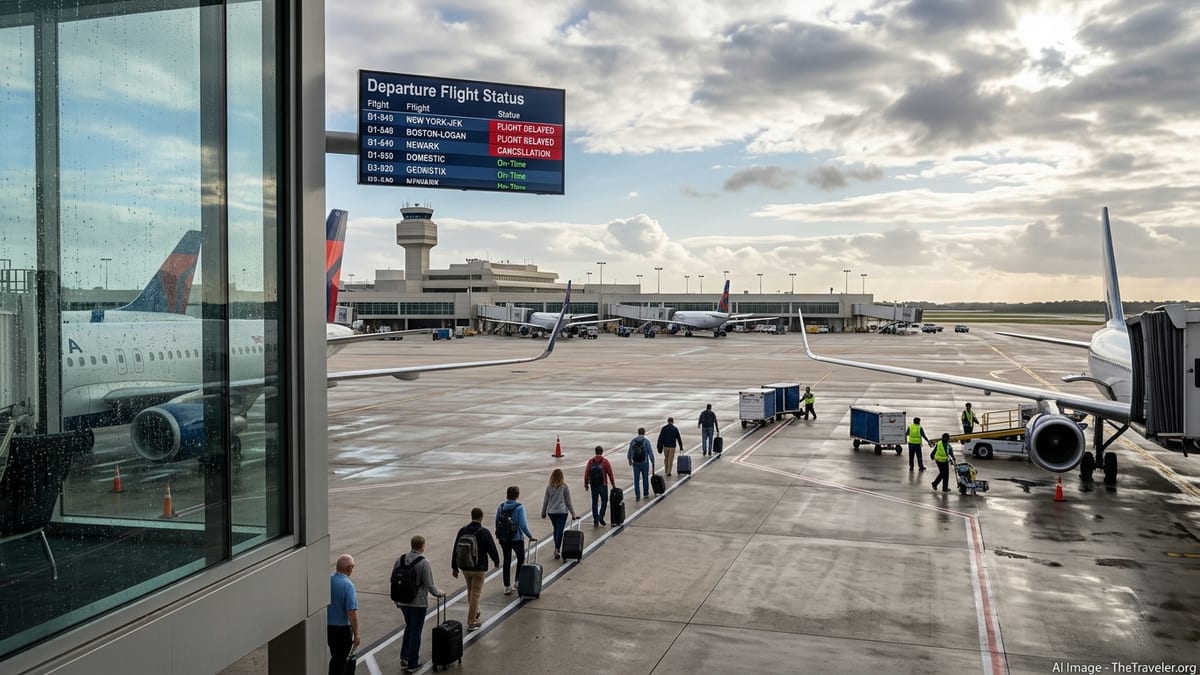
Storm’s peak impacts shift north as aviation system plays catch-up
Forecasts issued ahead of the holiday correctly flagged a rapidly intensifying coastal storm that would organize near Florida on Wednesday, November 25, then race up the Eastern Seaboard into Thanksgiving Day. Meteorologists at national and regional forecast centers described the system as a classic late‑autumn nor’easter, with heavy rain, strong onshore winds and coastal flooding potential from the Carolinas to New England on Thursday, November 26.
By Friday morning, November 27, surface analyses and satellite imagery showed the low‑pressure center lifting farther into Atlantic Canada, with the core of the strongest winds and heaviest rain displaced well northeast of the United States mainland. Advisories for storm‑force and gale‑force gusts remained in effect over parts of the western Atlantic and for some coastal zones in New England, but the broader precipitation shield that had covered the Interstate 95 corridor on Thanksgiving was breaking up into scattered showers.
Travel disruption from the storm has been significant but time‑limited. Flight tracking data for Thanksgiving Day indicated more than 2,000 delays and over 400 cancellations on U.S. routes as the combination of low clouds, heavy rain and crosswinds reduced arrival rates at key hubs including New York City, Boston, Philadelphia and Washington. Those figures cover the entire domestic network and not only Florida routes, yet they illustrate how quickly weather at a handful of high‑volume airports can reverberate across the system during one of the busiest travel days of the year.
Florida weather improves while knock-on delays persist
In Florida, the storm’s direct weather effects were felt primarily on Wednesday and early Thursday, when the developing system brought bands of heavy rain and gusty winds to parts of the peninsula and the Keys before accelerating northward. Rainfall totals in some locations, particularly in the Middle Keys, ranked among the highest November daily amounts in decades, but by Thursday night the most organized squall lines and coastal wind fields had cleared the state.
National Weather Service offices responsible for central and southern Florida were forecasting generally drier conditions and only isolated, mainly light showers for Friday, November 27, with no widespread severe thunderstorms or tropical hazards expected over major population centers. From an operational standpoint, major Florida airports such as Orlando International, Miami International, Fort Lauderdale–Hollywood International, Tampa International and Jacksonville International reported no large‑scale runway closures, visibility problems or wind restrictions attributable to the Thanksgiving nor’easter on Friday morning.
Despite the calmer local weather, passengers in Florida continued to encounter disruptions tied to the storm’s earlier impacts farther north. Airline status boards at leading Florida gateways on Friday showed clusters of delayed arrivals from and departures to Northeast and Mid‑Atlantic hubs that experienced the worst conditions on Thanksgiving. In several cases, early‑morning inbound flights from New York, Newark, Boston and Philadelphia reached Orlando, Miami and South Florida behind schedule, in turn pushing back the departure times of those aircraft on their next legs.
Northeast hubs remain the main constraint for Florida routes
The heaviest operational strain for Florida‑bound travelers on Friday could be traced to the major connecting hubs in the Northeast and Mid‑Atlantic that sat directly under the storm’s wind and rain shield on Thursday. Advance guidance from federal aviation authorities had highlighted New York’s LaGuardia and John F. Kennedy airports, Newark Liberty, Boston Logan, Philadelphia International and the Washington‑area airports as the most vulnerable to significant Thanksgiving Day delays given the forecast combination of low ceilings, heavy precipitation and strong surface winds.
To manage the reduced landing capacity under those conditions, the Federal Aviation Administration implemented traffic management initiatives at several of these hubs on Thursday, including ground delay programs that required aircraft bound for the affected airports to wait at their origin or to accept extended en route spacing. While detailed, airport‑by‑airport numbers for the storm period are still being compiled, the presence of these programs is visible in the national statistics: hundreds of flights were held or re‑timed even where the sectors they flew through were not experiencing hazardous weather aloft.
For Florida travelers, the practical effect is that many Friday disruptions have roots in aircraft and crew rotations that were broken on Thanksgiving. Flights scheduled from Florida to Northeast cities on November 27 have in some instances departed late because their inbound aircraft arrived hours behind schedule the previous evening. Similarly, some routes into Florida from still‑recovering hubs are operating with residual delays as airlines work to reposition equipment and re‑align crew schedules with their published timetables.
Measured disruption at Florida airports amid high holiday demand
One snapshot of conditions by late Friday morning showed just under 400 flight cancellations and around 1,000 delays across the United States compared with Thursday’s higher totals, suggesting that airlines were gradually regaining control of their schedules as the worst weather moved offshore. Florida airports accounted for a share of those figures but were not at the center of the national disruption picture, which remained focused on corridor hubs still dealing with low‑level clouds, lingering showers and traffic congestion.
Within Florida, roughly one in five of the day’s cancellations in that snapshot involved Miami or Fort Lauderdale, reflecting their role as large connecting points for both domestic and Latin American travel. Some of those cancellations and longer delays were also linked to a separate operational incident earlier in the week at Miami International, after a runway event there contributed to significant backlogs prior to the coastal storm. As of Friday, there was no indication from airport authorities that any runways or taxiways in Florida remained closed because of the Thanksgiving weather system itself.
High passenger loads are amplifying the impact of each individual disruption. Forecasts from transportation agencies and industry groups ahead of the holiday period projected tens of millions of Americans traveling between Tuesday, November 24, and Monday, November 30, with Sunday, November 29, flagged as a likely peak day at security checkpoints. On Florida routes in particular, which draw a mix of holidaymakers, visiting family travelers and seasonal residents, load factors on many flights were already close to capacity before the storm. That leaves airlines with limited spare seats to accommodate travelers whose original itineraries were shifted by Thursday’s delays and cancellations.
Airline waivers and recovery strategies for affected passengers
Several major U.S. carriers, including those with large presences in both Florida and the Northeast, issued flexible travel policies in the days before the nor’easter’s arrival. These policies, commonly known as weather waivers, allowed eligible customers booked to or from airports in the forecast impact zone to change their travel dates or departure times without change fees, provided they rebooked within specified windows, generally between November 25 and November 28. Some waivers also offered limited protection from fare differences when travelers moved to flights with the same origin, destination and cabin.
Publicly available statements and booking system advisories indicate that a portion of passengers took advantage of those waivers by shifting their trips earlier in the week or postponing departures to later in the weekend. That helped reduce the number of travelers caught on aircraft during the heaviest Thanksgiving Day weather but has also contributed to very full flights on surrounding days, including Friday and the upcoming Sunday. In Florida markets, that pattern is evident in constrained same‑day rebooking options on certain high‑demand routes, particularly on morning and evening departures to and from the Northeast.
On the operational side, airlines on Friday have been using familiar recovery tools to bring their networks back into balance. These include selectively canceling individual frequencies on routes where alternative services exist, substituting larger aircraft types on busy legs with many displaced passengers, and reassigning crews to cover gaps where original pairings were made unworkable by earlier delays. Early indications from industry metrics suggest that, while the Thanksgiving nor’easter has been disruptive, the scale of cancellations remains below that seen in some recent holiday travel crises that involved multiple days of compounding weather or technology failures.
What Florida-bound travelers should expect through the weekend
Looking ahead to Friday night and the remainder of the Thanksgiving travel window, forecast discussions from national and regional meteorological centers point to a continued easing of weather‑related constraints along the East Coast. As the nor’easter’s remnants move farther into Atlantic Canada and weaken, coastal wind advisories and flood warnings for the Mid‑Atlantic and New England are expected to diminish between late Friday and Saturday, November 28, improving the operational environment at the major hubs that feed many Florida routes.
Across Florida itself, official outlooks for Friday through Sunday call for largely dry conditions or only intermittent showers for most major cities, with no new organized storm system projected to track directly over the state during that period. That suggests that any additional air travel disruption affecting Florida this weekend is more likely to arise from residual network congestion, crew and aircraft positioning and high passenger volumes than from fresh local weather issues. Travelers can therefore anticipate a gradual improvement in reliability, although isolated delays and scattered cancellations remain possible, especially on routes involving connections through the still‑recovering Northeast.
Passengers booked to or from Florida between Friday, November 27, and Sunday, November 29, are advised to monitor their flight status frequently via airline apps or airport information screens, paying close attention to itineraries that include New York, Newark, Boston, Philadelphia or Washington. Where carriers continue to offer weather waivers covering the storm period, travelers with flexibility may be able to adjust departure times or travel days, though seat availability will vary by route. Those planning new reservations into or out of Florida for the remainder of the holiday weekend may wish to allow extra connection time at busy hubs and to favor earlier departures in the day, when schedules have had less opportunity for delays to accumulate. For now, official forecasts and operational data indicate a familiar pattern of short‑lived but sharp Thanksgiving disruption, followed by a one to two‑day return toward normal as airlines, airports and passengers work through the backlog.