


More news on this day
Hundreds of passengers were left stranded at London Stansted Airport on Sunday 25 October after a power surge knocked out key terminal systems, triggering hours of queues, delays and missed connections at one of the UK’s busiest low cost hubs.
Get the latest news straight to your inbox!
Power surge hits immigration, security and baggage systems
Publicly available information indicates that a brief but disruptive power surge affected London Stansted Airport on the morning of Sunday 25 October 2026, interrupting electricity supplies to parts of the terminal and to nearby areas in Essex. Airport systems linked to security screening, immigration control and baggage handling were among those reported as temporarily shut down, forcing staff to slow or halt processing of passengers at peak times.
Coverage from UK media and travel rights organisations describes automated passport gates and border control booths going offline, along with some security scanners and baggage belts. With electronic systems down or rebooting, staff reportedly resorted to manual checks and workarounds, which sharply reduced the number of passengers who could be cleared each hour.
The timing of the outage, during the busy autumn half term period, magnified the impact. Data cited by airline compensation services suggests that around 250 flights were delayed and six were cancelled as knock on effects rippled through the day’s schedule, affecting both departures and arrivals across Stansted’s predominantly short haul European network.
Reports also indicate that the surge did not last long in technical terms, but the subsequent restart of complex airport systems took significantly longer. Once queues had built up along the airport’s single terminal, it took hours to work through the backlog even after core systems were restored.
Long queues and stranded passengers across the terminal
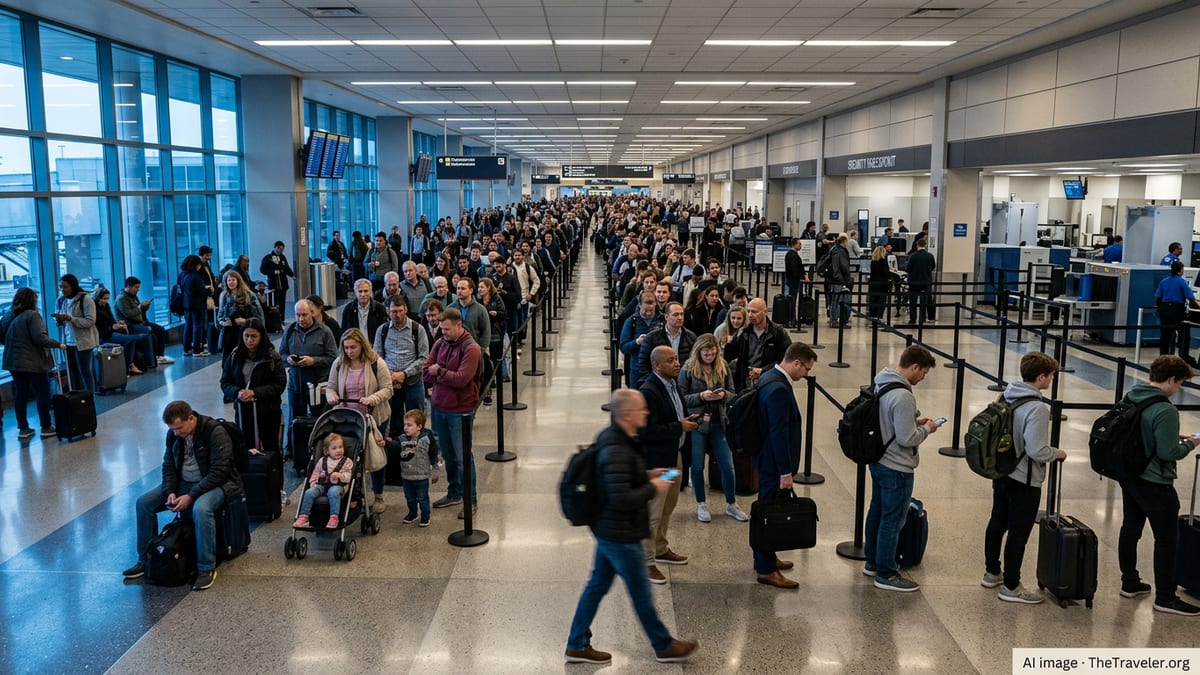
Passengers posting on social media and in online travel forums described queues stretching back from immigration halls into connecting corridors, with some reporting waits of more than two hours to clear passport control. BBC coverage relayed accounts of travellers who said they were effectively trapped in a corridor with no clear information on how long the wait would last or whether their connecting transport would be held.
In the departures area, images and descriptions collated by regional news outlets showed crowded check in halls and long lines for security screening as staff attempted to process passengers whose flights were already delayed. With limited space airside, bottlenecks formed landside and some travellers reported being held back from joining queues until congestion eased further inside the terminal.
According to travel disruption trackers, the combination of delayed inbound aircraft, slower security processing and ground handling issues meant that some flights left Stansted significantly behind schedule, while others were eventually cancelled outright. This left travellers facing missed hotel bookings and onward connections across Europe, particularly on point to point low cost routes where alternative same day options were limited.
Separate reports compiled by consumer sites indicate that many passengers missed flights through no fault of their own because they were physically stuck in immigration or in security queues when boarding closed. Some airlines reportedly rebooked passengers free of charge in these circumstances, while others directed them to customer service desks that were themselves overwhelmed by demand.
How the disruption fits into Stansted’s capacity pressures
Stansted has grown into a major base for low cost carriers in recent years, and scheduling documents for the 2026 summer season show rolling limits of more than 10,000 departing passengers every two hours at peak times. With much of this volume funneled through a single terminal, any outage affecting one part of the process can quickly create congestion elsewhere.
Earlier planning and climate adaptation reports for Stansted, published by UK authorities and the airport, have already highlighted power outages and voltage spikes as a key operational risk. These documents note that power cuts can compromise passenger and staff welfare, disrupt ground handling and restrict access to critical systems that depend on uninterrupted electricity, even when backup supplies and surge protection are in place.
The latest incident appears to illustrate how those risks play out in practice. Although the underlying power surge was relatively short lived, the interaction between tightly scheduled departures, immigration controls, security screening and baggage flows meant that a fault in one area cascaded across the airport’s constrained layout.
Trade and aviation data also show that Stansted has been approaching record annual passenger numbers, making it particularly sensitive to any reduction in processing capacity. For travellers, this means that even brief technical failures can translate into several hours of practical disruption on the ground.
What rights stranded passengers may have under UK rules
Passenger rights in the United Kingdom are set out in UK 261 regulations, which closely mirror the former EU 261 framework. Consumer advocacy groups explain that travellers may be entitled to meals, refreshments and hotel accommodation during long delays, along with rebooking or refunds if their flight is cancelled or significantly disrupted.
However, travel compensation specialists also emphasise that automatic cash compensation is not guaranteed in cases linked to airport infrastructure problems or external power issues. Published guidance notes that airlines are generally exempt from paying statutory delay compensation when the root cause is considered outside their direct control, such as an airport power failure that affects multiple carriers simultaneously.
Even where cash compensation is unlikely, passenger rights resources recommend that travellers keep boarding passes, booking confirmations and receipts for food, transport and accommodation. These documents can support claims for reimbursement of “duty of care” expenses, including reasonable meals, local transport between the airport and a hotel, and overnight stays if a new flight cannot be provided until the following day.
Specialist claim firms have also pointed out that some cases may still qualify for compensation if it can be shown that individual airlines handled the situation poorly, for example by failing to provide assistance or by cancelling flights after operations at the airport had largely returned to normal. Such assessments are typically made on a case by case basis and may require passengers to submit detailed evidence of the disruption they experienced.
Practical advice for upcoming Stansted travellers
In the wake of the power surge, travel advisers are urging passengers with upcoming flights from Stansted to build in extra time and to monitor airline and airport updates closely, particularly over busy weekends and holiday periods. While there is no indication of an ongoing technical problem, the recent disruption has underlined how quickly queues can form when any part of the system slows down.
Many airlines operating from Stansted allow passengers to drop checked bags and clear security several hours before departure, which can reduce the risk of missing a flight if unexpected congestion occurs. Some carriers also provide real time updates through mobile apps, including notifications of gate changes, revised departure times and options to switch to alternative services where available.
Passenger experience reports from recent days suggest that operations at Stansted have largely returned to normal, but that some travellers remain cautious after the events of 25 October. For those with tight connections to rail or coach services, building in a buffer between scheduled arrival and onward travel from the airport can provide an additional margin in case of residual delays.
The incident has also renewed discussion among aviation planners and local stakeholders about the resilience of power supplies and digital infrastructure at major UK airports. For now, the focus for travellers is on understanding their rights, keeping documentation, and allowing enough time at the airport in case another sudden surge turns routine journeys into unexpectedly long waits.