


Few European shorelines are as instantly recognizable as the seafronts of Nice and Cannes. The Promenade des Anglais unfurls for kilometers along the pebbly curve of the Baie des Anges, while La Croisette traces Cannes’s golden arc of sand, luxury hotels and palm trees. Both are iconic. Both deliver that Riviera hit of sun, sea and people‑watching. Yet they offer very different experiences and suit very different kinds of trips. If you can only choose one seafront as your base, the choice between Nice and Cannes really does matter.
Get the latest updates straight to your inbox!
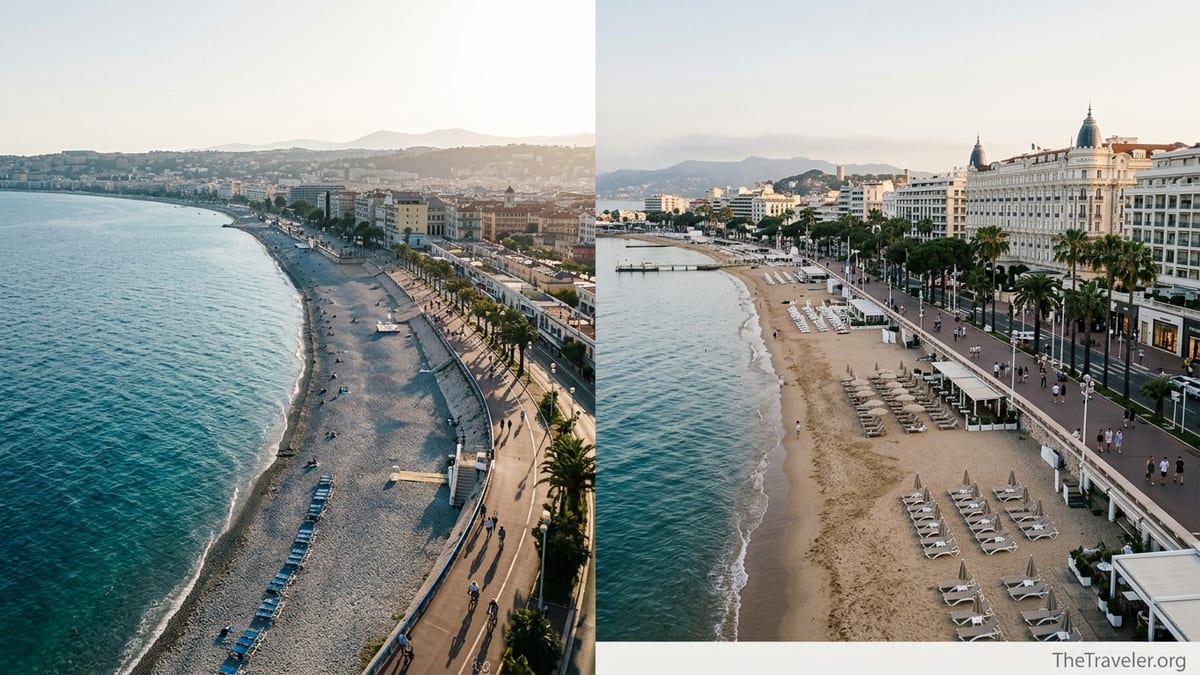
First Impressions: Atmosphere and Setting
Promenade des Anglais is Nice at its most open and expansive. The boulevard runs for around 7 kilometers from the airport in the west to the edge of the Old Town in the east, tracing the deep curve of the Baie des Anges against a backdrop of pastel apartment blocks and grand Belle Époque hotels. It feels like a big city seafront: broad, a little hectic where traffic flows, but airy and democratic, with joggers, families, students and retirees all sharing the same benches and famous blue chairs facing the sea.
La Croisette in Cannes feels more condensed and curated. The seafront is shorter than the Promenade but far more intensely polished. Between the Carlton, Martinez and JW Marriott, it resembles an outdoor showroom of Riviera glamour: polished marble facades, designer storefronts and carefully maintained flowerbeds. Instead of the sweeping, almost wild line of the Baie des Anges, you have a gentler, more intimate bay with calm water, soft sand and rows of regimented beach umbrellas in front of private beach clubs.
If you step out at sunset in Nice, the Promenade often feels like a public festival of everyday life: skateboarders weaving around families with ice creams, teenagers sitting on the pebbles, buskers near the Jardin Albert Ier. In Cannes, an equivalent evening stroll along La Croisette can feel like gliding through a glossy magazine spread: couples in resort wear leaving hotel bars, guests in evening dress heading toward the Palais des Festivals, and visitors lingering over cocktails at beach club lounges that spill right onto the sand.
In simple terms, Nice’s Promenade is broader, busier and more “real city by the sea,” while La Croisette is denser, tidier and unapologetically oriented to upscale leisure. Your choice starts with which atmosphere sounds more like you.
Beach Experience: Pebbles vs Sand and How You Actually Swim
For many travelers, the decision comes down to one very practical question: do you care about sand. Promenade des Anglais runs along a line of mostly public, smooth-pebble beaches. The water typically turns deep turquoise a few steps from shore, and on a calm day the sea can feel like a huge infinity pool. But the pebbles change the experience. You will want sturdy water sandals to avoid hobbling to the shoreline, and lying directly on the stones is uncomfortable unless you rent a lounger or bring a thick mat.
Along the Promenade, a full day at a private beach club in high season often runs somewhere in the range of 25 to 40 euros per person for a lounger and umbrella, depending on position and reputation, with simple mains like salade niçoise or grilled fish around 18 to 30 euros. If you skip the clubs, you can simply drop a towel on the public pebbles between them. It feels informal, with locals snorkeling just offshore, students drinking beers bought from a supermarket on Rue de France, and families plunging into relatively deep water only a few meters from the edge.
La Croisette offers a very different beach texture. The sand here is soft and golden, and the water tends to stay shallow for longer, which many families with small children prefer. The tradeoff is that much of the prime sand is in front of private beach concessions. A front-row lounger at a well-known Croisette beach club in July or August can often exceed 50 euros per person for a full day, and ordering even a simple lunch can nudge a couple’s bill toward 100 euros or more by the time drinks and coffee are added.
That said, Cannes does maintain public stretches of sand, especially at Plage du Midi and sections along La Croisette nearer to the Palais. If you do not mind sitting a little closer to your neighbors and bringing your own umbrella, these free areas can feel like surprisingly relaxed pockets in an otherwise high-end scene. In short, choose Nice if you value open, mostly free shoreline and do not mind pebbles. Choose Cannes if sand and easy entry to the sea are non‑negotiable and you are prepared for higher beach costs.
City Layout and Access: How Easy Is It to Get Around
One of Promenade des Anglais’s strongest advantages is how seamlessly it plugs into the rest of Nice. Nice Côte d’Azur Airport sits almost at the western end of the Promenade, and the modern tram line runs parallel inland, which means you can land, step onto the tram, and be near your hotel on or close to the seafront in roughly 25 to 35 minutes without a taxi. From the Promenade, side streets carry you quickly into the Old Town, to the Cours Saleya market, or up to the Colline du Château for panoramic views over the bay.
If you stay a block or two back from the Promenade, say near the pedestrian Rue Masséna or Avenue Jean Médecin, you can walk both to the seafront and to Nice-Ville train station in about 10 to 15 minutes. That train line links you east to Monaco and Menton and west to Antibes and Cannes, with frequent regional services. For travelers using public transport to explore the coast, Nice makes a very functional hub, and the Promenade is a navigational spine that helps you orient yourself quickly.
Cannes is smaller, and La Croisette effectively forms the front edge of a compact, dense center. The train station sits a few minutes’ walk back from the seafront, and streets run downhill toward the bay in a grid filled with boutiques, small supermarkets and restaurants. You can walk from the western end of La Croisette near the old port to the far eastern end in 20 to 30 minutes at a strolling pace. This compactness makes Cannes easy to understand in a day or two, especially if you also climb into Le Suquet, the old quarter on the hill, for views over La Croisette.
Arriving in Cannes by air involves either taking a direct coach from Nice Airport, the regional train from Nice-Saint-Augustin station, or a private transfer. Once there, you rarely need public transport inside the town itself unless you are heading out to the Îles de Lérins or further along the coast. In practical terms, Nice is better connected and larger, with the Promenade acting as one element in a bigger cityscape. Cannes is more walkable in a tight radius, with La Croisette occupying a larger share of what most visitors come to see.
Costs, Accommodation and Everyday Spending
On almost every metric, La Croisette skews more expensive than Promenade des Anglais. In Cannes, the flagship seafront hotels such as the Carlton or Martinez frequently post summer nightly rates in the high hundreds of euros for a standard room, especially during peak events and July and August. Even lesser-known three and four star properties directly facing La Croisette can easily surpass 250 to 350 euros per night in high season.
Promenade des Anglais also has prestigious addresses, including historic Art Deco and Belle Époque hotels with sea-view balconies. But Nice simply has more inventory in total, and this range trickles down to more mid-range and budget choices within two or three streets of the seafront. In June, it is often possible to find clean, central rooms in Nice for around 130 to 180 euros per night if you book early and are willing to trade a direct sea view for a side street near the Promenade.
Everyday spending follows the same pattern. A coffee and croissant at a café on or near the Promenade might come in around 5 to 7 euros, whereas a seafront terrace on La Croisette can easily edge that to 8 to 10 euros, especially at hotel bars. Two scoops of gelato on a side street behind the Promenade remain relatively affordable compared with sorbet ordered from a beach club sunbed service in Cannes. Lunch in Nice at a small bistro tucked a few blocks inland might be a fixed-price menu around 18 to 22 euros, while a comparable seafront setting in Cannes is frequently higher.
That said, if your goal is to lean into a once-a-year splurge, La Croisette concentrates those high-end experiences in one walkable strip: classic hotel bars, Michelin-starred dining, luxury shopping and polished beach service. Nice can deliver the same level of luxury, but it is more dispersed, with cocktail bars, rooftop pools and high-end restaurants spread between the Promenade, the port area and the Carre d’Or streets uphill.
Culture, Events and What You Do Off the Beach
Nice’s Promenade des Anglais forms only part of a broader cultural city. A morning might start with a run along the Promenade, continue at the Cours Saleya flower and produce market in the Old Town, then move on to the Matisse Museum or the Marc Chagall National Museum in the hills above. The Promenade itself hosts occasional events, from road races to public celebrations, and in summer portions of the bay fill with paddleboarders and small sailboats that bring activity right up to the shore.
Because Nice is larger, its off-beach life feels more varied. You can step back from the Promenade into neighborhoods where everyday life goes on with only a faint hum of tourism: residential streets with boulangeries selling still-warm baguettes, small wine bars on back corners, and local brasseries with affordable plat du jour chalked outside. The city’s tram network and bus lines make it easy to combine a late-afternoon swim with an evening in a completely different part of town.
Cannes’s La Croisette is intensely event-driven. Each May, the Cannes Film Festival transforms the seafront into a global stage, with red carpets at the Palais des Festivals and big-name brands filling every spare advertising space. Other events, such as luxury travel and tech conferences, return through the year, which can drive rates up and crowd the seafront even outside summer. At these times, a simple stroll along La Croisette can involve weaving through television crews, pop-up exhibition spaces and cordoned-off red carpet zones.
Outside major events, Cannes softens. You can combine beach time on La Croisette with a walk to the old port and a short boat ride to Île Sainte-Marguerite for pine-scented trails and rocky coves, or climb into the lanes of Le Suquet for candlelit dinners overlooking the bay. But in terms of variety, Nice offers more museums, larger markets and a greater sense that you are in a year-round city as well as a resort. If you want your seafront to be one part of a multi-layered urban break, the Promenade des Anglais may make more sense.
Day Trips and Wider Riviera Explorations
For many visitors, the seafront they stay on is also a base for exploring the wider Côte d’Azur. Here, Nice enjoys an unmistakable advantage. From the Promenade, you are a short walk, bike ride or tram ride from Nice-Ville station and the main bus corridors that run along the coast and into the hills. A typical three-day stay might see you swimming on the Promenade one morning, then hopping on the train to Antibes for lunch in the old town and a late-afternoon stroll around the Cap d’Antibes coastal path.
On another day, you could take a regional train east along the dramatic shoreline to Monaco, watching cliffs and small bays slide past the window, or cut inland on a bus to hill towns like Èze or Saint-Paul-de-Vence. Public transport tickets remain relatively affordable compared with Northern Europe, which allows budget-conscious travelers to see multiple Riviera highlights in a single trip without renting a car.
From Cannes, La Croisette is a convenient jumping-off point for the Îles de Lérins. Boats make the 15 to 20 minute hop across the bay to Île Sainte-Marguerite, where pine forest trails, rocky inlets and a small historic fort offer a wilder counterpoint to the polished seafront. You can also use Cannes station to head to Antibes, Nice or even Saint-Raphaël and Fréjus to the west. However, with fewer direct buses into the surrounding hills than Nice, it is slightly less convenient if your main ambition is to crisscross the Riviera without a car.
In practice, travelers who intend to spend several days taking trains and buses to different towns often find Nice more central and forgiving, especially when schedules are disrupted by strikes or summer delays. If your plan is more about stationing yourself in one refined place, taking an island boat trip, and perhaps adding one or two rail excursions, Cannes and La Croisette can work very well.
Who Each Seafront Suits Best
Thinking concretely about travel styles can make the choice easier. Promenade des Anglais tends to suit first-time visitors to the Riviera, couples or friends who want variety, and travelers using public transport. Imagine a long weekend where you rent city bikes to ride the dedicated lane along the Promenade, eat socca and pan bagnat in the Old Town, browse small galleries around Place Garibaldi, and take one day trip along the coast. You might stay in a mid-range hotel a block back from the sea, waking up to side-views of the bay and grabbing a takeaway coffee before walking down to the blue chairs to watch the morning light on the water.
La Croisette, by contrast, is ideal for travelers whose primary goal is a polished resort feel. Think of a couple on a special anniversary splitting their time between a sunbed at a private beach club, late-afternoon spa sessions in a palace hotel, window shopping at designer boutiques, and dinners on terraces where the bill matters less than the atmosphere. It also suits repeat visitors who already know the Riviera and want a compact, easy to navigate base with a high concentration of upscale services.
Families will weigh the tradeoffs. In Nice, older children who are strong swimmers often love jumping from the pebbles into deeper water and using the wide seafront path for scooters and bikes. Younger children may find the steep drop-off and stones challenging. In Cannes, sandy beaches and shallow water on La Croisette can be calmer and easier for toddlers, but the cost of renting sunbeds for a whole family and buying snacks from beach clubs adds up quickly.
Solo travelers and digital nomads often gravitate to Nice because of its larger community of long-stay visitors, language schools, coworking spaces and everyday cafés where lingering with a laptop feels normal. Cannes has some of this too, but La Croisette’s focus remains more squarely on short-stay resort and business-event guests. In that sense, the Promenade des Anglais can feel more like a slice of lived-in city, while La Croisette often feels like a thoughtfully curated stage.
The Takeaway
If you imagine the Riviera as a spectrum, Promenade des Anglais sits closer to the “city meets sea” end, while La Croisette anchors the “resort and glamour” side. Neither is objectively better; they simply serve different purposes. Promenade des Anglais gives you long, open views, relatively accessible prices, a strong public-transport network and a sense that local life is unfolding around you just beyond the pebbles. La Croisette offers soft sand, high-end service, a compact and polished setting and the frisson of walking the same strip that hosts the world’s most famous film festival.
If you are planning a first trip, want to explore widely by train and bus, and care as much about markets, museums and neighborhood restaurants as about beach clubs, basing yourself near Promenade des Anglais will likely make more sense. If your priority is a special-occasion stay with sandy beaches, glamorous evenings and everything within a short promenade stroll, La Croisette is probably the better fit.
For some travelers, the ideal solution is to divide time between both: two or three nights in Nice for day trips and big-city energy, followed by a couple of nights in Cannes focused on rest, sand, and sunset cocktails. Even if you ultimately choose just one, understanding what each seafront does best will help you match your own travel style to the right stretch of Riviera shoreline.
FAQ
Q1. Which is better for a first visit to the French Riviera, Promenade des Anglais or La Croisette
For a first visit, Promenade des Anglais in Nice usually makes more sense because the city is larger, better connected by public transport, and gives you easy access to multiple Riviera day trips.
Q2. Are the beaches nicer in Nice or Cannes
If you want soft sand and shallow water, Cannes and La Croisette are better. If you are happy with pebbles, deeper water and more open public shoreline, Nice works very well.
Q3. Is it much more expensive to stay on La Croisette than on Promenade des Anglais
In general yes. Seafront hotels and private beach clubs on La Croisette often command higher rates than comparable options along Promenade des Anglais, especially in peak season and during major events.
Q4. Can I get around without a car if I stay near Promenade des Anglais
Yes. Nice has trams, buses and frequent regional trains. From near the Promenade you can reach places like Antibes, Cannes, Monaco and several hill towns entirely by public transport.
Q5. Is Cannes worth it if I am not interested in the film festival
Definitely. Outside festival time, La Croisette still offers sandy beaches, island trips to the Îles de Lérins, a compact old town at Le Suquet and a relaxed resort atmosphere.
Q6. Which seafront is better for families with small children
La Croisette often works better for very young children because of its sandy, gently shelving beaches, though costs can be higher than a family day out on the pebbly shore in Nice.
Q7. Where will I find more budget-friendly food and drink options
Nice typically offers more budget-friendly choices. Step a few streets inland from Promenade des Anglais and you will find plenty of bakeries, casual bistros and bars at moderate prices.
Q8. Is one place livelier at night than the other
Nice usually has more varied nightlife, from wine bars in the Old Town to rooftop terraces and student-friendly pubs. Cannes’s La Croisette tends to focus on upscale hotel bars, lounges and seasonal clubs.
Q9. How many days should I plan if I choose Nice as my base
Three to four nights in Nice works well for combining time on the Promenade with one or two day trips along the coast or into the hills, without feeling rushed.
Q10. Is it realistic to visit both Promenade des Anglais and La Croisette in one trip
Yes. Nice and Cannes sit on the same coastal rail line and are roughly an hour apart by regional train, so you can either day-trip between them or split your stay across both.