


It was only when I slowed down to walking pace along the Promenade des Anglais that Nice finally made sense to me. From a taxi window the city looks like a streak of blue and beige, but on foot the famous seafront unfurls as a living room by the Mediterranean, a place where joggers, retirees, students, families, and sunburnt visitors all share the same strip of stone between city and sea. Over the course of one long walk from the airport end of the bay toward the old town, I began to understand why this promenade is not just a postcard view but the emotional spine of Nice, and why the city feels so special to the people who live and linger here.
Get the latest updates straight to your inbox!
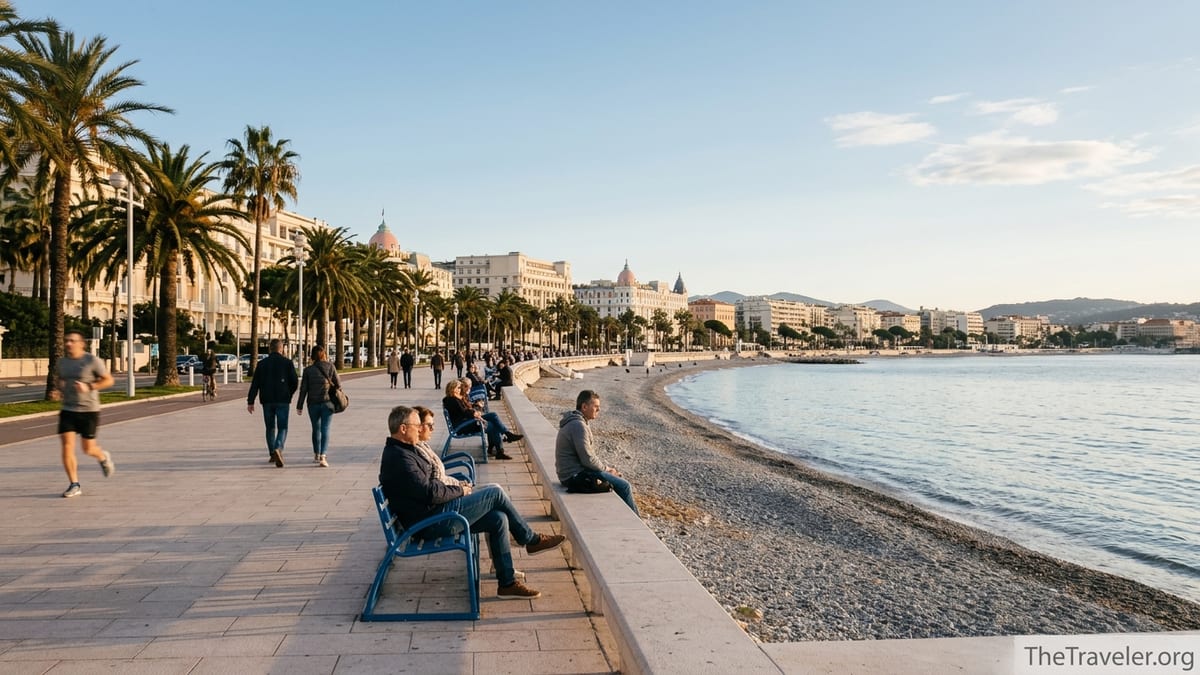
Arriving at the Edge of the Sea
Like most visitors, my first glimpse of the Promenade des Anglais came just after landing at Nice Côte d’Azur Airport, where jets seem to skim the water before touching down. The airport sits virtually at one end of the promenade, and the transition from runway to Riviera is remarkably quick. Outside the terminals, Line 2 of the tram and the 12+ bus connect you with the seafront, with regular tickets costing around 1.70 euros if you buy them away from the airport vending machines. The trick locals now recommend is to ride the free shuttle section to Grand Arénas and purchase a normal city ticket or a 24-hour pass there, instead of the special 10 euro airport ticket sold at the airport platforms.
From the Aéroport / Promenade bus stop, you step out almost directly onto the seafront road. The promenade proper stretches for about seven kilometers along the Baie des Anges, a broad ribbon of pale stone pavement running between a busy coastal boulevard and a long sweep of rounded pebbles and glassy water. Even at the western end, where planes still float low overhead, the street noise fades a little under the steady hush of waves and the rattle of luggage wheels being dragged toward hotel lobbies.
My walk began here in the late afternoon, the time when Nice’s light softens from a hard, reflective glare into something more forgiving. Cyclists in neon jerseys zipped past in a designated lane. A couple from Lyon parked rented blue city bikes and shared a paper-wrapped socca they had picked up in town earlier. An older Niçois man in a linen jacket paused at the balustrade, hands clasped behind his back, watching the incoming flight path as if greeting guests to his own front yard.
What struck me immediately was how egalitarian the promenade feels. There is no entrance fee, no gate, and no single way you are expected to use it. In the space of a few minutes I passed a suited woman walking home from an office near the Carré d’Or, teenagers with skateboards, and a group of Italian retirees in matching windbreakers timing their daily constitutional. Everyone, in their own way, was arriving home at the edge of the sea.
Walking Through History in Real Time
As the bay curved gently ahead of me, I began to notice how much of Nice’s story is written along this strip. The promenade owes its very existence to foreign visitors. In the late 18th and early 19th century, English aristocrats began overwintering in Nice, drawn by the mild climate when northern Europe was locked in ice. One local legend often repeated in guidebooks tells of how, after a harsh winter elsewhere, English benefactors funded a seafront walkway both to beautify the area and to give work to unemployed locals. The resulting path took the English name that still clings to it today.
Walking eastward, you can still sense that Anglo influence in the architecture on the landward side. Beyond the rows of palm trees, tall facades from the Belle Époque and early 20th century peer over the traffic. Some are now modest apartment blocks, others still-grand hotels with canopies and liveried porters at the door. The pastel shades are unmistakably Mediterranean, but the proportions have something of the Victorian seaside about them, as if Brighton or Eastbourne had been stretched and warmed in the sun.
About midway along the bay I stopped opposite one of the most famous of these buildings, the Hotel Negresco, with its pink dome and ornate frontage. Inside, rooms can easily run to several hundred euros a night in high season, but from the promenade the spectacle is free. A group of backpackers on a budget stood outside taking photos of its glowing sign, while a local woman in exercise gear jogged past without even glancing up. For her, this five-star landmark is simply a fixed point in a daily running route, another reminder that in Nice, luxury and everyday life occupy the same canvas.
Nice’s history has darker threads too, and the promenade does not let you forget them. Near the central section stands a sober memorial to the victims of the 2016 Bastille Day attack, when a truck drove through crowds celebrating the national holiday. Fresh flowers still appear regularly at the site. During my walk, two young men paused in the evening light, lowered their skateboards and took off their caps for a quiet moment before moving on. It was a simple gesture but one that underscored how this space holds both the joy and the trauma of the city.
The Rhythm of Daily Life on La Prom
If you want to understand why Nice feels different from many other resort cities, you need to watch the patterns of daily life on what locals affectionately call "La Prom." Early in the morning, before the sun becomes intense, the promenade belongs mainly to runners and dog walkers. Hotel breakfast rooms along the seafront start to fill with guests sipping coffee while looking out over the bay, but down on the pavement the soundtrack is the slap of running shoes and the soft jingle of pet collars. By mid-morning, the demographic shifts. Parents push strollers, small children wobble along on scooters, and visiting couples wearing broad-brimmed hats wander without any particular goal.
During my walk, I stopped at one of the classic blue benches that line the seaward side, their curved backs aimed squarely at the horizon. Almost every bench was occupied. A student in headphones annotated a French literature textbook, a delivery rider checked his phone between orders, and a retired couple from Germany unpacked a light supermarket picnic. None of these people were paying for the view, beyond the cost of a tram or bus fare to get there. In a region where private beach clubs charge for sunbed rentals and cocktails can easily reach double digits, the promenade remains determinedly public.
Down on the stones, a different rhythm plays out. Unlike sandy beaches elsewhere, Nice’s shore is made up of large smooth pebbles that massage and sometimes torment bare feet. Locals come prepared with folding foam mats, old yoga pads, or simply thick beach towels to cushion the impact. During my visit in early summer, public sections of the beach were busy but not frantic. A group of local teenagers ran into the water fully clothed on a dare, emerging laughing and dripping as an older woman on the promenade shook her head with theatrical disapproval.
Beyond the people watching, what stood out was how safe and straightforward it felt to participate in this everyday scene. Drinking fountains dotted along the route let you refill a bottle rather than buy plastic each time. Public toilets, though basic, are signposted and reasonably maintained. Police patrols on bikes moved past now and then without intruding, a low-key presence more reassuring than restrictive. For solo travelers and families alike, this combination of accessibility, visibility, and light-touch order is part of what makes Nice feel welcoming rather than exclusive.
Where Sea Meets City: Cafes, Kiosks, and Everyday Treats
As I continued toward the eastern end of the bay, the line between promenade and city blurred further. Side streets from the Carre d’Or and the Musicians Quarter spill directly onto the seafront, bringing with them a steady flow of residents going about their day. Many are not here for a grand outing but simply using the promenade as a scenic corridor between errands. I watched a woman in a supermarket uniform cross from a bus stop to grab a takeaway espresso at a small counter-service cafe near the sea, then head straight back inland without breaking stride.
For visitors, the temptation to linger over something stronger is ever present. Along the promenade and on the streets just behind it, cafe terraces offer everything from a quick café crème to a full seafood lunch. Prices vary, but a coffee on a seafront terrace often hovers around three to four euros, rising if the table is in an especially prized location with unobstructed views of the Baie des Anges. A glass of local rosé might run from five to eight euros in the early evening. A couple I spoke to from Dublin had chosen a second-row brasserie behind the main boulevard specifically because the prices were a few euros lower than on the front line, yet the view through a gap between palm trees was almost as good.
Food on the go is just as much a part of promenade life. In one of the kiosks near the central sections, a chalkboard advertised ice cream in classic flavors like pistachio and salted caramel for about three euros a scoop. A few steps away, a stall was selling pan bagnat, Nice’s iconic tuna and vegetable sandwich packed into a round bread roll, for under six euros. Sitting on the low wall above the beach, I watched as a local office worker carefully unwrapped his pan bagnat, tapping crumbs onto the stones so the pigeons, not the promenade itself, received the mess.
These small purchases are how many people effectively "rent" their Riviera view. You might not book a sunlounger at a private beach club, where a day bed paired with an umbrella and towel service can cost 25 euros or more in high season, but a takeaway espresso and a bench or a simple picnic from a nearby supermarket grant you the same blue horizon. In this way, the promenade gently dilutes Nice’s reputation for glamour with something more democratic: the right to linger.
Iconic Views, Subtle Details
On postcards, the Promenade des Anglais is usually shown at its most obvious: a broad angle shot taking in the sweep of the bay, the gentler pastel curve of the old town in the distance, and the ranks of palm trees marching along the seafront. Walking it in person teaches you to notice subtler details. The surface of the promenade itself changes underfoot, from smoother stretches near major hotels to slightly rougher paving where maintenance is ongoing. Painted lines separate walking and cycling zones, though the boundary is respected more in spirit than in law, and the result is a gentle choreography rather than rigid order.
One of my favorite moments of the walk came just after sunset. Streetlights flickered on behind me, and the last blush of dusk bled into the sea. From the pebbles below, the click of pétanque balls drifted up as a group of friends improvised a game using the flattest stones they could find. A busker near the central pergolas played a slightly out-of-tune guitar, his case open with a few scattered coins and a single five-euro note. Joggers, now dressed in reflective gear, kept pace with small electric scooters weaving cautiously between them.
The promenade is also an open-air gallery of small civic touches. Benches are painted in the same distinctive shade of Riviera blue, their wear and tear forming a kind of unofficial barometer of use. Neatly pruned palm trees mark the passing seasons, their silhouettes as iconic as any skyline. Public art pieces and sculptures appear along the route, including modern works that nod to the city’s cultural ambitions. If you look inland, ornate balconies and wrought-iron railings hint at the time when this seafront catered primarily to the wintering elite. Look seaward, and you see rows of towels spread by students, families, and workers spending a stolen hour between shifts.
Tiny rituals accumulate. In the early evening, you see locals bringing their own folding chairs to sit near the balustrade, chatting and sipping from thermoses rather than ordering drinks at a bar. Teenagers have their picture spots: a low section of wall near the central curve where everyone seems to pose, framed by the word NICE spelled out in sculptural letters further along, now one of the city’s most photographed backdrops. Each of these micro-scenes reinforces the larger sense that the promenade belongs to everyone, yet remains distinctly Niçois in its relaxed choreography.
Reaching the Old Town and Looking Back
As the promenade approaches its eastern end, near the Quai des États-Unis and the foot of Castle Hill, the mood shifts again. The stones give way to more tightly packed sunbathers, the sound of seagulls competes with the clatter of cutlery from beachfront restaurants, and the outline of Vieux Nice with its ochre facades begins to dominate the inland view. Here, the seafront cafes are busier, especially in peak months, their menus swinging between classic Niçoise salads and tourist-friendly pizzas.
I ended my walk at the base of the ascent to Colline du Château, the green headland that rises steeply from the sea. Many visitors climb or take the lift to the top for the famous panoramic view of the entire bay, and it is worth the effort. From up there, the Promenade des Anglais appears as a single sweeping brushstroke beneath you, connecting airport, city center, and old town in one uninterrupted line. The density of people thins and thickens along its length like the ink of a calligrapher, revealing which sections are most loved at different times of day.
Looking down at the promenade after having walked it, I found myself thinking less about the big hotels and more about smaller vignettes: the café worker sneaking a cigarette break by the balustrade, the cyclist pausing to take a phone call with one foot clipped into the pedal, the woman teaching her toddler to throw pebbles into the surf. Seen from above, they are tiny moving dots, but with the memory of the walk still fresh, each dot represented a person who had folded this shared space into their own daily story.
In many coastal cities, the seafront is treated primarily as a stage set for tourism. In Nice, after a day on the promenade, you walk away with the sense that locals are not simply enduring visitors but live their lives alongside them. This coexistence is part of what gives the city its particular warmth. Visitors might arrive with rolling suitcases and smartphones raised, but by the time they reach the far end of the promenade their pace has usually slowed to match that of the Niçois, who have been walking this route, in one form or another, for generations.
The Takeaway
My walk along the Promenade des Anglais did not reveal a series of must-see attractions or hidden spots that only insiders know. Instead, it exposed something more subtle: the way a single, shared public space can anchor an entire city’s identity. From the budget-conscious traveler using a standard tram ticket to reach the seafront to the five-star hotel guest stepping out of a marble lobby, everyone crosses the same strip of stone. The promenade levels these distinctions without erasing them, creating a place where different versions of Nice coexist in parallel.
What makes Nice feel so special, I realized, is not only the curve of its bay or the pastel buildings catching the evening light. It is the sense that daily life and holiday life overlap here rather than run on separate tracks. The Promenade des Anglais is where parents teach children to ride bikes, where teenagers fall in and out of love against a backdrop of improbable blue, where widowers take their morning walks and workers take their lunch breaks. As a visitor, you are not merely looking at the city. For as long as your feet carry you along that pavement, you are taking part in its ongoing ritual.
If you go to Nice, you could easily tick off sights and restaurants and claim you have "done" the city. But make time for at least one unhurried walk along the promenade, ideally at two different times of day. Start near the airport or near the old town and simply follow the curve of the bay until your legs are pleasantly tired and the stones and waves feel familiar. Somewhere along that line, as the wind shifts and the light changes on the water, you may find your own answer to why Nice feels unlike anywhere else.
FAQ
Q1. How long does it take to walk the full length of the Promenade des Anglais?
At a relaxed pace with a few photo stops, walking the roughly seven kilometers from the airport end to the foot of Castle Hill takes about one and a half to two hours.
Q2. What is the best time of day to walk the promenade?
Early morning and late afternoon into sunset are ideal, with softer light, fewer crowds in high summer, and more locals out for runs, dog walks, or evening strolls.
Q3. Is the Promenade des Anglais safe for solo travelers at night?
The main sections are usually busy and feel reasonably safe into the evening, though common sense applies: stay in well lit areas, avoid deserted stretches very late, and keep an eye on belongings.
Q4. Can you swim directly from the promenade beaches?
Yes, you can access public pebble beaches via stairways or ramps from the promenade, but the stones are large, the drop can be sudden, and water conditions change, so swim within marked zones and follow local advice.
Q5. Are there free areas on the beach, or do you have to pay for a sunbed?
Much of the shoreline is public and free to use if you bring your own towel or mat, while private beach clubs charge for loungers and service, especially in high season.
Q6. How do I get from Nice Airport to the promenade on public transport?
You can take tram Line 2 or the 12+ bus from the airport area, using a standard city ticket if you buy it away from the airport vending machines or combine it with a day pass, which keeps costs low.
Q7. Is the promenade accessible for wheelchairs and strollers?
Yes, the main promenade is wide, paved, and mostly level, with ramps down to many beach sections, though the pebble shore itself is difficult to navigate with wheels.
Q8. What should I wear for a long walk along the promenade?
Comfortable walking shoes, a hat, and sunscreen are essential in most seasons, and a light jacket is useful in the cooler months or when sea breezes pick up.
Q9. Are there places to buy food and drinks along the way?
Yes, you will find kiosks, cafes, and supermarkets either directly on the seafront or one or two streets inland, offering everything from takeaway sandwiches to sit down meals with sea views.
Q10. Can I cycle or use an e-scooter on the Promenade des Anglais?
There are marked lanes and many people use bikes and scooters along the seafront, but you should keep speeds moderate, respect pedestrian areas, and check local rules and rental company guidelines before riding.