


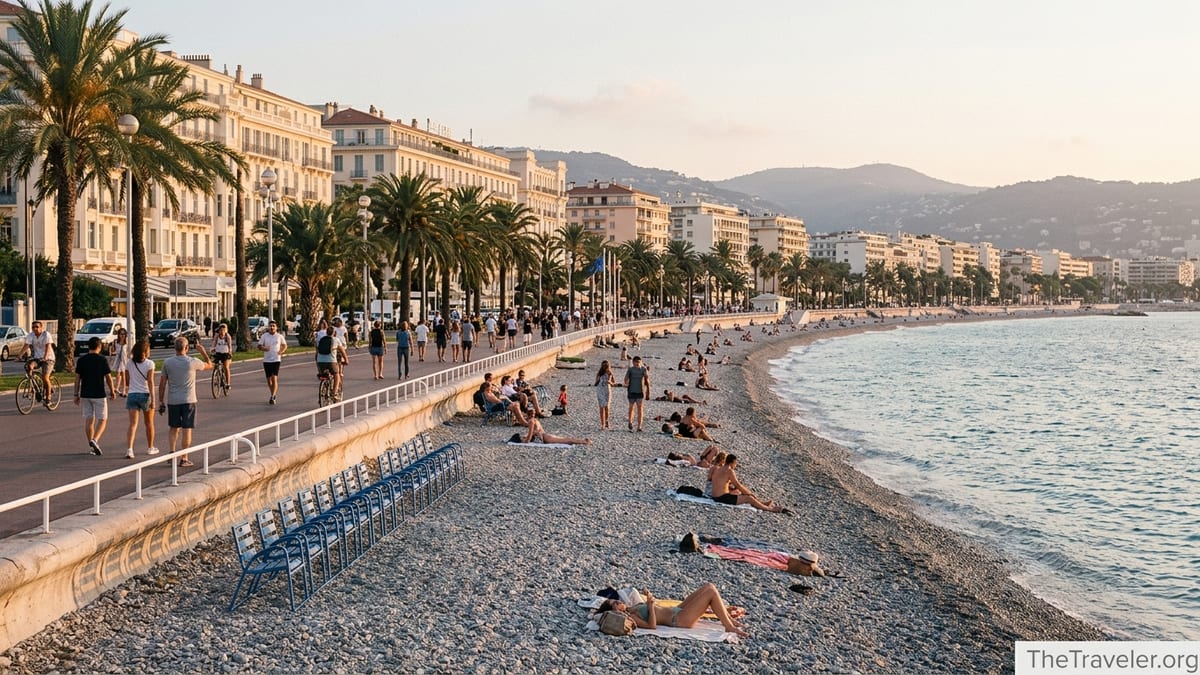
Few waterfronts in Europe feel as instantly iconic as the Promenade des Anglais in Nice. Seven kilometers of seafront curve around the Baie des Anges, lined with palm trees, Belle Époque hotels, blue chairs facing the Mediterranean, and a mix of joggers, cyclists, and sunbathers that changes with every season. To really enjoy it, though, you need to plan more than a casual stroll. From choosing the right section of beach to understanding current rules for bikes and scooters, a little preparation before you land at Nice Côte d’Azur Airport can turn a pretty walk into a standout Riviera experience.
Get the latest updates straight to your inbox!
Understand the Layout and Pick Your Base
The Promenade des Anglais runs west to east from near Nice Côte d’Azur Airport to the edge of the old town, roughly seven kilometers in total. In practice, most visitors focus on the central section between the Negresco Hotel and the Jardin Albert 1er, where the classic blue chairs, grand hotels, and busiest private beaches are clustered. If you imagine the promenade in three zones, the western stretch near the airport is more residential and practical, the middle is postcard-perfect Riviera, and the eastern end blends into the narrow Quai des États-Unis at the foot of the old town.
Deciding where to sleep is the first big planning choice. Staying directly on or just behind the Promenade puts the sea on your doorstep but can be noisy and more expensive. Well-known seafront properties like Hotel Le Negresco or the more contemporary Le Méridien Nice often price high in peak summer, while simpler three-star hotels one or two blocks inland around Rue de France or Rue de la Buffa can be significantly cheaper yet still only a five-minute walk from the water. Booking early for May to September is essential if you want a sea-view room without paying a top-tier luxury rate.
If you prefer local atmosphere over seafront prestige, consider basing yourself slightly inland near Place Masséna or in the old town and treating the Promenade as your daytime playground. This makes it easier to duck into quieter streets and markets, while still keeping the seafront within a ten-minute stroll. Families often appreciate this option because it offers both beach time and quick access to supermarkets, bakeries, and casual restaurants that are less prevalent directly on the Promenade.
Whichever area you choose, check your hotel’s exact access to the Promenade before booking. Some properties advertise a “Promenade des Anglais area” location but are actually a steep 15 to 20 minute walk uphill. Look at maps, satellite images, and recent guest comments to confirm that your daily route to the sea will be as easy as it sounds.
Time Your Visit and Plan Around Crowds
The Promenade des Anglais is walkable year-round, but the experience changes dramatically by season and even by hour of the day. July and August bring peak heat, heavier traffic, and the highest hotel and sunbed prices. Water temperatures are warmest and the city is lively late into the night, yet mid-afternoon on the pebbles can be punishing with full sun and very little natural shade. If your schedule allows, late May, June, or September often offer a better balance of pleasant temperatures, swimmable water, and thinner crowds along the walkway.
Day of the week and time of day matter too. Weekend afternoons from late spring through autumn see the promenade at its busiest, with families, runners, rollerbladers, and sightseeing groups all sharing space. For a calm first impression, aim for an early-morning arrival on your first full day, ideally around 7 to 9 a.m. The light is soft, runners are out, the sea is glassy, and even the most popular beach clubs are just setting up. In winter, mid-morning and early afternoon are prime times for a sunny stroll when the angle of the sun still offers warmth.
Large events can transform the feel of the promenade. The Nice Carnival in February, the Nice Jazz Festival in July, and the arrival of the Tour de France in 2024 highlighted just how much traffic patterns and pedestrian space can shift when the city hosts major happenings. In the run-up to big events, parts of the road lanes may close, stages can appear in the Jardin Albert 1er area, and security checks may pop up. Before your trip, it is wise to check the city’s events calendar and note any dates when crowds and road closures could affect your plans, whether you are staying for a few days or passing through on a Côte d’Azur road trip.
Finally, consider sunsets. Nice faces southwest, and sunsets from roughly April to October are often spectacular, with the sky turning orange and pink over the Baie des Anges. Planning a dedicated sunset walk along the central stretch of the Promenade, perhaps timed with an outdoor aperitif at a seafront terrace, is one of the simplest ways to feel the Riviera mood without spending much money.
Navigate Transport, Access, and Practicalities
Reaching the Promenade des Anglais from Nice Côte d’Azur Airport is straightforward and worth planning in advance to avoid expensive last-minute taxis. Tram line 2 runs from the airport terminals into central Nice and includes stops such as Cassin Kirchner, Magnan, Alsace-Lorraine, and Jean Médecin, which are all within walking distance of the seafront. Tickets are comparatively inexpensive and can be purchased at machines on the platform, making the tram the go-to option for many travelers heading directly to hotels near the Promenade.
If you arrive by car, be aware that seafront parking is limited and can be costly. Several underground car parks sit just off the Promenade, for example near the Jardin Albert 1er and around the city center, and daily rates can quickly add up. Nice has also been expanding its low-emission and traffic management zones in central areas, which include the Promenade and adjoining streets, so visitors with older vehicles should check current restrictions and consider parking further out, then switching to tram or bus for the final stretch into town.
Once you are on the Promenade, think about how you will move along it. There are dedicated bike lanes along much of the seafront, and bike counters installed by the city have recorded several thousand cyclists per day in high season. This makes cycling a scenic and efficient way to explore the whole length from the airport side to the eastern viewpoint near Rauba-Capeù. Public bike-sharing stations and private rental shops offer city bikes, e-bikes, and sometimes child seats or cargo bikes, which can be especially helpful if you want to cover the full seven kilometers without turning it into a workout.
However, you should be aware of current rules for scooters and two-wheelers. After a fatal collision involving an electric scooter in 2022, Nice tightened enforcement along busy pedestrian areas by the sea. Scooters and bikes are expected to stay in designated lanes, and in some sections heavily used by pedestrians, riders may be required to dismount and walk. Fines for riding fast among pedestrians are possible, and spot checks are not uncommon in peak season. For a relaxed trip, plan to use the cycle lane for actual transport and treat the main promenade pavement as a place to walk, not ride.
Plan Your Beach Strategy and Budget
The beach along the Promenade des Anglais is a continuous stretch of smooth pebbles, not sand, and that detail alone can make or break your first swim if you arrive unprepared. Public sections alternate with private beach clubs, and each functions quite differently. Public beaches are free to access, and you can lay down your own towel anywhere, but you will want water shoes or thick-soled flip-flops to walk comfortably over the pebbles and enter the water without slipping. A simple pair of swim shoes bought from a supermarket or beachfront kiosk can make the difference between a graceful dip and an awkward shuffle.
Private beaches, which line much of the central promenade, offer sun loungers, parasols, waiter service, changing cabins, and restaurants or snack menus. Prices vary by location, time of year, and position relative to the water. In high summer, expect to pay in the region of several tens of euros per person for a full-day lounger and umbrella at a central club in front of a major hotel, with slightly lower rates for back rows or shoulder season days. Some clubs offer half-day prices in the afternoon or morning, which can be a good compromise if you want the comfort without committing or paying for a full day.
Different stretches of beach have distinct personalities. Near the Negresco, many beach clubs lean toward classic Riviera style, with white loungers, striped umbrellas, and sit-down restaurants that serve seafood, salads, and chilled rosé. Further west near Magnan, you will find more local families and students on the public beach sections, bringing their own picnics and portable speakers. At the far western end, Plage Carras is equipped with facilities for visitors with reduced mobility, including beach access equipment and specially adapted chairs to help people into the water, plus a designated water sports zone popular with paddleboard and kayak rentals.
For practical planning, think through the length of time you want to spend on the pebbles and what level of comfort you need. If you are happy with a couple of hours of swimming and sitting on a towel, focus on locating showers and toilets, which are available at various points along the seafront. If you plan to spend a full beach day, reserving loungers in advance during July and August at your chosen private beach is wise, particularly on weekends. Many visitors find a hybrid approach works best: one indulgent day at a private club, followed by several shorter, more casual swims at public sections.
Stay Safe, Comfortable, and Respectful
The Promenade des Anglais feels generally safe, but simple precautions will help keep your experience stress-free. Like any busy tourist area, it attracts occasional pickpockets, particularly near bus stops, tram stops, and benches where people leave bags unattended. Plan ahead by carrying only what you need for the beach and using a small crossbody bag with a zipper for valuables. If you swim at a public beach, consider bringing a lightweight waterproof pouch for your keys, card, and phone, or take turns swimming so someone always stays with your belongings.
Sun and heat are bigger everyday risks than crime. The southern exposure and reflective effect of the pale pebbles can make the promenade feel hotter than the posted temperature, particularly in mid-afternoon. Packing a wide-brimmed hat, high-SPF sunscreen, and a refillable water bottle is crucial. Public drinking fountains are dotted along the seafront and nearby squares, so you can refill for free rather than buying multiple plastic bottles at kiosks. If you are sensitive to heat, structure your day with a long lunch under shade or a siesta back at your hotel, then return to the promenade in the cooler late afternoon.
Respecting local regulations will also make your visit smoother. Noise late at night on the pebbles can lead to complaints from residents, and glass bottles are discouraged or prohibited on many sections of the beach for safety reasons. If you plan a twilight picnic, opt for reusable or paper cups and avoid leaving anything behind on the stones. The city cleans the beaches, but a windy evening can quickly scatter plastic and napkins into the sea if they are not properly collected.
Finally, be aware of the divided spaces along the promenade itself. There are clearly marked lanes for cyclists, as well as broad pedestrian zones. Accidents have led to ongoing adjustments and extra crosswalks between the beach and the seaside buildings. When crossing the bike lane to reach the water, look carefully in both directions, and if you are walking with small children, hold their hands as you step out. Planning this awareness into your day helps you relax once you are settled on your towel or lounger.
Shape Your Ideal Promenade Day
To make the most of the Promenade des Anglais, it helps to imagine your ideal day and plan each element in advance. Many visitors enjoy starting with a sunrise or early-morning walk from the central section near the Jardin Albert 1er west toward the quieter residential stretch. You might grab a coffee and croissant from a bakery just off the seafront, then sit in one of the famous blue chairs to watch the city wake up, with joggers passing and the first swimmers heading into the water.
Late morning is a good time to move into beach mode. If you have reserved a sunbed at a private beach club, arrive before the late rush to secure the spot you prefer, whether close to the water or nearer to the restaurant for easy access to lunch. If you are using the public beach, this is the moment to set up your towel, adjust your sunshade if you brought one, and enjoy a swim while the crowds are still manageable. Planning to leave the beach for lunch, even for an hour, can help you avoid the most intense midday sun.
In the afternoon, consider stepping away from the stones for a while. A short walk inland takes you to the green corridor of the Promenade du Paillon, the open spaces around Place Masséna, or the narrow lanes of the old town behind Quai des États-Unis. This gives you shade, a chance to explore markets and gelato shops, and a different view of the city. Returning to the Promenade toward the end of the day, you can head east to the viewpoint at Rauba-Capeù, where many people gather to photograph the curve of the bay and the full sweep of the seafront.
Evenings are the time to slow down. Planning an aperitif at a terrace overlooking the water, then a leisurely dinner a block or two inland where prices tend to be slightly lower, allows you to enjoy the atmosphere without rushing. Couples often choose this moment for a final moonlit stroll back along the promenade, while families might cap the day with a ride on the small fairground attractions that sometimes appear near the beachfront gardens in high season. Thinking through this rhythm in advance lets you adapt once you are there rather than scrambling to decide what to do next.
The Takeaway
The Promenade des Anglais looks effortless, but the best experiences here tend to belong to those who plan the details. Choosing a base that suits your budget and walking comfort, timing your visit to the season and time of day, understanding current transport and cycling rules, and thinking through your beach strategy all add up to a far more relaxed stay. When you arrive prepared with water shoes, sun protection, a loose daily rhythm, and a sense of how the promenade is laid out, you are free to focus on what matters most: the glittering curve of the Baie des Anges, the everyday life of locals and visitors sharing the seafront, and the simple pleasure of watching the light change over the Mediterranean.
FAQ
Q1. Is the Promenade des Anglais suitable for families with young children?
Yes, as long as you plan ahead. The promenade itself is stroller-friendly, with smooth paving and plenty of benches. The pebble beach can be tricky for toddlers, so water shoes and a small beach mat or foldable chairs help. Choose calmer stretches, such as near public lifeguard posts or at Plage Carras, and avoid the hottest midday hours.
Q2. Do I need to book a private beach in advance?
In July and August, advance reservations are strongly recommended for popular private beach clubs in the central section, especially on weekends and for front-row loungers. Outside peak season or on weekdays, you can often walk up in the morning and still find space, though the most coveted spots may already be taken.
Q3. Are there showers and toilets along the Promenade des Anglais?
Yes. Public showers and toilets are available at various intervals along the seafront, particularly near major beach access points and lifeguard stations. Facilities near the most central stretches can be busy in midsummer, so be prepared for short waits and consider using facilities at nearby cafés if you are a paying customer.
Q4. Is it safe to swim on the public beaches?
Swimming is generally safe when you respect local conditions and lifeguard guidance. In season, many public sections have lifeguards on duty and clearly marked swimming areas. The main challenges are the depth increasing quickly and the slippery pebbles underfoot. Checking flag colors, avoiding rough seas, and entering the water carefully with suitable footwear all help ensure a safe swim.
Q5. Can I cycle on the Promenade des Anglais?
Yes, there is a dedicated cycle lane along much of the seafront, and it is a popular route for both locals and visitors. You should stay in the marked lane, respect speed limits, and be ready to slow down near busy crossings where people move between the buildings and the beach. Riding among pedestrians on the main walkway is discouraged and may be restricted in some zones.
Q6. How far is the Promenade des Anglais from the airport?
Nice Côte d’Azur Airport sits at the western end of the promenade, and the distance from the terminals to the central seafront near Place Masséna is roughly six to seven kilometers. Tram line 2 connects the airport to the city center in a relatively short ride, and taxis or ride-hailing cars typically take 15 to 25 minutes depending on traffic.
Q7. Are there sandy beaches on the Promenade des Anglais?
No, the beaches along the Promenade des Anglais are made up of smooth pebbles rather than sand. Some areas may have a thin layer of finer stones near the waterline, but you should not expect soft sand underfoot. If you prefer sandy beaches, plan a day trip to nearby spots along the Côte d’Azur that are known for sand, and treat the promenade as your base for walks and views.
Q8. What should I wear for an evening on the promenade?
Smart-casual clothing works well. Many people dress neatly for an evening stroll or dinner, but there is no need for very formal outfits unless you are visiting a particularly upscale restaurant. In summer, a light dress or shirt with trousers and comfortable walking shoes is typical. In the cooler months, a jacket or coat is advisable since the sea breeze can make temperatures feel lower than inland.
Q9. Is the Promenade des Anglais accessible for visitors with reduced mobility?
Yes, much of the promenade is relatively flat and accessible, and ramps connect the walkway to beach areas at several points. Plage Carras, toward the western end, is specifically equipped for visitors with reduced mobility, with adapted equipment and assistance available in season. If accessibility is a priority, it is worth confirming current details with your accommodation or the local tourist office before arrival.
Q10. Can I find food and drinks right on the Promenade des Anglais?
Yes, there are plenty of options. Private beach clubs serve full meals and drinks, while cafés, ice cream shops, and kiosks line the streets just behind the seafront. For better value, many visitors grab sandwiches or salads from bakeries or supermarkets slightly inland and bring them back to the promenade for an informal picnic, always taking care to clean up thoroughly afterward.