


For relocating families, schooling is one of the most consequential variables in assessing a move to the United Arab Emirates. The country has a dual system in which public schools are primarily designed for Emirati citizens, while a large and rapidly expanding private sector caters to expatriate communities. Understanding how these two pillars differ in access, language, curriculum, governance and capacity is essential for realistic education planning before relocation.
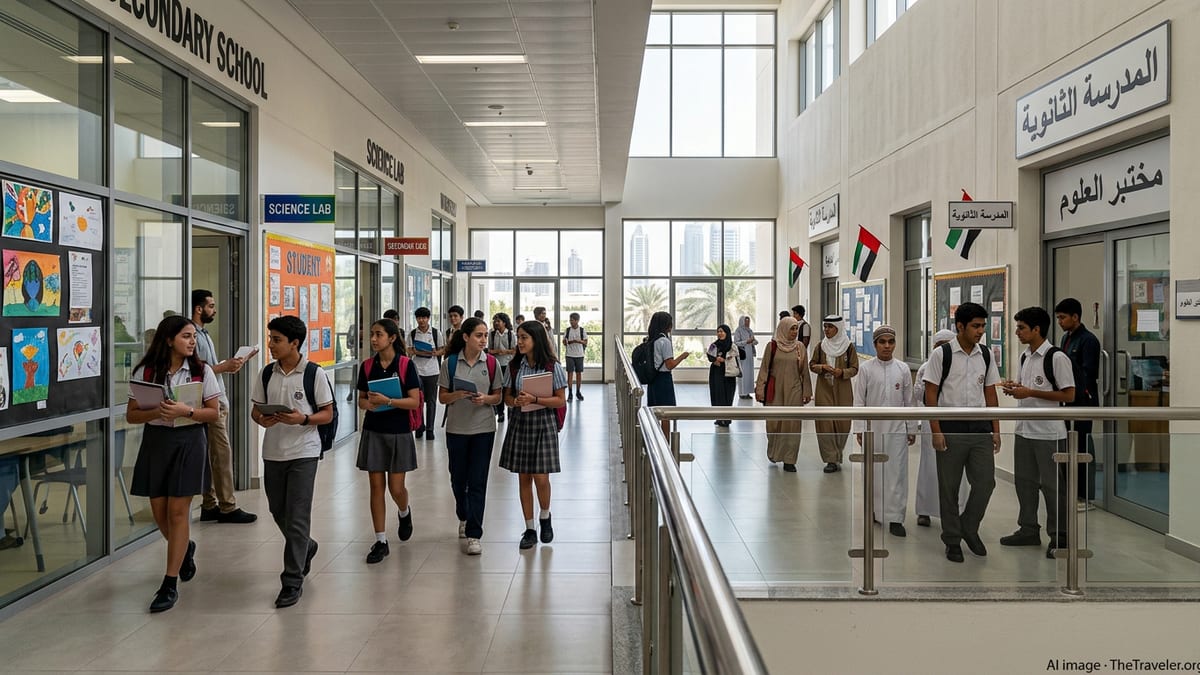
Structure of the UAE School System: Public vs Private for Expats
The UAE’s kindergarten to grade 12 landscape is dominated by private providers, with estimates indicating that roughly three quarters of all schools nationwide are privately operated. In major expatriate hubs such as Dubai and Abu Dhabi, private schools educate the overwhelming majority of students, including most Emirati children in those emirates. Public schools, funded by the federal and emirate-level governments, remain numerically significant but are geared primarily toward nationals.
For expatriate families, this structural reality means that private schooling is the default pathway. While legislation allows a limited proportion of non-Emirati students into public schools, capacity, language of instruction and eligibility conditions significantly constrain this option. In contrast, the private sector has grown rapidly alongside expatriate population growth, with Dubai alone educating close to 400,000 students across more than 220 private schools in the 2024–25 academic year.
Across the UAE, private schools offer a wide menu of international curricula and fee points targeting different national communities, income brackets and education philosophies. The system is highly stratified: some operators focus on premium, brand-name international schools, while others specialise in larger, more affordable schools following Indian or other national curricula. Public schools, in comparison, are more homogeneous in curriculum and language but have been undergoing reform and quality improvement, especially in core subjects and English provision.
Access and Eligibility: Can Expat Children Attend Public Schools?
By policy design, public schools in the UAE are free for Emirati citizens and certain other GCC nationals, with government covering the full cost of education. Expatriate children are not excluded in principle, but their access is tightly regulated and numerically limited. A federal decree allows only a minority share of places in public schools to be allocated to non-Emirati students, and emirates apply this through quota caps at the individual school level.
In Abu Dhabi, for example, rules have historically capped expatriate enrolment at around 20 percent of a given public school’s student body. Where access is permitted, expatriate families are required to pay tuition, which earlier policy announcements indicated at several thousand dirhams per year per child, irrespective of grade. While fee amounts and enforcement mechanisms may evolve, the broader picture has been consistent: public schools do not function as a low-cost universal option for expatriate communities, and places are often oversubscribed.
Admission of expatriate students into public schools typically prioritises children of public sector employees and those already resident in specific catchment areas. Documentation requirements can include valid residence visas, Emirates ID, previous school records and proof of address. Even where criteria are met, availability of English-language support, special educational needs provision and continuity across grades can be uncertain compared with the private sector. As a result, only a small fraction of expatriate families in practice rely on public schools for compulsory education.
Curriculum and Language: Alignment with Expat Family Objectives
Curriculum and language of instruction are decisive for many relocating families because they determine both the day-to-day learning experience and future portability of qualifications. In UAE public schools, the official curriculum is set by the federal Ministry of Education, taught primarily in Arabic, with English delivered as a strong second language. Recent reform initiatives have increased the share of STEM content delivered in English, but most subject teaching and school life remain Arabic-centric, reflecting the system’s core mission to educate national students.
Private schools, in contrast, operate under emirate-level regulators and may adopt any approved curriculum, including British, American, International Baccalaureate, Indian (CBSE or ICSE), Pakistani, French and others. In Dubai alone, regulators recognise more than a dozen distinct curricula. English is the dominant medium of instruction in most private schools, particularly those following British, American or IB programmes. Large South Asian schools may use English as the teaching language while maintaining strong Hindi or other regional language provision.
For expatriate families planning potential moves between countries or eventual return to their home system, this curricular diversity is an advantage. British-curriculum schools provide IGCSEs and A-levels, which articulate well into universities in the UK and elsewhere. American-curriculum schools often prepare students for SAT, AP and US college entry. IB World Schools offer the International Baccalaureate continuum, which is widely recognised globally. The public system’s national curriculum, although increasingly rigorous, is less directly aligned with many expatriates’ home qualifications, which is one reason why even many Emirati parents choose private schools in the main expatriate cities.
Quality Assurance, Inspections and Outcomes
Education quality in the UAE is uneven across both public and private sectors, but the inspection and rating systems that apply primarily to private schools give expatriate families greater transparency. In Dubai, the Knowledge and Human Development Authority conducts annual inspections of private schools and publishes quality ratings on a scale from Outstanding to Very Weak. Abu Dhabi’s Department of Education and Knowledge and Sharjah’s Private Education Authority operate similar inspection frameworks.
These rating systems assess teaching quality, student progress, curriculum implementation, leadership, governance and personal development outcomes. They also disaggregate performance by different student groups, including Emirati and expatriate learners. Over time, ratings in key emirates have improved, with a growing share of private schools moving into the Good and Very Good categories. However, there remain substantial differences between top-tier international schools and lower-cost providers, especially on measures such as teacher qualifications, classroom resources and student support services.
Public schools are also inspected and have been the target of quality improvement campaigns, including teacher training and curriculum upgrades. Nonetheless, available international benchmark data has historically shown a performance gap between public schools and the top private schools, particularly in English-medium subjects. For expatriate families whose children have limited Arabic proficiency, integrating into a public school can present additional academic and social challenges that may affect outcomes.
Capacity, Waiting Lists and Geographic Distribution
The UAE’s private education market has expanded rapidly but continues to experience capacity pressures in popular locations and at higher-performing schools. Recent data for Dubai indicates private school enrolments approaching 390,000 students across more than 220 institutions, with authorities forecasting the need for dozens of additional schools and tens of thousands of new seats by the early 2030s. Similar expansion dynamics are visible in Abu Dhabi, where private and charter schools have been opened to accommodate both expatriate and national demand.
For relocating families, this translates into practical questions of timing and flexibility. Highly rated international schools in established residential districts often operate waiting lists at multiple grade levels, particularly for early years and lower primary grades. Mid-market and newer schools on the outskirts of cities may have greater availability but could require longer commutes. In smaller emirates, the range of curricula and school brands is narrower, and families may face fewer realistic alternatives within acceptable travel times.
Public schools are more evenly distributed geographically, including in less densely populated areas, but the combination of quota limits for non-Emirati students and Arabic-medium instruction means they do not function as a simple overflow mechanism when private schools are full. For expatriates without strong Arabic proficiency, capacity in practice is largely defined by the private market in the relevant emirate, making early school engagement a critical part of relocation planning.
Financial Considerations and Strategic Trade-offs
While public schools are tuition-free for Emirati citizens, expatriate families normally pay fees whether they choose a public or private option. Where expatriate admission is permitted in public schools, fee levels have historically been set at a flat amount per year that is significantly lower than most private school fees but still material when multiplied across multiple children. In contrast, private school fees range widely, from comparatively modest amounts at large national-curriculum schools to premium-fee structures at top international schools.
At the higher end of the market, annual tuition in some international schools can exceed the after-tax education allowances offered in typical corporate expatriate packages, requiring families to make trade-offs between desired school brand or curriculum and overall household finances. Mid-market private schools that balance acceptable quality with more moderate fees have attracted strong demand and, in some emirates, are the focus of new investment. Relocating families should also consider incidental costs such as uniforms, transport, extracurricular activities and examination fees, which can be significant in premium schools.
In purely financial terms, a successful application to a public school as an expatriate may appear attractive because of lower published fees. However, the potential cost savings must be weighed against integration challenges, curriculum alignment with future destinations, and possible limitations on English-medium instruction or advanced subject offerings. For many expatriate families, especially those with older children approaching key examination years, the risk of misalignment with home-country or global qualifications is a decisive factor favoring private education.
The Takeaway
For expatriate families considering relocation to the UAE, the public education system is best understood as a national service designed around Emirati citizens, with limited and conditional space for non-nationals. While some expatriate children do attend public schools, access is constrained by quotas, Arabic-medium instruction and selective fee-based admission. These structural factors make public schools a niche rather than mainstream solution for most foreign families.
Private schools, by contrast, form the core schooling ecosystem for expatriate communities and a growing share of Emirati families in major cities. They offer extensive curriculum choice, English-medium instruction, transparent inspection ratings and strong global portability of qualifications, at the cost of significant and rising tuition fees. Capacity pressures and waiting lists at desirable schools underline the need to treat school selection as an early and central component of any relocation project plan.
Decision-grade planning therefore hinges on matching each child’s language background, age, academic trajectory and long-term mobility plans to available school types and locations. Families who require alignment with specific national or international curricula, and who value English as the primary teaching language, will almost always focus on the private sector. Those prepared to engage deeply with Arabic language and culture, and who can secure a place under expatriate quotas, may find that selected public schools offer a more economical but less internationally portable pathway.
FAQ
Q1. Can expatriate children enroll in UAE public schools?
Yes, but places are limited and subject to quotas, with priority given to Emirati citizens and specific eligible categories. Expatriates usually pay tuition and may face language and curriculum adjustment challenges.
Q2. Is education free for expatriate children in the UAE?
No. Free public education is reserved for Emirati citizens and certain GCC nationals. Expatriate families pay fees in both public schools that accept them and in private schools.
Q3. What is the main language of instruction in UAE public schools?
Arabic is the primary language of instruction in public schools, with English taught as a strong second language. This can be a significant adjustment for children without prior Arabic exposure.
Q4. Which curricula do private schools in the UAE offer?
Private schools offer a wide range of approved curricula, including British, American, International Baccalaureate, Indian, Pakistani, French and others, with English the usual teaching language.
Q5. Are private schools in the UAE regulated for quality?
Yes. Emirate-level regulators inspect private schools regularly and publish quality ratings, which assess teaching, leadership, student outcomes and overall school performance.
Q6. How early should relocating families apply for private school places?
Applications should be initiated as early as possible, often several months to a year in advance, especially for high-demand schools and key intake years with known waiting lists.
Q7. Are there affordable private school options for expatriates?
Yes. Beyond premium international schools, there are larger, more affordable schools, often following Indian or other national curricula, though these may have larger class sizes and fewer facilities.
Q8. Can children transition from a UAE private school back to their home-country system?
In many cases yes, particularly when enrolled in widely recognized curricula such as British, American or IB that articulate smoothly into other national systems and university admissions.
Q9. Do public schools in the UAE offer special education support for expatriate children?
Provision exists but is less transparent and often more limited for non-Emirati students than in many private schools, where specialized learning support departments are more common.
Q10. Should expatriate families consider public schools primarily for cost reasons?
Public schools may be less expensive where expatriate access is allowed, but cost savings must be weighed against language, curriculum fit, long-term portability and availability of places.