


The choice between Pula and Rovinj shapes how you experience Croatia’s Istrian peninsula. Pula is a lived‑in port city with a spectacular Roman arena, major bus hub and straightforward airport access. Rovinj is a compact, romantic fishing town of Venetian facades and a tight waterfront Old Town that feels made for evening strolls. Both work as bases, but in very different ways. This guide compares them on beaches, sights, transport, day trips and budgets so you can decide where to stay, or how to combine them.
Get the latest updates straight to your inbox!
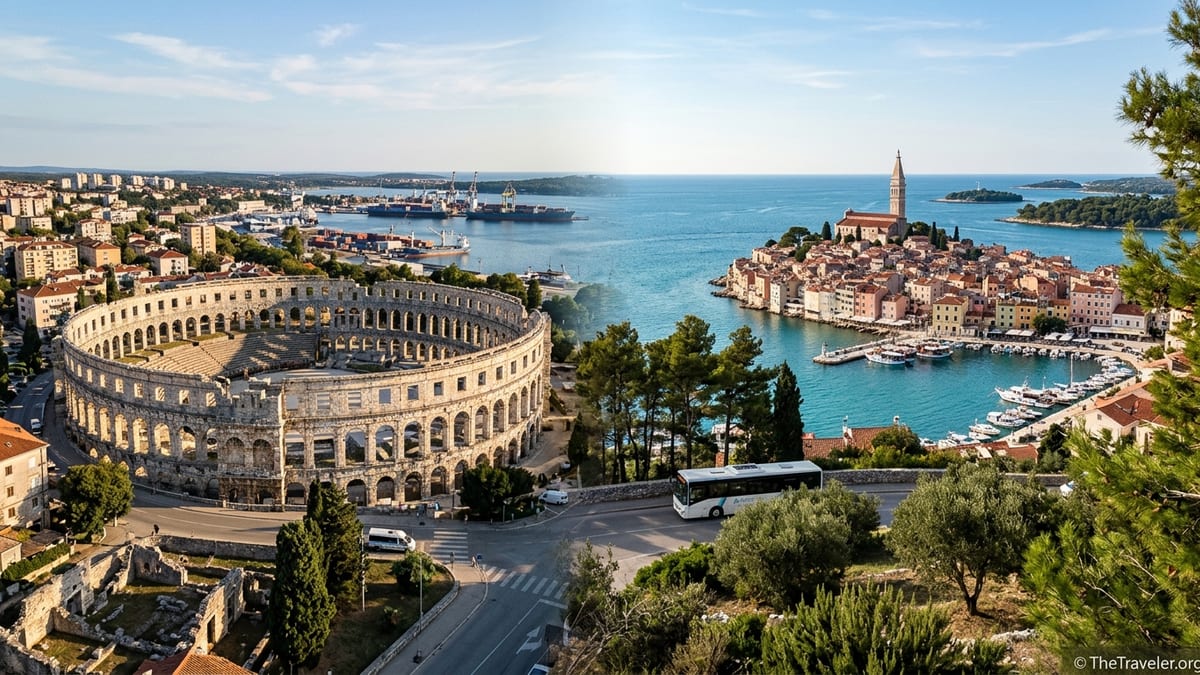
Pula and Rovinj at a Glance
Pula sits on the southern tip of Istria and feels like a working city first and a resort second. You step out of the bus station almost beneath the 1st‑century Pula Arena, still used for summer concerts, and wander past Roman arches, the Temple of Augustus and Austro‑Hungarian streets that fill with locals on their commute. The main bus terminal is one of Istria’s key hubs, with frequent regional services, and Pula Airport is about 6 kilometres away, which keeps transfers simple.
Rovinj, about 37 kilometres up the coast, is smaller and more romantic. The Old Town sits on a small peninsula topped by the church of St Euphemia, reached by steep, shiny stone alleys lined with art studios and wine bars. The waterfront curves into working fishing quays, cafe terraces and a small marina, before giving way to pine‑backed beaches around Lone Bay and the Golden Cape Forest Park. Ferries and seasonal boats shuttle out to the Rovinj archipelago, including St Katarina and St Andrew islands.
Atmosphere is the sharpest contrast. Pula has industry, shipyards and suburbs that spread inland; it is lively but not especially polished, with real‑life grit alongside historic monuments. Rovinj feels curated: pastel houses, sunset views and sea on three sides. That makes Pula stronger for Roman history and logistics, and Rovinj stronger for people who want to walk everywhere in a pretty coastal setting.
Getting In and Around: Airport, Buses and Taxis
Pula is the main entry point for both towns. Pula Airport lies roughly 6 kilometres from the centre and is connected by an airport shuttle that runs to the main bus station, scheduled about 30 minutes after arriving flights; a one‑way ticket costs around 6 euros as of October 2026. Taxis or prebooked transfers from the airport to central Pula usually fall in the 18 to 30 euro range for up to three or four passengers, depending on time of day and company, and take about 15 minutes.
From the airport to Rovinj you can sometimes book direct shared shuttles in high season, but year‑round the most flexible route is airport shuttle to Pula bus station, then an intercity bus. Private transfers from Pula Airport to Rovinj typically quote around 70 to 90 euros per car for a 40‑minute run, which can be cost‑effective for a family with luggage compared with multiple bus tickets plus local taxis.
Within Pula, local buses run by Pulapromet connect the centre with beach districts and suburbs. The Verudela peninsula, one of the main beach zones and hotel clusters, is linked by city lines such as 2a and 3a, with services starting around 05:00 and running until late evening according to the 2026 timetable. In summer an additional night line loops via Stoja and Verudela after midnight, which is useful if you stay by the sea but dine in the Old Town. Tickets are inexpensive and can be bought on board, though visitors often report some unreliability in high‑season traffic.
Rovinj is more compact. The intercity bus station sits a short walk east of the historic core, while most hotels and apartments are within 10 to 20 minutes on foot. There is no urban bus network like Pula’s; instead, you mostly walk or cycle. For outlying resorts and campsites, local shuttle buses or hotel golf carts pick up guests, or you can use taxis, which cluster at the bus station and near the marina.
Pula–Rovinj Buses: Schedules, Fares and Practicalities
The Arriva Croatia network, through Autotrans and Brioni, runs the main bus connection between Pula and Rovinj. The route is about 37 kilometres and current timetables show typical journey times of 40 to 45 minutes, depending on intermediate stops and traffic. On a recent weekday schedule, daytime departures from Pula included services around 11:30, 12:30, 13:00 and 13:30, with several more in the afternoon and early evening. Standard one‑way fares appear between about 6.50 and 9.20 euros, with cheaper promotional seats on some departures.
All Pula–Rovinj buses leave from Pula’s main bus station near the Arena and arrive at Rovinj’s bus station on Trg na Lokvi, around 10 to 15 minutes’ walk from the Old Town waterfront. On summer Saturdays schedules are usually at their fullest, while Sundays and off‑season dates show fewer departures; when checking sample Sundays in shoulder months there were roughly half as many buses as on peak weekdays. The safest approach is to book tickets in advance for July and August, and to allow buffer time if you are connecting to or from a flight.
For day trips between the towns, these buses are practical both ways. Leaving Rovinj for an afternoon in Pula, you can typically find early‑morning and late‑afternoon departures, which gives you enough time to tour the Arena, grab dinner and return. If you miss the last bus, a taxi between the towns will cost significantly more; local drivers in 2026 often quote in the 60 to 80 euro range depending on time and negotiation, so public buses are the sensible default.
Beaches and Swimming: Verudela and Stoja vs Golden Cape and Lone Bay
Neither Pula nor Rovinj has long sandy beaches in the Mediterranean resort sense; expect mostly rock shelves and pebble coves with clear water. Around Pula, Verudela and Stoja are the main beach districts. Verudela peninsula has hotel‑backed pebble and rocky beaches, small concrete platforms, ladders into deep water and a long promenade. Areas around Park Plaza Verudela and nearby resorts are family‑friendly, with sunbed rentals and cafes. Rocky sections and sea urchins mean water shoes are a good idea in many spots, though some managed pebble entries are gentle enough for bare feet.
Stoja, on the opposite side of the bay, feels wilder. Here you find rocky coves, cliffs and concrete platforms looking across to the open sea, especially near Galebove Stijene. The water is deep and exceptionally clear, but entry can be tricky, again favouring water shoes and confident swimmers. Both Verudela and Stoja are reachable by city bus from central Pula without a car, and it is common for visitors to stay near the Arena and ride out to the beach after breakfast.
Rovinj’s coastline is more continuously walkable. A fifteen to twenty minute seafront walk south from the Old Town brings you to Mulini Beach and Lone Bay, a deep curve of small pebbles and white terraces backed by pines and high‑end hotels. Lone Bay is popular with families because the entry is relatively gradual and there are cafes, showers and shade. Continue another ten minutes and you enter Punta Corrente or Golden Cape Forest Park, a 52‑hectare protected area of woodland and 5 kilometres of indented shoreline. Paths lead to rocky coves, small pebble sections and long stone slabs where locals spread towels; the water is beautifully clear but access is mostly over rock, so water shoes again help.
Further south, Cuvi Bay and the beaches near Polari and Villas Rubin mix pebbles and rock with more camping and resort infrastructure. In all these Rovinj areas you can swim without a car: Lone Bay and Golden Cape are fully walkable from the centre, and Cuvi is roughly 30 to 40 minutes on foot or a short taxi ride. Families who prefer defined pebble entries and services tend to favour Lone Bay and parts of Golden Cape, while strong swimmers enjoy the smooth rock shelves and deeper water closer to the park’s outer capes.
History, Sights and Urban Atmosphere
For historic sightseeing, Pula is the stronger base. The Pula Arena is one of the best preserved Roman amphitheatres in the world, rising almost directly above the harbour, and you can tour its interior, underground passages and exhibition spaces. Elsewhere in the compact centre you walk past the Arch of the Sergii, parts of the old city walls, the Twin Gate, and the Temple of Augustus on the Forum. These monuments cluster within 10 to 15 minutes’ walk of each other and of the main bus station, so even a short stay lets you see a surprising amount.
Pula also connects easily to Brijuni National Park, a group of islands that combine Roman and Byzantine ruins with pine forests and former presidential residences. Boats to Brijuni leave from Fažana, a fishing village northwest of Pula that you can reach by regional bus in roughly 20 to 30 minutes. Once there, you join a park boat tour across to Veliki Brijun, where entry tickets include the crossing and guided orientation. This is an easy half‑ or full‑day trip from a base in Pula even without a car.
Rovinj’s Old Town is more about Venetian charm and sea views than big museums. Its narrow streets rise from the harbour to the church of St Euphemia, whose bell tower is visible for miles. Along the way you pass artists’ studios, bars with steps directly into the sea, and outlooks towards the Rovinj islands. The town’s heritage reflects centuries under Venetian rule: houses tightly packed, windows facing the water and small squares tucked between alleys. There are small galleries and local history exhibits rather than blockbuster attractions, but the ambient experience of wandering is the main draw.
In terms of evening atmosphere, Rovinj has the edge for romance. The waterfront promenade, especially around the Balbi Arch and the central square, fills with people strolling at sunset, while bars string lights along the rocks. Pula has lively summer nights too, particularly when concerts are on at the Arena or in local clubs, but traffic, apartment blocks and the shipyard skyline keep it feeling more like a real city than a postcard.
Where to Stay: Neighborhoods, Parking and Prices
Accommodation in central Pula ranges from small hotels and hostels near the Arena to apartments in Austro‑Hungarian residential blocks. Staying near the Forum or Giardini puts you within walking distance of Roman sights and the bus station. Street parking in the core is zoned and paid, with strict enforcement; many older buildings do not have private parking, so drivers often prefer modern apartments slightly uphill with on‑site spaces. Nightly rates in July and August climb sharply, but you can still find basic doubles under 120 euros if you book early, with higher prices for boutique properties overlooking the Arena.
On the Verudela peninsula you find resort complexes with pools, kids’ clubs and on‑site restaurants. Here prices for hotel rooms and self‑catering apartments in high summer often start around 180 to 220 euros per night for a couple and rise well above that for sea views. Parking is generally included or charged at a modest daily rate, and you trade proximity to the arena for direct beach access. Buses run into town at least every 20 minutes in season, and you can also use coastal promenades for evening walks.
In Rovinj, staying inside the Old Town is atmospheric but comes with practical caveats. Many streets are pedestrian‑only or too narrow for cars; accommodation owners usually arrange check‑in by meeting guests at a nearby parking or drop‑off point and helping with luggage. Public parking zones just outside the core charge by the hour or day, and rates add up quickly for multi‑night stays. Summer nightly prices inside the Old Town can easily exceed 200 euros for a good double, particularly with sea view, and small boutique hotels command a premium.
More moderate options lie in residential districts like Borik or Centener, or near Lone Bay where larger hotels and modern apartments cluster. These areas are a 10 to 20 minute walk from the historic centre and waterfront, with easier access to parking and supermarkets. Restaurant prices in Rovinj are generally a little higher than in Pula, especially for waterfront seafood and fine‑dining spots. In both towns, budget‑minded visitors save money by choosing apartments with kitchens and eating some meals at bakeries or simple konobas away from the very centre.
Day Trips Without and With a Car
If you are not driving, Pula is slightly more flexible as a public‑transport hub. From Pula bus station you can reach Rovinj, Poreč, Medulin, Fažana for Brijuni boats and smaller inland towns on Pulapromet or regional lines. Buses to Poreč typically take around 1 hour 15 minutes with several services per day, while Fažana is closer to 30 minutes. Bale and Vodnjan, small stone towns inland, are reachable on certain regional routes, though schedules can be sparse outside summer.
From Rovinj, bus options exist but are thinner. There are direct buses to Pula and Poreč that make simple coastal day trips, and some services to Bale and Kanfanar inland. Reaching hilltop villages like Motovun or Grožnjan is noticeably harder without a car; you would generally need to connect in Pazin or Poreč and work around limited departures. In practice, many Rovinj visitors book an organized tour for the classic inland Istria loop of Motovun, Grožnjan and wine tasting, or they rent a car for a day.
Cape Kamenjak, the wild peninsula south of Pula dotted with coves and beach bars, illustrates the difference. With a car you simply drive about 12 kilometres from Pula towards Premantura, pay a modest entrance fee per vehicle at the gate and spend the day beach‑hopping. By public bus you can get to Premantura on suburban services, then walk or cycle into the park, which takes time and energy on hot days. For this particular excursion, a car base in or near Pula is a clear advantage.
Overall, couples or families relying strictly on buses will find it easier to cover Pula, Rovinj, Poreč and Brijuni from a base in Pula, perhaps with one or two nights in Rovinj. Drivers can comfortably base in either town and explore the full peninsula, including Motovun, Bale, Kamenjak and the Lim Fjord area, with relative ease.
Sample Itineraries and Realistic Budgets
From a base in Pula, a practical two‑day car‑free itinerary might look like this. Day one: morning walk around the Arena, Forum and old town streets, afternoon bus to Verudela for swimming, and an evening concert or dinner near the harbour. Day two: morning bus to Fažana and boat trip to Brijuni National Park, returning by late afternoon, then a casual dinner near the Arch of the Sergii. Each local bus leg is under 30 minutes; allowing 20 to 30 minutes buffer for delays keeps the plan comfortable.
From Rovinj, a two‑day plan could focus on coast and Old Town. Day one: explore the alleys and viewpoints up to St Euphemia, swim or sunbathe at Monte or Baluota rocks beneath the old walls, then enjoy sunset drinks along the waterfront. Day two: walk or cycle to Lone Bay and Golden Cape Forest Park, spend the day swimming from pebbly coves and rock slabs, then return for dinner in the centre. Journey times are mostly on foot; allow 20 minutes each way between Old Town and Lone Bay, plus a little more for deeper into the park.
For a three‑day combined plan using buses, start with one night in Pula. Day one: land at Pula Airport, shuttle or taxi into town, see the Arena and Forum. Day two: early bus to Rovinj, check into accommodation near the centre, and spend the afternoon along Lone Bay. Day three: morning in Rovinj’s Old Town then mid‑afternoon bus back to Pula for a final evening if your flight leaves next day, or stay in Rovinj and make your onward connection via Pula bus station. With 40 to 45 minute bus journeys, leaving at least one full hour before any fixed reservation or airport shuttle is sensible.
On budgets, a car‑free couple staying two nights in mid‑range accommodation in July might spend around 220 to 260 euros per night in Rovinj or 150 to 200 euros in central Pula, including local accommodation taxes but not breakfast. Add roughly 12 euros each for a return Pula–Rovinj bus trip and 6 euros each for an airport shuttle from Pula Airport into town. Restaurant spending can range widely, but a realistic middle ground is 50 to 70 euros per day for two if you mix konobas and bakery lunches, or considerably more with seafood feasts and cocktails.
With a rental car, the same couple might pay 50 to 70 euros per day in summer for a compact car collected at Pula Airport, plus local parking. City and resort parking often works out at 10 to 20 euros per day depending on zone and property. The car cost replaces most bus and taxi fares but adds fuel and any road tolls for longer drives. Some travelers choose a hybrid approach: two largely car‑free days based in Rovinj or central Pula, then a one‑day car rental to hit Motovun, Grožnjan and Kamenjak in a single loop.
Seasons, Crowds and Boat Services
July and August bring the highest crowds and prices to both Pula and Rovinj. Pula’s centre can feel busy around the Arena and waterfront, particularly on days when concerts or festivals are in town, but its wider layout disperses people. Verudela and Stoja beaches fill up by late morning, and city buses get crowded, especially after 10:00. In Rovinj, Lone Bay, Golden Cape and the Old Town lanes become very busy from late morning through sunset, and parking around the historic core is often saturated by mid‑morning.
May and September are more forgiving months. Sea temperatures in late May can be cool but pleasant for hardy swimmers; by September the water is usually warm from the summer heat while air temperatures soften. In these shoulder months, restaurants are open, many seasonal boat trips still run and accommodation drops noticeably in price compared with high summer. City buses in Pula and seafront promenades in Rovinj are less crowded, making it easier for families with strollers or people who prefer quieter travel.
Seasonal boat services shape some experiences. From Rovinj, excursion boats to nearby islands and along the Lim Fjord operate most frequently from late May to September, tapering off outside that window. In high season, small taxi boats regularly hop between Rovinj’s waterfront and islands like St Katarina for swimming and views back to the town. From Fažana, boats to Brijuni National Park follow a published schedule that is denser in summer and limited in winter, so it is wise to check departure times a day ahead, especially if you rely on a bus connection.
Accessibility is mixed in both towns. Pula’s main monuments and waterfront have relatively level access, though cobblestones and occasional steps appear around the Forum and old streets. Rovinj’s Old Town is steeper, with polished stone alleys that can be slippery and many stairways; people with limited mobility may prefer accommodation closer to the flatter waterfront or modern districts near Lone Bay rather than inside the historic core. Seafront promenades and main beaches in both destinations usually provide at least some step‑free stretches and ramps.
Which Base Wins for Different Travelers
For couples, Rovinj generally wins. The compact Old Town, sea views on three sides, Golden Cape walks and sunset bars create an immediate sense of romance. A couple could happily skip the car, walk everywhere, and take one or two boat trips to islands or along the coast. Pula works well too, especially if you enjoy concerts at the Arena, but the industrial backdrop and spread‑out beaches feel a little less intimate.
Families are more of a tie. Pula’s Verudela and Stoja districts offer resort facilities, pools and playgrounds, with easy bus links into town and plenty of space, which suits younger children and anyone who values on‑site amenities. Rovinj’s Lone Bay and family‑oriented hotels around Golden Cape are superb for older kids who can manage some walking and like mixing city strolls with beach time. If you want frequent short outings to different towns and parks, Pula’s bus network or a rental car base there have an edge.
History lovers should choose Pula. The Arena, Roman arches and imperial temple all sit within a few blocks, and Brijuni National Park adds layers of antiquity and more recent political history. Rovinj’s strengths are Venetian streetscapes and maritime atmosphere rather than museums or specific monuments. Beach‑focused travelers who like pine‑backed coves and long promenades may lean towards Rovinj, while those who want a mix of city and sea, plus the option of wilder spots like Cape Kamenjak, will feel comfortable in Pula, especially with a car.
For visitors exploring Istria without driving, Pula is the more practical hub. Its bus station links efficiently to Rovinj, Poreč, Fažana for Brijuni and other towns, and airport access is much simpler. One appealing strategy is to spend a first or last night in Pula for flights and Roman sights, then move to Rovinj for two or three slower days by the sea, using the Arriva buses in between. Whichever way you choose, both towns offer enough character, coastline and cuisine to justify their place at the heart of an Istrian itinerary.