


More news on this day
New figures from the UK rail regulator and Heathrow Airport show Gatwick Airport station handling record passenger volumes in 2024–25 and Heathrow welcoming an all‑time high of 83.9 million air travellers in 2024, underscoring how rail has become a leading way for many London‑area flyers to reach the country’s two busiest airports.
Get the latest news straight to your inbox!
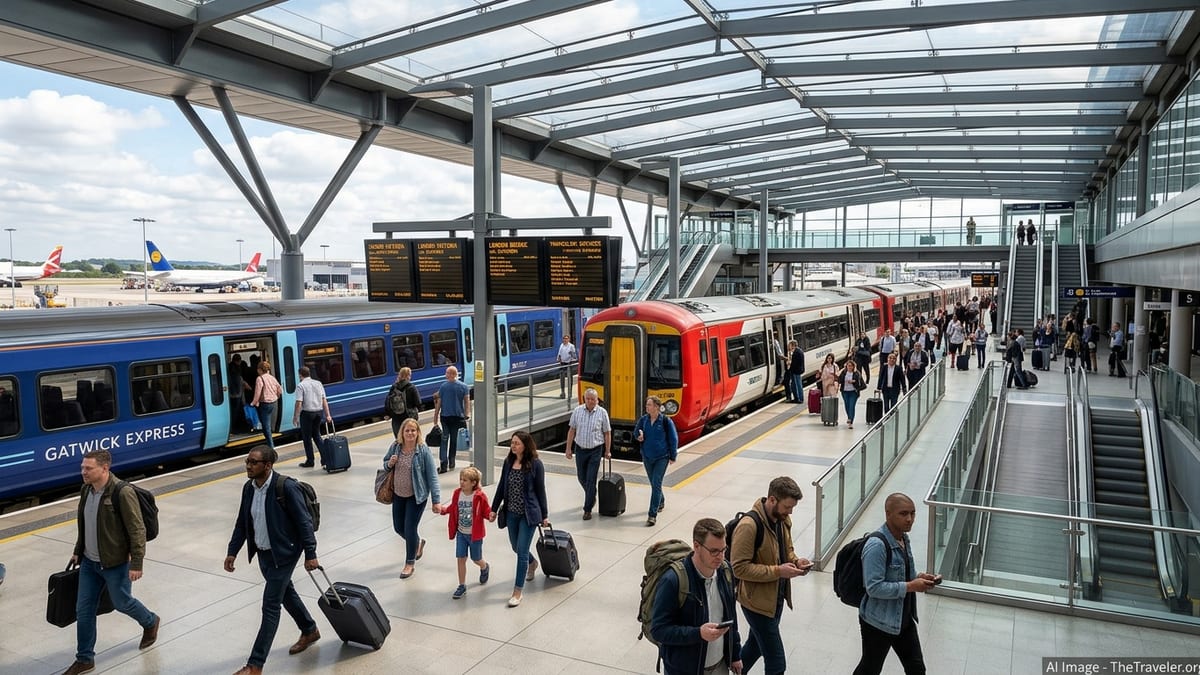
Fresh ORR data put Gatwick Airport station at new high
The Office of Rail and Road’s latest Estimates of Station Usage, covering April 2024 to March 2025, record just over 21.2 million entries and exits at Gatwick Airport rail station, up from around 19.5 million the previous year. That makes Gatwick the busiest railway station in South East England outside London and by some distance the country’s most used dedicated airport rail station.
The same ORR tables show that only a small group of major London termini and city‑centre hubs handled more rail passengers than Gatwick in 2024–25, underlining the scale of airport‑related rail travel now concentrated on the Brighton Main Line. Although different datasets use slightly different rounding conventions, independent analyses of the ORR release are consistent in placing Gatwick Airport station above 21 million entries and exits for the year.
The Chartered Institute of Logistics and Transport has combined ORR station counts with Civil Aviation Authority data to estimate around 19.5 million rail passengers using Gatwick Airport station in calendar 2024. Of these, approximately 16.2 million are assessed to have been air passengers using the train to or from flights, with the remainder comprising airport workers and non‑airport travellers making use of fast services on the corridor.
Rail captures a growing share of Gatwick air trips
CILT’s breakdown suggests rail accounted for close to 40% of terminating air passengers’ surface trips to or from Gatwick in 2024, a higher share than before the pandemic even though overall air traffic has also grown. The institute’s analysis draws on CAA departing passenger surveys, which track travellers’ reported main access mode, and matches these with ORR’s station‑usage figures.
The latest figures mean that, for many London‑origin passengers, trains are now competing directly with private cars, ride‑hailing and dedicated coach services as the default way to reach Gatwick. The airport’s recent station upgrade, completed in stages and delivering a larger concourse and improved platform access, has also increased the capacity of the rail gateway, although regulators have not attributed specific portions of growth to any single factor.
Despite Gatwick’s strong rail performance, CAA survey evidence still shows that, across the wider UK airport network, the private car remains the dominant mode for airport access. Even at Gatwick, the majority of passengers continue to arrive by car, taxi or coach, so the new data point to a significant but not yet dominant rail role in airport access.
Heathrow records busiest year as rail share climbs
At Heathrow, newly published airport accounts confirm that 2024 was the hub’s busiest year on record, with 83.9 million air passengers, up from about 79.2 million in 2023 and above the previous 2019 peak. Airport reports and supporting CAA material indicate that a rising proportion of those passengers are now reaching the terminals by rail, using a mix of the Elizabeth line, Heathrow Express and the London Underground’s Piccadilly line.
Detailed 2024 and 2025 CAA access‑mode tables and Heathrow’s own surface‑access strategy documents show rail as the only access mode with a clear positive shift in recent years, helped by the full opening of the Elizabeth line and upgrades to Underground rolling stock. At the same time, Heathrow Express’s individual patronage has softened slightly under competition from the Elizabeth line, but the combined rail offer appears to be attracting a larger overall share of airport trips.
Neither the CAA nor Heathrow has yet declared that total rail access to the airport has reached a national record, and the available datasets use different definitions for what counts as a “rail” journey. As a result, the current data support describing Heathrow’s rail share as rising and historically strong, but not as a confirmed all‑time high relative to every other UK airport.
What rail to Gatwick and Heathrow looks like for travellers in 2026
For travellers in 2026, the regulatory data translates into a dense and often time‑competitive set of rail options. From central London to Gatwick, typical journey times are about 30 minutes non‑stop on Gatwick Express from London Victoria and around 30 to 45 minutes on Southern services that make intermediate stops. Thameslink trains link Gatwick directly with London Bridge, Blackfriars, Farringdon and St Pancras in roughly 30 to 50 minutes depending on the origin.
Walk‑up anytime single fares in autumn 2026 generally start around the upper‑teens of pounds on Gatwick Express, with Southern and Thameslink standard walk‑up singles from central London a few pounds cheaper. Advance purchase fares and Railcard discounts can bring costs down significantly on some departures, although specific prices and availability vary by date and time and should be checked directly with operators or accredited retailers before travel.
At Heathrow, the Elizabeth line typically takes about 30 to 35 minutes from London Paddington to Heathrow Terminals 2 & 3, with through trains also running from central and eastern London. The premium‑priced Heathrow Express covers the Paddington to Terminals 2 & 3 run in about 15 minutes, while the Piccadilly line provides the lowest‑cost option but with journey times from central London commonly 45 to 60 minutes. Sample published fares in late 2026 show Heathrow Express advance singles from around the high single digits of pounds on off‑peak trains when bought well ahead, Elizabeth line pay‑as‑you‑go caps applying at typical TfL zone rates, and Piccadilly line trips priced as standard Underground journeys.
What passengers should check next
Both ORR and CAA plan periodic updates to station‑usage and passenger survey data, meaning that the 2025–26 rail figures for Gatwick and any refreshed breakdown of access modes at Heathrow could adjust the picture again. Travellers interested in the long‑term balance between rail and road access may wish to watch for the next ORR Estimates of Station Usage release and future CAA surface‑access reports.
Anyone planning a trip in 2026 or 2027 should verify current timetables, service frequencies and fares directly with train operators or Transport for London before travel, as journey times and prices can change with new timetables or commercial decisions. For now, though, the latest regulator and airport data confirm that, at London’s two busiest airports, rail is handling record or near‑record numbers of passengers and has become one of the main ways flyers get to their flights.