


More news on this day
A North Carolina father’s viral claim that Southwest Airlines damaged his twins’ stroller and initially refused compensation is drawing fresh attention to the carrier’s newly revised baggage-liability rules and to how well U.S. consumer protections cover families traveling with strollers, car seats and other baby gear.
Get the latest news straight to your inbox!
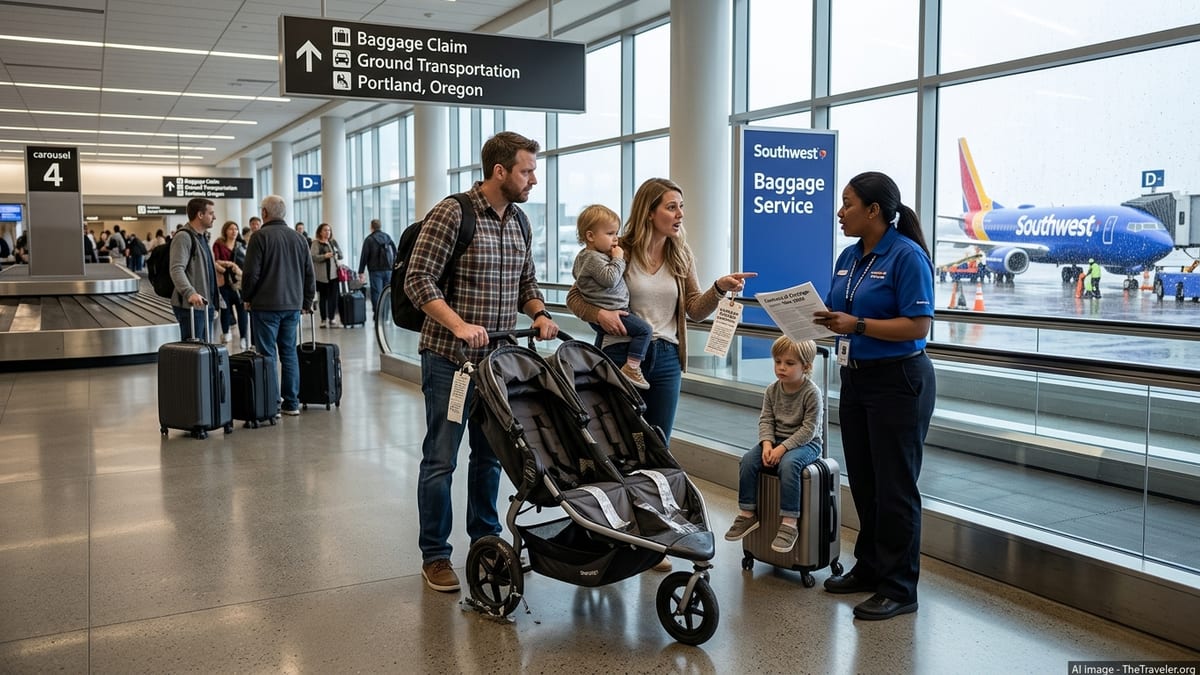
Viral stroller case raises questions over “limited liability” for families
On November 7, 2026, North Carolina traveler Jason Piquette flew with his family to Portland, Oregon, and says their double stroller was returned so badly damaged it could no longer be used safely. In TikTok videos that have since drawn millions of views, he alleges Southwest Airlines staff told his wife the carrier was not responsible for the damage and that its liability only applied if the stroller was completely lost.
Coverage by multiple outlets in mid November 2026 confirms that the incident involved a Southwest flight to Portland and that the family was initially denied compensation, with staff reportedly citing company rules that treat strollers differently from standard checked bags. Later reports indicate a Southwest representative based in Dallas contacted Piquette after the videos gained traction, though the terms of any resolution have not been independently disclosed.
While the case remains a single disputed incident, it has become a focal point for broader frustration among parents who discover only at the airport, or after damage occurs, that strollers and car seats may be carried under stricter “limited release of liability” conditions than other baggage.
What Southwest’s November 2026 Contract of Carriage actually promises
Just one day before the Portland flight, Southwest issued the 59th revised edition of its Contract of Carriage, dated November 6, 2026. The contract, which governs all tickets sold by the airline, confirms that Southwest is liable for loss, damage or delay of passenger baggage within limits set by the Montreal Convention and expressed in Special Drawing Rights. The latest version also codifies that excess, oversize or overweight baggage fees are to be refunded if a checked bag is lost or delayed by at least 15 hours after the flight’s arrival.
In practice, Southwest’s public-facing policies and its contract distinguish between ordinary baggage and items accepted only with “limited” or “conditional” liability. Strollers and child restraint systems are transported for free for each child but are explicitly subject to a limited release of liability, meaning Southwest routinely accepts them with the understanding that the customer assumes some or all risk of damage. The airline’s own guidance for families states that strollers and child restraint systems are transported only with limited release and that its primary obligation is for loss, not cosmetic or functional damage.
The new contract remains governed by Texas law and issued from Southwest’s Dallas headquarters, but it applies to all of the airline’s U.S. markets. There is no indication in the November 2026 revision that stroller or car-seat liability has been expanded; if anything, the Portland case is testing how the existing fine print is interpreted when serious damage leaves a family without essential gear during a trip.
Federal and state consumer protections: Texas within a wider U.S. framework
The stroller dispute is unfolding against a backdrop of closer coordination between the U.S. Department of Transportation and state attorneys general on airline consumer issues, including baggage mishandling. Under a partnership announced in 2024 and implemented through a series of memoranda of understanding, state attorneys general in participating states can investigate complaints, make preliminary determinations about potential violations of federal aviation consumer rules and fast-track referrals to DOT for enforcement review.
Texas is among the states whose attorney general can cooperate with DOT under this framework, but as of mid November 2026 there is no public indication that Texas has launched a Southwest-specific baggage-liability case tied to strollers or baby gear. Instead, the partnership gives Texas and other states a consistent route to raise patterns of complaints about baggage loss, delay or deceptive representations of liability, which DOT can then pursue using its own enforcement authority.
For now, the main impact of the Portland stroller case appears reputational rather than regulatory. It underscores that even when airlines comply with the letter of their contracts, parents may feel protections are inadequate when essential child equipment is rendered unusable, especially on trips where purchasing or borrowing a replacement is difficult or expensive.
What families checking strollers and car seats should know before flying
For travelers, the key issue is that the liability limits Southwest cites for ordinary checked baggage do not automatically extend to strollers and car seats. The airline’s policies and contract indicate that these items are typically carried subject to limited liability, which often means coverage for loss but not for damage arising from normal handling. At the same time, federal rules set overall ceilings for baggage claims and require airlines to honor their own written commitments, but they do not mandate full replacement of damaged baby gear in every case.
Parents planning trips with infants or toddlers should be prepared for this gap. Using padded travel bags, removing accessories or fragile attachments before checking, and, where feasible, bringing car seats into the cabin on a purchased or available extra seat can reduce the risk of damage. Travelers should also document the pre-flight condition of strollers and car seats with clear photos and keep boarding passes, bag tags and any incident reports in case they do file a claim.
Looking ahead, the combination of a high-visibility social media case and a freshly updated contract is likely to keep pressure on Southwest and other carriers to clarify how far their family baggage protections really go. Families with upcoming travel should review the latest version of the airline’s Contract of Carriage and its specific policies on strollers, car seats and other child equipment just before departure, since carrier rules and federal enforcement priorities can evolve without much advance publicity.