


Puri, on the Bay of Bengal in India’s Odisha state, is at once a major Hindu pilgrimage destination and a relaxed seaside town. Travelers come for the sacred Jagannath Temple, sweeping sandy beaches and easy day trips to Konark, Chilika Lake and artisan villages. This guide brings together the latest practical information on temple restrictions, festivals, accommodation options often highlighted on Booking.com and how to build a smooth, respectful Puri itinerary.
Get the latest updates straight to your inbox!
Why Puri Belongs on Your India Itinerary
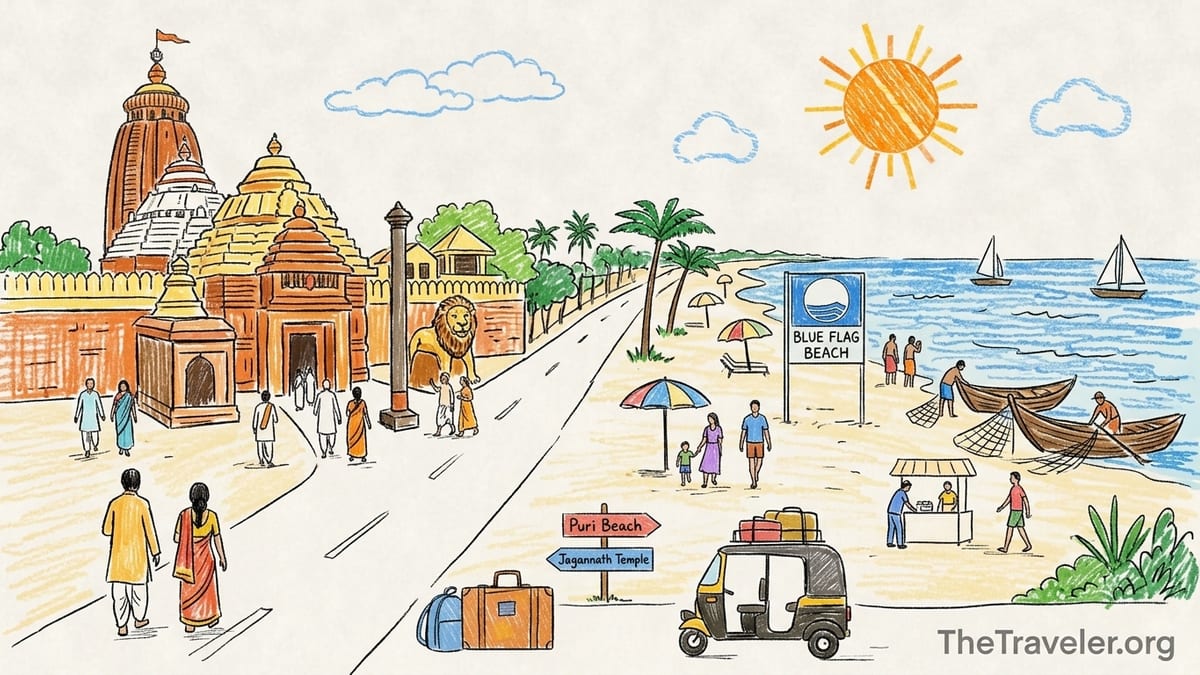
Puri is one of India’s four cardinal Char Dham pilgrimage sites, centred on the 12th century Jagannath Temple that draws millions of devotees annually. At the same time, the city stretches along a broad sandy coast where visitors stroll the promenade, watch fishermen mend nets and cool off in the evening sea breeze. That rare combination of intense spirituality and easygoing beach life makes Puri a natural stop for travelers heading through eastern India.
Located about 65 kilometers from Bhubaneswar, Puri is most often reached by train or road in around 1.5 to 2 hours. Many visitors base themselves in Puri for three or four nights to mix temple visits, sunrise walks on Golden Beach and day trips to the Konark Sun Temple or the vast lagoon of Chilika Lake. First-time visitors are often surprised by how compact the city feels: the traditional temple quarter, the beach strip and the railway station are all within a short auto-rickshaw ride.
Recent investment by the state government in heritage and beach infrastructure means that conditions for travelers have noticeably improved in the past few years. Golden Beach has earned prestigious Blue Flag certification for cleanliness and safety standards, and a new heritage corridor around the temple has created more organized entry and cloakroom facilities. For visitors, this translates into cleaner public spaces, better lighting and clearer security and dress rules you need to understand before you arrive.
Visiting Jagannath Temple: Entry Rules and Dress Code
The Jagannath Temple is the spiritual heart of Puri, but it is also one of India’s more regulated shrines. Entry to the main temple complex is currently restricted to Hindus; non-Hindu and foreign visitors are not allowed inside the sanctum precincts and usually pay respects from outside the Lion Gate or from nearby rooftops. Travelers who do not meet the entry criteria can still experience the atmosphere on the Grand Road outside, attend arati from a distance and explore related maths and smaller shrines that are open to all.
For those who can enter, dress and conduct rules are taken seriously. The temple administration has issued “decent attire” guidelines and reminds hotels and priests to brief visitors. In practice this means long trousers or dhoti with a shirt or kurta for men, and saris or salwar kameez for women, with shoulders and legs fully covered. Torn jeans, shorts, sleeveless tops and overly tight or revealing clothing are likely to be refused at the gate. In recent years guards have become stricter, so it is safer to err on the conservative side instead of testing the limits with Western casual wear.
Mobile phones, cameras and all electronic gadgets are banned inside the temple complex. Security staff screen bags before the main gate and visitors are expected to leave phones, smartwatches and large bags in a cloakroom or at designated deposit counters near the heritage corridor. Using your phone inside is not a minor issue: local guidance warns of confiscation and possible penalties, so plan your visit as if it were a complete “offline” experience. Carry only some cash, a small offering and any essential medication in a simple cloth bag.
The temple typically opens very early in the morning, often around 5 am, and remains accessible until late evening with short closures for key rituals. First-time visitors often choose a quiet morning darshan on a non-festival weekday, arriving before 8 am to avoid the heaviest lines and midday heat. If you want to partake of Mahaprasad, the temple’s famous cooked offering, local practice is to buy it from Anand Bazaar inside the complex or, if you cannot enter, to arrange it through a trusted local contact or hotel that works with temple cooks.
Temple Etiquette, Safety and Festival Crowds
Inside and around the Jagannath Temple, behavior is expected to match the sanctity of the site. Photography is strictly prohibited within the walls, and even outside it is wise to ask before photographing priests, security staff or individual pilgrims. Removing shoes before entry is mandatory, so consider carrying inexpensive sandals and light socks to handle the hot stone floor in the middle of the day. As in other major shrines across India, you may encounter touts or self-appointed “guides” offering fast-track darshan in exchange for donations; the safest practice is to politely refuse and place any offerings only in official temple donation boxes.
Women travelers should be aware that, while Puri is an important pilgrimage town, it is not immune to the issues found in other crowded Indian cities. Isolated reports of harassment around the temple approach streets and the beach promenade serve as a reminder to use the same precautions you would in other busy destinations: avoid walking alone in unlit alleys late at night, keep valuables secure and, when in doubt, move toward police kiosks or areas with families and larger groups. Many women report feeling comfortable visiting with relatives, friends or reputable tour guides, particularly during the evening.
Puri’s peak crowds arrive during major temple festivals, especially the Ratha Yatra when the deities are taken out on towering wooden chariots along the Grand Road toward Gundicha Temple. On the main chariot-pulling day, hundreds of thousands of devotees can pack into a few kilometers of street. Recent editions of the festival have seen tightened crowd control and broader media coverage following accidents and at least one fatal crowd surge. If you plan to attend, it is prudent to book accommodation months in advance, follow local advisories about restricted zones and consider viewing from a safe, elevated position rather than pushing into the densest crowds.
Other important observances include the Snana Yatra ritual bathing, the Anavasara period when the deities are considered unwell and out of public view and the Niladri Bije return journey after the chariot festival. Each has its own rhythm of crowds, partial temple closures and processions. Before timing your visit around any particular festival, ask your hotel to confirm the exact dates for that year and what it means in practice for darshan access, transport closures and security barricades along the Grand Road.
Beaches of Puri: Golden Beach, Blue Flag Zone and Swimming Safety
Puri’s coastline is one of its most visible attractions. The main stretch, often called Golden Beach, runs parallel to the marine drive and is free to access, with a broad promenade, simple snack stalls and views of the Bay of Bengal surf. At sunrise, you will see local fishermen bringing in their catch and pilgrims taking ritual dips; by late afternoon, families stroll, children ride small amusements, and vendors sell roasted corn and chai. The atmosphere is busy but convivial, especially on weekends and holidays.
Within this larger stretch lies a fenced “Blue Flag” section that has been certified for its high environmental and safety standards. Entry to this managed zone carries a modest fee that, according to recent state tourism roadmaps, is in the ballpark of a few dozen rupees per person for a timed session, with a higher rate for a full day. In return, visitors get cleaner sand, lifeguard presence, basic facilities such as changing rooms and showers, and more controlled crowd numbers than on the open beach. Many travelers find it worthwhile, particularly for families who want predictable restroom access and clearer swimming flags.
The Bay of Bengal can be rough, with powerful waves and strong currents during certain seasons. Red and yellow flags mark safer, monitored sections, but lifeguards regularly advise visitors not to venture too far out or to ignore warnings during high surf or cyclones. Even strong swimmers are better off staying in shallow water, especially outside the Blue Flag zone where supervision is patchier. Alcohol is not permitted on the beach and is best kept for licensed hotel bars rather than carried into public areas, where it may attract negative attention from police or local families.
The best time for long beach walks is usually from November to February, when humidity drops and evenings are pleasant. In peak summer from April to June, daytime heat can be extreme and sand temperatures high enough to burn bare feet, which is important to remember because you will be barefoot at the temple as well. During the monsoon months, frequent rains and occasional cyclonic storms can make the sea rougher and sometimes prompt temporary advisories or closures for swimming.
Where to Stay: Booking.com Highlights and Neighborhoods
Puri’s accommodation scene has expanded in step with rising tourism, with many properties now featured on Booking.com and similar platforms. These range from simple guesthouses near the temple to mid-range seafront hotels with pools and restaurants, and a smaller handful of higher-end resorts along the quieter stretches of the marine drive. When choosing, think about whether your priority is quick access to the Jagannath Temple or views of the sea and easy evening walks on the promenade.
Along the main beach road, you will find multiple mid-range hotels and lodges frequently highlighted to foreign travelers for their sea-facing rooms and on-site dining. Nightly rates for standard double rooms in this category often fall somewhere between the equivalent of 25 to 80 US dollars depending on the season, room category and how far in advance you book. Listings on major booking platforms allow you to filter for essentials such as air conditioning, Wi-Fi, in-house vegetarian restaurants and proximity to the beach or temple, which can help narrow down options in a busy marketplace.
Closer to the temple, narrow lanes are lined with dharmashalas and budget lodges catering mainly to pilgrims. These may not always appear on large international booking platforms, and many expect walk-in guests or telephone reservations. Facilities can be basic but functional: simple rooms, ceiling fans, shared or attached bathrooms and strict check-out times aligned with temple schedules. If you stay in this area, you will be able to walk to early morning darshan, but should also be prepared for loudspeakers, processions and heavier traffic at festival times.
Travelers who value quieter nights sometimes choose resorts and boutique properties a few kilometers down the marine drive toward Balighai or other outlying beaches. These may offer landscaped grounds, swimming pools and more spacious rooms, and they are often bookable online. The trade-off is a reliance on taxis or auto-rickshaws to reach the temple and main beachfront. Wherever you stay, read recent guest reviews carefully: they are often the best indicator of current cleanliness standards, security practices, generator backup during power cuts and staff willingness to help with temple visit logistics.
Konark Sun Temple and Other Essential Odisha Day Trips
One of the great advantages of basing yourself in Puri is the number of high-impact day trips within easy reach. Foremost among them is the Konark Sun Temple, a UNESCO World Heritage Site approximately 35 kilometers away along a scenic coastal road. The complex is managed by the Archaeological Survey of India, which maintains a structured ticketing system with a modest entry fee for Indian citizens and a higher but still reasonable rate for foreign visitors, payable via card or digital methods at the gate or through official platforms.
The Konark complex is famed for its 13th century stone chariot carved with intricate wheels, dancers and astronomical motifs. Much of the main temple is partially ruined, yet the sculptural detail remains remarkably vivid, making it one of India’s most photogenic ancient sites. Visiting earlier in the morning or late in the afternoon avoids the harshest light and heat, while guided tours available through licensed guides at the entrance or through reputable tour operators add valuable context. Modest dress is once again recommended, though rules here are less strict than at Jagannath Temple, and photography is allowed within reasonable bounds.
Another popular excursion from Puri is Chilika Lake, one of Asia’s largest brackish lagoons. Day trips typically involve driving about an hour to a jetty point such as Satapada, where local boat associations operate sightseeing cruises to watch dolphins, explore small islands or simply experience the watery expanse. Prices vary with boat size and duration, but visitors can expect to pay a flat rate for the entire vessel rather than per person. To avoid confusion or inflated quotes, it is sensible to ask your hotel to confirm approximate current tariffs and recommend a reliable operator before you go.
Cultural travelers should not miss Raghurajpur, a heritage crafts village roughly an hour from Puri that is renowned for its Pattachitra scroll paintings and traditional wooden toys. Here, families open their homes and workshops to visitors, and you can watch artists paint scenes from the Jagannath legends, the Ramayana and local folk stories. Supporting artisans by buying directly from them, even modestly, helps sustain traditions that are inseparable from Puri’s temple culture. It is courteous to ask permission before photographing artworks or artisans, and to carry cash in small denominations for purchases.
Planning Your Trip: Seasons, Transport and Practical Tips
When planning a Puri itinerary, timing is crucial. The most comfortable weather generally falls between November and February, with cooler nights and somewhat lower humidity. This is also a popular tourist window, so hotel prices rise and temple queues lengthen, especially around New Year and school holidays. March to early June brings intense heat; while it is still possible to visit, you should build in rest times, carry sun protection and plan temple visits for early morning or after sunset. The monsoon from June to September brings frequent showers and occasional storms that can disrupt transport and beach plans.
Puri is well connected by rail, with direct trains from cities such as Kolkata and Bhubaneswar, and by road along the highway from the state capital. Bhubaneswar’s airport provides the most convenient air link; from there, taxis and app-based cabs usually take one and a half to two hours to reach Puri depending on traffic. Within the city, auto-rickshaws and cycle rickshaws dominate short hops, while local buses and shared vehicles connect to Konark and nearby villages. For Konark and Chilika, many visitors prefer hiring a private car for the day through a trusted agency or their hotel, which offers flexibility in timing and stops.
Crowd and security measures around the Jagannath Temple and Grand Road change during major festivals and VIP visits, with vehicle access sometimes cut off several hundred meters from the main gate. On such days, be prepared to walk significant distances and allow extra time to reach darshan queues or return to your accommodation. Carry a physical card from your hotel with its name and address written clearly in English and Odia so that rickshaw drivers can bring you back even if your phone is deposited or runs out of battery.
Money exchange and ATMs are available across town, though smaller shrines, local eateries and auto drivers still expect cash payments. Many government-managed sites and larger hotels accept cards or Indian digital wallets. For food, Puri offers both standard North and South Indian dishes and regional Odia specialties, including temple-inspired vegetarian thalis and sweets such as khaja and chhena-based desserts. To minimize stomach troubles, choose busy, clean-looking restaurants, drink sealed bottled water and be cautious with raw salads and street drinks if you are not used to local conditions.
Respecting Local Culture While Enjoying the Coast
The most memorable Puri trips tend to balance reverence for local customs with time to simply enjoy the sea air. Around the temple, modest dress and quiet behavior are not just rules but gestures of respect for a living tradition that shapes daily life for thousands of residents. On the beach, swimwear norms are far more conservative than at Western resorts; most locals bathe fully clothed, and visitors are more comfortable in shorts and T-shirts than in brief swimsuits. Keeping alcohol out of public view, asking before photographing individuals and supporting local crafts and eateries all help ensure that your visit contributes positively to the community.
At the same time, Puri offers plenty of simple pleasures. Early mornings on Golden Beach with tea from a roadside stall, an afternoon drive through casuarina groves toward Konark, or watching artisans in Raghurajpur finish a delicate brushstroke all show sides of Odisha that many rushed itineraries miss. Because infrastructure is improving but still uneven, approach your trip with flexibility: a sudden religious procession might reroute your rickshaw, or a rain shower might delay a boat ride, but these unscripted moments often lead to conversations and encounters you will remember long after you leave.
Before you travel, check the latest advisories from official tourism and temple administration sources regarding dress codes, festival dates, entry restrictions and shore safety. Policies around phones, plastic use and crowd control have tightened in recent years and may be refined further. By arriving informed and attentive, you can navigate both the spiritual intensity of Jagannath’s city and the calming rhythm of its waves with confidence and respect.
In the end, Puri is less a checklist of sights than a layered experience of devotion, ritual, craft and coastline. Whether you come as a pilgrim, a culture seeker or a beach lover, a thoughtfully planned visit that honours both the temple and the sea will reveal why this corner of Odisha has drawn travelers for centuries.