


More news on this day
Travelers connecting through Doha are still experiencing delays, cancellations and longer routings on Qatar flights as the Gulf hub recovers unevenly from this year’s unprecedented Middle East airspace shutdown.
Get the latest news straight to your inbox!
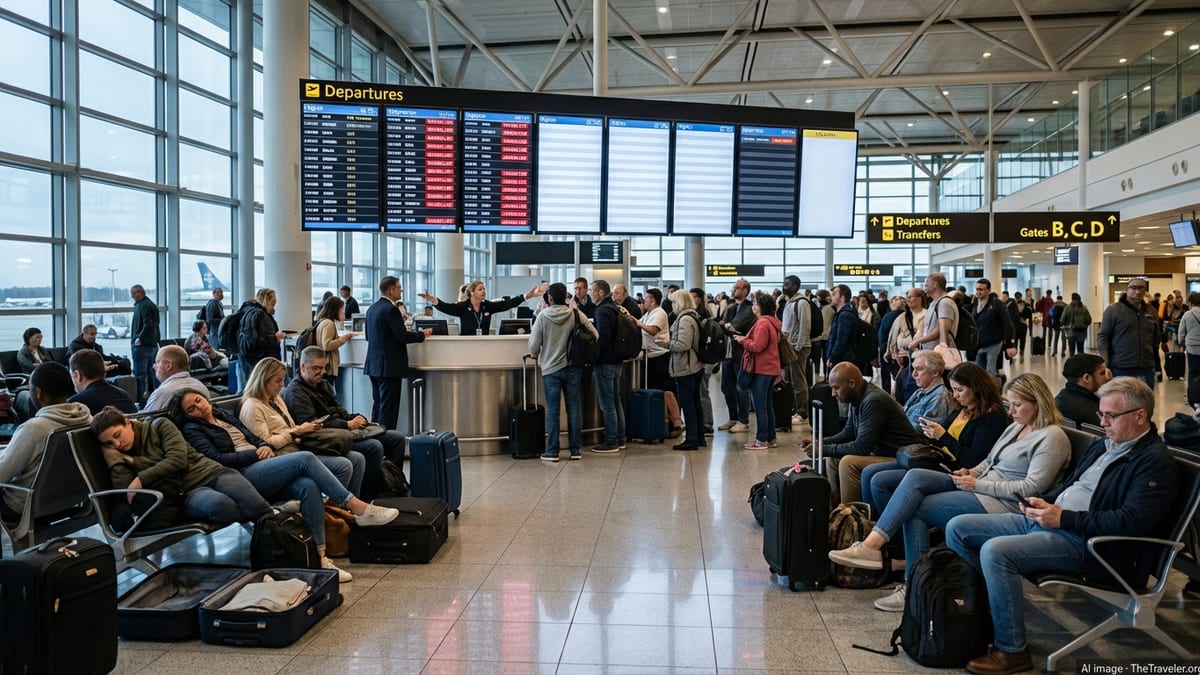
Regional Airspace Turmoil Reshapes Qatar’s Flight Network
Qatar’s flight delays in 2026 are rooted in a wider airspace crisis across the Middle East that began with large-scale military escalation at the end of February. Publicly available information shows that multiple states, including Qatar, temporarily closed all or part of their airspace to civil traffic, forcing airlines to cancel thousands of flights and reroute long-haul services around conflict zones.
Reports indicate that Qatar’s airspace closure on 28 February led to immediate disruption at Doha’s Hamad International Airport, with standard commercial flights suspended and only limited evacuation and cargo services allowed in the days that followed. Travelers in transit through Doha during that period described days-long delays, missed onward connections and difficulty rebooking as airline schedules were repeatedly redrawn.
By early March, the Qatar Civil Aviation Authority announced a partial reopening of air navigation on restricted contingency routes with capped capacity. While that move enabled more flights to operate, it did not restore the pre-crisis hub model. Many long-haul itineraries continued to face cancellations or lengthy detours as airlines navigated complex regional restrictions and shifting risk assessments.
Industry analysis of the wider Middle East region suggests that the closure and partial reopening of several neighboring flight information regions added hours to typical routings between Europe, Africa, Asia and the Americas. For Qatar-based operations built around fast, tightly timed connections, these extended routings translated into rolling delays and last-minute schedule changes through the spring.
Knock-on Delays at Hamad International as Operations Scale Back
Operational data and traveler accounts from March and April point to a Doha hub under pressure. Limited airspace corridors and altered flight paths compressed arrival and departure banks, leaving less margin to recover from everyday disruptions such as weather or ground handling issues. Even as more flights returned, passengers reported crowded transfer areas, longer queues and uncertainty over departure times.
Published coverage of the period highlights that Qatar Airways initially shifted to a skeleton schedule focused on repatriation and essential routes, with many transit passengers rebooked days later or rerouted via alternative gateways such as Dammam. Some travelers reported being sent back to their origin points when connections collapsed, underscoring how fragile the network became under tight airspace constraints.
As partial normality has returned, day-to-day performance at Hamad International appears mixed. Flight-tracking services show some Qatar Airways services operating with only minor delays, suggesting that specific city pairs and time windows are stabilizing. At the same time, reduced frequencies and continuing reroutes mean that missed connections can still cascade into long waits, especially for itineraries linking secondary cities.
The result for travelers is an uneven experience. Passengers on certain trunk routes may see near-normal operations, while others on more complex multi-leg journeys still confront significant schedule changes, overnight layovers and reduced options if something goes wrong en route.
Fleet Groundings and Planned Capacity Cuts Add to Disruptions
Beyond regional airspace restrictions, Qatar’s own fleet and capacity decisions are contributing to ongoing flight delays and cancellations. Aviation outlets report that Qatar Airways has temporarily grounded its Airbus A380 fleet through at least the end of May 2026, removing some of the highest-capacity aircraft used on flagship routes between Doha, Europe, Asia and North America.
At the same time, industry databases and specialized news coverage show that the airline is trimming overall capacity during the second quarter of 2026, in part to accommodate infrastructure works in Doha. These planned cuts, estimated at several percentage points compared with earlier schedules, reduce the buffer available to absorb disruption or to accommodate passengers from canceled flights.
Analysts following Gulf aviation note that these strategic choices come as Qatar Airways rebuilds from the initial shock of the airspace shutdown. The carrier is publicly targeting a network of more than 150 destinations by mid-2026, rising toward 160 by the peak summer season, which remains below its pre-crisis reach. Until that recovery is complete, fewer frequencies and smaller aircraft on some routes are likely to keep seats tight and rebooking options limited when delays occur.
For travelers, this means that even if their own flight operates on time, upstream cancellations or aircraft changes may still affect seat assignments, cabin availability and onward connections, particularly on popular transcontinental corridors where wide-body capacity has been reduced.
From Full Shutdown to Gradual Recovery for Qatar-bound Travelers
Public timelines compiled from airline advisories, aviation authorities and traveler forums outline a phased recovery for Qatar-bound flights. The most severe disruption coincided with the complete or near-complete closure of Qatari and neighboring airspace in late February and early March, when many passengers found themselves stranded in Doha or unable to reach the hub at all.
As limited corridors reopened and relief flights ramped up, airlines began operating selected services to move stranded travelers and restore critical connections. During this phase, reports indicate that Hamad International functioned more as an evacuation and cargo node than as a full-scale transfer hub, with heavily constrained schedules and stringent route planning.
By mid-March, more regular commercial flights were progressively restored, though often at reduced frequency and via longer routings that skirted sensitive airspace. Several accounts from travelers passing through Doha in April and May describe near-normal airport conditions and on-time operations, suggesting that for some passengers the disruption has become less visible even as the underlying network remains less flexible than before.
Despite this progress, international aviation bodies and industry analysts continue to characterize the regional environment as fragile, with the potential for renewed disruption if security conditions change or if additional restrictions are imposed on key corridors.
What Qatar-bound Passengers Should Expect in the Coming Weeks
Looking ahead to late May and early June 2026, publicly available schedules and capacity plans imply that Qatar flights will remain vulnerable to disruption, even as overall reliability improves. Ongoing infrastructure works in Doha, the absence of A380 capacity and lingering airspace constraints are likely to keep some long-haul itineraries longer and more delay-prone than in previous years.
Travel analysis platforms suggest that passengers connecting through Doha should continue to build in extra time for transfers, pay close attention to schedule changes and remain prepared for last-minute rerouting via alternative gateways if regional conditions shift again. Flexible tickets, longer layovers and careful monitoring of airline communications can help mitigate the impact of rolling delays.
At the same time, the gradual restoration of Qatar Airways’ global network means that more destinations are returning to the map, providing additional options compared with the immediate aftermath of the shutdown. As frequencies are added and routings are refined, the overall pattern of delays should ease, even if the risk of sudden disruption has not disappeared.
For now, Qatar remains a critical but still-recovering node in global aviation. Travelers planning to fly to, from or through Doha in the coming weeks are likely to encounter a system in transition, where improved on-time performance coexists with pockets of significant delay and an elevated need for flexibility.