


More news on this day
Severe storms tracking across the Mid-Atlantic have disrupted operations at Baltimore/Washington International Thurgood Marshall Airport and nearby hubs, triggering around 50 cancellations across Southwest, American and United networks and unleashing a new wave of travel chaos for passengers across the United States.
Get the latest news straight to your inbox!
Storm Cells Converge on a Critical Mid-Atlantic Gateway
Publicly available flight-tracking data for the Baltimore and Washington region on May 24 and May 25 indicates that a compact but intense band of storms moved through the Mid-Atlantic just as weekend travel volumes were climbing. Low clouds, reduced visibility and pockets of heavy rain in the Baltimore/Washington corridor prompted a series of flow-control measures, including brief ground delays that slowed the rate of departures and arrivals at Baltimore/Washington International (BWI) and, at times, nearby Washington Reagan National (DCA).
These measures had an immediate impact on a region that functions as a critical junction in several airline networks. BWI in particular handles a dense schedule of short- and medium-haul services for Southwest, American and United, linking major hubs such as Chicago, Atlanta, Orlando and Denver with East Coast and Midwestern markets. When even a small number of flights are unable to depart or arrive on time at such a node, the disruption can quickly propagate outward as crews and aircraft fail to reach their next scheduled legs.
Regional weather patterns this spring have already produced multiple days of widespread disruption across the eastern United States, with earlier storm systems prompting thousands of delays and hundreds of cancellations nationwide. The latest Mid-Atlantic outbreak is smaller in scale but has proved especially disruptive because it coincides with a busy late-May travel period when aircraft and crews are tightly scheduled and spare capacity is limited.
Operational summaries compiled by travel-industry outlets describe the current pattern as a familiar one: storms trigger a short, sharp reduction in airport capacity, airlines hold departures on the ground or divert arrivals, and the resulting backlog strains networks well beyond the immediate weather zone, extending the pain to travelers in unaffected cities hours or even days later.
Nearly 50 Flights Grounded Across Three Major Carriers
Based on tallies from real-time tracking dashboards and aggregated airport-status data, roughly 50 flights tied to Southwest, American and United were canceled in the most recent Baltimore/Washington disruption window, alongside a far larger number of extended delays. The cancellations are spread across multiple city pairs, but many involve routes connecting BWI with high-traffic leisure and connecting destinations including Orlando, Fort Lauderdale, Chicago, Dallas and Denver.
The mix of affected flights reflects how each airline uses the region. Southwest relies on BWI as one of its busiest East Coast gateways, with a dense pattern of point-to-point services that can quickly unravel when a morning bank is interrupted. United and American, which funnel passengers through nearby hubs such as Chicago O'Hare and Charlotte, are more exposed to knock-on effects when storms in the Mid-Atlantic intersect with weather or congestion elsewhere in their systems.
Reports compiled by flight-tracking providers show that on several BWI departures, posted departure times were repeatedly pushed back in small increments as dispatchers waited for updated weather windows and air-traffic flow slots. While some of those flights ultimately departed, others were scrubbed altogether once crew duty-time limits loomed or when it became clear that connections at downline hubs would no longer be viable.
Industry analyses of recent storm-related disruptions underscore how quickly a relatively modest number of cancellations can cascade through a tightly wound summer schedule. Aircraft that fail to reach BWI on time cannot operate subsequent legs, while crews who exceed regulated duty limits must be replaced. When this occurs simultaneously across several major carriers, even a figure such as 50 cancellations at one airport can translate into missed connections and overnight disruptions for thousands of travelers across the country.
Ripple Effects Felt From East Coast Hubs to Sun Destinations
As the storms moved through Maryland and northern Virginia, their impact extended far beyond the immediate Baltimore/Washington catchment area. Publicly available data for East Coast hubs such as New York, Boston and Charlotte indicates that some flights destined for or departing from BWI and DCA were slowed or rerouted to avoid the most active storm cells, adding airborne holding time and further complicating crew scheduling.
Travel-industry coverage notes particular strain on routes linking BWI with popular holiday destinations in Florida, the Caribbean and Mexico. Flights from Baltimore to Orlando, Fort Lauderdale and Miami have seen elevated delay rates across several recent weather events, reflecting both the popularity of these routes and their sensitivity to disruptions at intermediate hubs. Connections onward to Jamaica and Mexican resort gateways are also vulnerable when northbound flights from those countries face ground delays or diversions on approach to BWI.
Passengers traveling between smaller interior markets and the Northeast have not been spared. When regional jets or narrowbody aircraft are delayed leaving Baltimore or Washington, subsequent legs to secondary cities in the Midwest and Southeast often depart late or, in a subset of cases, are canceled outright. That pattern leaves some travelers stranded in intermediate hubs, where hotel capacity and rebooking options can quickly become constrained during peak periods.
Earlier episodes this spring showed how similar weather-driven snarls at BWI can coincide with systemwide volatility, including high winds around New York and convective storms in the Midwest. When several of these pressure points align on the same day, cancellations in the dozens at a single airport can contribute to nationwide disruption counts in the thousands, amplifying the sense of chaos for travelers monitoring their flights from home.
What Travelers Are Experiencing on the Ground
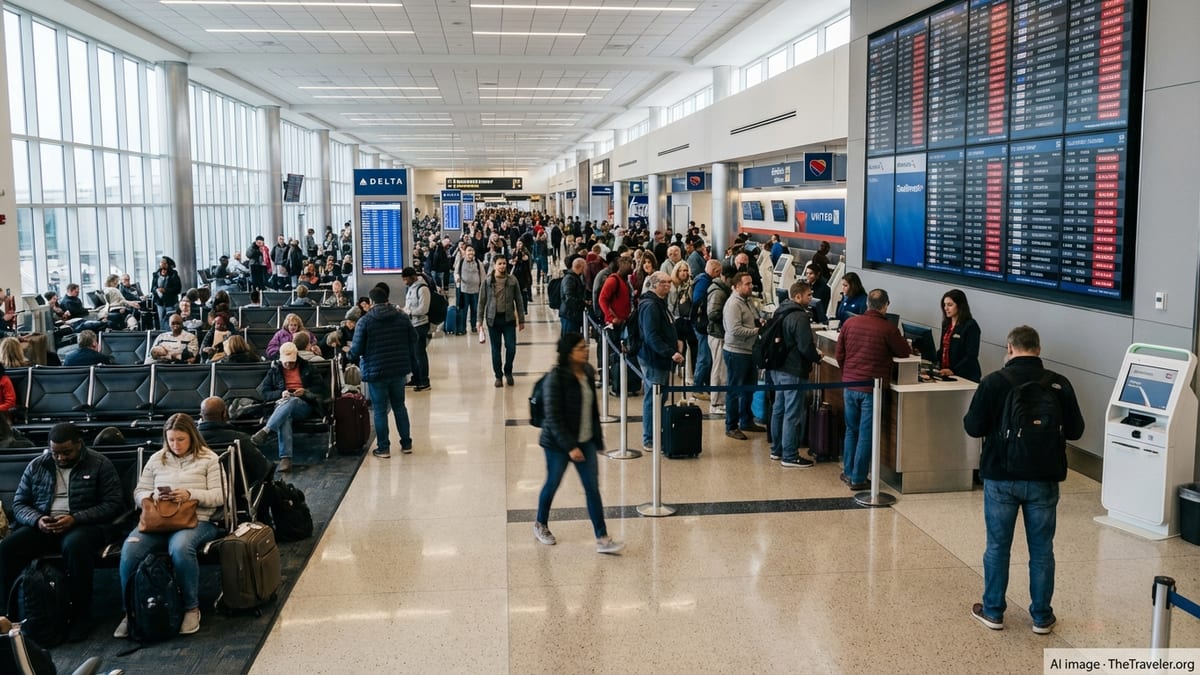
For passengers, the operational dynamics translate into long lines, shifting departure boards and a sense of uncertainty that can persist well after the worst of the weather has passed. Accounts shared on social platforms in recent weeks describe travelers at Baltimore and other East Coast airports waiting through multiple rolling delay notices on Southwest, American and United flights, only to see their trips canceled late in the day when crews timed out or aircraft could not be repositioned.
Some passengers report spending hours on board aircraft parked at gates or holding areas while dispatchers weigh takeoff opportunities against the risk of further ground stops at destination airports. Others describe racing between concourses as rebooked connections change yet again in response to evolving storm tracks and congestion levels. Even in cases where flights ultimately depart, boarding processes can be rushed and onboard services abbreviated as cabin crews work to limit further schedule slippage.
Airline apps and airport information displays sometimes lag behind rapid operational decisions, adding to confusion. Travel-advisory articles reviewing recent events at BWI recommend that passengers cross-check airline messages with independent flight-tracking tools and monitor overall airport delay indexes to understand whether they are facing a localized hold-up or part of a broader systemwide slowdown.
For those stranded overnight, lodging and meal arrangements have become a recurring stress point. While carriers typically highlight weather as a factor outside their direct control, consumer-rights groups argue that airlines still have scope to offer more consistent care and clearer communication about options when repeated storms coincide with tightly scheduled peak travel weekends.
Managing Future Trips as Storm Season Intensifies
With the US moving deeper into a season of convective storms and increasingly volatile weather patterns, analysts expect further bouts of disruption around mid-continent and East Coast hubs, including Baltimore/Washington. Historical data compiled by aviation and tourism outlets shows that late spring and early summer often bring clusters of thunderstorm-related delays, which can be especially disruptive on Friday evenings and Sunday afternoons when leisure and business travel peaks.
Travel-planning guidance emerging from recent disruption cycles encourages passengers to build extra time into connections involving BWI and other weather-sensitive hubs, particularly when flying on network carriers such as Southwest, American and United that rely on rapid aircraft and crew turns. Morning departures are often recommended, as they offer more recovery options later in the day if storms or operational constraints intervene.
Observers also highlight the value of flexible ticketing policies now common across major US airlines, which can allow travelers to shift flights away from predicted storm windows without additional change fees. During significant weather events, carriers frequently publish travel waivers that relax fare rules for affected dates and airports, giving passengers a chance to rebook before delays and cancellations peak.
While the latest round of Baltimore/Washington disruptions involves a relatively modest number of cancellations compared with some nationwide events earlier this year, the episode underscores how intensely interconnected the modern US air-travel system has become. A cluster of grounded flights at a single Mid-Atlantic airport can still send shockwaves through networks stretching from the West Coast to Caribbean beach destinations, leaving travelers across the map searching for alternative paths to their final destinations.