


More news on this day
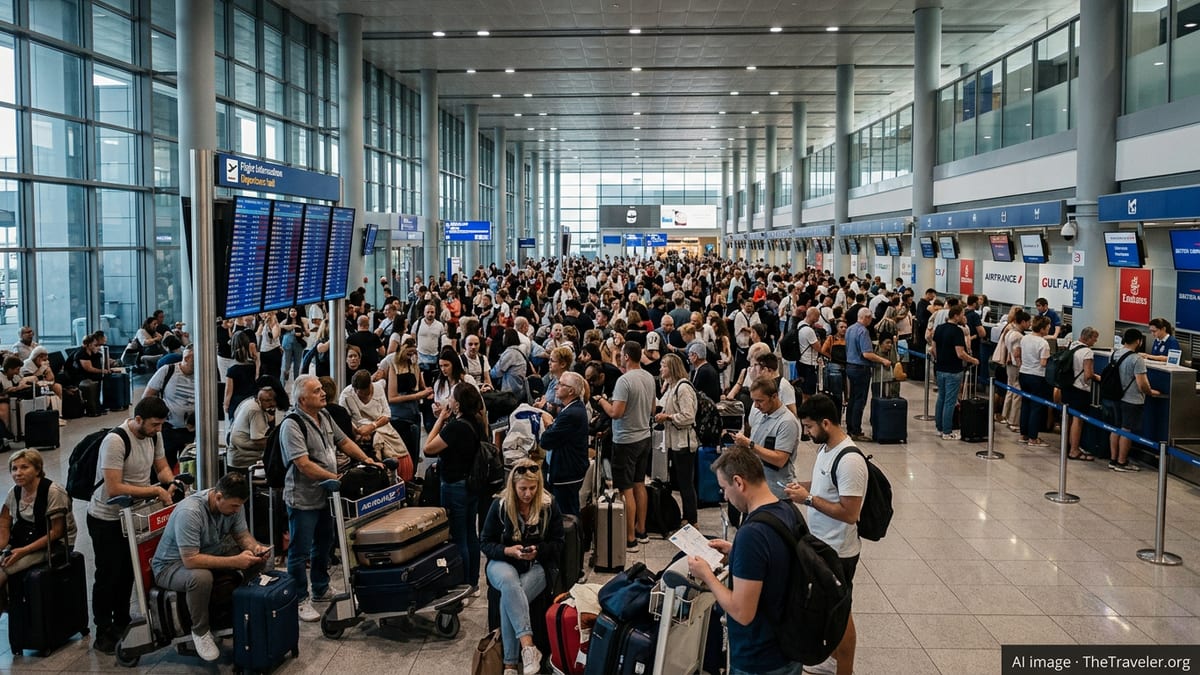
Passengers traveling through Athens International Airport on Thursday faced significant disruption, with flights delayed by up to two hours after a failure in one of the key approach radars serving the Greek capital.
Get the latest news straight to your inbox!
Approach radar outage disrupts peak-season traffic
According to Greek media reports, the problem emerged late on Wednesday night, June 25, when data from an approach radar site at Merenta, used by the Hellenic Civil Aviation Authority to manage traffic into Athens, was lost. The outage affected radar coverage for aircraft approaching Athens International Airport, known as Eleftherios Venizelos, at one of the busiest points of the early summer travel period.
The malfunction forced air traffic control to limit the number of incoming flights for safety reasons, reducing the arrival rate into the airport. While departures continued, the constrained flow of arrivals quickly created a bottleneck, leading to knock-on delays throughout Thursday morning.
Local coverage indicates that the technical teams were able to restore the affected radar shortly after mid-morning on Thursday, but by that time the backlog of aircraft and disrupted rotations meant delays were still being felt across multiple flights in and out of Athens.
Passengers reported on social platforms and to local outlets that aircraft were held at departure airports, put into holding patterns before landing, or kept at gates while new takeoff slots were arranged. Several short-haul services within Greece and to nearby European destinations were among those affected.
Delays of up to two hours on affected flights
Publicly available information from Greek news outlets describes delays of up to two hours on some services to and from Athens as the radar issue unfolded. Early-morning arrival waves on Thursday were particularly affected, since many overnight and first-wave flights were scheduled to land during the period when the approach capacity was restricted.
In practical terms, that meant some passengers arrived late into Athens and missed first-leg connections to islands or onward European hubs. Others saw morning departures pushed later into the day as aircraft arriving late from previous sectors struggled to return to schedule.
While many flights eventually operated, the rolling nature of the delays created uncertainty at terminals, with departure boards frequently updated and revised estimated times shifting throughout the morning. Travel advisories shared in local coverage recommended that passengers allow extra time at the airport and remain in close contact with their airlines for rebooking options where connections were at risk.
By Thursday afternoon, operations were gradually stabilizing, but residual delays and some aircraft rotations running out of sequence meant schedules remained fragile for the rest of the day.
Incident highlights strain on Greek air traffic systems
The radar malfunction comes in a year when Athens has already been under scrutiny for aviation system resilience. Earlier in 2026, reports from air traffic controller associations and European aviation monitoring bodies pointed to pressure on Greek airspace management, including episodes of technical disruption and capacity constraints affecting the wider flight network.
Recent traffic statistics from Athens International Airport show continued growth in both domestic and international flights compared with last year, reflecting the city’s status as a major gateway for Greek tourism. The combination of higher volumes and infrastructure issues has made the network more vulnerable to individual technical failures, such as the latest radar outage.
European aviation performance summaries for the current season also place Greece among the states contributing a notable share of air traffic flow management delays, largely due to capacity, staffing and weather factors. Against that backdrop, the temporary loss of an approach radar in Athens added a further layer of complexity to an already busy operating environment.
Industry observers note that while safety protocols require traffic to be slowed whenever there is any degradation in surveillance capability, such measures inevitably translate into longer waits for passengers and increased costs for airlines as aircraft and crews fall out of their planned rotations.
What travelers through Athens should expect next
With the immediate radar issue reported as resolved, the focus for travelers is on how quickly the airport and airlines can absorb the disruption and restore normal punctuality. For most passengers flying later on Thursday and into Friday, the primary impact is expected in the form of lingering knock-on delays rather than outright cancellations.
Travel industry analysts suggest that passengers with tight connections through Athens in the coming days should build in extra time where possible, particularly for itineraries involving separate tickets or transfers onto domestic island flights during peak morning and evening banks. Crowded terminals, longer-than-usual queues at check-in and security, and busy gates are all likely as the summer holiday period accelerates.
For airlines, the priority will be to realign aircraft and crew schedules, which can take several cycles even after a technical problem is fixed. Some carriers may opt to swap aircraft or consolidate lightly loaded services to recover reliability, especially on short-haul routes with multiple daily frequencies.
Despite the disruption, there have been no indications in publicly available reports of safety incidents linked to the radar failure. Standard contingency procedures for reduced surveillance environments allowed air traffic control to maintain safe separations between aircraft, albeit at the cost of longer waits and altered routings for many travelers.
Renewed debate over investment in radar and navigation infrastructure
The radar failure is likely to intensify ongoing debate in Greece about the state of air navigation and surveillance infrastructure. Previous episodes involving communications and radar systems have already prompted calls from aviation unions and industry groups for accelerated modernization of equipment and better redundancy in critical systems.
European network performance documents have highlighted how unplanned technical events at major hubs can ripple across the continent’s flight schedules, especially when they occur during peak travel periods. In that context, robust backup systems and rapid maintenance responses are increasingly viewed as essential to limiting disruption.
For a country whose economy is heavily reliant on tourism, reliable air connectivity through Athens plays a central role in maintaining visitor confidence. Analysts note that while occasional technical faults can occur in any aviation system, repeated high-profile incidents risk damaging perceptions of reliability unless they are followed by visible improvements and clear communication about corrective measures.
As the summer 2026 season progresses, attention is likely to remain on how effectively Athens and the wider Greek aviation network balance soaring passenger numbers with the operational resilience needed to keep delays from radar, communications or capacity problems from cascading into multi-day disruptions.