


More news on this day
A rare midwinter medical evacuation from Antarctica involving the United States and New Zealand is drawing fresh attention to the complex safety systems that protect scientists, support staff and growing numbers of polar travelers in one of the world’s most dangerous environments.
Get the latest news straight to your inbox!
A High-Risk Rescue in the Deep Polar Night
Recent reporting on a midwinter medical evacuation from the U.S. McMurdo Station has underscored how exceptional such flights remain. Public coverage describes an American patient being flown off the ice in severe cold and darkness so they could receive advanced treatment in New Zealand, a reminder that even with modern aircraft and navigation technology, winter operations over Antarctica are considered a last resort.
Accounts from New Zealand Defence Force updates and international news outlets describe Royal New Zealand Air Force Hercules crews flying thousands of kilometers from Christchurch to Antarctica and back, threading narrow weather windows and operating on ice runways at temperatures well below minus 40 degrees Celsius. These missions are generally approved only when a condition is assessed as life threatening, since any mechanical issue or rapid weather change so far south can limit options for diversion or rescue.
Coverage of the most recent midwinter evacuation and several earlier cases indicates that the United States typically requests assistance through existing logistics channels, while New Zealand provides aircraft, crews and primary reception hospitals. Australia and other Antarctic programs have also mounted rare winter flights over the years, but the Ross Sea sector around McMurdo is most often supported from Christchurch, which serves as a key “gateway city” for both countries’ Antarctic operations.
These high-profile rescues are rare in the broader context of Antarctic activity, yet they shape public perceptions of polar travel and highlight how much planning goes into preventing emergencies from occurring in the first place.
United States and New Zealand: Longstanding Antarctic Partners
The United States Antarctic Program and New Zealand’s Operation Antarctica operate on parallel but closely linked tracks. Public briefings and official documents describe how U.S. research stations in the Ross Sea region rely on New Zealand for airfield access, port facilities in Christchurch and Lyttelton, and significant military airlift support. In return, New Zealand benefits from logistics sharing, scientific collaboration and long-term investment in polar infrastructure that serves multiple nations.
New Zealand Defence Force summaries characterize their contribution as part of a “joint logistics pool” that supports Antarctica New Zealand, the U.S. program and other partners. That pool covers everything from cargo flights and fuel delivery to search and rescue and aeromedical evacuation. When a serious medical case arises on the U.S. side of the ice, existing agreements and procedures allow New Zealand aircraft to be tasked quickly to carry a patient to Christchurch, where major hospitals can provide specialized care.
Publicly available participant guides for the U.S. program describe a layered medical system on station, including telemedicine links, winterover physicians and staged treatment protocols. The aim is to stabilize patients on the ice whenever possible and avoid risky flights during the darkest, coldest months. Only when medical experts judge that a patient’s outcome would likely worsen without evacuation does the discussion move toward a midwinter mission.
Antarctica New Zealand’s annual reporting highlights these rescues as examples of international cooperation under the Antarctic Treaty System. They show how safety is treated as a shared responsibility, extending beyond national programs to encompass all personnel, whether they are scientists, construction workers or visiting technical specialists.
Beyond Two Nations: A Global Safety Web at the Poles
Although the most recent evacuation centered on United States and New Zealand assets, a wider network of countries quietly underpins safety for polar travel. Published information from Antarctic operators shows that Australia, Chile, Argentina, South Africa and European nations all maintain airfields, ports and emergency-response capabilities that can support international missions in their respective sectors of the continent.
In the North, Arctic states including Canada, Norway, Russia, Greenland via Denmark, and the United States coordinate maritime and aeronautical search and rescue zones under separate agreements. Those arrangements are becoming more visible as expedition cruises, adventure tourism and scientific activity increase across the polar regions. Cruise operators typically rely on national coast guards or air forces for major search and rescue interventions, while maintaining onboard medical teams and contingency plans.
International reporting on polar operations points out that collaborative drills, shared weather forecasting and harmonized safety standards are central to these systems. For Antarctica, the Antarctic Treaty and the related search and rescue framework encourage countries to assist one another when emergencies occur, whether that means diverting an icebreaker to help a foreign research vessel or making aircraft, medevac specialists and hospital beds available at short notice.
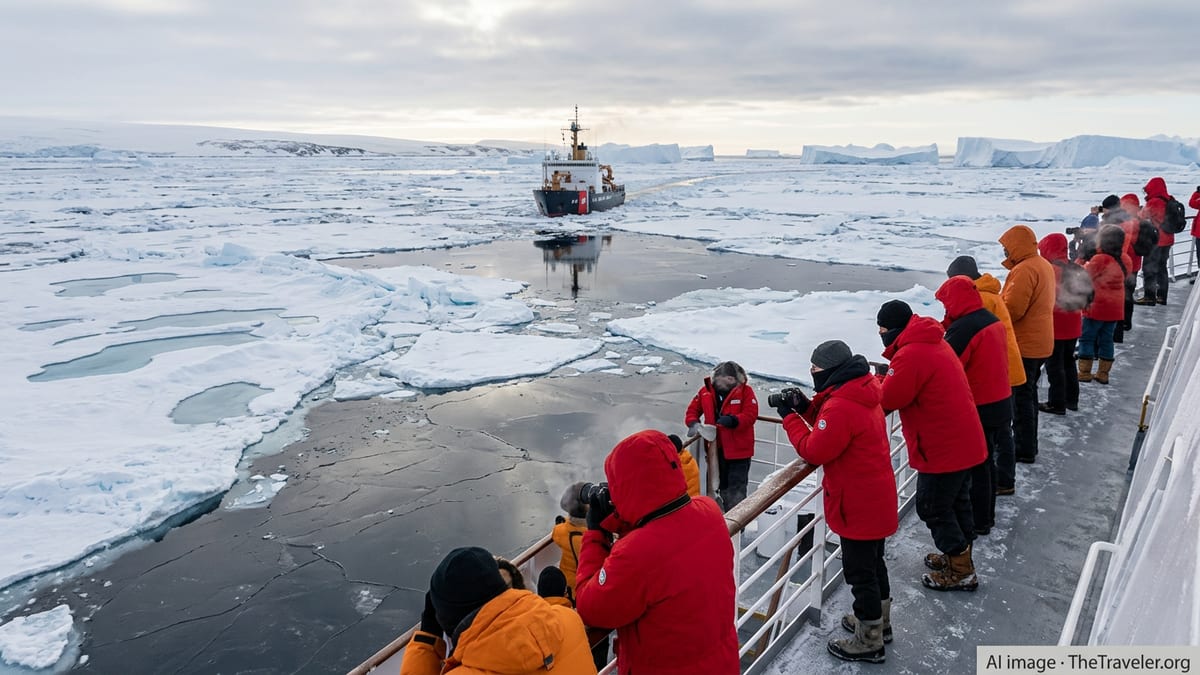
This interconnected approach has direct implications for travelers. Commercial polar cruises and organized expeditions are expected to meet strict safety benchmarks, but their ultimate safety net often depends on the willingness and capacity of multiple nations to cooperate when something goes wrong far from any permanent settlement.
What Polar Travelers Need to Know About Medical and Evacuation Risks
For the growing number of people considering a trip to the polar regions, recent Antarctic medevac coverage offers a stark reminder that help may be distant, delayed and dependent on volatile conditions. Public deployment guides for the U.S. Antarctic Program stress that evacuation from remote sites can take many hours or even days, and may be impossible for extended periods during winter storms or darkness.
Travel medicine experts and polar operators generally advise that anyone heading south or north should undergo a thorough medical screening and disclose all preexisting conditions. While research programs follow their own stringent medical clearance processes, commercial cruise passengers and private expedition members are typically urged to carry comprehensive travel insurance that explicitly covers emergency evacuation from polar regions, which can involve chartered aircraft, ice-capable ships and extended hospital stays.
Published information from national Antarctic programs notes that aircraft used in medevac roles must contend with limited navigation aids, extreme cold affecting hydraulics and fuel systems, and the possibility of having to turn back if weather deteriorates at the destination. Travelers should understand that, in some scenarios, onboard treatment and careful monitoring could be the only practicable option until conditions improve.
These complexities help explain why itineraries may be altered at short notice and why operators emphasize flexibility. Routes can be shifted, landings canceled and voyages shortened if local authorities, coast guards or station managers assess that medical and rescue cover is temporarily degraded.
Raising the Bar on Polar Safety as Interest Grows
The spotlight created by rare midwinter rescues is feeding into a broader reassessment of how to keep polar travel sustainable and safe as demand rises. Reports from Antarctic and Arctic governance bodies indicate that regulators and operators are increasingly focused on vessel standards, ice navigation training, onboard medical capability and coordination with national rescue services.
In Antarctica, this discussion intersects with environmental rules that limit where ships can go, how waste is managed and what kinds of fuel they can burn. Safety experts argue that strict environmental protections can also enhance safety by reducing the risk of fuel spills, fires and other incidents that complicate emergency response in fragile ecosystems.
For travelers, the trend points toward more transparency about contingency planning, including how an operator would respond to serious illness or injury far from help. Prospective visitors are being encouraged to ask detailed questions about medical facilities on board, communications with shore, and the practical realities of evacuation in ice-covered waters or from remote airstrips like Antarctica’s snow and ice runways.
As the United States, New Zealand and other countries refine their joint procedures in the wake of each challenging mission, the lessons learned are filtering into industry standards and traveler guidance. The midwinter flights that capture headlines are only the visible tip of a much larger effort to ensure that the world’s most remote destinations remain accessible, but not at the expense of human life or polar environments.