


More news on this day
Renfe is ramping up its summer offering with more than 21.6 million train seats on sale across Spain and select international routes, highlighting the central role of rail in the country’s peak holiday travel season.
Get the latest news straight to your inbox!
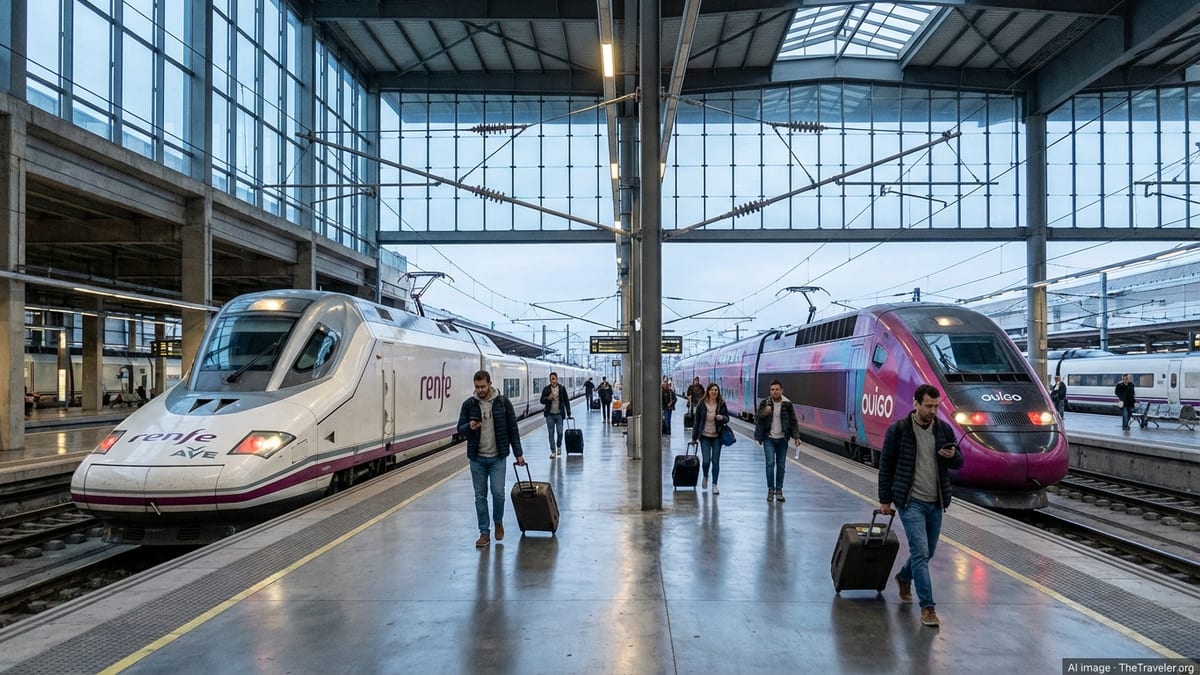
Massive capacity boost across Renfe’s network
Publicly available information from Renfe’s latest summer campaign shows that the operator is putting over 21.6 million seats on the market between late June and mid-September. The offer covers all major service types, including AVE, Avlo, Alvia, Euromed, Intercity, Avant, Media Distancia and international high speed. The scale of the deployment is designed to absorb a seasonal jump in demand as domestic and inbound tourism rise.
Within that total, more than 8.9 million seats are being allocated to high speed and long distance commercial services. Reports indicate that this represents an increase of over 100,000 seats compared with the previous summer, reflecting both higher passenger numbers and the gradual incorporation of new high capacity rolling stock on key corridors.
On public service routes, Renfe’s plans point to around 12.8 million seats on Avant and conventional Media Distancia trains that knit together smaller cities and regional hubs. These services, together with Cercanías and Rodalies commuter networks, are positioned as the backbone of everyday mobility while also absorbing leisure and family travel during the holiday period.
The coordinated capacity boost illustrates how the Spanish rail network is being managed as a single system, with commercial and public service segments adjusted in tandem to cope with peak season flows.
High speed focus on coastal and northern destinations
The largest summer increases are concentrated on high speed routes linking Madrid with Spain’s most in-demand holiday regions. Information from Renfe’s seasonal plan highlights particularly strong capacity on services to the Valencian Community, the northern Atlantic coast and Andalucía, as well as to key cities in Catalonia.
On the southern corridor, Málaga and Seville stand out with roughly 635,000 and 552,000 seats respectively on high speed services over the summer window. These cities combine strong tourism draws with sizeable resident populations, creating dense flows that support frequent AVE and Avlo operations.
To the east, the Madrid Alicante corridor is scheduled to offer more than 410,000 seats, underlining the Costa Blanca’s continued popularity with both domestic and foreign visitors. On the Atlantic side, capacity to A Coruña is reported at close to 382,000 seats, helped by the deployment of the latest high capacity trainsets that are being used to reinforce long distance services to Galicia and other northern destinations.
Industry coverage notes that Renfe has been using its newest high speed rolling stock to stretch capacity on long haul routes where highway or air alternatives are less convenient, a strategy that aligns with the company’s efforts to shift more long distance travel onto rail.
Regional and Avant services underpin territorial cohesion
Beyond headline high speed figures, a significant portion of the 21.6 million seats is assigned to regional and mid distance routes that play a crucial role in territorial cohesion. Renfe’s summer timetable provides nearly 12.8 million seats on Media Distancia and Avant services during the holiday period, in addition to dense commuter operations.
Reports on the summer plan highlight an increase in seats on Avant services in particular, with more than 3 million seats aimed at frequent intercity trips of up to a few hundred kilometres. These trains cater to both regular commuters and occasional travelers who rely on rail for family visits, weekend getaways and access to coastal or cultural destinations.
Among the most in-demand Media Distancia and Avant routes are Madrid Segovia Valladolid, Madrid Toledo and Madrid Puertollano. These corridors combine commuting patterns with leisure peaks, which intensify in July and August as residents leave major cities for shorter regional trips.
Observers note that by strengthening these intermediate services alongside flagship AVE lines, Renfe is seeking to balance its public service obligations with commercial objectives, while maintaining rail’s role as a nationwide connector during the busiest travel months.
Youth discounts and loyalty schemes drive summer demand
The decision to release more than 21.6 million summer seats also builds on a multi year trend of higher rail patronage, accelerated by targeted discounts for younger travelers. According to government and company data, recent editions of the Verano Joven program have led to strong uptake among passengers aged 18 to 30, with several million discounted tickets issued in past summers.
Published coverage of the latest initiatives indicates that the current season again includes substantial rebates on high speed, long distance and regional services for eligible young residents. These discounts, combined with Renfe’s own Más Renfe and Más Renfe Joven loyalty schemes, are designed to encourage repeat travel and position rail as the default option for domestic summer trips.
In earlier editions of Verano Joven, Renfe has reported year on year growth in the number of discounted tickets sold, with double digit percentage increases compared with prior years. Analysts see this as evidence that price sensitive younger travelers are increasingly choosing trains over private cars or short haul flights when attractive fares are available.
By aligning expanded capacity with discount programs, Renfe aims to fill the additional seats while further normalizing rail as a flexible, affordable mode for last minute city breaks, festival travel and long weekends at the coast.
Rail positioned as a key pillar of sustainable summer travel
The summer capacity push comes against a backdrop of record passenger numbers for Renfe in recent years, alongside growing policy emphasis on shifting travel to lower emission modes. Company documentation notes that the daily operation of Renfe’s passenger and freight trains avoids millions of tonnes of carbon dioxide emissions annually compared with equivalent road and air journeys.
Transport analysts point out that the combination of dense high speed services between major cities and an extensive regional network gives Spain one of Europe’s most comprehensive rail offerings. The decision to add more than 21.6 million seats for the summer period reinforces that positioning, especially as travelers increasingly weigh environmental considerations when choosing how to move around the country.
For visitors and residents alike, the enlarged timetable and seat offer translate into more departure options, better chances of finding lower fares and greater flexibility when planning trips at short notice. Travel industry observers suggest that this may also help ease pressure on overburdened road corridors and domestic air routes during peak holiday weekends.
As the summer season unfolds, the extent to which the expanded capacity is absorbed by demand will provide a useful indicator of how far Spain’s rail renaissance can go. For now, the decision to put more than 21.6 million train seats on sale underlines Renfe’s commitment to capturing a larger share of the country’s busiest travel months.