


More news on this day
A river cruise passenger ship has run aground on a shallow section of the Rhine, after an early summer heatwave and weeks of scant rainfall pushed water levels to new seasonal lows along one of Europe’s busiest waterways.
Get the latest news straight to your inbox!
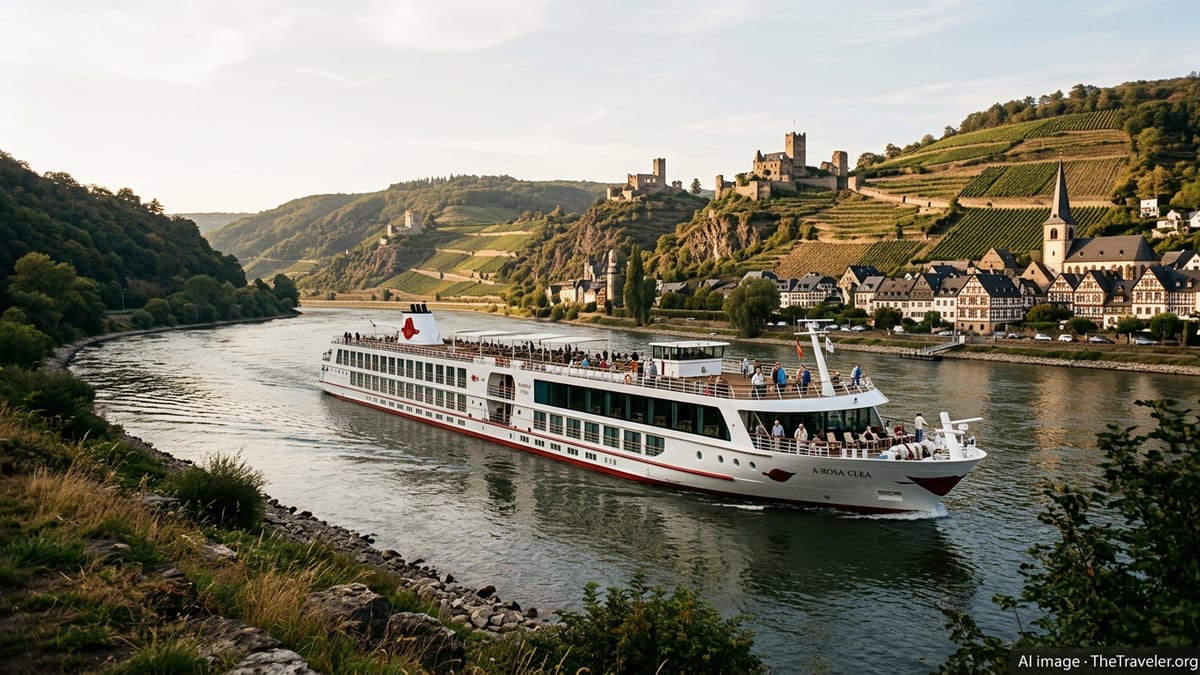
Grounding highlights mounting strain on iconic waterway
Initial reports from German and regional European media describe the incident as a grounding of a multi‑deck river cruise vessel near Cologne, where an especially shallow stretch of the Rhine has become increasingly difficult to navigate during this year’s dry spell. Coverage indicates that the ship, carrying holidaymakers along a popular itinerary, became stuck when the riverbed rose close to the hull, leaving the vessel unable to maneuver clear without assistance.
According to published coverage, no serious injuries have been reported among passengers or crew, and there were no immediate signs of pollution or hull breach. Local responders and river management agencies were cited as monitoring the situation while tug support and river pilots assessed options to refloat the vessel once conditions permit.
Early indications suggest that the ship may have to wait for either a modest rise in water levels or a carefully controlled towing operation before it can resume its journey. In the meantime, passengers have faced delays and itinerary changes, with some likely to be moved onward by coach while operators reorganize schedules.
The grounding has drawn fresh attention to the vulnerability of European river cruising to climate‑driven swings in water levels. Travel observers note that recent seasons on the Rhine and Danube have already seen a growing number of route alterations, ship swaps, and partial closures driven by both low and high water events.
Heatwave and scant rainfall push Rhine gauges lower
The incident comes amid an early summer heatwave sweeping parts of western and central Europe. Publicly available hydrological data and logistics industry updates show that water levels along key Rhine gauges, including Kaub and Duisburg‑Ruhrort, have been drifting downward in June after a brief period of relief from spring rains. Forecasts from German federal agencies and river research institutes point to continued low or falling levels if the current pattern of high temperatures and limited rainfall persists.
Trade and energy publications in recent days have described how shrinking river depth is already affecting barge traffic, with fuel and commodity shipments forced to sail with sharply reduced loads. In some stretches, shippers have introduced low‑water surcharges and warned customers about potential delays, signaling that the navigational margin for larger vessels is narrowing.
For passenger ships, the operational threshold is different from heavy cargo barges, but the underlying challenge is similar. Shallow sandbars and rocky outcrops that are normally submerged can become hazards when river stages drop below certain reference points. Navigation channels are maintained and dredged, yet prolonged low water can expose sections that pilots usually cross with comfortable clearance.
Hydrologists and climate researchers have pointed out that the Rhine, like many European rivers, is increasingly experiencing more frequent and pronounced low‑water episodes linked to warmer, drier periods. While year‑to‑year conditions still vary, the trend has prompted river authorities to expand monitoring and early‑warning systems and has pushed shipping companies to refine contingency plans.
Disruption for river cruise season and local tourism
The grounding near Cologne coincides with the peak start of the summer river cruise season, when ships carrying international travelers typically ply the Rhine between the Netherlands, Germany, France, and Switzerland. Tour operators promote the route for its castles, vineyards, and historic cities, making any high‑profile disruption especially visible to the travel market.
Travel industry reports suggest that operators have already been adjusting itineraries in response to low water, in some cases reversing directions, shortening legs, or substituting coach transfers for stretches of river that have become unreliable. The latest incident is likely to intensify scrutiny from travelers who are weighing bookings for late summer and autumn departures.
Local tourism businesses along the affected stretch, including hotels, restaurants, and excursion providers, may see short‑term impacts if river traffic is interrupted or if ships are forced to dock further from city centers. However, previous seasons have shown that many visitors ultimately complete their trips, albeit with modified routes, and that operators often emphasize flexibility in managing changing conditions.
Insurers and analysts observing the sector note that repeated low‑water seasons can increase costs for river cruise lines, from higher fuel consumption when vessels must detour or reposition, to additional logistics expenses for buses and alternative accommodations. At the same time, strong underlying demand for European river travel has so far encouraged companies to maintain or even expand their fleets.
Freight arteries and regional supply chains under pressure
The Rhine is not only a scenic corridor for travelers but also a core freight artery linking industrial regions of Switzerland, France, Germany, Belgium, and the Netherlands with North Sea ports. Commodity markets and trade publications have been tracking low‑water developments closely, as past episodes have disrupted deliveries of coal, oil products, chemicals, and agricultural goods and driven up transport costs.
Recent logistics updates describe barges on some Rhine sections sailing at a fraction of their usual capacity because draught restrictions limit how deeply they can sit in the water. When river depth falls too far, barges must either carry less cargo, combine shipments, or shift loads to rail and road. These adjustments can lengthen transit times and add costs that eventually ripple through supply chains.
Regulators and river commissions have highlighted in public reports that maintaining safety under such conditions is paramount. Measures range from tightened navigational rules in critical reaches to temporary restrictions on certain vessel sizes when levels cross predefined thresholds. The grounding of a passenger vessel, while primarily a tourism story, underscores how razor‑thin the operational margin has become for many types of traffic during dry spells.
While freight operators are generally more accustomed to planning around low‑water risk, episodes of extreme shallowness can still catch supply chains off guard, particularly when they overlap with spikes in energy demand or other market stressors. Analysts caution that if the current heatwave extends into July without substantial rainfall, the economic implications could intensify.
Rising climate risk reshapes river travel planning
For travelers, the Rhine passenger ship grounding is another reminder that river cruises are increasingly subject to climate‑related variability. In recent years, trip‑planning advice from travel media and specialist agencies has started to emphasize the importance of flexible itineraries, robust travel insurance, and an understanding that route changes due to high or low water are no longer rare exceptions.
River cruise companies have responded with a range of strategies, according to industry coverage. Some lines deploy slightly smaller or shallower‑draft ships on vulnerable stretches, while others build in additional slack to schedules to accommodate slower speeds or detours. Several operators have refined ship‑swap procedures, allowing passengers to transfer between sister vessels when one section of the river becomes impassable, in order to preserve as much of the planned route as possible.
Infrastructure planners and policymakers along the Rhine corridor are also weighing long‑term adaptations. Ideas discussed in public forums include targeted dredging of critical bottlenecks, improved retention of winter and spring precipitation in upstream catchments, and enhanced cross‑border coordination of water management. Each option carries financial, environmental, and political trade‑offs that continue to be debated.
As the stranded passenger vessel awaits refloating and the heatwave continues, attention is turning to how resilient Rhine travel and trade can remain in the face of more frequent extremes. The episode serves as a vivid illustration for tourists and industry alike that Europe’s storied rivers are operating under new and shifting constraints.