


More news on this day
Thousands of travelers across Asia faced extended waits and missed connections after a fresh wave of airline disruption led to 7,947 delayed flights and 302 cancellations centered on Bangkok and other major regional hubs, according to multiple operational tracking reports.
Get the latest news straight to your inbox!
Bangkok at the Heart of Regional Turbulence
Bangkok’s Suvarnabhumi and Don Mueang airports emerged as focal points of disruption, with ripple effects spreading across some of Asia’s busiest corridors. Publicly available airport and airline operations dashboards showed departure boards dominated by late departures and rolling gate changes, affecting both regional low cost carriers and full service airlines.
Reports indicate that a significant share of the 7,947 delays involved short haul routes linking Bangkok with other Southeast Asian cities, including Singapore, Kuala Lumpur, Hanoi, and Manila. These sectors typically run at dense frequencies, so cascading delays on a handful of morning rotations quickly multiplied across afternoon and evening schedules.
Travelers transiting through Bangkok on long haul itineraries were particularly exposed. Missed onward connections to Europe, the Middle East, and Australia triggered rebookings onto already crowded services, extending the impact to airports such as Dubai, Doha, London, and Sydney as carriers worked to accommodate displaced passengers.
Operational statistics from recent months already show Thai airports running at close to or above pre pandemic traffic levels, and observers note that such heavy utilization leaves little buffer when a disruption day of this scale hits the system.
Knock on Effects Across Major Asian Hubs
While Bangkok recorded the sharpest concentration of problems, the wave of disruption spread quickly to other major Asian gateways. Published coverage and live flight tracking data pointed to delays and cancellations mounting at Singapore Changi, Kuala Lumpur International, Tokyo’s airports, Hong Kong International, and key airports in India.
Once Bangkok departures slipped out of sequence, aircraft and crews scheduled to operate onward legs into neighboring countries arrived late or out of position. That imbalance pushed airlines to cancel selected rotations to reset their timetables, contributing to the total of 302 cancellations recorded across the region.
Regional aviation analysts note that point to point and hub operations in Asia are highly interdependent. A delay on an early morning Bangkok to Singapore sector, for example, can jeopardize an onward midday service from Singapore to Jakarta or Manila if the aircraft and crew cannot be turned around in time. On a day when hundreds of such small disruptions coincide, the cumulative effect is a sharp spike in system wide delay indicators.
Several carriers also operate tightly timed “banked” schedules at their hubs, where arrivals and departures are clustered within narrow time windows. When those windows are disrupted by late inbound aircraft from Bangkok and other affected airports, airlines face difficult choices between holding connections and protecting on time departures, often resulting in further knock on delays.
Weather, Congestion and Operational Strain Blamed
According to operational summaries released by airport operators and route monitoring platforms, a combination of adverse weather, constrained airspace, and staffing pressures contributed to the spike in delays and cancellations. Thunderstorms and heavy rain were reported near Bangkok and other parts of mainland Southeast Asia, periodically reducing runway capacity and forcing holding patterns for arriving aircraft.
Air traffic flow restrictions imposed to maintain safety under those conditions lengthened arrival and departure queues. With many carriers already scheduling aircraft close to maximum daily utilization during the busy travel period, there was limited slack to absorb the resulting delays.
Public data on flight performance across Asia in recent years already highlights the sensitivity of operations to relatively small shifts in capacity, whether generated by weather, technical issues, or staffing gaps in ground handling and air traffic control. On the latest disruption day, those factors appeared to align, pushing on time performance sharply lower and driving the unusually high one day totals of 7,947 delays and 302 cancellations.
Airlines have also been contending with network complexity as they restore and expand routes that were reduced during the pandemic years. Industry observers suggest that such rapid scaling can expose weak points in crew rostering, maintenance planning, and spare aircraft availability, all of which become visible when stress tests like this disruption event occur.
Stranded Passengers Face Long Queues and Limited Options
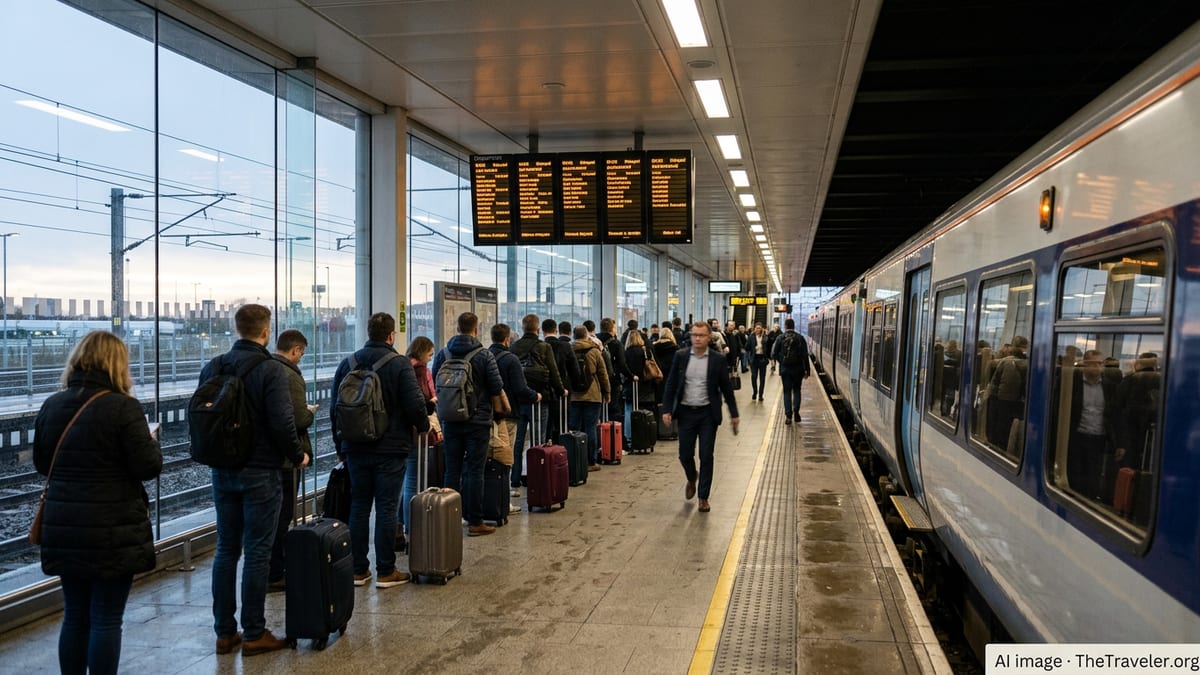
Scenes shared through social media and traveler forums showed long lines at airline service desks across Bangkok, as passengers sought rebookings, hotel vouchers, or confirmation of revised itineraries. Reports from multiple airports in the region described overnight crowds in terminal seating areas and transit zones as travelers waited for the next available seats.
With many flights operating near capacity during peak travel season, rebooking options were limited. Some travelers opted to route through secondary hubs or to accept multi stop itineraries involving extended layovers in order to reach their destinations within one or two days of their original plans.
Consumer advocates point out that disruption events of this magnitude often expose gaps in information and support. Passengers reported difficulty accessing accurate, real time updates through airline apps and call centers, leading many to rely on third party flight trackers and airport displays to monitor changes.
Travel specialists recommend that passengers caught in similar scenarios document their delay or cancellation, keep receipts for extra expenses such as meals and accommodation, and review the conditions of carriage and any travel insurance policies that may provide compensation or refunds.
What Travelers Should Do If Flying Through the Region
In the wake of the widespread disruption, aviation and travel experts are advising passengers with upcoming trips through Bangkok and other major Asian hubs to prepare for continued volatility, even as operations gradually normalize. Schedules often remain fragile for several days after a major disruption as airlines reposition aircraft and crews and work through backlogs.
Travel planners suggest allowing longer connection times, particularly when combining tickets on separate airlines or when onward flights involve long haul sectors. Where possible, booking through tickets on a single carrier or alliance can simplify rebooking options if earlier segments are delayed.
Passengers are also encouraged to monitor flight status closely in the 24 hours before departure and again on the day of travel. Checking both the airline’s own channels and the departure airport’s information screens can provide early warning of gate changes, equipment swaps, or schedule adjustments.
For those yet to purchase tickets, flexible fares and comprehensive travel insurance can add cost but may prove valuable when events of this scale occur. As Asia’s air traffic continues to rebound and intensify, industry observers expect periodic disruption days to remain a recurring challenge for airlines and travelers alike.