


Landing at Riyadh’s King Khalid International Airport and heading straight to Diriyah’s UNESCO-listed At-Turaif is one of the most rewarding ways to start a trip to Saudi Arabia. The journey is not complicated, but the options can be confusing: airport taxis, Uber and Careem, private drivers and a new metro that, for now, does not run all the way to Diriyah. This guide walks you through realistic door-to-door routes, what they cost, how they work with luggage, and whether it makes sense to go directly to At-Turaif right after you land.
Get the latest updates straight to your inbox!
Understanding the Route from Riyadh Airport to Diriyah
King Khalid International Airport (RUH) sits to the northeast of central Riyadh, while Diriyah and the At-Turaif district lie on the city’s northwest edge near King Salman Road. In light traffic, the door-to-door drive from the airport to the Bujairi Terrace and At-Turaif area usually takes around 35 to 45 minutes. At peak rush hour, especially late afternoon and early evening on weekdays, this can stretch closer to an hour.
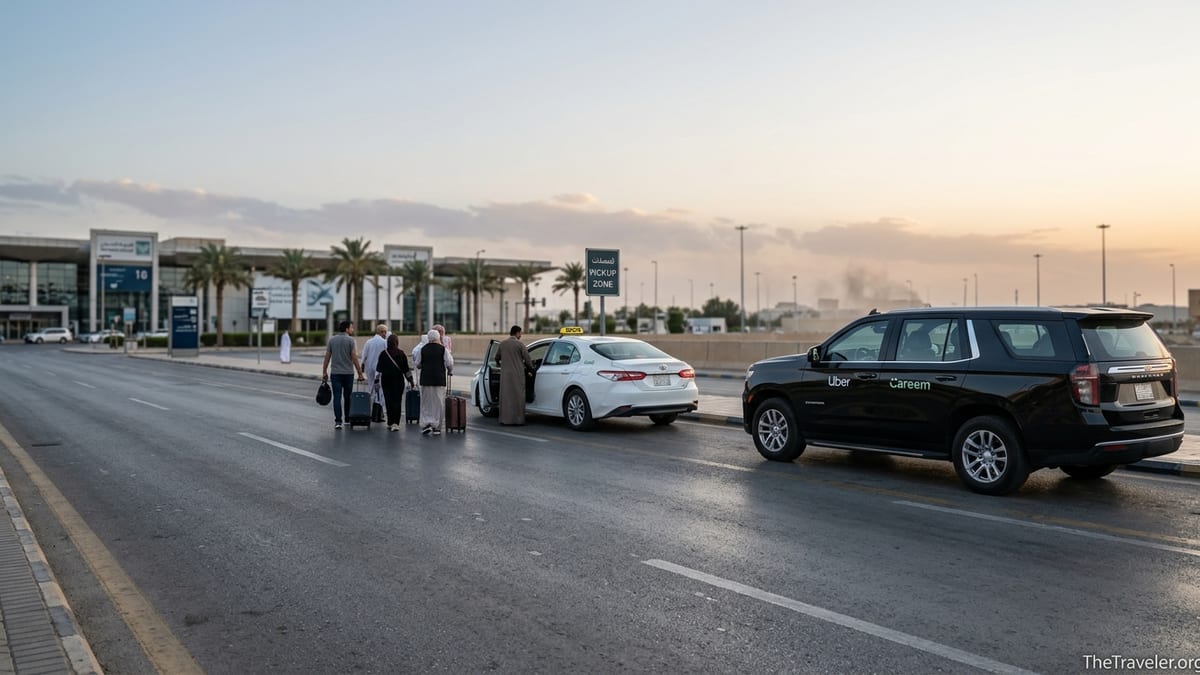
Most visitors heading to At-Turaif first will be dropped at Bujairi Terrace or the Bujairi drop-off zone. This is the main arrival point for taxis, ride-hailing cars and chauffeured vehicles. From there, visitors walk through security and access gates toward At-Turaif or directly into the dining and viewing terraces overlooking the mud-brick palaces.
At-Turaif itself is accessed through controlled entry points with tickets or access passes. Current visitor information explains that you need either a dedicated access pass for At-Turaif or a restaurant reservation in the wider Diriyah area that generates an access pass for that day. On arrival, signs point private drivers, taxis, Uber and Careem cars to the Bujairi drop-off area, while private cars follow directions to self-parking or valet services.
The practical takeaway is that no matter which transport option you choose from the airport, your real navigation target should be “Bujairi Terrace” or “Diriyah – At-Turaif Visitor Centre,” not just the generic word “Diriyah.” This reduces confusion for drivers and helps ensure you are dropped within a short walk of the historic district.
Taking an Official Airport Taxi
Riyadh’s airport has a dedicated taxi system with clear signage in the arrivals area. After you clear immigration and customs, you will pass currency exchange counters and SIM-card vendors before entering the public arrivals hall. From there, “Taxi” signs lead to official queues outside each terminal, where dispatchers coordinate licensed cabs operating under the airport’s transport arrangements.
Airport authorities advertise “various taxi options” at competitive prices, and many visitors report that fares into central Riyadh are generally predictable and metered. A standard saloon taxi from RUH to Diriyah often costs in the rough range of 120 to 180 Saudi riyals depending on time of day, exact drop-off point and traffic conditions. Drivers may quote a fixed figure rather than running the meter, especially for trips outside the core downtown area, so it helps to confirm the approximate total before you set off.
The main advantages of taking an airport taxi are simplicity and immediacy. You do not need a local SIM card or app, you can pay in cash, and you will usually be on the road within minutes of collecting your bags. Taxis are used to carrying luggage and can readily accommodate two large suitcases plus cabin bags in typical sedans. For families or small groups with more luggage, minivan-style taxis may be available, though you might wait longer at busy times.
The downsides are less price transparency than app rides and occasional language barriers. Many drivers speak basic English but not all. Having your destination written clearly, for example “Diriyah – Bujairi Terrace” in both English and Arabic from your hotel or ticket confirmation, makes communication easier. If your priority is to get to At-Turaif quickly after a long-haul flight and you are comfortable with a typical airport taxi experience, this is a reliable baseline option.
Using Uber or Careem from the Airport
For visitors who prefer app-based rides with upfront pricing, both Uber and Careem are authorized and promoted as ride-hailing options from King Khalid International Airport. The airport’s transport information lists them alongside taxis, and Uber maintains dedicated information pages for pickups at RUH.
In practice, using Uber or Careem works much like in other major cities. After connecting to Wi‑Fi or a local data network, you open the app, confirm your pickup terminal and choose your drop-off as “Bujairi Terrace” or “Diriyah – At-Turaif Visitor Centre.” The apps show an estimated fare and waiting time before you confirm. Depending on time of day and demand, typical quotes from the airport to Diriyah can fall in a similar band to taxis or slightly lower, often somewhere around 90 to 170 riyals for standard cars. Surge pricing can push this higher during busy evening hours or special events in Diriyah.
Pickup points are clearly defined. Once your ride is confirmed, the app will direct you to the correct meeting spot outside your terminal. At RUH, riders often report that signs and numbered pillars help match drivers with passengers. It is common for the app to instruct you to wait near a specific pillar or zone. As always, check the license plate and driver name in the app before getting into the car, and avoid handing over any one-time passcodes or confirmation numbers to people who are not shown as your assigned driver.
Uber and Careem offer multiple service levels in Riyadh, from budget options to larger or more premium vehicles. If you have substantial luggage or a family group, select an SUV or a “Max” style category where available. Note that specialized services like “Kids” rides with pre-installed child seats, common in some countries, are limited or not consistently available in Saudi Arabia. If you need a secure child seat, a pre-booked private transfer is often more dependable.
For many visitors, the key benefit of Uber or Careem is control: you see the route in real time, can share your trip with friends or family, and pay by card without negotiating at the curb. The drawback is that you depend on mobile data or airport Wi‑Fi and may encounter occasional delays if demand is high, such as during major Diriyah events or conference periods when a surge of passengers arrive at once.
Private Transfers and Hotel Cars
Travelers who value maximum convenience, have specific requirements such as child seats, or are arriving very late at night might prefer to pre-book a private transfer to Diriyah. A number of Riyadh hotels and third-party chauffeur services offer airport pickups tailored to your flight schedule and destination. These range from mid-range sedans to luxury SUVs with bottled water, meet-and-greet signage and professional drivers.
Prices for such services can be significantly higher than taxi or app fares. It is not unusual for a hotel-arranged car from RUH to urban destinations to cost two or three times a standard ride-hailing fare. For example, some Riyadh business hotels quote airport transfers to central districts in the 250 to 400 riyal range for a standard car, with larger vehicles priced above that. A direct transfer to Diriyah, which lies a bit beyond the central business area, may be quoted at a similar or slightly higher level.
In return, you get a driver waiting in arrivals with your name, assistance with luggage through the terminal and a guaranteed vehicle class. This can be invaluable if you are arriving with heavy camera equipment for documenting At-Turaif, traveling with small children or elderly relatives, or landing around 3:00 in the morning when you would rather not spend time comparing taxi and app options at the curb.
Specialist car services operating in Riyadh, including international brands that focus on pre-booked chauffeur rides, often allow you to specify extras such as infant or toddler seats, multiple stops or additional waiting time at Diriyah if you are visiting At-Turaif briefly before continuing on to a hotel elsewhere in the city. If you are planning a once-in-a-lifetime heritage visit and want to minimize friction from airport to site, budgeting for a private transfer can make sense, especially when the cost is shared across a small group.
Riyadh Metro and Why It Is Not Yet a Direct Solution
Riyadh’s metro is one of the largest new public transport systems in the Middle East and is gradually reshaping how residents move around the city. The network was inaugurated for passengers in late 2024, with lines opening in stages. The currently operating Yellow Line, also labeled Line 4, runs along the King Khalid International Airport corridor, linking the airport with the King Abdullah Financial District and other parts of the city.
Additional lines, including the Blue, Red and Green lines, have been rolled out to serve major corridors such as Olaya, Batha, King Abdullah Road and King Abdulaziz Road. These routes are excellent for connecting inner neighborhoods and business districts to each other. However, the Diriyah and At-Turaif area, located west of central Riyadh along and beyond King Salman Road, is not yet directly served by the existing metro lines.
Plans for a future Line 7 have been discussed, designed to link all airport terminals down to new developments including Diriyah and eventually Qiddiya City. This would transform public access to At-Turaif, but as of mid‑2026 that line remains in the planning and development stage rather than a visitor-ready reality. In other words, you cannot currently board a metro at the airport and ride straight to Diriyah.
In theory, a highly budget-conscious traveler could combine the metro with ride-hailing by first taking a metro line from the airport to a central interchange such as King Abdullah Financial District, then switching to an Uber, Careem or local taxi for the final stretch to Diriyah. This might shave some cost off a direct car journey. In practice, most short-stay visitors, especially those carrying luggage or arriving in the evening when At-Turaif opens to visitors, find that the time and transfer complexity outweigh the savings. For now, the metro is a useful tool once you are settled in Riyadh, but it is not the primary way to get from the airport to At-Turaif.
Luggage, Timing and Whether to Go Direct After Landing
One of the most common questions is whether it makes sense to go directly from the airport to Diriyah and At-Turaif, or to first check in to a hotel in central Riyadh. The answer depends on your arrival time, luggage and personal energy levels. At-Turaif’s published visiting hours emphasize evening access, typically beginning in the late afternoon, and many of the restaurants around Bujairi Terrace are at their most atmospheric after sunset.
If you land in Riyadh around midday or early afternoon and feel relatively rested, going straight to Diriyah can be a memorable way to begin your trip. For example, a visitor arriving from Dubai on an early afternoon flight could be in a taxi or Uber by 2:30 pm, reach Diriyah by 3:15 pm, have a relaxed coffee on Bujairi Terrace while waiting for At-Turaif to open, then join a late afternoon guided walk through the mud-brick alleys as the heat subsides and the lighting installations begin to glow.
Luggage is the main logistical challenge. There are no long-stay luggage storage facilities advertised at At-Turaif itself, and the area is not designed as a left-luggage hub. If you arrive with full-size suitcases and camera gear, you will need to bring them with you to Diriyah. That means either keeping them inside the car if your driver is waiting, which can be impractical or expensive, or wheeling them through Bujairi Terrace to a hotel or restaurant willing to hold them briefly. Some higher-end restaurants or hotels within the broader Diriyah development might accommodate this for patrons, but it is not something to rely on spontaneously.
For most long-haul arrivals with heavy bags, the smoother pattern is to head first to a hotel in central Riyadh, shower and rest, and then visit Diriyah later that afternoon or on the following evening. A typical scenario is a traveler landing from Europe in the late morning, taking an Uber to a hotel near the King Abdullah Financial District, then booking a late afternoon ride from the hotel to Bujairi Terrace once the day’s heat has peaked. If you arrive late at night, for instance after 10:00 pm, it rarely makes sense to go straight to At-Turaif, as visiting hours will be limited and you may miss the best of the experience.
Practical Tips for At-Turaif Visitors Arriving by Car
Regardless of how you travel from the airport, a bit of preparation makes your arrival in Diriyah smoother. First, secure your access: At-Turaif requires either a specific ticket or an access pass linked to a restaurant or experience booking. The official Diriyah information explains that a restaurant reservation in Bujairi Terrace or an “access only” ticket will generate a QR-based access pass for the chosen date. Having this ready on your phone avoids unnecessary backtracking at the gates.
Second, plan your drop-off. If you are being driven by a taxi, Uber, Careem or private chauffeur, ask them clearly to drop you at the Bujairi drop-off location, which is signposted as the arrival point for chauffeured vehicles and ride-hailing services. From there, it is a short, pleasant walk through landscaped paths and viewpoints into the At-Turaif precinct. Self-drivers should follow signs to Bujairi Parking, where you pay for parking at ticket machines by entering your license plate number before returning to your car.
Finally, think about your departure in advance. When you are ready to leave Diriyah, it is usually easy to order an Uber or Careem from the Bujairi drop-off area, but there can be spikes in demand at the end of busy evenings or after large events. If you are on a tight schedule to catch a late-night flight, allow extra buffer time and consider pre-arranging a driver or hotel car to meet you at a set time. If you arrived by self-drive rental, remember that Diriyah’s parking is well signposted but can involve multi-level structures; taking a quick photo of your parking level and zone when you arrive can save confusing searches at the end of the night.
Dress comfortably but with cultural sensitivity: At-Turaif is a heritage site that involves walking on uneven surfaces and stairs, so closed, sturdy shoes are advisable. In the cooler winter evenings, a light jacket is useful, while in summer a hat and hydration plan are essential. All of these practicalities become easier to manage if you are not juggling large suitcases, another reason many visitors choose to visit At-Turaif after checking into their accommodation rather than directly after landing.
The Takeaway
Traveling from Riyadh’s King Khalid International Airport to Diriyah and the At-Turaif district is straightforward once you understand that there is, for now, no single metro line that will take you door to door. Instead, your choices focus on how much convenience, control and comfort you want in a car-based journey.
Official airport taxis offer a quick, no-app solution that suits travelers who prefer to pay cash and get moving immediately. Uber and Careem, fully supported at the airport, provide predictable pricing and app-based navigation that many visitors find reassuring, especially when heading to a specific destination like Bujairi Terrace. Pre-booked private transfers and hotel cars cost more but can be worthwhile for families, business travelers or anyone arriving at awkward hours with lots of luggage or special requirements.
Going directly from the airport to At-Turaif can be magical if your arrival time, energy and baggage all line up, but for most long-haul travelers the more comfortable pattern is to rest in the city first and visit Diriyah later, ideally in the cooler hours of the evening. With a little planning around tickets, drop-off points and timing, your first glimpse of At-Turaif’s adobe walls rising above the valley can become a highlight of your journey, rather than a logistical puzzle.
FAQ
Q1. How long does it take to get from Riyadh Airport to Diriyah by car?
In normal traffic, the drive from King Khalid International Airport to the Bujairi Terrace and At-Turaif area usually takes around 35 to 45 minutes. At peak rush hour it can extend toward an hour.
Q2. Is Uber or Careem cheaper than an airport taxi to Diriyah?
Prices vary with demand and time of day, but standard Uber or Careem rides often fall in a similar band to official taxis, roughly in the low to mid-hundreds of riyals for the airport to Diriyah. At busy times, surge pricing may make app rides more expensive than a metered cab.
Q3. Where exactly should my driver drop me for At-Turaif?
Ask to be dropped at the Bujairi drop-off area or Bujairi Terrace in Diriyah. This is the designated arrival zone for taxis, Uber, Careem and chauffeured cars, with a short walk to At-Turaif’s entrance and security checkpoints.
Q4. Can I take the Riyadh Metro directly from the airport to Diriyah?
No. The existing metro lines include one that serves the airport corridor and others across central Riyadh, but as of mid‑2026 there is no direct metro link to Diriyah or At-Turaif. You would still need a taxi or ride-hailing car for the final leg.
Q5. Is it realistic to visit At-Turaif directly after my flight?
It can work if you arrive around midday or early afternoon, travel light and feel rested. Many visitors, especially those on long-haul flights with heavy luggage, prefer to check into a hotel first and visit At-Turaif later that day or on another evening.
Q6. What should I enter as my destination in Uber or Careem?
Use “Bujairi Terrace” or “Diriyah – At-Turaif Visitor Centre” as your drop-off point. This helps drivers navigate to the correct access area and reduces confusion compared with entering only “Diriyah.”
Q7. Are child seats available in taxis or ride-hailing cars?
Standard taxis and most Uber or Careem vehicles do not routinely provide child seats. If you require one, pre-booking a private transfer or hotel car and requesting a suitable seat in advance is generally more reliable.
Q8. Can I store my luggage at At-Turaif or Bujairi Terrace?
There is no widely advertised long-stay luggage storage at At-Turaif or Bujairi Terrace. Limited short-term help may be possible via hotels or certain venues, but most travelers either visit after checking into their hotel or keep luggage in a waiting chauffeured vehicle.
Q9. Do I need a ticket or pass before I arrive at Diriyah?
Yes. Access to At-Turaif and Bujairi Terrace requires either an access pass linked to a restaurant or experience booking, or an access-only ticket. It is best to arrange this online before traveling from the airport.
Q10. Is it easy to find a ride back to the airport from Diriyah at night?
Generally yes. Many visitors use Uber or Careem from the Bujairi drop-off area in the evening. During major events or at very late hours, demand can spike, so allow extra time or consider pre-arranging a driver if you must catch a specific flight.