


More news on this day
Ryanair has identified seven European airports where passengers are facing some of the longest queues and delays as the European Union’s new Entry/Exit System beds in, raising fresh concerns about bottlenecks at border control ahead of the peak summer travel period.
Get the latest news straight to your inbox!
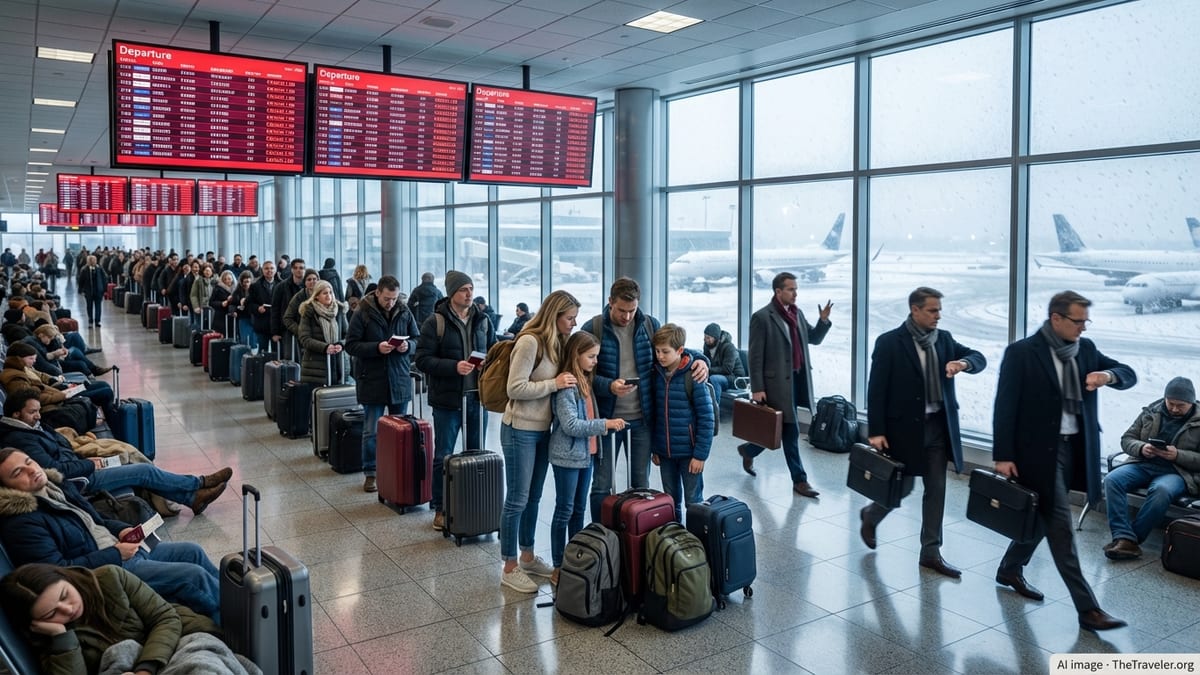
New border checks strain airport capacity across Europe
According to recent coverage of Ryanair’s latest warnings, the airline has highlighted that the introduction of the EU Entry/Exit System, which records biometric data for non EU nationals entering and leaving the bloc, is already creating serious pressure at a number of busy leisure hubs. The rules apply to travellers from countries such as the United Kingdom and the United States, who now face extra steps at passport control.
Publicly available information indicates that the new system requires fingerprints and facial images to be captured on arrival and departure for many third country travellers. Airport operators and border agencies have had to install new kiosks and reorganise staffing, but reports suggest that the roll out has been uneven, with some airports better prepared than others.
Ryanair has argued in public statements that the checks add several minutes per passenger at peak times, an increase that quickly multiplies into long lines when flights arrive in waves. Industry reports indicate that airports already operating close to capacity are the most vulnerable to disruption, especially where terminal space is tight or where border police staffing cannot easily be expanded.
Travel industry analysts note that these early strains are arriving before the full weight of the summer holiday season, raising questions about whether existing infrastructure will be sufficient once peak July and August traffic begins to move through the system in greater volume.
Seven airports singled out as worst affected
In its latest public briefing on the issue, Ryanair has named seven European airports where passengers are currently reported to be facing the longest waits linked to the new border checks. Reports in European and Middle Eastern media outlets describe the list as a mix of Spanish sun destinations, a key Italian base, a fast growing Polish airport and a major low cost hub near Paris.
The airports identified as struggling most with delays are Tenerife South, Palma de Mallorca, Alicante and Malaga in Spain, Milan Bergamo in northern Italy, Krakow in southern Poland and Paris Beauvais in France. These locations are among Ryanair’s busiest bases and attract large numbers of non EU holidaymakers, making them early test cases for how well the Entry/Exit System can handle sustained leisure travel demand.
Coverage of the airline’s warnings indicates that queues at these airports have, at times, stretched well beyond the usual passport control areas, with reports of travellers waiting for extended periods to clear border checks. Travel journalists note that while delays can vary by day and time of arrival, the pattern at these airports has been consistent enough for the carrier to single them out as particular risk points.
Local media in several of the affected countries have also picked up on the concerns, describing complaints from passengers about missed connections and tight margins for boarding after clearing passport control. These reports suggest that, although airlines themselves are not in charge of border procedures, they are experiencing knock on effects as passengers struggle to reach gates on time.
Airline urges governments to act as summer peak nears
Ryanair’s public messaging has focused heavily on the role of national governments and border authorities, arguing that they must move quickly to reinforce staffing and capacity at airports most exposed to the new checks. According to recent news coverage, the airline has called on the governments of Spain, Italy, France and Poland to respond more urgently to the risk of widespread disruption if volumes continue to grow without additional resources.
Reports indicate that the carrier is pushing for more passport control officers, better layout and signage in arrival halls, and closer coordination between airports, airlines and border agencies. The company has also publicly urged EU institutions to monitor the impact of the Entry/Exit System and to consider adjustments or transitional measures if delays become unmanageable at certain locations.
Some European media coverage notes that officials at EU level have downplayed the broader scale of the problem so far, describing the impact as limited at most airports and suggesting that teething issues will ease as staff and travellers become more familiar with the procedures. However, Ryanair’s warnings about potential “queue chaos” this summer highlight a clear divergence between industry concerns and more cautious official assessments.
Observers point out that many of the airports identified as worst hit are heavily reliant on peak season tourism, meaning that a sustained period of long queues could have reputational consequences well beyond the main holiday months. Travel organisations are watching closely to see whether authorities move to introduce short term fixes before the busiest weeks of the year.
Passengers advised to arrive earlier and expect longer processing times
Alongside its criticism of government preparedness, Ryanair has been drawing attention to the steps passengers can take to reduce the risk of missing flights. Reports of its public guidance indicate that the airline is advising customers travelling from non EU countries into the Schengen area to build extra time into their journey, particularly at the seven airports it has flagged.
Air travel commentators note that many airports already recommend arriving at least two to three hours before departure for short haul flights in peak periods. In the context of the new border checks, industry advice circulating in consumer travel coverage often suggests erring on the side of caution, especially for early morning or evening wave departures when several flights may be processed in close succession.
Published information from Ryanair suggests that the airline is not routinely holding flights for passengers delayed at passport control, arguing that doing so would create knock on delays across the wider network. This approach places greater responsibility on travellers to anticipate potential queues at border control and to allow more time than they may have done before the new rules were introduced.
Consumer advocates quoted in recent travel reports are reminding passengers that delays caused by border control procedures are generally outside airlines’ control, which can limit eligibility for standard flight delay compensation. As a result, travel insurance policies that explicitly cover missed departures due to airport bottlenecks are likely to take on greater importance for non EU travellers heading to the most affected destinations.
What the delays reveal about Europe’s readiness for new systems
The difficulties reported at Tenerife South, Palma, Alicante, Malaga, Milan Bergamo, Krakow and Paris Beauvais are being seen by some aviation analysts as a stress test of Europe’s ability to implement complex, technology heavy border systems at scale. The Entry/Exit System has been in development for years, but the early congestion at certain airports suggests that transforming legal requirements into on the ground capacity is a continuing challenge.
Industry commentary notes that many of the affected airports are secondary or regional hubs that have grown rapidly with the rise of low cost carriers, often without the same space or resources as larger capital city airports. Integrating new biometric infrastructure into terminals designed for an earlier era of travel has required compromises that may limit how quickly passenger flows can be expanded.
Aviation specialists also point out that the situation underlines the interdependence between airlines, airports and border agencies. Airlines rely on swift border processing to maintain on time performance, while airports depend on predictable passenger flows to manage everything from security queues to retail revenues. When a new rule slows one part of the chain, the ripple effects can travel quickly through the system.
How governments and EU institutions respond in the coming weeks is likely to shape not only the remainder of this summer but also traveller confidence in Europe’s broader border modernisation plans. For now, Ryanair’s decision to publicly identify the airports struggling most with delays has thrown a spotlight on the practical realities behind the bloc’s new entry rules and the delicate balance between security, technology and passenger experience.