


More news on this day
France’s already strained summer air travel network is facing fresh disruption as operational problems at Paris Charles de Gaulle and mounting bottlenecks at Gustaf III and Maupiti airports in French Polynesia combine to delay 324 flights and cancel 34, heavily impacting Air France, Air Tahiti, Air Caraïbes and several regional operators.
Get the latest news straight to your inbox!
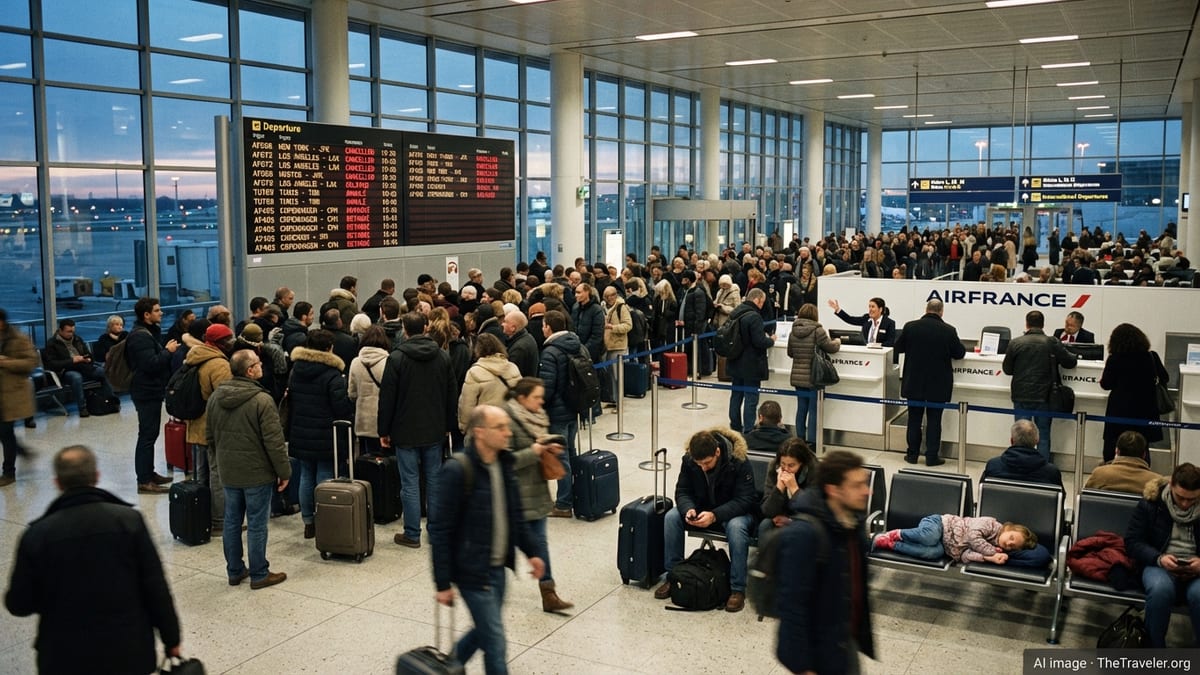
Major French Hubs Buckle Under Peak Summer Traffic
Real time data from flight tracking platforms and passenger rights organizations indicates that the latest wave of disruption is centered on Paris Charles de Gaulle, the country’s largest international hub, where a combination of heavy summer demand, air traffic management constraints and residual staffing pressures is reducing the margin for error in daily operations.
Publicly available statistics suggest that hundreds of departures and arrivals at Charles de Gaulle have faced extended holds on the ground or in the air, with knock-on effects that ripple into evening and overnight schedules. While the majority of affected services are ultimately operating with delays, a smaller but still significant number are being canceled outright when aircraft and crews fall too far out of position to recover.
Recent operational summaries for the Paris region show that even localized weather events can quickly compound these strains. Earlier in June, a short but intense storm cell over Île de France forced air traffic regulators to slow arrivals into Charles de Gaulle, resulting in dozens of flights landing behind schedule and leaving airlines with tightened turnarounds and disrupted rotation plans heading into subsequent days of peak demand.
The current spike in disruption builds on that fragile backdrop, leaving Charles de Gaulle functioning but congested, with longer queues at departure control points and passengers frequently advised to monitor their flight status until shortly before departure.
French Polynesia Links Snared At Gustaf III And Maupiti
The knock on effects are being felt thousands of kilometers away in French Polynesia, where small but strategically important island airfields play an outsized role in regional connectivity. At Gustaf III Airport, better known for serving high end leisure traffic, and at Maupiti Airport, a key link in the domestic network, schedule data and local reporting point to a cluster of delayed and canceled services as operators work around aircraft availability and crew duty time constraints.
These airports rely heavily on tightly choreographed rotations operated by carriers such as Air Tahiti and partner airlines feeding into long haul services via Papeete. When upstream flights from mainland France or other regional hubs land late or arrive with aircraft out of sequence, small airports with limited stands, short runways and minimal spare capacity can quickly find themselves over capacity.
Available information from traveler accounts and regional aviation updates indicates that several multi sector itineraries involving Maupiti and other remote islands have been disrupted in recent weeks by a mix of technical issues, industrial actions and weather related constraints. The latest surge in late running services has tipped that pattern into a broader wave of delays and cancellations that is now visible in consolidated tracking statistics.
Given the geography of French Polynesia, a single canceled sector at Maupiti or Gustaf III can strand travelers far from their onward connection points, forcing last minute rebookings or overnight stays on islands with limited accommodation stock during the high season.
Air France, Air Tahiti And Air Caraïbes Among Worst Hit
Across the affected network, long haul and regional French carriers appear to be bearing the brunt of the latest disruption. Aggregated data from flight tracking dashboards for the current operating day show Air France handling a high volume of late departures and arrivals at Charles de Gaulle, with some European and transatlantic routes posting delays of an hour or more as the airline works to re synchronize aircraft and crew rotations.
On domestic and regional routes, Air Tahiti is contending with a compressed schedule in French Polynesia that leaves little slack when flights are delayed or aircraft are temporarily withdrawn from service. Recent industrial actions among technical flight crews and reports of occasional technical inspections on turboprop fleets have added to the operational complexity, increasing the risk that localized issues at one island airfield cascade into a rolling pattern of late running and cancellations across multiple islands.
Air Caraïbes and smaller regional operators that rely on shared infrastructure and overlapping airspace are also being drawn into the disruption. Timetables serving the French Caribbean, transatlantic leisure routes and inter island connectors have all been affected to varying degrees by aircraft arriving late from Paris or other hubs. When combined with crew duty time limitations and slot restrictions at constrained airports, these delays can leave airlines with few options other than trimming frequencies or consolidating lightly booked services.
Although low cost and non French carriers operating at Charles de Gaulle and in the wider region are also experiencing delays, publicly available tallies of disrupted flights indicate that the largest concentration of impacted services is within the French flag and regional carrier ecosystem.
Passengers Face Missed Connections And Tight Rebooking Windows
For travelers, the operational challenges are translating into long waits, missed connections and a heightened risk of extended stays at intermediate hubs. At Charles de Gaulle, the combination of late inbound flights, busy security and passport control areas and tight minimum connection times is increasing the number of passengers who fail to make onward services, even when their original flights are not formally canceled.
In French Polynesia, the stakes are often higher because many visitors plan once in a lifetime itineraries that string together multiple islands with limited flight frequencies. A delayed departure from Maupiti or a canceled sector into Gustaf III can mean waiting a full day or more for the next available flight, with accommodation and activity bookings at subsequent stops left in limbo.
Industry guidance and recent case summaries from European passenger rights platforms suggest that travelers whose flights are significantly delayed or canceled for reasons within an airline’s control may be entitled to care and compensation under EU and international regulations. However, the determination of eligibility often depends on the precise cause of disruption, the length of delay and the route operated, factors that can vary widely across the patchwork of affected flights in France and French Polynesia.
As a result, many passengers are turning to online claim tools and third party advisory services after the fact, once they have reached their final destination and can piece together the sequence of delays and schedule changes that affected their journey.
Outlook For Summer Travel Across France And Its Overseas Territories
Aviation analysts monitoring European and Pacific networks indicate that the underlying drivers of the current disruption are unlikely to disappear quickly. Peak summer demand in Europe, ongoing recruitment and training cycles in the aviation sector, and continuing airspace and weather related constraints across parts of the continent are all expected to keep pressure on French hubs such as Paris Charles de Gaulle throughout July and August.
In French Polynesia, the high season for international arrivals overlaps with the period when local inter island demand is also strong, leaving carriers with limited scope to add backup aircraft or spare crews. Any further technical, industrial or meteorological shocks could therefore trigger additional clusters of delays and cancellations at smaller airports including Maupiti and Gustaf III.
Travelers planning itineraries that combine mainland France, Paris connections and time in the French overseas territories may wish to build in longer connection windows and consider overnight stops at key hubs to reduce the risk of missed long haul flights. Industry observers also highlight the importance of monitoring flight status closely on the day of travel and retaining documentation of delays and expenses that might later support claims under applicable passenger rights frameworks.
For now, France’s air travel system remains operational but stretched, with the latest tally of 324 delayed flights and 34 cancellations at Charles de Gaulle, Gustaf III and Maupiti serving as a reminder of how quickly pressure at major hubs and remote island airfields can combine to disrupt journeys across vast distances.