


More news on this day
Ryanair is warning travelers of long queues and potential disruption at several major holiday airports this summer, as the European Union’s newly operational Entry Exit System (EES) strains border operations during the peak holiday season.
Get the latest news straight to your inbox!
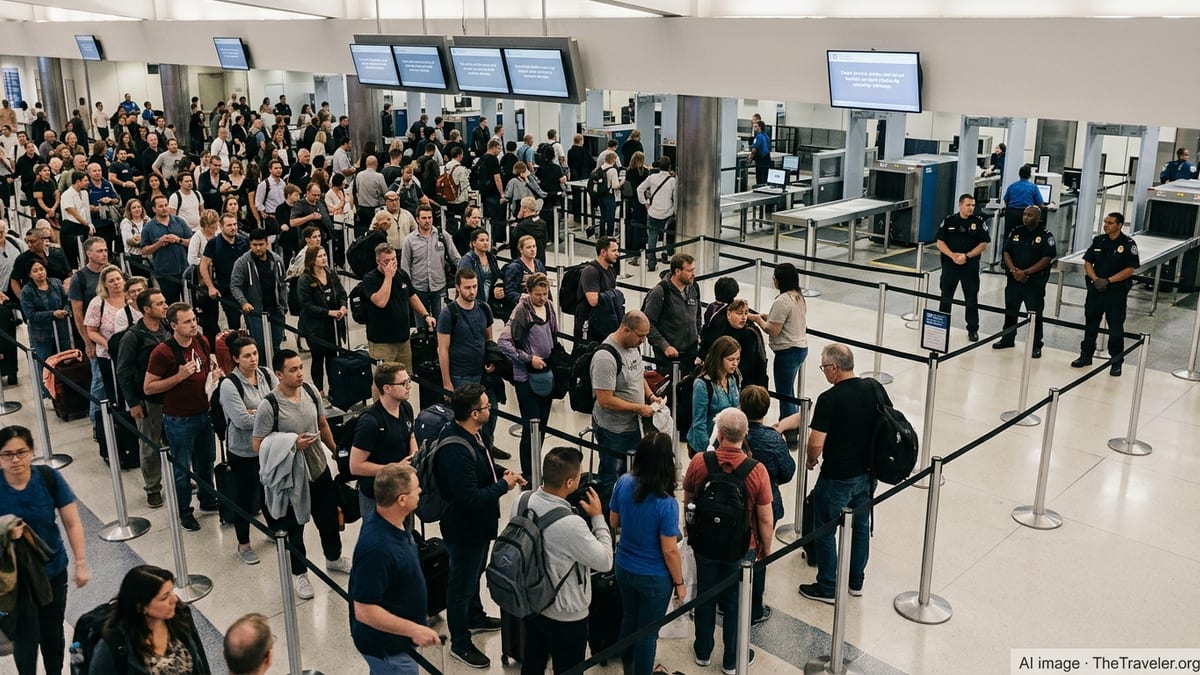
New biometric checks slow peak holiday traffic
The EU’s Entry Exit System became fully operational across the Schengen Area in April 2026, introducing biometric registration for most non-EU travelers at external borders. The system replaces manual passport stamping with electronic records that capture fingerprints and facial images on first entry, and then verify those details on subsequent trips.
Publicly available information indicates that the roll out has coincided with a sharp increase in waiting times at some airports serving high volumes of leisure passengers. Airlines and airport industry groups have already raised concerns that the additional steps required for first-time enrollment are not being matched by sufficient staffing and infrastructure at border-control points.
According to recent coverage, the European Commission has acknowledged capacity issues around the new checks and has signaled that Member States may temporarily relax or suspend parts of the process during the busiest summer weeks if queues become unmanageable. However, operational arrangements remain the responsibility of national authorities and individual airports, creating a patchwork of traveler experiences across the region.
Reports from early summer travel weekends show that at certain terminals, queues for third-country passport control have spilled into public areas and, in some cases, outside terminal buildings, particularly when multiple wide-body or high-density narrow-body flights arrive within a short window.
Seven Ryanair hubs singled out for “queue chaos” risk
Ryanair has now named seven European airports where it says the impact of the Entry Exit System is already acute: Tenerife South, Palma de Mallorca, Alicante and Málaga in Spain, Milan Bergamo in Italy, Krakow in Poland, and Paris Beauvais in France. These airports are key bases in the carrier’s network and handle large volumes of summer traffic from the UK, Ireland and other non-Schengen origins.
According to recent reports on the airline’s public statements, border-control bottlenecks at these airports have led to queues extending well beyond the normal passport-control area at peak times. Some passengers have reported multi-hour waits to clear border checks, especially when arriving during busy morning and evening waves.
Ryanair’s public messaging characterizes the situation as a foreseeable clash between a complex new IT-driven border system and the highest-demand weeks of the year for short-haul leisure travel. Coverage of those statements indicates that the carrier argues governments and airport operators had years of notice to prepare but are still ramping up workstations, staffing levels and signage only after serious congestion has begun to appear.
The seven airports highlighted share common traits: strong reliance on point-to-point low-cost carriers, limited terminal expansion space and a high proportion of non-EU arrivals on summer sun and city-break routes. That combination means even small slowdowns in the border process can cascade quickly into long queues.
EU and industry wrestle with timing of full EES rollout
The Entry Exit System has been planned for several years as part of a wider modernization of Europe’s external border controls, with the goal of improving security, tracking overstays and streamlining repeat travel by replacing manual passport stamps. Yet, as the system moves from test phase to real-world use, the timing of its full implementation has drawn criticism.
Airline and airport associations have warned in recent letters and position papers that introducing time-consuming biometric registration just as summer demand peaks risks overwhelming facilities that were designed for shorter manual checks. They argue that the busiest months of July and August leave little room for experimentation or technical teething problems.
In response to mounting concerns, European institutions have convened meetings with industry groups to review early data on queue lengths and throughput. Publicly available briefings indicate that one mechanism under discussion is allowing Member States to scale back EES checks temporarily at times of sustained congestion, provided security standards are maintained through alternative means.
Nonetheless, the system remains in place at most external Schengen border points, and adjustments are expected to be incremental rather than a full suspension. This leaves airlines, airports and passengers managing the practical consequences in real time as the summer season unfolds.
What travelers using affected airports should expect
For passengers flying through Tenerife South, Palma, Alicante, Málaga, Milan Bergamo, Krakow and Paris Beauvais, current reports suggest that the greatest pressure is at arrivals passport control, where non-EU travelers undergo the biometric checks required by EES. Departures can also be affected when outbound passport control facilities are shared or constrained, though delays on arrival are more commonly cited.
Travel coverage indicates that first-time EES registrations take significantly longer than traditional manual stamping, particularly for families who must process multiple individuals, including children, at kiosks or manned stations. Technical glitches, unfamiliarity with the process and limited staffing can all amplify delays, especially if several flights land within a narrow time window.
To reduce the risk of missed onward connections or tight transfers, airlines, including Ryanair, are advising customers to build in additional time on both ends of their journey. While specific recommendations vary, guidance commonly suggests arriving earlier than usual at departure airports and allowing generous buffers when planning self-connecting itineraries through affected hubs.
Travelers are also being encouraged by publicly available advisories to ensure passports are valid, undamaged and easily accessible, and to follow airport signage carefully to the appropriate non-EU or EU/EEA/Swiss lanes, as misdirected queues can further slow processing.
Pressure grows for short-term fixes before summer peaks
With July and August widely regarded as the busiest period for European leisure travel, industry observers note that the window for short-term fixes is rapidly narrowing. Any further increases in passenger volumes could exacerbate existing pressure points at the seven airports flagged by Ryanair and potentially at other Schengen gateways with similar traffic patterns.
Some national authorities have already moved to add staff, open additional control booths or adjust shift patterns at key airports. Published reports also mention the use of temporary infrastructure such as overflow queuing zones and portable barriers to manage passenger flows more safely and predictably during peak arrival waves.
At the policy level, the debate centers on whether to continue pushing ahead with the system’s full functionality during the height of the holiday season or to scale back certain requirements, such as collecting fingerprints on every first entry, until after traffic levels subside in September. Airlines are broadly in favor of delaying the most time-consuming elements, while policymakers aim to balance operational realities with security and data-collection objectives.
For now, travelers heading to Tenerife, Palma, Alicante, Málaga, Milan Bergamo, Krakow and Paris Beauvais are being told through public advisories to expect potential passport-control delays and to factor them into their journey planning. How well authorities and airports manage the next several weeks will likely shape public perception of the Entry Exit System and influence future decisions on its scope and timing.