


More news on this day
American Airlines is launching a broad cabin refresh that will add more premium seats, expand free high-speed Wi‑Fi and introduce seatback entertainment across much of its fleet, signaling a renewed push for higher-yield travelers on domestic and international routes.
Get the latest news straight to your inbox!
More premium seats across key fleets
American Airlines is increasing the share of premium seating on a wide range of aircraft as part of a multiyear fleet renewal and retrofit program. Publicly available information indicates that the carrier is reconfiguring many of its narrowbody jets with additional first class and extra-legroom Main Cabin Extra rows, while new deliveries of Airbus A321neo and Boeing 737 MAX aircraft arrive with denser premium layouts.
Recent fleet details show that some A321neo aircraft will feature up to 24 first class seats, compared with 20 on earlier versions, alongside an expanded Main Cabin Extra section. Similar changes are planned for forthcoming 737 MAX 10 aircraft, which are expected to debut with larger premium cabins and updated interiors. These adjustments are designed to capture more high-yield demand on business-heavy and transcontinental routes where competition from Delta Air Lines and United Airlines has intensified.
Widebody jets are also being upgraded. American has begun rolling out aircraft fitted with its new Flagship Suite business-class product and premium economy seating on Boeing 787-9s and is extending these cabins to Boeing 777-200 and 777-300ER aircraft through extensive interior overhauls. Industry coverage describes the 777-300ER refurbishment, now entering service, as one of the airline’s most significant premium upgrades in years, replacing older first class cabins with higher-density suites and modernized premium economy.
The strategy aligns with a broader industry trend of trading some standard economy seating for more lucrative premium cabins. Reports indicate that American’s management views premium revenue as a crucial lever for improving unit revenues, especially on long-haul international and transcontinental flights where corporate and affluent leisure demand is strongest.
Free high-speed Wi‑Fi for loyalty members
Connectivity is another pillar of the upgrade program. According to recent company disclosures and travel-industry reporting, American is rolling out free high-speed Wi‑Fi for AAdvantage loyalty members on most domestic flights. The rollout, which began in early 2026, builds on several years of installing satellite-based systems across hundreds of dual-class narrowbody aircraft.
Financial filings and news releases state that American now offers high-speed satellite Wi‑Fi on more aircraft than any other U.S. airline, with coverage extending across nearly the entire dual-class narrowbody fleet and a growing share of regional jets. Free access for loyalty members is presented as a way to encourage enrollment in AAdvantage while differentiating the onboard experience from rivals that still rely heavily on paid connectivity models.
The airline is also upgrading the underlying technology. Aviation and business coverage reports that American has selected new satellite providers for parts of its fleet, including low Earth orbit systems intended to deliver faster, more consistent performance. These systems are being prioritized for narrowbody aircraft that operate dense domestic schedules, where reliable streaming and real-time VPN access are seen as critical for business travelers.
While some widebody aircraft used on long-haul international routes still rely on older connectivity platforms, American has indicated that the goal is to standardize a high-speed experience over time. For now, passengers may encounter different Wi‑Fi performance depending on aircraft type and route, but the direction of travel is clearly toward faster and more widely available inflight internet, particularly within North America.
Seatback entertainment returns to narrowbody jets
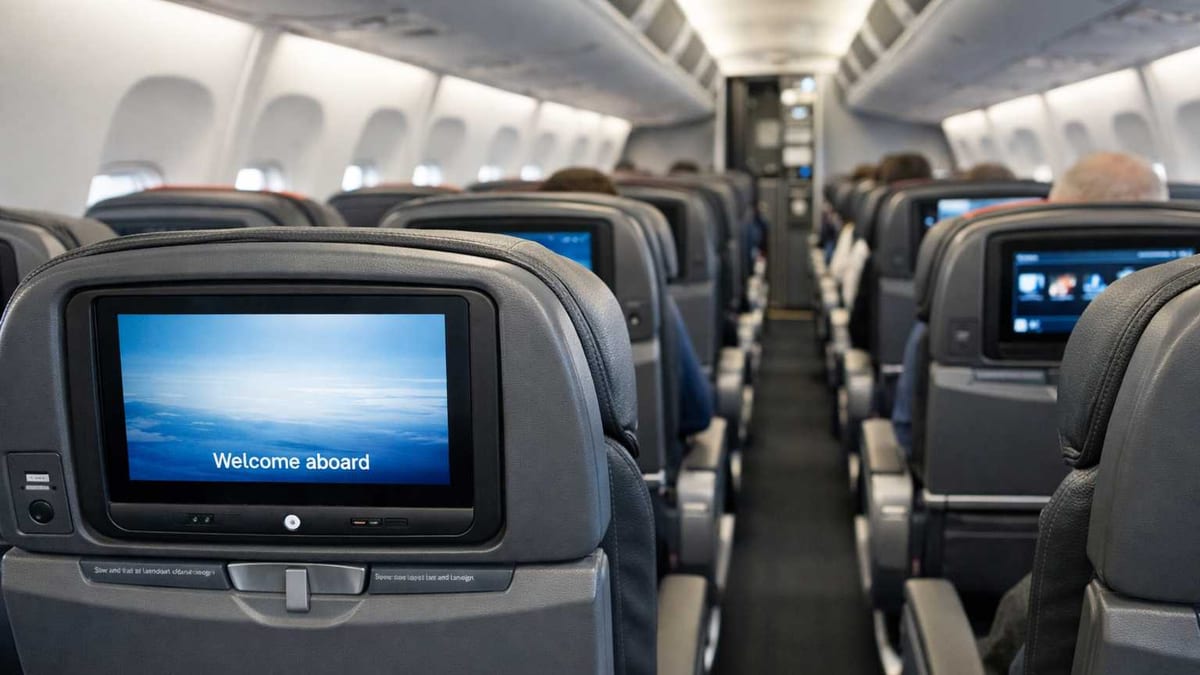
In a notable shift from its earlier strategy, American is bringing seatback entertainment screens back to many of its narrowbody aircraft. Aviation-focused coverage of the carrier’s latest fleet announcement describes a plan to install modern seatback displays across large portions of the Boeing 737 and Airbus A321 families as they undergo interior refreshes.
The move effectively reverses a high-profile decision from several years ago to remove built-in screens in favor of streaming content to passengers’ personal devices. At the time, American emphasized the ubiquity of smartphones and tablets and sought to reduce weight and maintenance costs. However, competitive pressure and customer feedback appear to have pushed the airline toward restoring individualized screens, particularly in premium cabins and on longer domestic segments.
The new screens are part of a broader interior redesign that includes larger overhead bins, updated lighting and refreshed seat designs. Reports indicate that American aims to pair the hardware with its upgraded Wi‑Fi network, enabling a mix of cached content and streaming options that mirror modern home and mobile entertainment ecosystems.
Reintroducing seatback systems also helps American narrow the perception gap with competitors that have invested heavily in onboard entertainment. Delta and United both highlight widespread screens as a core part of their premium positioning. American’s renewed investment suggests it is unwilling to cede that ground on key high-revenue routes.
Regional jets get dual-class cabins and connectivity
The upgrade program extends beyond mainline jets to American’s large regional fleet. According to recent news releases, the airline is replacing many of its smallest single-cabin regional aircraft with larger dual-class jets that feature a dedicated first class section, Main Cabin Extra seats and Wi‑Fi throughout the cabin.
These aircraft, operated by American’s regional partners, serve smaller cities and short-haul routes feeding the carrier’s hubs. Historically, passengers on these flights often faced limited legroom, no premium seating and little or no connectivity. The introduction of dual-class cabins with power at every seat and fast internet access is intended to make the experience more consistent with mainline service and more appealing to frequent flyers.
American has outlined plans to complete the transition to an all dual-class regional fleet, with high-speed Wi‑Fi installed across the network. Publicly available information indicates that some of these aircraft are also being prepared for complimentary Wi‑Fi for AAdvantage members, mirroring the policy on larger jets and reinforcing the loyalty program’s role at every stage of the journey.
For customers in smaller markets, the changes may be especially noticeable. The combination of first class seating, extra-legroom rows and reliable connectivity on short hops could help American defend market share against low-cost carriers while maintaining yields closer to those seen on longer mainline routes.
Competitive and passenger implications
American’s focus on premium seating and connectivity reflects a broader recalibration of its business model. Recent quarterly filings describe a deliberate shift toward higher-margin products, supported by configurations that favor first class, premium economy and extra-legroom seating at the expense of some standard economy rows.
This strategy mirrors moves by competing network carriers, yet the scale at American, which operates one of the world’s largest mainline fleets, makes the changes particularly consequential. More premium seats translate into additional opportunities to sell higher fares and ancillary upgrades, but also require careful yield management to avoid diluting revenue through excessive discounting or upgrades for elite frequent flyers.
For passengers, the experience is set to become more segmented. Travelers willing to pay for extra space, upgraded meals and priority services will find more options, especially on popular domestic trunk routes and international long-haul flights. At the same time, those in standard economy may see little change beyond access to faster Wi‑Fi and, on many aircraft, a revived seatback screen.
As these cabin changes roll out through 2026 and beyond, American’s ability to consistently deliver the promised Wi‑Fi speeds, entertainment quality and seat comfort will be closely watched by both corporate travel buyers and leisure customers. The success of the initiative is likely to hinge on whether the upgraded hard product, combined with the AAdvantage program and network breadth, can meaningfully differentiate the airline in an increasingly crowded premium travel market.