


More news on this day
U.S. travelers heading to Europe this fall are being urged to build in significant extra time at passport control, as Ryanair highlights three-hour biometric fingerprinting queues and missed connections at seven major holiday airports under the European Union’s new Entry/Exit System.
Get the latest news straight to your inbox!
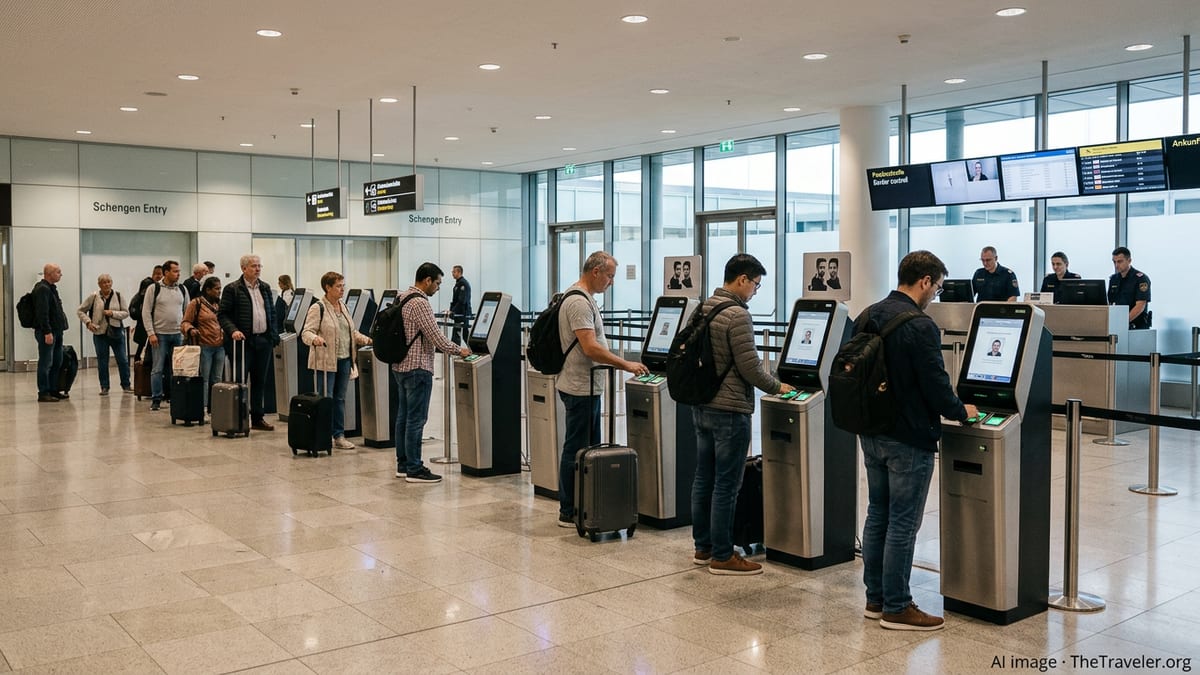
New EU Entry/Exit Rules Behind Growing Airport Bottlenecks
The delays stem from the EU’s Entry/Exit System (EES), a biometric border-control scheme that became fully operational at all external Schengen border points in April 2026. The program replaces manual passport stamping for most non-EU visitors with a digital file that stores fingerprints, a facial image, and details of each border crossing.
According to publicly available information from EU institutions, the EES records the biometric and travel-document data of non-EU nationals entering or leaving the Schengen area, generating a record that can be reused for up to three years. For first-time users, however, border checks now involve several steps, including scanning passports, capturing four fingerprints and a live facial image, and validating each record against central databases.
Industry analyses indicate that the more complex process has created a new choke point at many airports. Surveys of European hubs this summer reported queues reaching between two and three and a half hours at peak times, especially where staffing, kiosk numbers, or terminal layouts have not kept pace with demand.
For U.S. passport holders, who are treated as visa-exempt third-country nationals under Schengen rules, the EES procedures apply on both arrival into and departure from the zone. That means the same biometric checks can affect tight connections, especially when travelers are transiting between Schengen and non-Schengen flights on separate tickets.
Seven Airports Where Ryanair Reports the Worst Queues
Ryanair’s latest travel advisory, summarized by consumer-rights and flight-disruption trackers, identifies seven airports where EES queues have been particularly disruptive for non-EU passengers this summer and are expected to remain a concern into the fall season. The affected hubs are Tenerife South, Palma de Mallorca, Alicante-Elche and Málaga-Costa del Sol in Spain, Milan Bergamo in Italy, Kraków John Paul II in Poland, and Paris Beauvais in France.
Reports indicate that at these airports, first-time EES registration and repeated biometric checks are contributing to long lines at passport control. In some cases, non-EU travelers are being held in queues so long that they miss onward flights, even when they arrived at the airport well ahead of departure. Travel-compensation platforms tracking these incidents note recurring patterns of missed services attributed to time spent at the border rather than airline delays or security screening.
Data collated by airport-performance and passenger-experience monitors shows that several of the named airports have already experienced severe spikes in EES-related waiting times this year, with historical examples of three-hour queues or more at peak holiday periods. Industry briefings also suggest that some border authorities have intermittently switched off biometric kiosks and reverted to manual passport stamping when lines became unmanageable, creating an uneven experience for travelers depending on the time and day of travel.
Although Ryanair focuses on these seven hotspots, aviation bodies have pointed out that congestion can flare up at many other Schengen gateways as traffic ebbs and flows. Travelers are being advised not to assume their departure airport will be exempt, even if conditions were smooth on a previous trip.
Why U.S. Travelers Are Especially Vulnerable This Fall
Published guidance on the EES confirms that U.S. citizens and other visa-exempt visitors must complete biometric registration the first time they cross an external Schengen border after the system’s launch. That initial enrollment tends to take significantly longer than repeat checks, increasing the risk of lengthy queues for Americans arriving in Europe for fall vacations or business trips.
Travel media accounts from the system’s first peak season describe passengers being sent back to repeat scans, struggling with malfunctioning kiosks, and queuing again at staffed booths when machines rejected their fingerprints. For those traveling on low-cost carriers from secondary airports, the layout of terminals and the concentration of non-EU flights during certain hours can magnify the effect, creating surges of U.S. and UK passengers all funneled through the same limited border-control area.
Ryanair operates a point-to-point model with no protected connections, which means missed onward flights caused by long immigration queues are usually treated as separate events rather than a single through journey. The airline’s own help pages emphasize that passengers are responsible for allowing enough time to clear passport control and recommend extra buffer time at airports where EES checks are in full effect, especially for those arriving from or departing to non-Schengen destinations.
With U.S. travel to Europe remaining strong into the shoulder season, aviation groups caution that traffic may still be heavy at popular leisure hubs in September and October. For American travelers routing home via the seven highlighted airports, even an evening departure after a quiet-looking afternoon schedule can coincide with sudden peaks in border-queue times.
Missed Connections and What Travelers Can Do
Consumer-rights organizations and flight-delay specialists tracking the rollout of EES report a steady stream of missed departures linked to biometric bottlenecks. In many documented cases, passengers arrived at the airport with what would previously have been considered a generous margin, only to find that passport-control backlogs consumed most of that time.
Published coverage suggests that, at several airports on Ryanair’s list, non-EU travelers have been advised to arrive at least three hours before departure, and in some instances longer, to allow for potential biometric registration queues. Travel-industry guidance also stresses that the situation can change quickly within a single day, meaning that a smooth experience in the morning does not guarantee short waits for an evening flight.
For U.S. travelers with self-arranged onward journeys on separate tickets, including onward long-haul flights, the risk is particularly acute. If a short-haul leg on a low-cost carrier is missed because of delays at border control, the subsequent long-haul itinerary is not automatically protected, and rebooking costs can be significant. This dynamic is one reason Ryanair’s warning to passengers transiting through its European network has drawn attention among North American travelers planning multi-stop itineraries.
Travel advisors and passenger-rights advocates therefore recommend conservative planning for fall 2026 trips that involve entering or exiting the Schengen area by air. That includes leaving broad gaps between independently booked flights, prioritizing longer connection times at the seven named airports, and monitoring airport and carrier updates closely in the weeks before travel as EES operations continue to evolve.
What to Expect at the Border This Fall
Public documentation from the European Commission and the European Parliament describes a standard EES process that begins with scanning a traveler’s passport and collecting their biometric identifiers. At many airports this initially takes place at self-service kiosks, with a subsequent inspection by a border officer to verify the data and finalize the entry or exit record.
For U.S. travelers using EES for the first time this fall, the procedure will typically involve placing fingers on a scanner and looking into a camera to capture a facial image. Once their data is stored, subsequent crossings within a three-year window should be faster, but published accounts indicate that travelers may still periodically be asked to re-scan fingerprints or have their photo taken again if systems fail to match records automatically.
Industry assessments of the system’s early performance highlight several factors driving the three-hour queues Ryanair warns about, including a shortage of kiosks relative to passenger volumes, inconsistent instructions for travelers unfamiliar with biometric checks, and limited space in passport-control halls. Some airports have responded by deploying additional staff, adjusting queue management, or requesting temporary flexibility from the EU to pause full biometric capture during extreme peaks.
For now, though, travel outlets and rights groups agree that non-EU visitors should plan for a more time-consuming border experience at many European airports compared with pre-EES years. With Ryanair singling out seven specific hubs where these challenges are especially pronounced, U.S. travelers passing through Tenerife South, Palma de Mallorca, Alicante-Elche, Málaga-Costa del Sol, Milan Bergamo, Kraków, or Paris Beauvais this fall may wish to treat three-hour buffer times at passport control as a minimum rather than a luxury.
AirHelp: Ryanair warns of EES queues at 7 EU airports
AFAR: Europe’s new EES digital entry system causing travel delays
European Commission: Entry/Exit System overview