


San Francisco International Airport is large, busy, and constantly under construction, but its free AirTrain system makes navigating it much easier. Whether you are catching a tight connection, picking up a rental car, or transferring from BART to a different terminal, understanding the Red Line and Blue Line will save you time and confusion. This guide explains, in practical terms, how to use AirTrain for terminal transfers, BART access, rental cars, parking garages, and hotel connections at SFO.
Get the latest updates straight to your inbox!
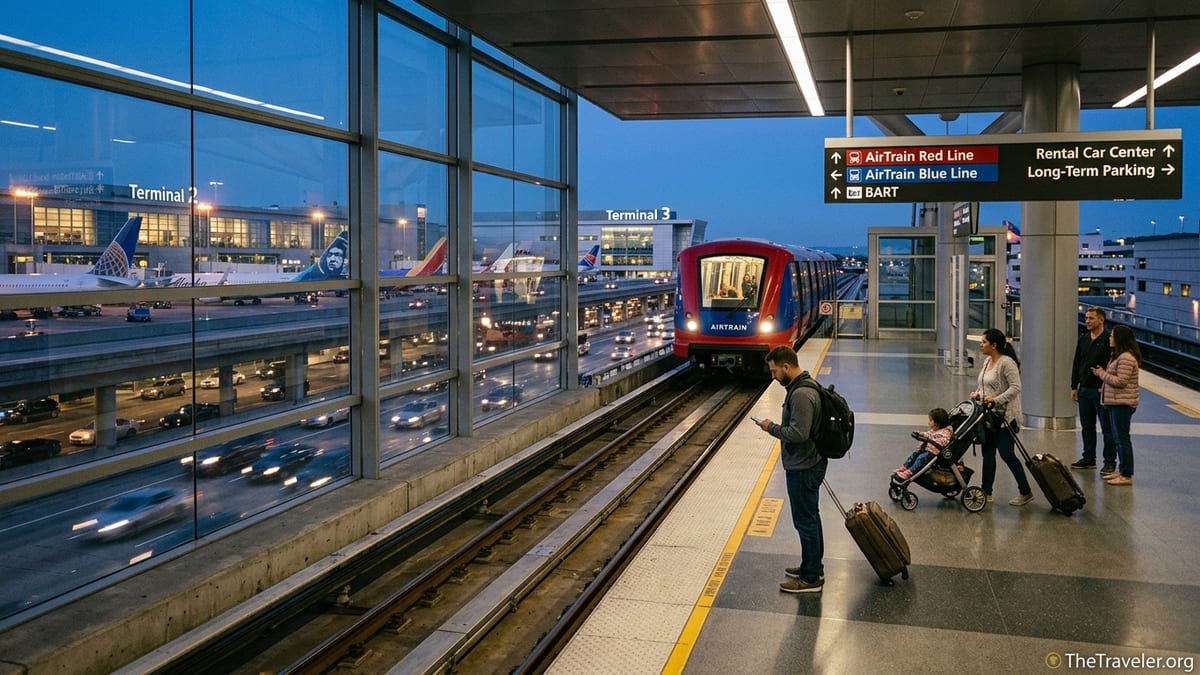
How SFO’s AirTrain Works
AirTrain is San Francisco International Airport’s free, 24‑hour automated people mover. It operates entirely within the airport grounds and links every terminal with key facilities such as parking garages, the BART station, the Rental Car Center, long‑term parking, and the Grand Hyatt at SFO hotel. Trains run frequently, typically every few minutes, and a complete loop around all terminals usually takes under 15 minutes during normal operations.
Unlike public transit systems that charge a fare, AirTrain is free to ride. You do not need a ticket, clipper card, or boarding pass to use it. This makes it useful not just for passengers, but also for people dropping off or picking up travelers, airport employees, and hotel guests. The platforms are inside the airport’s secure roadway ring but on the “landside” of the terminals, meaning you always pass through security after you get off the train and walk to your departure gate.
AirTrain runs on elevated guideways above the main airport roadways, which makes it easy to spot the trains from the terminal windows and parking garages. Trains and stations are clearly branded in SFO’s blue and red AirTrain colors. Inside the cars you will find automated announcements, dynamic screens that list the next stops, and overhead maps that show both the Red Line and Blue Line routes so you can confirm you are headed the right direction.
In practice, most travelers encounter AirTrain in one of three situations: changing terminals between domestic and international flights, connecting from the SFO BART station to a different terminal, or traveling to the Rental Car Center and long‑term parking. Understanding which line serves which facilities is the key to using it confidently.
Red Line vs Blue Line: What Each Route Covers
AirTrain operates two lines: the Red Line and the Blue Line. Both lines are loops, and they share the same tracks around the main terminal and parking core of the airport. The difference is that the Blue Line continues beyond the terminal loop to serve the Rental Car Center, Long‑Term Parking, and the Grand Hyatt at SFO hotel, while the Red Line focuses on the compact “inner loop” around the terminals, terminal garages, and BART station.
The Red Line connects all terminals, the domestic and international terminal garages, and the SFO BART station. If you are simply moving between Terminal 1, Terminal 2, Terminal 3 and the International Terminal, or connecting between your gate and BART, the Red Line is usually the fastest choice. For example, a traveler arriving on an Alaska Airlines flight into Terminal 2 and connecting to a United Airlines international departure at the G gates can board a Red Line train at Terminal 2 and ride two or three stops to International Terminal G.
The Blue Line serves all of the same inner‑loop stops as the Red Line, but continues farther out to the Rental Car Center and Long‑Term Parking. It also serves the Grand Hyatt at SFO hotel on its way between the BART station and the Rental Car Center. This means that if you are heading to a rental car desk after your flight, or you parked your own car in the long‑term garage, you will specifically need the Blue Line. A typical example: after landing from a Delta flight at Terminal 2, a traveler with a Hertz reservation can ride the Blue Line from the Terminal 2 station to the Rental Car Center station, then follow signs to the Hertz counters.
In many cases, either line will work for short trips between adjacent terminals, but knowing which line you actually need prevents you from accidentally doing a full loop. If you are at the International Terminal and your next step is “pick up a car,” “go to long‑term parking,” or “check in at the Grand Hyatt,” the correct answer will almost always be “Blue Line.” For straightforward terminal‑to‑terminal transfers or BART access, “Red Line” is usually the quickest option.
Finding AirTrain Stations in Each Terminal
At SFO, AirTrain stations are generally located one level above the ticketing and check‑in areas, on the same level as the pedestrian bridges to the parking garages. In all terminals, you can follow the red AirTrain signs without needing to exit the building to the curbside roadway. This is especially convenient in bad weather or during peak traffic, as you can avoid the congested pickup and drop‑off lanes entirely.
In the International Terminal, there are AirTrain stations near both the A gates (primarily used by certain international carriers) and the G gates (the side often used by United and its partners). From the central departures hall, overhead signs point to AirTrain A Station and AirTrain G Station. These stations also serve International Garages A and G, so if you parked your car there, you can cross the enclosed bridge from the garage and enter the AirTrain platform without re‑entering the terminal.
Terminals 1, 2, and 3 each have their own AirTrain station connected by a short enclosed walkway to the check‑in and security areas. For example, from Terminal 1 (where airlines like Southwest and JetBlue operate), travelers can take an escalator or elevator up from the ticketing level, cross the bridge toward the Domestic Garage, and reach the shared AirTrain platform. In Terminal 2, serving carriers such as Alaska and Delta, the station is at the northern end of the terminal, again accessible by following AirTrain signs up one level and across toward the parking garage.
These stations all have elevators, escalators, and ramps, so travelers with wheelchairs, strollers, or heavy luggage can access them without stairs. A practical tip: if you are using a ride service like Lyft or Uber, pick‑up is generally on upper levels of the Domestic Garage, which you can reach using AirTrain directly from your terminal. For example, after landing in Terminal 3 on a United flight, you can follow signs to AirTrain, ride one stop to the Domestic Garage station, and then follow signs on Level 5 to the app‑based ride pick‑up area.
Using AirTrain for Terminal Transfers and Short Connections
Because SFO’s terminals are arranged in a ring, there are some walking connections within the secure area, but many passengers with tight domestic‑to‑international or international‑to‑domestic connections find AirTrain to be the most predictable option. Keep in mind that AirTrain runs outside the secure zone, so you will almost always need to exit security at your arrival terminal, ride AirTrain, and then clear security again at your departure terminal. You should allow extra time for this, especially during morning and late‑afternoon peaks.
For a typical domestic‑to‑international example, consider a traveler arriving from Los Angeles into Terminal 1 with a connecting flight to Tokyo from International Terminal G. After deplaning, they would follow signs to Baggage Claim and Ground Transportation, then look for the red AirTrain icons. From Terminal 1 station, they can board a Red Line train and ride to International Terminal G station in just a few minutes. From there, escalators and elevators lead directly down to the G‑side departure hall and security checkpoint.
Another example is a passenger arriving on United at Terminal 3 and connecting to an Alaska Airlines flight in Terminal 2. After exiting security and following signs to AirTrain, they would board a Red Line or Blue Line train from Terminal 3 station, ride one stop to Terminal 2 station, and then re‑clear security at Terminal 2. Even with a short AirTrain ride, this type of connection can easily take 30 minutes from gate to gate once you account for walking and security lines, so travelers with tight connections should plan accordingly and consider asking their airline about minimum connection times.
Families or groups with lots of luggage often use AirTrain to stage themselves closer to their next flight or to meet others. For instance, if one family member arrives early at Terminal 2 and the rest of the group lands later at International Terminal A, the first traveler can take AirTrain to the A station and meet them near the baggage claim there, instead of everyone trying to navigate the roadway system separately. Because trains are frequent and the system is relatively compact, these short hops are generally easier than trying to use a taxi or ride service within the airport itself.
Connecting Between AirTrain and BART at SFO
SFO’s Bay Area Rapid Transit (BART) station is located adjacent to International Garage G, underneath the AirTrain station that serves the garage and the International Terminal G side. This makes AirTrain the default way to connect between most terminals and regional rail. If you arrive at SFO by BART, you will first exit the BART fare gates on Level 3 of the International Terminal area and then follow signs to AirTrain, usually via escalators or elevators one level up to the shared AirTrain platform.
From the BART and Garage G AirTrain station, both the Red Line and Blue Line serve all terminal stations. If you are coming from downtown San Francisco with luggage and flying out of Terminal 2, for example, you would ride BART to San Francisco International Airport station, walk out of the fare gates, follow signs for AirTrain, and then board either line. Within a few minutes, you will reach the Terminal 2 station, where you can cross the enclosed bridge and head down to check‑in.
For arriving passengers, the process is reversed. A traveler landing at Terminal 3 who wants to take BART into San Francisco would follow signs to AirTrain, ride either the Red or Blue Line to the Garage G / BART station, and then descend to the BART concourse. From there, they can purchase or use a Clipper card and board trains toward San Francisco or the East Bay. This connection is generally faster and more predictable than trying to reach BART from the curbside using shuttles or walking, as the AirTrain platform is directly stacked above the BART station.
This vertical integration is especially helpful late at night or early in the morning when passengers may be less familiar with the terminal layout. Because AirTrain is free and BART is a separate paid service, travelers should remember that these are two distinct systems. You cannot board BART directly from the AirTrain; instead, you always pass through a set of fare gates between them. However, the signage is clear, and BART staff are typically available around the station concourse to answer questions during operating hours.
Reaching the Rental Car Center and Long‑Term Parking
For anyone renting a car at SFO, the Blue Line is your lifeline. The Rental Car Center is located away from the main terminal loop, and the only practical way for most passengers to reach it is via the AirTrain Blue Line. After collecting your luggage, you should follow signs for AirTrain and then specifically look for Blue Line trains labeled “Rental Car Center” or “Long‑Term Parking” as one of the end destinations on the platform displays.
Once you board the Blue Line from any terminal station, you will first pass through the BART and Garage G stop, then the Grand Hyatt hotel station, and finally arrive at the Rental Car Center station. Inside the Rental Car Center, major brands such as Hertz, Avis, Budget, Enterprise, Alamo, National, and others operate counters or self‑service kiosks. A traveler arriving on an evening international flight, for example, might ride the Blue Line from International Terminal A, walk directly to the Enterprise desk to pick up a reserved mid‑size SUV, and then exit the facility via the dedicated ramps to Highway 101 or local roads.
The same Blue Line continues to Long‑Term Parking, which is SFO’s official on‑airport long‑term garage. Many Bay Area residents choose to drive themselves to the airport, park in the long‑term facility for several days, and then ride AirTrain to their departure terminal. As a real‑world example, a family from San Mateo on a week‑long trip might park in Long‑Term Parking, unload their luggage near the AirTrain platform, and ride the Blue Line back to Terminal 1 for their Southwest flight. Upon their return a week later, they simply reverse the route, retrieving their car from the same garage.
Another practical detail is that the Rental Car Center also functions informally as a “kiss and fly” area. Some locals drop off passengers at the Rental Car Center rather than at the busy terminal curbs, allowing their friends or family to ride the Blue Line to whichever terminal they need. This method is especially useful during peak drop‑off hours, as the roadway at the Rental Car Center is usually less congested than the terminal departures levels. However, travelers should allow extra time for the Blue Line ride back to the terminals, especially during busy periods.
Parking Garages, Hotel Connections, and Rideshares
SFO’s central Domestic Parking Garage and the International Garages A and G are tightly integrated with AirTrain. Each has at least one AirTrain station accessible directly from the parking levels, so travelers can park, lock their car, and reach their terminal without ever stepping outside. For example, someone flying out of International Terminal A might reserve parking in International Garage A, park near the upper levels, and then take the elevator to the AirTrain platform shared with the terminal and nearby facilities.
The Grand Hyatt at SFO hotel is another major Blue Line stop. The hotel is located adjacent to the International Terminal and directly connected to the AirTrain via its own dedicated station. Guests can ride the Blue Line between the hotel, all terminals, and the BART station without needing a shuttle bus. A business traveler arriving late on a transcontinental flight might check in at the Grand Hyatt and then, the next morning, use AirTrain to reach Terminal 3 for an early United flight, all in a matter of minutes.
Rideshare services and some shuttles also rely on AirTrain connections. At SFO, many app‑based rides pick up in designated levels of the Domestic Garage rather than directly at every terminal curb. Travelers landing in the International Terminal might follow signs to AirTrain, ride one stop to the Domestic Garage station, and then walk to the rideshare pick‑up zone. This short AirTrain segment can be the difference between a smooth pickup and a long walk through multiple parking decks with luggage.
For travelers who park off‑airport at private lots or nearby hotels, shuttle buses often drop passengers near one of the terminals. From there, AirTrain can help complete the trip. For instance, a traveler using an off‑airport lot south of SFO may be dropped at International Terminal G, even though their flight departs from Terminal 1. Instead of moving curbside with luggage, they can head inside, follow signs to AirTrain, and ride the Red Line or Blue Line to Terminal 1 in just a few minutes.
The Takeaway
San Francisco International Airport can feel complex at first glance, but the AirTrain system significantly simplifies movement between its widely dispersed terminals, garages, and support facilities. Remember the core distinction: the Red Line efficiently loops around the terminals, terminal garages, and BART station, while the Blue Line does all of that plus continues to the Rental Car Center, Long‑Term Parking, and the Grand Hyatt at SFO.
In practical terms, this means using the Red Line when your main goal is a quick terminal‑to‑terminal transfer or a connection to BART, and choosing the Blue Line whenever you need a rental car, long‑term parking, or the airport hotel. Because AirTrain is free, frequent, and fully accessible, it is almost always the best way to navigate between facilities within SFO’s boundaries.
By following the clear AirTrain signage in each terminal, allowing enough time for security re‑checks during transfers, and planning your route based on whether you need the inner loop or the extended Blue Line stops, you can turn what might otherwise be a stressful airport experience into a straightforward, predictable journey. For most travelers, mastering AirTrain is the single most useful step in making SFO feel manageable, even on a tight schedule.
FAQ
Q1. Is AirTrain at SFO free to ride?
Yes. AirTrain is completely free and operates 24 hours a day, so you do not need a ticket or transit card to use it between terminals, parking, BART, the Rental Car Center, or the Grand Hyatt at SFO.
Q2. How do I know whether to take the Red Line or Blue Line?
Use the Red Line for quick transfers between terminals, terminal garages, and the BART station. Use the Blue Line if you are going to the Rental Car Center, Long‑Term Parking, or the Grand Hyatt at SFO, in addition to any terminal.
Q3. Where do I catch AirTrain in each terminal?
In all terminals, follow the red AirTrain signs from the ticketing or arrivals level to escalators and elevators that lead up to the AirTrain platforms, usually near the walkways to the parking garages.
Q4. Can I stay inside security when transferring with AirTrain?
Generally no. AirTrain runs outside the secure area, so you must exit security at your arrival terminal, ride AirTrain, and then clear security again at your departure terminal, which requires extra time.
Q5. How do I get from BART to my terminal using AirTrain?
After exiting the BART fare gates at San Francisco International Airport station, follow signs for AirTrain and take an escalator or elevator up to the shared platform, then board either line to reach your terminal’s station.
Q6. Which AirTrain line do I take to the Rental Car Center?
You must take the Blue Line to reach the Rental Car Center. Board a Blue Line train from any terminal, BART, or parking garage station and ride until the Rental Car Center stop is announced.
Q7. How do I reach Long‑Term Parking with AirTrain?
From any terminal, board the Blue Line and remain on the train past the Rental Car Center until it reaches the Long‑Term Parking station, which is connected directly to the long‑term garage.
Q8. Does AirTrain go to the Grand Hyatt at SFO hotel?
Yes. The Blue Line serves a dedicated Grand Hyatt at SFO station. Guests can ride directly between the hotel, all terminals, the BART station, the Rental Car Center, and Long‑Term Parking.
Q9. How much time should I allow for an AirTrain terminal transfer?
While the actual AirTrain ride between adjacent terminals is usually just a few minutes, you should allow at least 30 minutes gate to gate to account for walking, waiting for the train, and going through security again.
Q10. Is AirTrain accessible for wheelchairs and strollers?
Yes. All AirTrain stations have elevators or ramps, and trains have level boarding, making them accessible for travelers using wheelchairs, strollers, or heavy luggage.