


Landing at San Francisco International Airport can feel intense, especially after a long-haul flight. The good news is that SFO is one of the easiest major U.S. airports to navigate once you know the sequence: clear formalities, collect your bags, get connected, find cash if you need it, then choose the right transport into the city or beyond. This guide walks you through every step after landing, whether you arrive on a domestic hop from Los Angeles or an overnight flight from Tokyo.
Get the latest updates straight to your inbox!
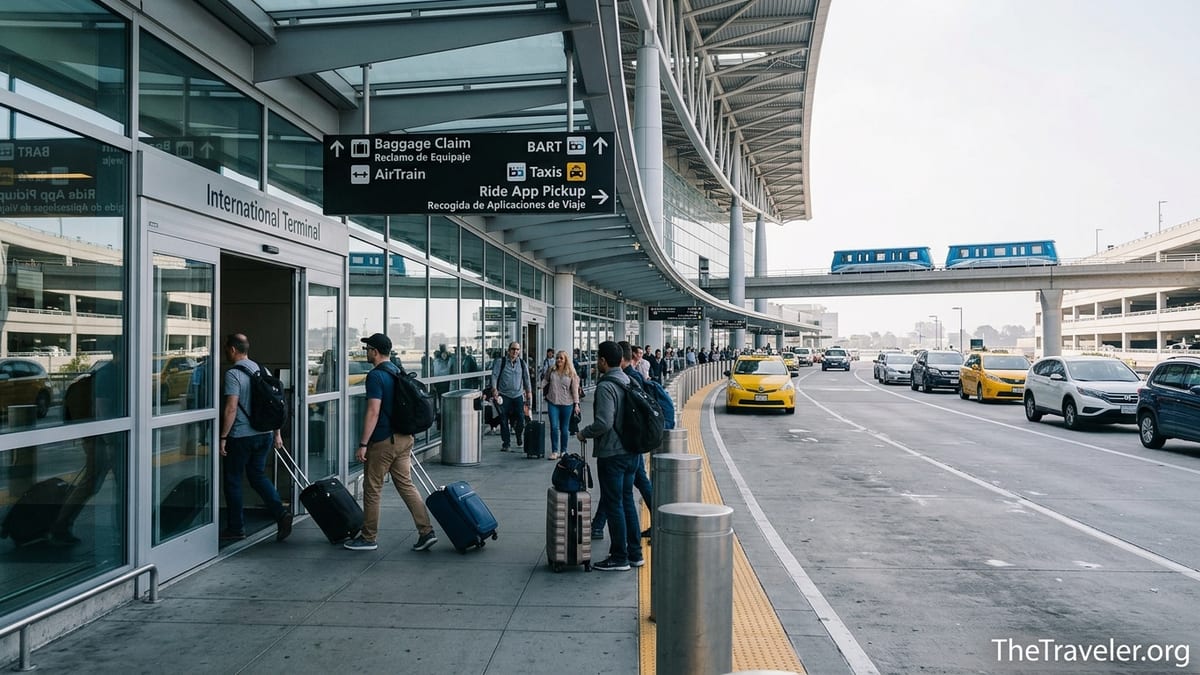
Understanding SFO’s Layout and What Happens Right After Landing
San Francisco International Airport has four terminals: the Dianne Feinstein International Terminal (with A and G boarding areas) and three domestic terminals (1, 2, and 3). All of them are linked by the free AirTrain system, which loops around the terminals, parking garages, the BART rail station and the Rental Car Center. In practice this means that even if you land in one terminal and your ride or connection is in another, you can reach it in a few minutes without leaving the airport campus.
Your first steps after landing depend on whether you arrive from within the United States or from abroad. Domestic passengers walk straight from the gate to the main concourse, then down to baggage claim on the arrivals level if they have checked luggage. International passengers, by contrast, are funneled into the Federal Inspection Area for immigration and customs before reaching the public arrivals hall. From there, everyone has access to the same ground transport options.
Because SFO is a hub for United and a major base for Alaska and Delta, peak arrival times cluster in the mid-morning and early evening. That means queues for immigration, taxis, and rideshares are usually longer around those times. Build in a buffer if you are planning same-day rail connections or time-sensitive meetings in the city.
Signage at SFO is generally clear, with color-coded icons for baggage claim, ground transportation, AirTrain, and BART. If you get turned around, look for the large overhead signs that say "Ground Transportation" or "BART" and follow the arrows. All major pathways between terminals and transport options are indoors or covered, which is useful on windy or rainy Bay Area days.
Immigration, Customs, and Baggage Claim for International Arrivals
If you arrive on an international flight, you will first go through U.S. Customs and Border Protection in the International Terminal. SFO uses automated passport control kiosks and mobile passport control for many nationalities, which can significantly speed up the process. Typical wait times can range from 10 minutes on a quiet afternoon to 45 minutes or more when multiple wide-body flights from Europe and Asia arrive together.
After passport control, you will proceed to the baggage carousels in the same secure area. Large monitors show flight numbers, and each international flight is assigned its own carousel. Baggage handling at SFO is generally efficient, but long-haul flights arriving at busy times can still see a 20 to 30 minute wait for the first bags. If your bag does not appear, the airline baggage office desks are located near the carousels, and staff will help you file a missing baggage report before you exit customs.
Once you collect your bags, you will walk toward customs. Here, officers may ask you about your trip and what you are bringing into the United States. Many travelers are simply waved through after declaring standard items, but you must declare foods, large amounts of currency, and commercial goods. After customs you will exit into the public arrivals hall on Level 2 of the International Terminal, where you can meet friends and access services such as SIM cards, ATMs, and currency exchange.
If you have a same-day connection on a separate ticket, allow generous time to clear immigration, collect bags, re-check with your next airline, and go back through security. SFO is compact for a major hub, but during busy periods the entire process from touchdown to reaching your next departure gate can still take two hours or more for international arrivals, especially if you need to change terminals.
Getting Cash, SIM Cards, and Connectivity at SFO
Once you are through arrivals, most travelers want two things: money and mobile data. SFO has both, but costs and convenience vary. For cash, you will find bank-branded ATMs in each terminal on the arrivals level, often near the baggage claim exits and information desks. These machines typically charge a local fee on top of whatever your own bank charges. A typical withdrawal fee might be around 3 to 5 dollars, so pulling out a larger amount at once is often more economical than multiple small withdrawals.
If you are arriving from abroad and need mobile service, look for mobile services counters and kiosks in the International Terminal arrivals hall. These outlets sell prepaid SIM cards and eSIM activations from major U.S. carriers or resellers. Exact brands on offer change over time, but you can expect to see options that run on large American networks with nationwide LTE and 5G coverage. A common short-stay package might include roughly 10 to 20 gigabytes of data for 10 to 15 days at a price in the 30 to 50 dollar range, though offers vary.
In addition, some currency exchange counters at SFO sell international SIM cards and portable Wi-Fi hotspots alongside their main business. The convenience is high, but prices can be steeper than buying an eSIM online before you travel or visiting a regular electronics store in the city. If your phone supports eSIM, it is often cheaper and easier to purchase an eSIM plan from a global provider before you land and simply use the airport Wi-Fi to complete activation if needed.
Free Wi-Fi is available throughout SFO. After landing you can connect to the airport network in the gate area, immigration hall, baggage claim, and arrivals level. The signal is generally good enough for messaging, ride-hailing apps, and basic browsing. If your banking app requires a one-time verification to use tap-to-pay or to enable a digital transit card, you can safely complete that process on the airport Wi-Fi before heading to ground transportation.
Using AirTrain to Move Between Terminals, BART, and the Rental Car Center
AirTrain is SFO’s free, automated people mover that runs 24 hours a day. It connects all four terminals, the two main parking garages, the BART station, the Grand Hyatt hotel, and the Rental Car Center. For a new arrival, this is often the fastest way to reach another terminal for a pickup, to head to BART, or to pick up a rental car without stepping outside.
There are two AirTrain lines, Red and Blue. The Red Line runs a shorter loop among the terminals, garages, and BART station. The Blue Line makes the full loop and continues to the Rental Car Center and long-term parking. Trains typically run every few minutes, so you rarely wait long. For example, if you arrive on a United international flight and need to pick up a Hertz rental car, you would follow the red AirTrain signs from the International Terminal up to the station, board any Blue Line train, and ride a few short stops to the Rental Car Center.
AirTrain stations are accessed by escalators and elevators from the main terminal levels, so it is fully accessible for travelers with luggage carts or mobility needs. Travel time between adjacent stops is only a minute or two. As a concrete example, a passenger arriving in Terminal 2 who wants to take BART to downtown San Francisco would simply follow signs to AirTrain, ride the Red Line one stop to the International Terminal/BART station, then follow signs down to the BART ticketing area.
Because AirTrain operates landside, you do not need to go through security to use it. This is useful if you are meeting someone who lands in a different terminal, or if you want to walk to a quieter terminal to find food or a lounge before heading into the city. Just remember where you started, as the terminals are labeled by number and letter, and it is easy to forget if you arrived at Terminal 1 or 2 after a long flight.
Taking BART and Other Public Transit from SFO
For many travelers, the Bay Area Rapid Transit system, or BART, is the most efficient way to reach downtown San Francisco or the East Bay. The SFO BART station sits inside the International Terminal, adjacent to Garage G. From the arrivals level in the International Terminal, you take the escalator or elevator up to Level 3, then follow signs that say "BART" to reach the station concourse.
BART trains typically run every 15 minutes or so during the day and less frequently late at night. Fares are distance-based and calculated automatically when you tap in with a Clipper card or a contactless bank card. As an example, a one-way adult fare from SFO to downtown stations like Powell Street or Montgomery Street is usually in the range of 10 dollars, though pricing can change over time. Travel time from SFO to downtown San Francisco is around 30 minutes, depending on your exact stop.
If you do not already have one, you can load a Clipper transit card onto your phone or buy a physical card at the BART station using vending machines. Many visitors now use a contactless credit or debit card instead of a separate transit pass, simply tapping in and out at the fare gates. From BART, you can connect to Muni Metro, buses, and cable cars once in the city, or continue on to Oakland, Berkeley, and other East Bay destinations.
Besides BART, SamTrans buses serve SFO and connect the airport to San Mateo County and downtown San Francisco. These buses are useful if you are staying along the Peninsula or looking for a low-cost option, though journey times can be longer than BART, especially in peak traffic. Bus stops are signposted on the arrivals level outside each terminal, with route numbers and destination names clearly displayed on the shelters and buses.
Taxis, Rideshares, Shuttles, and Hotel Transfers
SFO offers several options for door-to-door transport: traditional taxis, rideshare apps like Uber and Lyft, shared shuttles, and private hotel or corporate transfers. Each has a different pickup location and price range, and knowing the layout can save you time and confusion when you are tired from travel.
Taxi queues are located just outside the arrivals level of each terminal. Uniformed coordinators often manage the lines, directing passengers to the next available cab. For a typical ride into central San Francisco, expect to pay roughly 50 to 75 dollars before tip, depending on traffic and your exact destination. Taxis can be faster to access than rideshares in bad weather or late at night because you simply walk out, join the line, and go, without waiting on an app match.
Rideshare pickups at SFO are split between the domestic terminals and the International Terminal. For domestic Terminals 1, 2, and 3, app-based pickups are centralized on Level 5 of the Domestic Garage. After collecting your bags, you follow signs for "Ride App Pickup" or "Lyft/Uber" and take an elevator or walkway into the garage cores corresponding to your terminal. Once there, you request your ride and meet your driver in the marked zones. At the International Terminal, rideshare pickups are generally hosted at designated zones on the departures level center island, with signage marking the zones used by Uber, Lyft, and similar services.
Shared-ride shuttles operate between SFO and hotels or neighborhoods across the Bay Area. These can be cost-effective if you are traveling alone and do not mind additional stops on the way. You can pre-book online or look for shuttle company counters and self-service phones near the ground transportation area on the arrivals level. Many mid-range and upscale hotels near the airport run their own complimentary or low-cost shuttles, which typically pick up at clearly marked hotel shuttle zones outside each terminal.
Whichever option you choose, be wary of unofficial drivers who approach you inside the terminal offering rides for cash. Official taxis, shuttles, and rideshares will direct you to marked pickup areas, and any paid ride from the airport should be arranged either at a regulated taxi stand, a shuttle counter, or through a recognized app. If in doubt, ask an airport information desk to point you toward the correct, official ground transportation zone.
Rental Cars and When You Actually Need One
All major rental car brands at SFO, including the large international chains and U.S. favorites, are housed in a single Rental Car Center on the airport grounds. To get there, you take the AirTrain Blue Line from any terminal. The ride typically takes under 10 minutes, and because the trains run frequently, you rarely wait more than a few minutes for the next one.
Once you arrive at the Rental Car Center station, escalators and elevators bring you down into a multi-level building where each company has its counters and parking area. If you have a reservation, you can usually proceed directly to your company’s desk or, for loyalty members, sometimes straight to your assigned car in the garage. Walk-up rentals are also possible, but prices at the airport are often higher than in-city locations, especially during peak tourist periods or large conventions.
Before you rent, consider whether you truly need a car in San Francisco. Parking in the city center can cost 40 to 70 dollars per night at hotels, and many neighborhoods have strict street parking rules. For a typical three-day city break focused on areas like Union Square, Fisherman’s Wharf, North Beach, or the Mission, public transit, rideshares, and walking are usually more practical and cheaper. A rental car starts to make more sense if you plan to explore farther afield, such as Napa Valley, Sonoma, Point Reyes, or Big Sur, where public transit options are limited.
If you do rent, factor in tolls for Bay Area bridges and potential congestion on Highway 101 or Interstate 280, especially during weekday rush hours. Many rental car companies offer electronic toll pass options that automatically bill your card. This can be convenient if you plan multiple bridge crossings, but always read the fine print so you understand daily fees and markups on the tolls themselves.
The Takeaway
Arriving at San Francisco International Airport is far less daunting once you know the sequence. International travelers clear immigration and customs, domestic travelers head straight to baggage claim, and everyone eventually converges on the same arrivals level with clear signage to ground transportation. From there, you choose the combination of connectivity, cash, and transport that best matches your plans and budget.
For many visitors, the smartest move is to get online using the free airport Wi-Fi, decide whether BART or a taxi or rideshare fits your destination and schedule, and only then move toward ground transportation. If you are staying in central San Francisco and traveling light, BART is often the fastest and most predictable way in. If you are jet-lagged, carrying heavy luggage, or arriving late at night, a taxi or rideshare to your hotel door may be worth the extra cost.
Above all, remember that SFO is designed for easy transfers between terminals, rail, and road. With AirTrain linking everything, you can always backtrack, change plans, or meet your group in a different terminal without too much hassle. Build in a little extra time, especially during peak hours, and your arrival in the Bay Area will be smoother and far less stressful.
FAQ
Q1. How long does it usually take to get from landing to the arrivals hall at SFO?
For a domestic flight with only carry-on luggage, you can often reach the public arrivals area in 15 to 25 minutes. For international arrivals, including immigration, baggage claim, and customs, plan anywhere from 45 minutes to 2 hours, depending on how many flights land at the same time and how quickly bags are delivered.
Q2. If I land in the International Terminal, can I still take BART to downtown San Francisco?
Yes. The BART station is located in the International Terminal. After exiting customs, you go up to the departures level and follow the signs to BART. From there, trains run directly to downtown San Francisco stations like Powell Street and Montgomery Street, usually in about 30 minutes.
Q3. Where do Uber and Lyft pick up passengers at SFO?
For domestic Terminals 1, 2, and 3, rideshare pickups are centralized on Level 5 of the Domestic Garage, accessed via walkways and elevators from each terminal. At the International Terminal, pickups are generally at designated zones on the departures level center island, with airport signage directing you to the correct curb for app-based rides.
Q4. Is it better to take a taxi or BART into the city?
It depends on your priorities. BART is usually cheaper and avoids traffic, making it a strong choice if you are traveling light and staying near a downtown station. A taxi is more expensive but offers door-to-door service, which is helpful if you have heavy luggage, are traveling with a family, or arriving very late at night when trains are less frequent.
Q5. Can I get a local SIM card or eSIM at SFO when I arrive?
Yes. In the International Terminal arrivals hall you will find mobile services outlets and some currency exchange counters that sell prepaid SIM cards and sometimes eSIM activations or portable Wi-Fi devices. Packages and brands change regularly, but you can expect options suitable for short-term visitors. Prices tend to be higher than buying an eSIM online before your trip.
Q6. How do I reach the Rental Car Center from my arrival terminal?
You take the AirTrain Blue Line. Follow the red AirTrain signs from baggage claim to the nearest station, then board any Blue Line train. The Rental Car Center has its own stop, and the ride from most terminals takes under 10 minutes. From the station, escalators and elevators bring you directly into the rental building.
Q7. Do I need a rental car to visit San Francisco?
For most city-focused visits, you do not. Neighborhoods like Union Square, SoMa, Chinatown, and the Embarcadero are well served by BART, Muni buses and light rail, and rideshares. Parking is expensive and often limited. A rental car is more useful if you plan day trips to wine country, the coast, or national and state parks outside the urban core.
Q8. Is there somewhere to get cash at SFO after I land?
Yes. ATMs are available in every terminal on the arrivals level, typically near baggage claim exits and information desks. If you need foreign currency exchange, you will find exchange counters in the International Terminal. Keep in mind that both ATMs and exchange offices may charge fees or offer less favorable rates than city banks.
Q9. How late does BART run from SFO at night?
Operating hours can change, but BART typically runs until around midnight, with reduced frequency later in the evening. If your flight arrives very late, it is wise to check the current BART schedule before you travel and have a backup plan such as a taxi or rideshare in case you miss the last train.
Q10. Are there hotel shuttles from SFO, and where do they pick up?
Many hotels near the airport offer free or low-cost shuttles. These usually pick up at marked hotel shuttle zones outside each terminal on the arrivals level. After collecting your bags, follow the signs for "Hotel Courtesy Shuttles" and check the signage or digital boards that list arriving shuttles by hotel name.