


Arturo Merino Benítez International Airport in Santiago is the main gateway to Chile, but for many first-time visitors the trip into the city can be the riskiest part of their stay. Aggressive unofficial taxi drivers, confusing offers in the arrivals hall and inflated or fraudulent card charges have all been reported in recent years. With a little preparation, though, you can walk through the terminal confidently and choose safe, fairly priced transport.
Get the latest updates straight to your inbox!
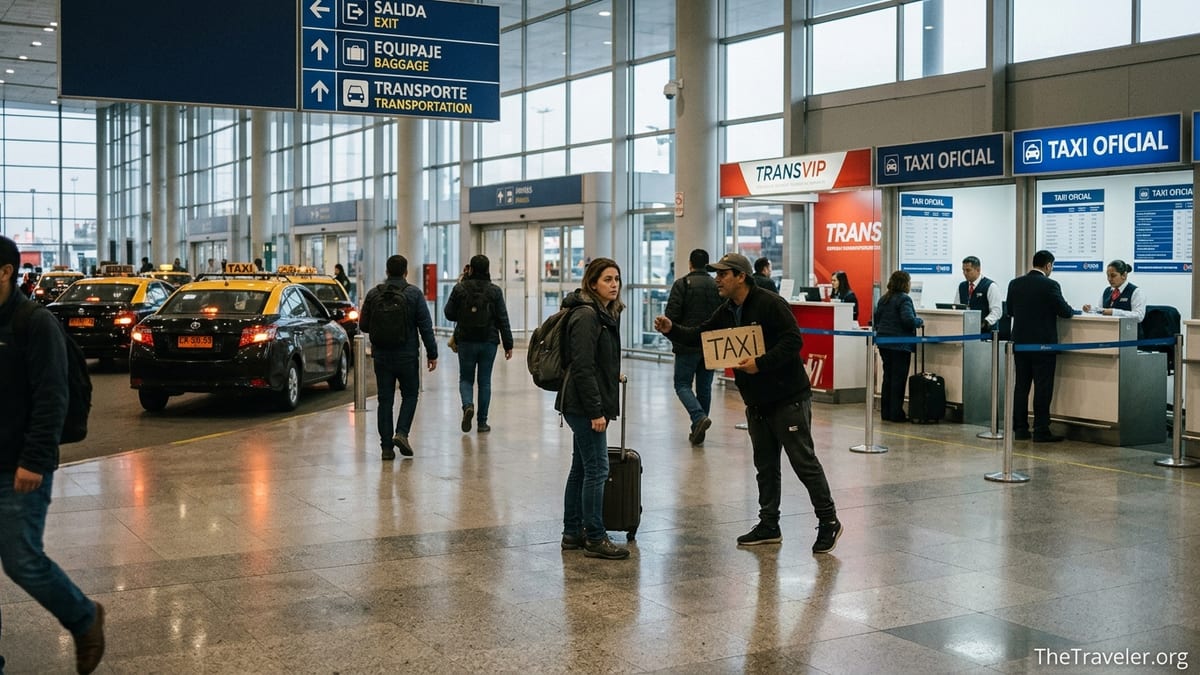
Why Santiago Airport Attracts Taxi Scams
Santiago’s Arturo Merino Benítez International Airport is about 15 to 20 kilometers from downtown, depending on where you are staying. The ride can take between 20 and 40 minutes in normal traffic. That combination of distance, jet-lagged passengers and unfamiliar currency has created fertile ground for taxi scams, especially around the international arrivals area. Local and foreign travelers have reported being charged hundreds or even thousands of US dollars for a single ride after landing.
In June 2024, Chilean radio and television outlets covered the dismantling of a group of so‑called pirate taxi drivers who targeted tourists at the airport and processed card payments worth several thousand dollars for a simple ride into town. In some cases drivers told passengers that foreign cards were not accepted normally and then used tampered card terminals to overcharge them. The passengers only discovered the real amount days later when checking their bank statements. Stories like this underline why it is essential to understand how scams work before you arrive.
Although Chile is considered safer than many regional neighbors and official airport transport is generally reliable, opportunistic drivers know that a tired traveler emerging from a long-haul flight is more likely to accept the first offer that sounds helpful. The combination of language barrier, unfamiliar layout and the pressure of people calling out “Taxi, taxi, official taxi!” can quickly overwhelm anyone who has not researched the airport in advance.
The good news is that Santiago’s airport authority, the city tourism board and several foreign embassies consistently advise using a small set of official options that have clear price structures. Once you know where these counters and stops are located and roughly what a ride should cost, it becomes much easier to ignore the noise and walk straight to a safe choice.
How Unofficial Taxi Scams Typically Work
Most scams begin immediately after you leave customs. Before you reach the public arrivals hall you will pass through a corridor lined with official counters, including the desks of licensed taxi and shuttle companies. If you keep walking out to the main hall without arranging transport here, you become a prime target. Unofficial drivers, and sometimes people posing as airport staff or hotel representatives, approach with friendly small talk and offers that sound straightforward: “Fixed price to your hotel,” “Cheaper than the counter,” or “Official taxi, follow me.”
One of the most commonly reported patterns is the card terminal overcharge. A traveler agrees on what seems like a fair price in Chilean pesos, for example 25,000 CLP to a central neighborhood such as Lastarria or Providencia. At the end of the ride, the driver tells them that foreign cash is not accepted or that cards must be processed in a particular way. The driver then shields the card terminal screen, quickly enters a much larger amount and asks the passenger to enter their PIN. In several real cases reported in local media and travel forums, amounts equivalent to several thousand US dollars were charged this way.
Another variation involves drivers who are not licensed to operate at the airport at all. These pirate taxis wait in the car park or at the exit doors and guide passengers away from the official taxi rank. They may use unmarked cars or vehicles with homemade signage on the dashboard. Some will show a plastic badge or lanyard that looks official at a glance but is not tied to any of the accredited airport operators. Once the ride begins, the driver may inflate the fare, claim that tolls are extra at a very high rate or simply refuse to accept the originally agreed price.
A third pattern is the emotional pressure tactic. In this scenario, a driver or tout approaches directly at the luggage carousel exit, insists that all other services are closed or fully booked and walks quickly ahead, expecting you to follow. When you show hesitation, they may imply that the neighborhood you are going to is unsafe or that buses do not run at that time of night. First‑time visitors, especially solo travelers, can feel cornered into accepting because they do not know that official taxi counters and 24‑hour bus services are still operating a short walk away.
Recognizing Official Airport Transport in Santiago
The single most important step to stay safe is to distinguish between official airport transport and everything else. Inside the terminal, immediately after you clear customs and before you exit to the public arrivals hall, you will find licensed counters for official taxis and shared shuttle vans. Names and operators can shift over time, but at the time of writing, counters for services such as Taxi Oficial and several pre‑booked shuttle brands are located in this secure area. Staff stand behind branded desks, issue a printed receipt with your destination and price, and direct you to a marked pickup zone.
When you arrange a taxi or shuttle at these counters, you normally prepay or at least receive a ticket stating the fixed price. For example, many visitors report paying within a broad range that can start around 20,000 to 30,000 Chilean pesos for a standard taxi from the airport to central areas like Bellas Artes or Providencia, depending on the time of day, number of passengers and luggage. Larger vans and private transfers to neighborhoods farther east, such as Las Condes or Vitacura, can cost more, and some conference organizers note example prices in the 40,000 to 60,000 Chilean peso range for pre‑arranged private vehicles. What matters is that the amount is known in advance and does not change once you are in the car.
Outside the building there is a designated rank for official airport taxis. These vehicles are usually clearly marked with branding such as “Taxi Oficial” on the doors or roof and have visible company telephone numbers. Chilean regulations also require commercial taxis to display orange or yellow license plates, which is another sign that the vehicle is authorized to carry passengers. A legitimate driver will not pressure you away from the taxi line, will accept the printed ticket you received inside and will not renegotiate the price on the curb.
In addition to taxis, two long‑running airport bus services link Santiago Airport with the city. Centropuerto and Turbus operate frequent buses to downtown terminals connected with Line 1 of the Santiago Metro, including stops around the Los Héroes and Alameda areas. These buses have branded ticket counters or machines at the airport and clearly signed platforms outside the terminal doors. Fares are typically far lower than a taxi; even with slight increases over time, most travelers find that a one‑way ticket costs only a fraction of a private ride. For solo travelers or budget visitors arriving in daytime or early evening, these buses are among the safest and best value options.
Arrival Hall Pressure: What It Feels Like and How to Respond
Travel advisories from several governments note that unauthorized drivers are particularly active in the arrivals area at Santiago Airport. As soon as you pass through the sliding doors into the public hall, you may be greeted by a line of people holding printed signs for tour groups and private transfers. Mixed among them are freelance drivers who call out to anyone without a sign: “Taxi? Official taxi? City center?” It can feel chaotic, especially after a long flight, and the pressure to choose quickly can be intense.
The key is to remember that you are not required to speak with anyone in the public hall to arrange safe transport. If you have not already booked a transfer, you can simply stay on the inside of the barrier and follow the overhead signs back toward the official transport counters, which are still within the secure area. If you have already left that zone, you can step aside, keep walking without making eye contact and avoid responding to repeated offers. Polite but firm phrases such as “No, gracias” or “Ya tengo transporte” are enough. Legitimate drivers contracted through the counters will not shout or chase you; they will hold a sign with your name or wait at the official rank.
Real‑world reports describe how some pirate drivers stand close to the official signage and even point in the same direction while leading passengers elsewhere. Others may claim that the official taxi counter is closed for the night or that buses are not operating because of protests or road closures. There have been cases where scammers wore jackets with generic airport‑style logos or lanyards that resemble ID badges but do not match any of the major operators. If someone approaches you out of nowhere and insists that their service is official, your safest response is to decline and instead look for fixed counters, large printed price boards and uniformed staff behind desks.
Another subtle form of pressure comes when a tout helps you with your luggage without being asked, walking ahead toward a car park. Once your bags are inside a vehicle, it becomes much harder to walk away, even if you are unsure about the price. To avoid this, hold on to your bags until you are satisfied with the company name, have a printed ticket or receipt and can clearly see that the vehicle is marked as an official taxi or shuttle. If someone grabs your bag handles or trolley without permission, calmly but clearly say that you will manage on your own.
Safe Alternatives: Buses, Pre‑Booked Transfers and Ride‑Hailing
Official airport buses are one of the safest and most budget‑friendly ways to leave Santiago Airport. Centropuerto operates routes between the terminal and key points such as the Los Héroes area, with services as frequent as every 10 minutes during busy daytime periods and extended schedules into the early morning hours. Turbus runs a similar route between the airport and central bus terminals along the Alameda corridor. Both companies load passengers at clearly signed platforms just outside the arrivals area, and you pay a fixed fare either at the counter, at a machine or directly to a staff member by the bus door.
For travelers carrying heavy luggage, arriving late at night or heading straight to more distant neighborhoods, pre‑booked private transfers are a strong option. International and local transfer companies allow you to reserve a car or van in advance, provide your flight details and receive a confirmation with the final price. Drivers then wait in the arrivals hall with a sign bearing your name and walk you directly to the vehicle. Large business and academic events in Santiago often recommend specific transfer partners to participants and list example prices to hotels in the city, which helps set expectations and avoids haggling during a busy conference period.
Ride‑hailing apps such as Uber, Cabify or DiDi operate in Santiago, though their legal status in Chile has been a gray area for several years. Many locals use them daily in the city because fares are shown upfront in the app and payments are processed electronically, reducing the scope for on‑the‑spot negotiation. At the airport, however, ride‑hailing pickups often occur in the general car parks rather than at the main taxi rank, and drivers and passengers sometimes coordinate by message to pinpoint the exact meeting point.
If you decide to use a ride‑hailing service on arrival, it is wise to wait until you are in a safe, well‑lit area inside the terminal before opening the app and ordering. Check the driver’s name, vehicle model and license plate carefully and do not get into any car that does not match what the app shows. Some visitors prefer to walk to a designated meeting point such as a higher‑level car park once they have confirmed the car’s location. Others choose to avoid ride‑hailing on arrival entirely and instead use official taxis or buses, switching to ride‑hailing only after they have reached their hotel.
Paying Safely: Cash, Cards and Common Tricks
Many of the worst taxi scams in Santiago reported in recent years involve payment by card. Drivers or accomplices manipulate card terminals to charge far more than the agreed fare, then distract the passenger while the transaction is processed. Techniques include covering the screen with a sticker that hides extra zeros, rapidly entering a much larger figure than stated, or claiming that the machine failed and needs the PIN to be entered again. In some extreme situations, tourists have been charged the equivalent of several thousand US dollars for a single ride from the airport to the city.
The safest strategy is to avoid paying individual taxi drivers with your card where possible. If you use an official airport taxi counter inside the terminal, you can often prepay for the ride with cash or card at the desk, receive a proper receipt and then simply hand your ticket to the driver at the vehicle. This setup greatly reduces the opportunity for the kind of terminal manipulation that occurs in the car or on the sidewalk. If you must pay a driver directly by card, insist on entering the amount yourself or seeing the full figure on the screen before you insert your card or tap.
Carrying some local cash when you land is also useful. ATMs within the secure area of the airport allow you to withdraw Chilean pesos before you reach the public hall, and currency exchange booths are available, though their rates may be less favorable than in the city. Having enough cash to cover at least your first transport and a small meal can help you decline suspicious card payment setups. If a driver refuses to accept cash after previously agreeing to do so, that is a clear warning sign that something is not right.
As a backup, take a quick photo of the taxi’s license plate and the driver’s visible ID card before departure, and keep the printed ticket from the official counter if you used one. If you later notice an irregular charge on your card, these details can be very helpful when speaking with your bank or, if necessary, filing a report with local police. Travelers who have done this in past incidents in Santiago have described how officers at the airport police unit were familiar with such scams and could at least document the complaint to support chargeback requests.
The Takeaway
For all the worrying stories, it is entirely possible to arrive at Santiago’s airport and reach your hotel smoothly, even as a first‑time visitor. The key is not to improvise in the arrivals hall or accept offers from anyone who approaches you there. Instead, decide in advance whether you will use an official taxi booked at the counter, a shared shuttle, a reputable pre‑booked transfer or one of the airport buses, and then walk directly to that option when you land.
Remember a few core points: official services are arranged at desks inside the terminal or at clearly marked bus platforms; prices are fixed or at least displayed in writing; and legitimate drivers do not need to chase passengers or apply pressure. If a situation feels confusing or rushed, step back, keep your luggage with you and look for airport staff or information desks rather than following an insistent stranger to the car park.
By learning how pirate taxis at Santiago Airport typically operate, recognizing official signage and company names, and setting firm rules about how you will pay, you dramatically reduce your risk of being scammed. That means you can focus on what really matters: enjoying Santiago’s museums, cafes and mountain views, instead of spending your first days in Chile on the phone with your bank.
FAQ
Q1. Is it safe to take a taxi from Santiago Airport into the city?
It is generally safe if you use official services booked at the counters inside the terminal or clearly marked taxis at the official rank. Problems mostly arise with unofficial drivers who approach passengers in the arrivals hall or car parks.
Q2. How much should a taxi from Santiago Airport to downtown cost?
Prices vary by neighborhood, time of day and vehicle type, but many visitors pay somewhere in the tens of thousands of Chilean pesos for central areas. If a driver is asking for several hundred US dollars or cannot give a clear price in pesos, you should walk away.
Q3. Where do I find official taxis when I land at Arturo Merino Benítez Airport?
After collecting your luggage and clearing customs, look for the official taxi and shuttle counters in the secure area before the public arrivals hall. Outside, use only the marked taxi rank directly in front of the terminal and avoid anyone steering you toward unmarked cars.
Q4. Are the Centropuerto and Turbus airport buses safe?
Yes, these long‑established bus services are considered safe and are widely used by locals and tourists. They operate from clearly signed platforms outside the terminal and run to major transport hubs in the city where you can connect to the metro or other buses.
Q5. Can I use Uber or other ride‑hailing apps at Santiago Airport?
Ride‑hailing apps operate in Santiago, and some travelers use them from the airport by meeting drivers in parking areas. However, because they do not pick up at the main taxi rank and their legal status has been debated, many first‑time visitors prefer official taxis, shuttles or buses on arrival.
Q6. How can I avoid being overcharged by a taxi driver?
Arrange your ride at an official counter where the price is fixed, or at least agree the fare clearly in Chilean pesos before getting into the car. Avoid drivers who refuse to state a price, insist on only card payment or try to renegotiate midway through the trip.
Q7. Is it better to pay for my airport taxi in cash or by card?
Paying in cash or prepaying at an official counter is usually safer because it removes the opportunity for a driver to misuse a card terminal. If you do pay by card, insist on seeing and confirming the amount on the screen before entering your PIN or tapping.
Q8. What should I do if I realize I have been scammed by a taxi at the airport?
As soon as you notice a suspicious charge or realize the fare was far above what was agreed, contact your bank to report it and ask about reversing the transaction. If possible, file a report with local police or the airport police unit and provide details such as the taxi plate number, time, date and any receipts.
Q9. Are late‑night arrivals at Santiago Airport more risky?
Scammers can operate at any time, but late at night you may encounter fewer official staff and bus departures. If you land very late, consider booking an official taxi or private transfer in advance so a driver is waiting for you, or confirm the overnight timetable for airport buses before you travel.
Q10. I do not speak Spanish. Can I still arrange safe transport easily?
Yes. Staff at official taxi and shuttle counters are used to international travelers and usually handle basic English. Having your hotel address printed on paper or on your phone, plus an idea of typical prices and the names of official services, will help you communicate and avoid confusion.