


More news on this day
Europe’s new digital border system is now fully operational across the Schengen Area, reshaping how millions of visitors enter and exit countries such as Sweden, Finland, Spain and Croatia through biometric checks and automated stay tracking.
Get the latest news straight to your inbox!
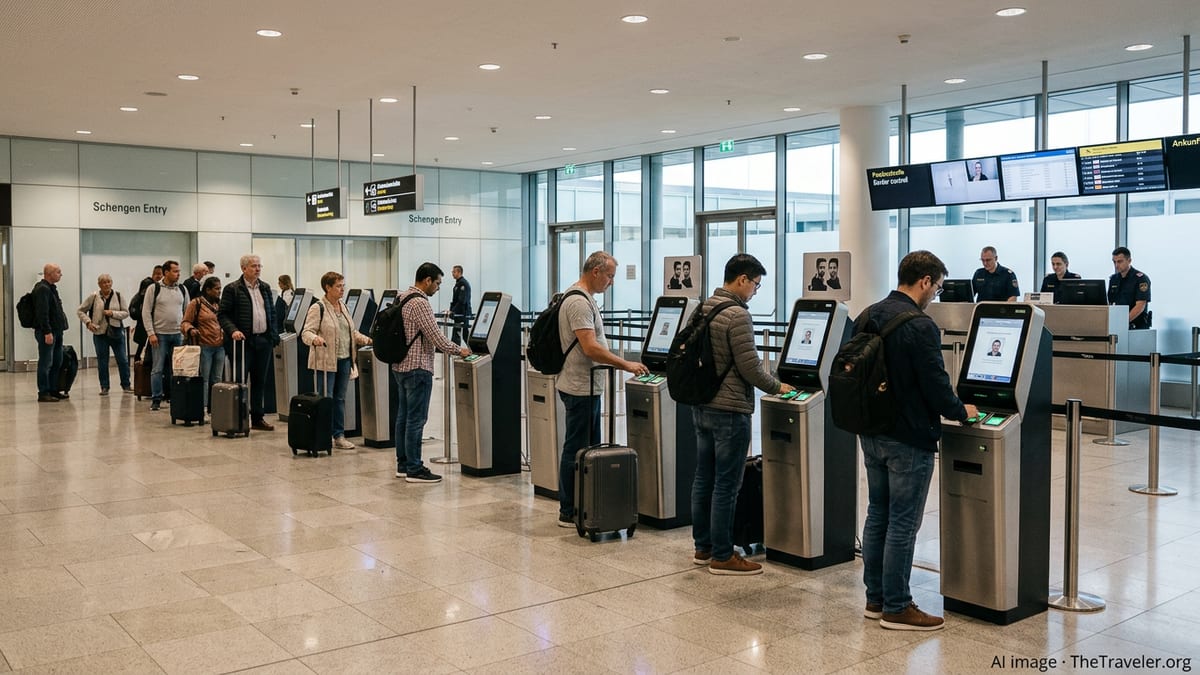
From passport stamps to biometrics across Schengen
The European Union’s Entry Exit System, known as EES, has moved Schengen’s external borders from ink stamps to a fully digital register for most non EU and non EEA travelers. The system logs each entry and exit for short stays, replacing manual stamping with a central database of travel history.
Publicly available information from European institutions describes EES as a large scale IT platform built to register when and where a traveler crosses an external border, how long they are allowed to remain in the area and whether they have previously overstayed. The data set includes personal details taken from the travel document, along with biometric identifiers.
For travelers arriving by air, land or sea, the most visible change is an additional registration step at the first Schengen border they cross. This initial enrollment records facial images and four fingerprints, after which returning visitors are expected to pass through the border more quickly on future trips as their data are already stored.
Authorities across the bloc continue to operate EES in a progressive, location by location rollout, but the system is now in effect at the vast majority of external checkpoints. The change is especially noticeable at major hubs in Spain and key sea and land crossings in the Nordics and the Balkans.
What visitors to Sweden and Finland should expect
In northern Europe, airports in Sweden and Finland are applying the new digital procedures to third country nationals, including travelers from the United States, the United Kingdom, Canada and many Asian countries. At airports such as Stockholm Arlanda and Helsinki Airport, arriving passengers who require EES registration are directed to dedicated lanes or kiosks for biometric capture before proceeding to a border guard booth.
Airport operators in the region have circulated guidance advising passengers to allow more time for border controls, particularly on their first trip since EES went live. Reports indicate that the extra steps can add several minutes per passenger during quiet periods, but queues may lengthen significantly during peak holiday traffic or when multiple long haul flights arrive together.
Travelers should also be aware that EES does not alter existing visa rules, but it does tighten the monitoring of time spent in the Schengen Area. The familiar rule that many non EU nationals may stay up to 90 days within any rolling 180 day period still applies. With digital records, however, calculations are now based on precise entry and exit data rather than stamped pages, reducing room for error at the border.
For visitors who combine Sweden or Finland with non Schengen destinations such as the United Kingdom, the system’s focus on the first external Schengen entry point matters. A traveler flying from New York to London and then transiting to Stockholm, for example, will complete EES registration when entering the Schengen zone, not when boarding the initial transatlantic flight.
Spain’s busy airports at the center of the change
Spain, one of Europe’s largest tourism markets, has become a focal point for EES implementation. Major airports serving holiday traffic, including Madrid Barajas, Barcelona El Prat and coastal gateways such as Malaga and Palma de Mallorca, are now handling millions of passengers under the new rules.
Coverage in European media highlights early bottlenecks at some Spanish and other southern European airports as staff and travelers adapt to the technology. Reports describe cases of long queues at passport control when biometric capture points become saturated, particularly on weekends and during school holidays when flows of non European visitors surge.
Airport authorities and airlines are responding by advising travelers to arrive earlier and by adjusting queue layouts to separate first time EES registrations from subsequent crossings. Industry groups have called for continued investment in automated gates, clearer signage and better coordination between airports and governments to prevent missed connections.
For travelers planning multi stop itineraries across Spain and neighboring Schengen states, the new system brings both challenges and potential benefits. Once the initial registration is complete, automated gates using facial recognition or electronic passport readers are intended to speed up later crossings, especially for passengers who repeatedly visit popular leisure destinations.
Croatia’s new Schengen status meets digital borders
Croatia joined the Schengen Area relatively recently and has been integrating EES as part of its broader shift to common European border rules. The change is particularly visible for visitors arriving by road from non Schengen neighbors or by sea to Adriatic ports that host large volumes of cruise and ferry traffic.
Travel information published for Croatia notes that non EU travelers entering the Schengen zone via Croatian airports or land crossings will undergo the same biometric enrollment as in longer standing member states. For drivers, this can mean slower processing at busy road checkpoints as new infrastructure is introduced and staff work with unfamiliar hardware.
Tourism organizations in the country have been working to explain the new procedures ahead of peak summer travel. Guidance generally advises visitors to keep passports ready, follow signs indicating EES or biometric control, and factor additional time into journeys to and from popular coastal regions such as Dalmatia and Istria.
Because Croatia now shares a common external border regime with other Schengen states, travelers who enter through the country can move onward to destinations including Slovenia, Italy or Austria without facing additional systematic border checks. EES registration at the first entry point effectively covers the entire Schengen itinerary.
Practical tips and what comes next for travelers
For visitors heading to Sweden, Finland, Spain, Croatia or any other Schengen destination, the most practical step is to build extra time into journeys that involve crossing the external border. Travel advisories from airports and airlines commonly recommend arriving earlier than before and paying close attention to signage pointing to EES or biometric registration lanes.
Passengers should ensure that passports are valid for the duration required and undamaged, as the new system relies heavily on machine readable data. Removing hats, masks and sunglasses when prompted can help speed up facial image capture, and travelers accompanying children should be prepared for additional time at manual booths, since automated gates are often restricted by age.
Looking ahead, EES is also laying the groundwork for the European Travel Information and Authorisation System, or ETIAS, a separate electronic pre travel clearance for visa exempt visitors that is scheduled to follow once the border database is fully bedded in. Together, the two systems are intended to shift more checks away from the physical border and into pre screening and automated risk analysis.
For now, the expansion of Schengen’s digital border controls is most immediately felt in longer queues and unfamiliar procedures at key gateways. As Sweden, Finland, Spain and Croatia adjust their border operations and travelers become accustomed to biometric registration, the balance between tighter controls and smoother journeys will be closely watched across Europe’s tourism industry.