


More news on this day
Amsterdam’s Schiphol Airport is again at the center of major travel disruption, with cascading delays and targeted cancellations leaving passengers stranded on key European and intercontinental routes this weekend.
Get the latest news straight to your inbox!
Targeted Cancellations Hit Core Network Links
Reports from airline trackers and travel industry coverage indicate that Schiphol has been one of Europe’s most heavily disrupted hubs in the current wave of aviation turmoil, with selective cancellations and rolling delays rippling across the route network. Flights serving important leisure and business markets, including several Spanish coastal cities, Greek destinations and northern European capitals, have seen schedule changes and extended departure holds.
Coverage from aviation analysts highlights that these are not isolated point-to-point issues but concentrated on routes that act as feeders into long haul services. Connections linking Amsterdam with cities such as Madrid, Malaga, Athens and Leeds have been affected, making it harder for travelers to reach onward flights to North America, Africa and the Middle East. As aircraft and crews are repositioned, some departures are operating significantly behind schedule while others are removed from the timetable at short notice.
On certain days, airlines sharing the Schiphol hub have jointly reduced frequencies on overlapping routes, effectively trimming capacity in an attempt to stabilize the operation. That approach limits choices for passengers who suddenly find that alternative departures are fully booked or depart too late to preserve their itineraries.
Separate reporting on Europe wide disruption underscores how a single constrained hub can magnify the impact of operational problems. When Schiphol experiences congestion or systems strain, knock on effects quickly reach other airports that depend on Amsterdam as a transfer gateway, compounding the overall disruption picture.
Passengers Left Stranded as Missed Connections Pile Up
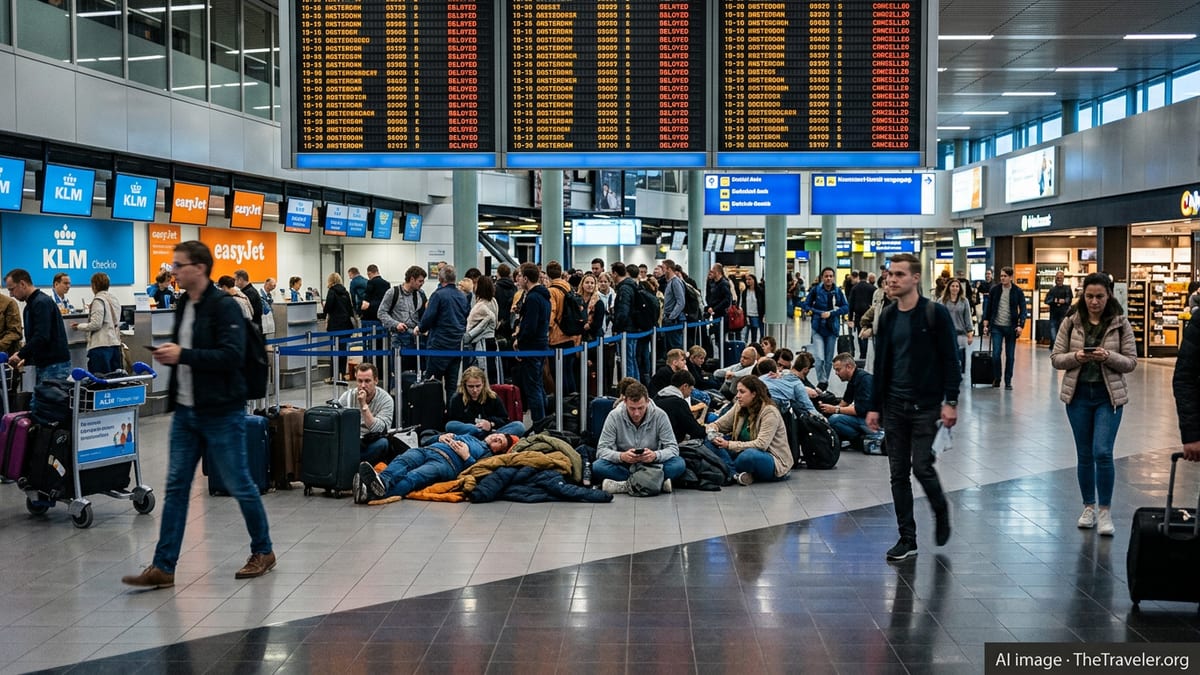
The most visible consequence for travelers has been the growing number of people stranded in terminals or forced into unexpected overnight stays when their connecting flights fail to materialize. Publicly shared accounts from passengers describe long queues at service desks, difficulty securing rebookings on the same day and uncertainty over accommodation and baggage handling.
Travel forums and social media posts referencing the latest disruption wave at Schiphol point to missed long haul departures after relatively short delays on feeder flights. A flight departing late from a nearby European city can arrive in Amsterdam after its onward service has already closed, leaving travelers in transit with limited options, particularly on routes that operate only once daily.
Some passengers report being reprotected via alternative hubs such as Frankfurt, Paris or London, adding extra connections and hours of travel time to already lengthy journeys. Others have opted to abandon itineraries entirely and seek refunds, especially where the purpose of travel such as a short city break or a time sensitive business meeting has already been undermined.
The strain is not confined to airside operations. Accounts from recent disruption episodes at Schiphol describe crowded landside areas, with travelers searching for last minute hotel rooms around Amsterdam or attempting to continue their journeys by rail. Local community discussions show residents offering spare rooms to travelers when nearby accommodation reaches capacity, illustrating the scale of the dislocation.
Knock On Effects for Long Haul and Seasonal Traffic
The timing of the latest Schiphol disruption coincides with the ramp up of summer schedules, when airlines rely on smooth hub operations to feed seasonal services. Published route data shows that many of the flights affected are those that channel passengers from secondary European cities onto long haul departures to destinations in North America, East Africa and popular holiday regions.
Industry commentary notes that even a relatively small number of cancellations on these feeder routes can have an outsized impact on long distance traffic. If a key inbound service from a regional city is canceled, dozens of travelers booked through to a single long haul destination may fail to reach Amsterdam in time, leaving widebody aircraft departing with empty seats or prompting last-minute rebookings that overwhelm call centers and airport staff.
Travel coverage of today’s broader European aviation disruptions highlights that congestion at major hubs, including Schiphol, is contributing to systemic delays across the continent. Aircraft that depart late from Amsterdam arrive late at their next destinations, pushing back subsequent departures in a chain reaction that can extend well into the night and into the following operating day.
For travelers, this translates into prolonged uncertainty on routes that are already heavily booked for the peak season. Some are now facing multi day delays when initial cancellations force them onto later flights that are themselves capacity constrained, particularly on popular sun destinations and key transatlantic links.
Operational Pressures Expose System Vulnerabilities
Aviation analysts point to a combination of factors behind Schiphol’s renewed difficulties, including tight staffing, high aircraft utilization and a network still adjusting to shifts in demand and airspace availability. While the specific trigger for each day’s disruption can vary, the result is a familiar pattern of bottlenecks at security, congestion on the apron and heavy reliance on precise aircraft rotations.
Recent Europe wide reporting on airport disruptions suggests that Schiphol’s role as a dense transfer hub leaves it especially exposed when any part of the system falters. A localized technical issue, weather disruption at a partner airport or air traffic control constraints can quickly propagate into large numbers of delayed and canceled flights, particularly when there is limited spare capacity in the schedule.
Commentary from passenger rights advocates and travel experts notes that these recurring episodes raise questions about resilience planning. Airlines and airports are under pressure to demonstrate that contingency measures such as additional staff, spare aircraft and more conservative scheduling are sufficient to prevent minor incidents from escalating into large scale disruption events.
Industry observers also point out that Schiphol is not alone. Parallel coverage of major operational breakdowns at airports in North America and elsewhere illustrates a global pattern in which highly optimized hub systems struggle to absorb sudden shocks, leaving travelers bearing the brunt when things go wrong.
What Travelers Can Do if Their Route Runs Through Schiphol
Travel advisories circulating in response to the latest disruptions recommend that passengers transiting Schiphol build extra buffer time into their itineraries wherever possible. Itineraries with tight minimum connection times are particularly vulnerable when the airport experiences congestion, making it harder for travelers to reach onward flights in case of even short delays.
Consumer travel guidance also emphasizes the importance of monitoring flight status through multiple channels, including airline apps and airport departure boards, and being prepared with fallback options such as alternative routings or nearby hubs. In several recent cases, travelers who were able to switch to flights via other European airports at the first sign of trouble avoided longer delays later in the day.
For those already stranded, published advice stresses documenting expenses for meals, hotels and ground transport, as these records may be important when seeking reimbursement. Travelers are also encouraged to review the conditions of carriage and applicable passenger rights rules to understand what assistance or compensation might apply in the case of prolonged delays or cancellations.
With Schiphol remaining a critical node in Europe’s air transport network, further disruption cannot be ruled out as airlines and airport operators work to stabilize operations. For now, publicly available information indicates that passengers booked on key routes through Amsterdam face a heightened risk of schedule changes and should plan accordingly.