


More news on this day
Hundreds of travelers faced lengthy waits and missed connections at Amsterdam Schiphol Airport after operational data showed 252 flights delayed and 20 canceled in a single day, disrupting services for major carriers including KLM, Delta Air Lines, Lufthansa, British Airways, easyJet and several others on domestic, European and long haul routes.
Get the latest news straight to your inbox!
Operational Turbulence Hits One of Europe’s Busiest Hubs
The disruption, recorded in early June, highlights the continued fragility of Europe’s air travel network as Schiphol once again emerged as a focal point for cascading delays. Airport performance data and flight-tracking services point to a day when the number of disrupted services at Amsterdam climbed into the hundreds, with delayed departures far outnumbering outright cancellations.
The 252 delayed flights represented a significant share of Schiphol’s daily schedule, affecting both arrivals and departures. While the 20 cancellations accounted for a smaller proportion of total movements, the knock-on impact was magnified by the airport’s role as a transfer hub linking secondary European cities with intercontinental destinations in North America, Asia and Africa.
Publicly available information indicates that the delays were driven by a combination of tight scheduling, wider European capacity constraints and reactionary disruption from earlier in the week. In practice, that meant aircraft and crews arriving late from elsewhere in Europe, leaving Schiphol with limited slack to absorb even minor schedule changes.
Data from passenger-rights services tracking real time performance show that Amsterdam has experienced repeated spells of heavy disruption in recent months, with days of elevated delays and cancellations feeding into a broader pattern of strained operations at major European hubs.
Major Airlines See Networks Disrupted
The day’s disruption at Schiphol rippled across airline networks, with KLM and its partners bearing much of the burden due to the airport’s status as the Dutch carrier’s primary hub. Short haul flights within Europe, feeder services from regional cities and long haul departures all featured in the list of delayed operations, complicating crew and aircraft rotations across multiple time zones.
Delta Air Lines, which operates transatlantic services in cooperation with KLM, was among the carriers affected as delayed inbound aircraft from the United States and Canada compressed turnaround times for onward services. Passengers on joint itineraries involving connections in Amsterdam to destinations such as London, Berlin, Rome and Scandinavian cities were particularly vulnerable to missed onward flights once earlier segments slipped behind schedule.
Lufthansa and British Airways, both running competitive services between their home hubs and Amsterdam, also appeared in disruption tallies as delays at Schiphol intersected with broader congestion across European airspace. Low cost carrier easyJet, which operates a mix of leisure and business routes to and from the Netherlands, saw its highly time sensitive schedules pressured by extended ground times and knock on rotation delays.
Reports from aviation data providers show that additional European and international airlines serving Schiphol, including other network and low cost operators, were also caught up in the turbulence. Even when individual services operated broadly on time, the broader network effect often left passengers with tight or missed connections, extending the reach of the disruption well beyond Amsterdam.
Passengers Face Long Queues, Missed Connections and Overnight Stays
For travelers on the ground, the statistics translated into real world inconvenience. With hundreds of flights running late, long lines formed at transfer desks and service counters as passengers sought rebooking options, hotel vouchers and meal provisions. Those on tight itineraries through Amsterdam found that even relatively modest delays of one to two hours could render onward connections unworkable.
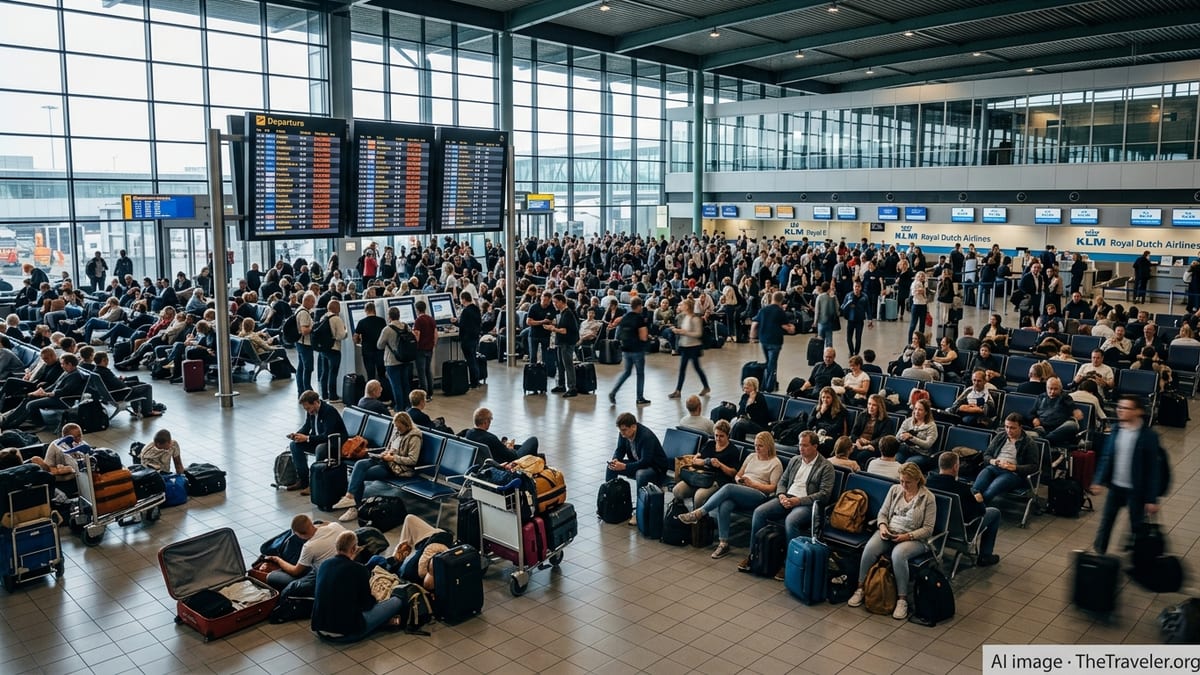
Travel disruption reports describe scenes of crowded departure halls, with passengers camped out near power outlets and information screens while monitoring shifting departure times. Some travelers reported being unable to secure same day alternatives on heavily booked routes, forcing overnight stays in airport hotels or nearby accommodation as airlines worked through rebooking queues.
Travel data coverage notes that baggage handling systems also came under strain, particularly for those who missed connections at Schiphol. Bags that had been tagged through to final destinations sometimes continued onward without their owners, while in other cases luggage remained in Amsterdam awaiting re-routing instructions. That created an additional layer of complexity for travelers who eventually continued their journeys on alternative flights or different airlines.
Passenger-rights platforms indicate that, although the number of outright cancellations at Schiphol that day remained limited compared with major winter-weather episodes earlier in the year, the far larger wave of delays significantly increased the number of travelers eligible to explore potential compensation under European Union regulations.
Part of a Wider Pattern of European Aviation Strain
The Schiphol incident formed part of a wider pattern of strain across Europe’s aviation network in 2026. Recent operational snapshots have shown thousands of flights delayed and hundreds canceled on peak days, with hubs in the United Kingdom, Germany, France, Spain and the Netherlands regularly featuring in disruption statistics compiled by flight tracking and air passenger advocacy services.
Analysts of publicly available performance data point to a mix of factors behind the recurring issues, including air traffic control capacity, periodic weather disturbances, high demand during peak travel periods and the lingering effects of earlier schedule cuts and staffing adjustments. When one or more of these elements converges, disruptions at a single major hub such as Amsterdam can propagate rapidly across the continent.
Coverage focusing on recent days of heavy disruption notes that Schiphol has already endured multiple episodes of large scale delay this year, from winter storms that curtailed runway capacity to baggage system failures and rolling schedule adjustments by airlines. Against that backdrop, a day with 252 delays and 20 cancellations may not rank as the worst of the year, but it underlines how little margin for error remains during busy travel periods.
Observers suggest that unless structural constraints in European air traffic management and airport operations are eased, similar incidents are likely to recur through the high season, especially on Fridays and weekends when leisure and business demand converge.
What Stranded Travelers Can Do Next
Consumer advocates and passenger-rights organizations regularly advise travelers caught in mass disruptions such as the one at Schiphol to document their experiences carefully. Keeping boarding passes, booking confirmations, screenshots of delay notices and receipts for meals, transport and accommodation can prove important when filing claims with airlines or specialized claim-handling services.
European air passenger rules generally provide for assistance when delays reach certain thresholds, potentially including refreshments, two free communications and overnight accommodation where necessary. Where disruptions are within an airline’s control, travelers on impacted flights may also be able to pursue financial compensation, subject to route distance, length of delay and specific circumstances surrounding the disruption.
Practical travel guidance based on recent events at Schiphol and other European hubs also highlights the value of proactively monitoring flight status through airline apps and airport information displays, particularly for those relying on short connection times. In many cases, passengers who react quickly to early signs of trouble are better placed to secure alternative routes before options become scarce.
As airlines and airports across Europe seek to stabilize operations, the scenes at Amsterdam Schiphol serve as another reminder that even a limited number of cancellations, when combined with hundreds of delays, can leave large numbers of travelers stranded and reshape travel plans across multiple continents in the space of a single day.