


More news on this day
Air travelers across the United States faced another difficult day as flight-tracking data showed 69 cancellations and 2,875 delays affecting services through key hubs from Illinois and Nevada to Puerto Rico, Los Angeles, Atlanta, New York, Seattle and San Diego, impacting operations at major carriers including American Airlines, Southwest, United and Delta.
Get the latest news straight to your inbox!
Nationwide Disruptions Concentrated at Major Hubs
Publicly available data from flight-tracking platforms indicates that the latest wave of disruption is concentrated at some of the country’s busiest hubs and coastal gateways. Flights within, into and out of the United States recorded dozens of cancellations and thousands of delays, adding strain at airports already dealing with heavy summer schedules.
Tracking boards reviewed on Wednesday highlight clusters of delayed departures and arrivals at large connecting hubs such as Chicago, Atlanta and New York, as well as western gateways including Los Angeles, Seattle and San Diego. Additional disruption is evident at airports in Nevada and Puerto Rico, reflecting the reach of the operational issues beyond the mainland’s largest cities.
While the volume of outright cancellations is modest compared with some past nationwide meltdowns, the high number of delayed flights is creating a cascade effect across the system. Late-arriving aircraft and crews are feeding knock-on schedule problems throughout the day, leaving many passengers facing missed connections and extended waits on the ground.
The imbalance between cancellations and delays also means that many flights are still operating, but significantly behind schedule. For travelers, that can translate into crowded gate areas and tight turnaround times, even when their original flight number remains unchanged on airport departure boards.
American, Southwest, United and Delta Under Pressure
Operational statistics show that the disruption is spread across all of the major U.S. legacy and low-cost networks, with American Airlines, Southwest Airlines, United Airlines and Delta Air Lines all reporting affected flights. Regional affiliates that operate under these brands are also contributing to the overall totals, as they feed traffic into the big carriers’ hubs.
Published coverage and flight-status feeds suggest that no single airline is solely responsible for the pattern of delays. Instead, the data points to a broadly shared strain in which mainline and regional flights alike have been forced to adjust departure and arrival times. That includes shuttle-style services between major business centers, as well as leisure routes to and from tourist destinations.
The concentration of delays rather than mass cancellations indicates that airlines are still aiming to operate their planned schedules where possible, even if some services depart significantly late. For American, United and Delta, this approach helps protect complex hub-and-spoke networks, where a cancelled feeder flight can disrupt dozens of onward connections.
Southwest, which operates a more point-to-point style network across more than 100 destinations, appears in a similar position, with data showing scattered cancellations but a larger number of delayed services. For passengers, the impact can feel similar regardless of airline, as full flights and tight aircraft utilization leave little slack in the system when problems arise.
Regional Spread From Illinois and Nevada to Puerto Rico
The disruption is not limited to a single geographic corridor. Tracking maps and airport statistics show that flights in and out of Illinois, Nevada and Puerto Rico feature among the affected routes, alongside heavy schedule changes along both coasts. That pattern reflects the interconnected nature of U.S. domestic air travel, where an issue in one region can quickly ripple to others.
Illinois, home to one of the country’s busiest hub airports, is seeing delayed departures and arrivals pile up through the day, affecting both short-haul and transcontinental flights. In Nevada, a mix of leisure and convention traffic means that even a relatively small number of cancellations can create outsized queues at security checkpoints and customer-service counters.
Services into and out of Puerto Rico add an additional layer of complexity, blending domestic-style operations with longer overwater segments that are more tightly scheduled. When disruptions occur on these routes, aircraft may be out of position for subsequent flights back on the mainland, further contributing to the tally of delays at large continental hubs.
On the West Coast, Los Angeles, San Diego and Seattle are all showing elevated delay levels on arrival and departure boards. Many of those flights are tied into broader national networks, meaning that an aircraft that lands late in California may depart late again to its next city, continuing the cycle of disruption well into the evening.
Causes Range From Weather to Congested Airspace
Comprehensive cause data for each individual flight is not immediately available in aggregate, but historical reporting and current conditions suggest a familiar mix of weather-related disruptions, traffic-management initiatives and operational constraints. U.S. airspace is tightly managed on busy days, and even moderate storms or low clouds around major hubs can prompt the introduction of flow-control programs that slow departures and arrivals.
According to recent government and industry reports, a majority of U.S. delays in typical months are associated with factors such as weather, air-traffic volume and late-arriving aircraft. That backdrop is consistent with the current pattern of widespread schedule slippage, in which flights are still operating but pushed back from their original times.
Operational data also shows that staffing and aircraft-positioning challenges can exacerbate the impact of any weather disruption. When a storm or air-traffic restriction disrupts one wave of flights, it can leave jets and crews in the wrong place for subsequent departures. This appears to be a factor in the latest round of travel headaches, with delay clusters spreading across multiple banks of flights throughout the day.
The result is a travel environment in which even airports not directly under severe weather may still experience significant knock-on effects. Passengers departing from cities with clear skies may find that their aircraft is arriving late from a region coping with thunderstorms, strong winds or earlier air-traffic control restrictions.
What Travelers Are Experiencing at the Terminals
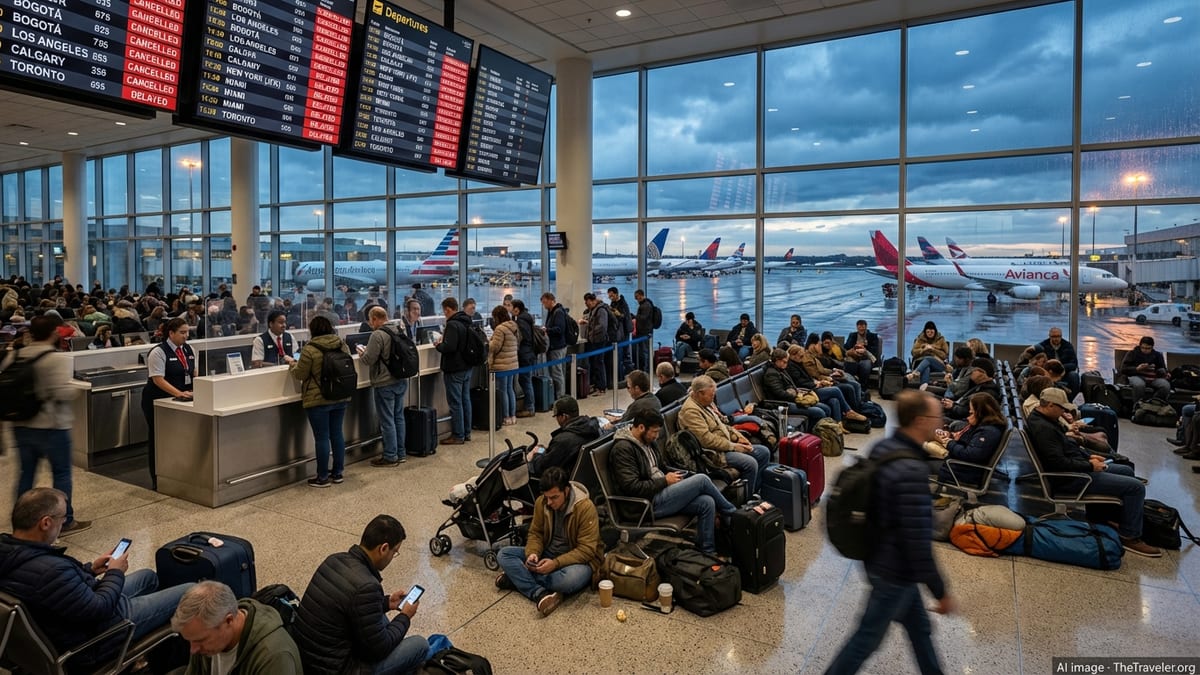
Across the network, the statistics are translating into familiar scenes at terminals. Long lines have formed at check-in areas, security checkpoints and customer-service desks as passengers attempt to rebook missed connections, secure meal and hotel vouchers, or obtain updated information about changing departure times.
Reports from travelers and airport information screens describe rolling delays, with departure times frequently pushed back in small increments as airlines and air-traffic managers reassess conditions. In some cases, flights that appear to be operating on time may still encounter extended taxi times or holding patterns, adding additional minutes to already long travel days.
Despite the frustrations, most flights are still operating, and many passengers are ultimately reaching their destinations, albeit later than planned. For those with flexible itineraries, tracking apps and airline notifications are proving essential tools to monitor gate changes, updated boarding times and any last-minute cancellations that may arise as the day progresses.
With summer travel demand running high, the latest wave of 69 cancellations and 2,875 delays serves as a reminder of how quickly the U.S. aviation system can become strained, even without a single dramatic weather event or operational failure. For now, publicly available data suggests that the disruption is significant but manageable, as carriers work to absorb the schedule shocks rippling across the country’s busiest routes.