


More news on this day
Amsterdam Schiphol Airport is experiencing widespread flight delays and extended queues after a major overhaul of its security contracts coincided with new border and security procedures, creating fresh disruption at one of Europe’s busiest hubs.
Get the latest news straight to your inbox!
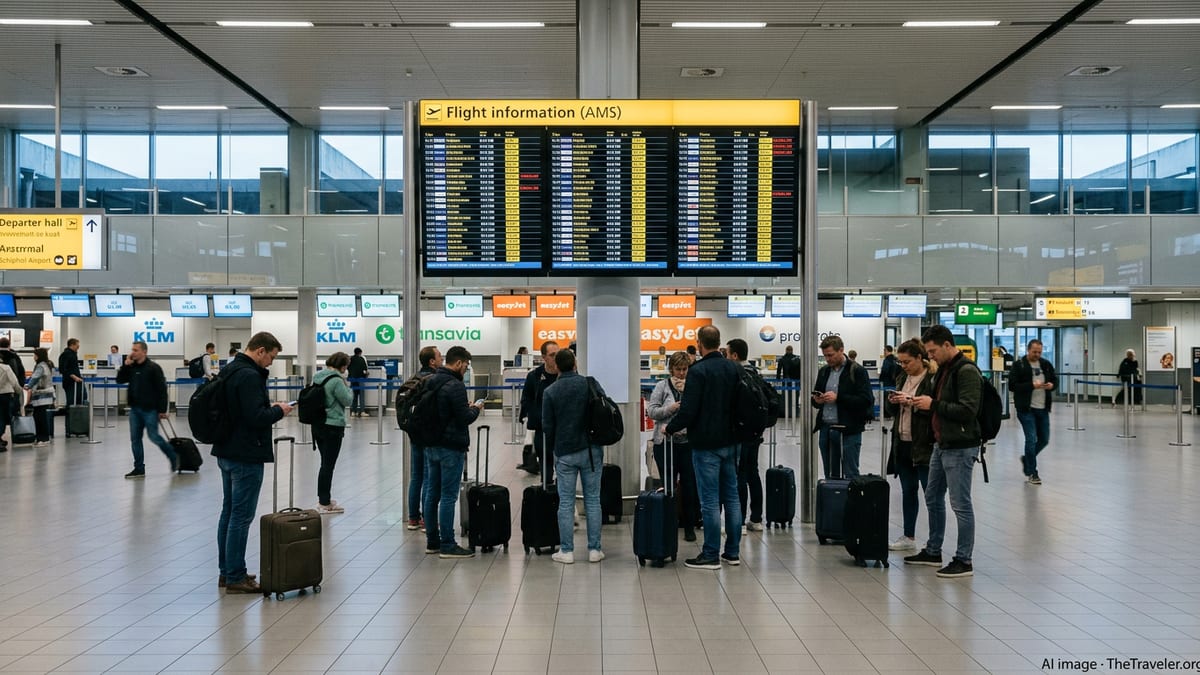
Contract shake-up triggers operational bottlenecks
Publicly available information from Amsterdam Schiphol indicates that the airport transitioned to a new security organisation on 18 May 2026, consolidating operations under three security companies. Around 4,000 security workers reportedly changed employer as part of a long-term contract programme intended to give the airport greater operational control and avoid a repeat of the staffing crisis seen in 2022.
Reports from Dutch media describe a difficult first full day for the new system, with a combination of staff shortages and technical issues restricting the number of open security lanes in several departure halls. In Departure Hall 2, fewer than half of the checkpoints were in use for periods of the day, while parts of the security area in Departure Hall 3 were described as largely closed.
Data cited in local coverage show that on Monday 18 May, 279 of 679 scheduled departures suffered delays as passengers queued for security screening and struggled to reach gates on time. The disruption affected both short-haul and long-haul services and spilled over into connecting traffic using Schiphol as a transfer hub.
Schiphol’s own passenger information pages acknowledge longer-than-usual security waiting times and advise travellers to arrive two hours before departure for Schengen flights and three hours for non-Schengen services. The airport has also highlighted the availability of free pre-booked security time slots for some departures, although social media posts suggest these dedicated lanes have not always been fully staffed.
New European border systems add to delays
The security reorganisation has coincided with the gradual rollout of new European entry and exit checks for non-EU travellers, further slowing the flow of passengers at Schiphol. According to published coverage, additional data collection and verification steps for some non-Schengen transfer passengers are lengthening the time needed to clear border controls between flights.
Travel forums and local news reports indicate that passengers connecting from long-haul services outside the Schengen Area have faced particularly tight connections. Some travellers have reported missing onward flights after queuing at border control and then encountering further lines at security checkpoints set up for transfer traffic.
Industry observers note that these developments follow several years of major regulatory and technological changes at European airports, including the phased introduction of new biometric systems and updated screening equipment. At Schiphol, these shifts appear to be intersecting with the internal security reorganisation at a moment of rising passenger volumes ahead of the main summer travel period.
While the new systems are intended to improve border management and security in the long term, their early operational impact at Schiphol has prompted renewed questions about how airports can phase in complex procedures without triggering significant disruption for travellers and airlines.
Airport response focuses on staffing and communication
Schiphol’s public messaging acknowledges that the transition to the new security organisation has been more difficult than anticipated, citing higher-than-expected sickness absence among security officers and lingering IT problems on the first operational day. Publicly available statements emphasise that extra office staff have been deployed to assist in the terminals and that water has been distributed to passengers waiting in longer queues.
Background documentation from the airport and previous security updates show that Schiphol has been preparing for a multi-year renewal of its screening infrastructure and service contracts, including tenders for new equipment and efforts to centralise recruitment. The change to three security providers is positioned as part of that strategy, intended to simplify lines of responsibility and make it easier to manage peaks in demand.
In practice, the launch of the new setup has highlighted how sensitive airport operations remain to short-term fluctuations in staffing and system reliability. Transport analysts point out that high-volume hubs like Schiphol rely on tightly planned security throughput and that even small reductions in available capacity can quickly lead to knock-on effects across the daily flight schedule.
Passenger communications have therefore become a central part of the response. The airport’s travel advice stresses early arrival times, use of online check-in, and checking the Schiphol app or airline channels for the latest gate and delay information. Travellers are also encouraged to prepare hand baggage carefully to minimise secondary screening, in an effort to keep each security check as short as possible.
Impact on airlines, hubs and connecting passengers
The flight delays linked to the security transition are particularly sensitive for airlines that use Schiphol as a major transfer point. According to media reports, carriers have acknowledged that the airport’s security issues are affecting their operations and may lead to missed connections and knock-on delays across their networks.
For connecting passengers, the combination of longer security and border checks has reduced the margin for error on itineraries with tight connection times. Travel advice circulating in forums and consumer media increasingly recommends longer minimum connection times at Schiphol during the current period of disruption, especially for itineraries involving a switch between Schengen and non-Schengen zones.
Some travel specialists suggest that, in the near term, passengers may prefer more generous layovers or alternative routings through other European hubs where operational conditions are currently more predictable. However, Schiphol’s extensive route network and status as a key gateway for the Netherlands mean that significant volumes of traffic are likely to continue flowing through the airport even as it works through the transition.
Airlines and airport planners will be closely watching how quickly security performance stabilises in the coming weeks and whether early teething problems give way to smoother throughput as staff and systems adapt to the new organisation and processes.
What travellers should expect in the coming weeks
Recent updates from Schiphol and news outlets suggest that elevated security waiting times could persist in the short term while the new organisation beds in and staffing levels are adjusted. Passengers traveling in late May and early June may therefore continue to experience queues at peak periods, particularly in the early morning and late afternoon departure waves.
Travel information services are advising passengers to monitor their flights closely on the day of travel and to allow additional time at the airport beyond the minimum guidance where possible. For those with connections at Schiphol, building in a wider buffer between flights, especially when switching between Schengen and non-Schengen areas, may reduce the risk of missed departures.
In the medium term, Schiphol’s contract changes and investments in security infrastructure are intended to create a more resilient and predictable screening operation. The current disruption illustrates how challenging it can be to overhaul critical airport processes without significant impact on day-to-day operations, but also underscores the importance of modernising systems to meet future demand.
As the summer travel season approaches, the experience at Amsterdam Schiphol will likely serve as a test case for how major European airports manage the intersection of large-scale security changes, new border technologies and strong passenger demand, and how quickly they can turn a difficult start into more reliable performance for travellers.