


More news on this day
Amsterdam Schiphol, one of Europe’s busiest hubs, is grappling with significant flight delays and disruption after a sweeping reorganisation of security checkpoints coincided with new border control procedures for transfer passengers.
Get the latest news straight to your inbox!
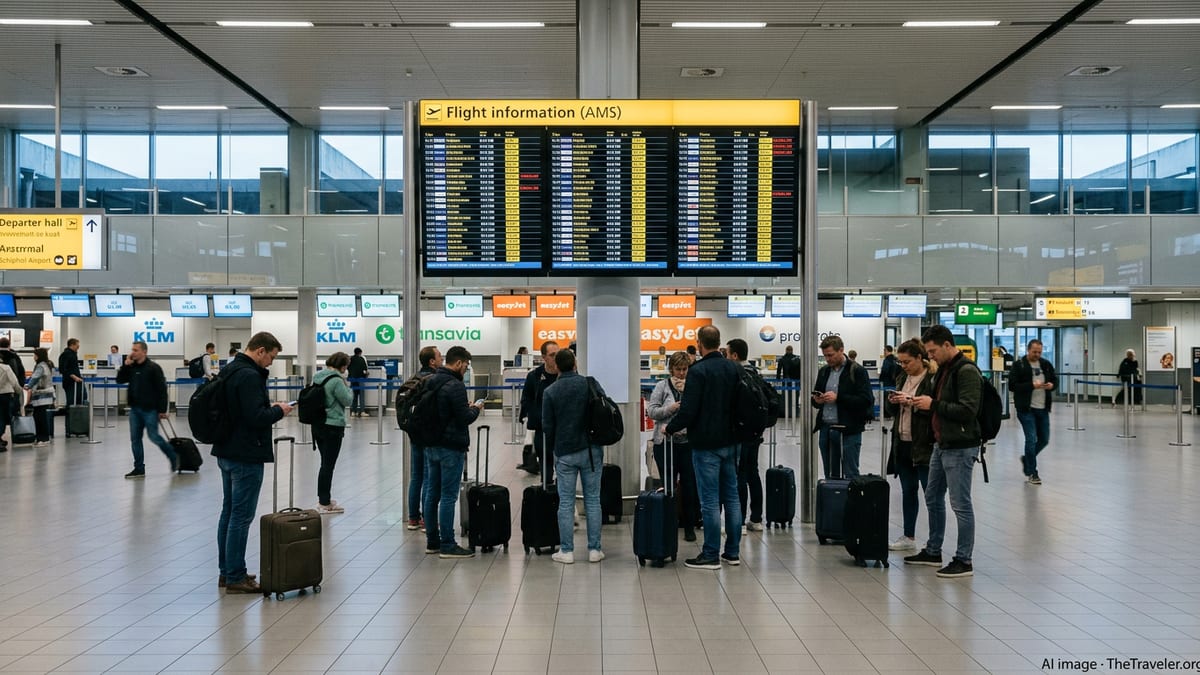
Hundreds of Flights Affected as Queues Build
Operational data from recent days indicates that Schiphol’s new security setup has had an immediate impact on punctuality. On Monday 18 May, 279 of 679 scheduled departures were reported delayed as long lines formed at passenger screening points and passport control, sharply above the airport’s typical delay levels for this time of year.
Passenger accounts and local media coverage describe queues stretching across multiple departure halls, with some travellers waiting close to an hour to clear security where the usual target is around 10 minutes. The resulting knock-on effect has been missed connections, tightly timed transfers under pressure, and aircraft held at the gate while late-arriving passengers are processed.
Reports indicate that while throughput improved at certain points on 19 May, Schiphol has cautioned travellers that waiting times remain unpredictable as the airport and its contractors adjust to the new procedures. Travellers are being urged to arrive well ahead of departure and to monitor their airline’s latest flight information.
The situation comes at the start of the late spring travel period, a time when Schiphol typically sees steadily rising passenger volumes. The combination of higher traffic and a new operating model has left little margin for error during the first days of implementation.
Security Contractor Shake-up at the Heart of Changes
At the core of the disruption is a major reorganisation of security services at Schiphol. Publicly available information shows that the airport has moved from a fragmented model with five contracted security firms to a streamlined structure involving three companies, with roughly half of around 5,000 security staff transferring to new employers and roles.
According to Dutch news coverage, the goal of the shift is to give Schiphol greater control over staffing, training and working conditions after the severe staffing shortages and queues seen in the summer of 2022. The reorganisation is intended to create more stable rosters and clearer lines of responsibility, but the transition itself has introduced short-term complexity as teams adapt to new schedules and checkpoints.
Industry-focused reports note that Monday’s “day one” of the new system coincided with what appears to have been a particularly busy travel period, amplifying the impact of any teething problems. Even minor slowdowns at checkpoints quickly cascaded across the tightly timed departure bank, placing extra pressure on airlines’ turnaround times.
Security screening at Schiphol is centrally organised in the departure halls and at dedicated transfer checkpoints. The new contractor setup affects both departing origin passengers and those connecting via Amsterdam, making the hub especially sensitive to any imbalance between passenger arrivals and available screening capacity.
New Border Checks Add Pressure for Transit Passengers
Alongside the security contractor overhaul, Schiphol is adjusting processes in preparation for the European Union’s forthcoming Entry/Exit System, which is gradually reshaping checks for non-EU citizens. Reports from Dutch and European travel outlets indicate that additional registration steps for some non-Schengen transfer passengers have been introduced, lengthening procedures at border control.
For Schiphol’s core role as an intercontinental transfer hub, the interaction between border checks and security queues is particularly challenging. Many long-haul travellers connect to intra-European flights with relatively short layovers, leaving limited buffer if border processing times increase by even 10 to 20 minutes.
Local coverage describes cases of passengers missing onward flights because of combined delays at security and passport control, especially in the non-Schengen areas used by long-haul routes. Airlines have in some instances held departures to accommodate travellers stuck in queues, which in turn creates further delays as outbound schedules ripple across the network.
Publicly available guidance for travellers transiting through Schiphol now places greater emphasis on allowing additional time to clear formalities, particularly for those arriving from or departing to non-Schengen destinations. Travel organisations are advising passengers with tight connections to be prepared for longer walks between gates and possible congestion at transfer checkpoints.
Airport Advises Early Arrival and Use of Timeslots
On its passenger information pages, Schiphol urges travellers to prepare carefully for their journey and to arrive at the airport with ample time before departure, especially during the current adjustment period. The airport’s standard recommendation is to be at the terminal at least two hours before European flights and three hours before intercontinental services, with some outlets now suggesting that cautious travellers consider even more generous buffers at peak times.
Schiphol continues to promote its free security timeslot system for many departing passengers. By reserving a specific time window to pass through security, travellers can in principle bypass the longest general queues and head directly to a dedicated entrance where staff scan a QR code and guide them into the screening area.
Travel reports note that while timeslots can help spread demand over the day, their effectiveness depends on sufficient staffing and clear separation from regular queues. During the recent disruption, some passengers with bookings reported still encountering congestion as overall volumes exceeded the capacity of both timed and walk-up lanes.
The airport also highlights the importance of hand baggage rules in preventing delays at checkpoints. Ensuring liquids, electronics and restricted items are packed according to regulations can reduce the need for manual bag checks, which slow screening and contribute to backlogs during busy periods.
Knock-on Effects for Airlines and Summer Travel Plans
The security overhaul and evolving border checks are arriving at a sensitive time for airlines using Schiphol as a hub. Published coverage from Dutch media notes that leading carriers have already been facing operational challenges in early 2026, including winter weather events and air traffic control constraints, leaving limited resilience for additional disruption on the ground.
For passengers, the most immediate impact is on connection reliability. Short transfer windows that previously felt comfortable are now more exposed to the risk of missed flights if either the inbound service is delayed or security and border control queues are longer than expected. Travel forums and consumer advisories are encouraging passengers to consider longer layovers where possible, particularly on itineraries that combine long-haul and short-haul segments.
Looking towards the summer peak, Schiphol’s reorganisation is designed to prevent a repeat of the severe queues seen in 2022, when security staffing shortages led to flight caps and widespread cancellations. Airport statements about the new system emphasise long-term stability and better working conditions, but the early days of implementation underline how sensitive large hubs are to changes in security and border processes.
For now, publicly available information suggests that travellers using Amsterdam Schiphol in the coming weeks should plan for potential delays, arrive early, and make full use of airline and airport tools such as online check-in, baggage drop automation and security timeslot bookings to reduce the risk of disruption.