


For many visitors, the first big decision in Seattle comes the moment they step out of baggage claim at Seattle-Tacoma International Airport: taxi, rideshare, or Link light rail. The 1 Line has become the go-to option for budget-conscious and traffic-averse travelers, connecting Sea-Tac directly with downtown Seattle and beyond. This guide walks you through every step, from finding the station and buying a ticket to choosing the right downtown stop and avoiding the most common mistakes first-timers make.
Get the latest updates straight to your inbox!
Why Take Link Light Rail From Seattle-Tacoma Airport
Link light rail’s 1 Line runs directly from SeaTac/Airport Station to downtown Seattle and on north to neighborhoods like Capitol Hill, the University District, and Lynnwood. The ride from Sea-Tac Airport to central downtown stations such as Westlake or University Street typically takes around 35 to 40 minutes, depending on the time of day and schedule. In real world terms, that usually beats sitting on Interstate 5 in rush hour traffic while your rideshare fare climbs.
Cost is a major advantage. As of mid-2026, adult Link fares are a few dollars per person for the airport-to-downtown segment, usually less than what you would tip an Uber driver on the same route. For a couple or small family, that can mean saving 30 to 60 dollars compared with a taxi or rideshare, especially during busy evenings, game days, or cruise weekends.
The train is also predictable. Trains run on a published schedule, and once you are on board, the travel time does not change with traffic jams, accidents, or heavy rain. For example, if your cruise check-in is midday at Pier 66, you can ride from the airport to Westlake knowing it will be roughly a 40 minute ride almost any day of the week, then transfer to a short walk, monorail, or rideshare for the last mile.
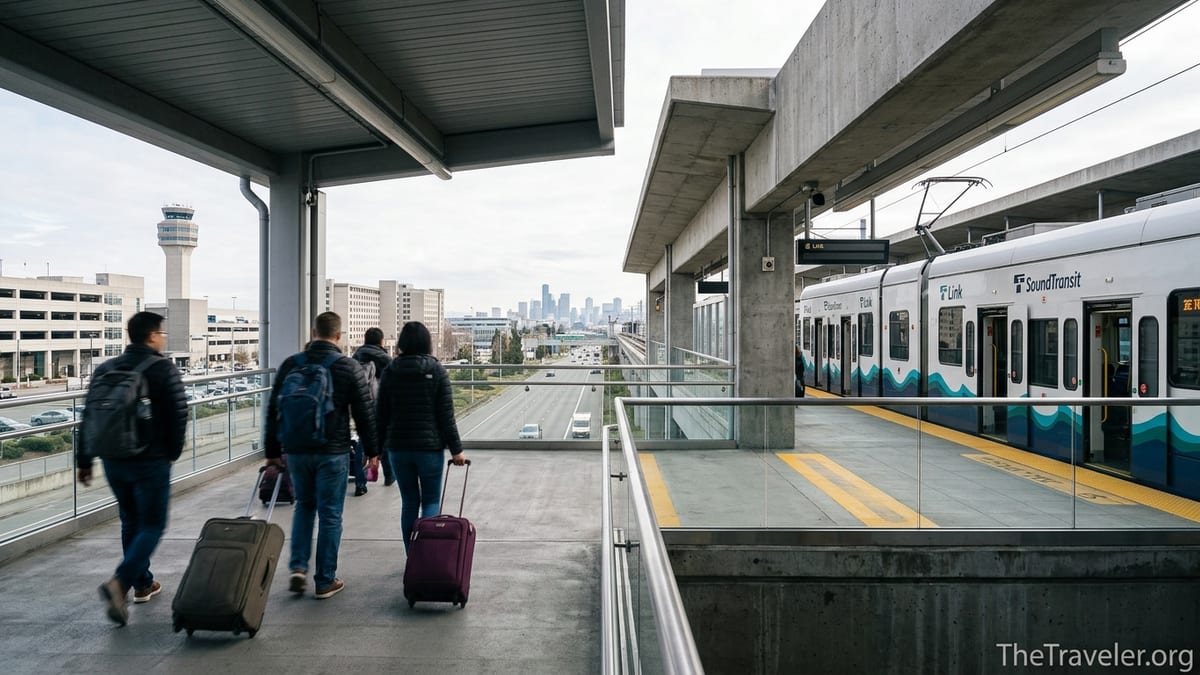
Finally, Link offers a simple, mostly step-free route when you know where you are going. The station at Sea-Tac is linked to the terminal by a fully covered walkway and skybridge, so you will not be dodging cars in the pickup lanes. With wheeled luggage and a bit of patience, most travelers find the walk comfortable, even after a long flight.
Finding the SeaTac/Airport Link Station and Using the Skybridge
The SeaTac/Airport Station is not inside the terminal, but it is directly connected via the airport parking garage and a pedestrian bridge. After you collect your bags, follow the overhead signs for “Public Transit” or “Link Light Rail.” These will guide you past the baggage carousels toward the central hallway where multiple skybridges cross into the parking garage.
For Link, you want Skybridge 6, which is at the north end of the main terminal. In practice, that means walking toward the end of baggage claim closer to Alaska Airlines’ check in and the N and C concourses. You will see large color-coded signs for Link light rail and ground transportation. Take the escalator or elevator up from baggage claim level to the skybridge level, then cross into the parking garage. The walkway is fully enclosed and well signed, so even late at night you will be under cover and away from road traffic.
Once inside the garage on Level 4, simply follow the painted floor markings and overhead Link signs along a long, straight indoor corridor. This is where many travelers misjudge the distance; it is a real walk, usually 5 to 10 minutes at an unhurried pace with luggage. Moving walkways are not provided, so expect to roll your suitcase the whole way. At the end of the corridor you will exit the garage into the open but covered SeaTac/Airport Station entrance, with ticket machines and elevators down to the platform.
If you have mobility issues or are traveling with someone who cannot handle a 10 minute walk, ask airport staff near baggage claim for assistance. The Port of Seattle and Sound Transit periodically provide electric carts to shuttle passengers between the terminal and the Link station area, and staff can also direct you to elevators rather than escalators at each step along the route.
Tickets, ORCA Cards, and How to Pay
At the SeaTac/Airport Station entrance you will find blue ticket vending machines before you pass through the platform area. You do not need to buy in advance; tickets are sold on the spot for the next available train. Machines accept debit and credit cards and usually cash. Travelers can choose a simple single ride ticket or pay using the regional ORCA transit card, which also works on King County Metro buses, the Seattle Streetcar, and some regional buses and ferries.
For most visitors, a straightforward adult single ride ticket from SeaTac/Airport to downtown Seattle is sufficient. If you are staying several days and expect to use buses and Link repeatedly, consider purchasing a reusable ORCA card and loading value onto it. For example, a traveler staying in Capitol Hill might ride from the airport to Capitol Hill Station on day one, then use the same card on the streetcar or bus to reach South Lake Union the next day. The ORCA reader is tapped before boarding, and again if you transfer to another system within the allowed transfer window.
Children, seniors, and riders with disabilities typically qualify for reduced fares, but obtaining the specific reduced-fare version of an ORCA card often requires local registration and paperwork. Short term visitors traveling with kids may find it simpler to purchase a mix of adult and youth single ride tickets at the machines. If you are uncertain which fare category to choose, the machines provide an information screen and there is often a Sound Transit staff member or security officer nearby who can answer basic questions.
One important detail is that Link trains operate on a proof of payment system. There are no turnstiles at the SeaTac/Airport Station; instead, fare inspectors make spot checks on board. Keep your printed ticket or ORCA card handy for the duration of your ride. Being caught without valid fare can result in a citation, which is an unpleasant beginning to any Seattle vacation.
Travel Times and Choosing the Right Downtown Station
From SeaTac/Airport to downtown Seattle, most travelers are heading to one of four main stations: Stadium, International District/Chinatown, Pioneer Square, or Westlake. The total ride to Westlake, the northernmost of these downtown stops, is generally in the neighborhood of 37 to 40 minutes. Stations are announced on board and displayed on digital screens, and audio announcements distinguish northbound rides toward Lynnwood from southbound rides back toward the airport and Federal Way.
Which station you choose depends on your final destination. For hotels near Lumen Field or T-Mobile Park, such as those along 1st Avenue South or in SODO, Stadium Station is usually the best choice. If you are connecting to Amtrak or Sounder commuter trains at King Street Station, or staying near Seattle’s Chinatown-International District, you should exit at International District/Chinatown Station, which is about a block from King Street and a short walk from many Asian restaurants and shops.
Travelers staying in Pioneer Square or heading to the Seattle waterfront near the Colman Dock ferry terminal often prefer Pioneer Square Station. It places you at the heart of the historic district, a few minutes’ walk down to the piers. Finally, Westlake Station is ideal for central downtown hotels, Pike Place Market, and transfers to the Seattle Center Monorail, which runs up to the Space Needle and Seattle Center. Westlake is located under Pine Street, steps from large hotels and the city’s main shopping area.
If you are going farther north, such as Capitol Hill, the University of Washington, the U District, or all the way to Lynnwood, you can remain on the same train after Westlake. The airport-bound 1 Line is a single continuous service, so you do not need to change trains downtown. This is particularly useful for visitors with university business or those booking less expensive accommodations in neighborhoods like Roosevelt or Northgate that still offer a direct rail connection back to the airport.
Riding With Luggage: What to Expect on Board
Link light rail trains are designed with luggage in mind, though they are still urban transit vehicles rather than intercity trains. Cars have open floors, few internal steps, and dedicated spaces at the ends of each car for wheelchairs and strollers. Many travelers stand with their suitcases in the aisle or slide smaller carry ons under the side benches. There are no formal overhead racks like on long distance trains, so keep larger bags at your feet or by your side.
During busy periods, such as Sunday afternoons in summer or mornings before a Seahawks or Mariners game, trains between the airport and downtown can become crowded. A family of four each wheeling large checked suitcases might find themselves standing in the middle of a full car. If you have bulky luggage, consider waiting a few extra minutes for the next train if the one that arrives looks packed, especially if you are heading all the way to Lynnwood or the University District.
Most riders feel comfortable managing one rolling suitcase and one backpack. Travelers with more elaborate setups, such as two large checked bags, a carry on, and a musical instrument, may want to think about a taxi, shuttle, or rideshare instead. Link platforms and car floors are level, and the station at Sea-Tac uses elevators and escalators so that you do not need to lift heavy bags up stairs, but you will still be pushing them along platforms, through the parking garage walkway, and possibly up a sloping block or two in downtown Seattle.
Keep your luggage close and clearly within sight when the train stops at intermediate stations in the Rainier Valley, Tukwila, and SODO. The route is generally safe and well patrolled, but as in any major city, opportunistic theft is possible. Avoid leaving bags unattended near doors while you sit across the aisle, and when the train nears your station, move toward the door a bit early so you can roll off without rushing.
Walking Tips in Downtown Seattle After You Get Off the Train
Seattle’s downtown is compact but hilly. Once you step off Link at stations like Pioneer Square or University Street, you may find yourself walking up or down noticeable slopes with your luggage. The blocks descending from 3rd Avenue to 1st Avenue and the waterfront can feel steep, especially on wet days. If you are staying at a hotel near the waterfront, such as those along Alaskan Way, consider whether you are comfortable walking down a steep hill with roller bags; uphill in the rain can be even tougher on your return trip.
From Westlake Station, many popular downtown hotels like those around 4th and 5th Avenue are within a 5 to 10 minute walk on mostly level streets. For example, a traveler staying near Pine and 6th Avenue can exit the train at Westlake, take the elevator or escalator to street level, and walk a few flat blocks past department stores and cafes. Pike Place Market is also a relatively short walk, though the last block or two drop toward the water.
Pedestrian signals in downtown Seattle are timed generously, but be patient at major intersections such as 3rd and Pike or 4th and James. Crosswalks can be busy with buses, bikes, and cars. Stick to well lit streets and, if you are arriving late at night, consider using a short rideshare or taxi hop from your Link station to your final address, especially if you are managing multiple children or several bags.
For cruise passengers heading to Pier 66 or Pier 91, walking the entire way from a downtown Link station with bags is possible for very light packers, but most travelers opt for a quick taxi or rideshare from Westlake, Pioneer Square, or International District/Chinatown. The cost of that short final leg is modest compared with a direct airport to pier taxi, and still significantly cheaper than private shuttles marketed specifically at cruise guests.
Common Mistakes First-Time Riders Make
One of the most common mistakes at Sea-Tac is underestimating the walk from baggage claim to the Link platform. A traveler landing from a long flight at 11:30 p.m. might assume the station is just outside the door and be surprised by a 10 minute indoor walk through the garage. If you have a tight connection, such as a reserved hotel shuttle downtown, build in extra time for this walk plus a few minutes to buy tickets.
Another frequent error is boarding the wrong direction. At SeaTac/Airport Station, northbound trains are signed for destinations like downtown, Northgate, or Lynnwood, while southbound trains go one stop farther to Angle Lake or beyond. Visitors occasionally step on the first train without checking the overhead signs, ride one stop in the wrong direction, and then have to cross the platform and wait again. Before boarding, look at the digital sign on the platform and confirm it says the destination you expect, usually Lynnwood or Northgate for downtown bound rides.
Fare mistakes also happen. Some travelers assume the system works like airport shuttles and board without a ticket, intending to pay someone on board. Link does not work that way, and fare inspectors do conduct checks. Others buy a ticket to a closer station like SODO, then stay on past downtown, which technically counts as riding beyond the paid zone. To keep it simple, if you are going anywhere in central Seattle, buy a ticket that clearly lists a downtown station such as Westlake or Pioneer Square.
Finally, visitors sometimes get off at the wrong downtown stop. For instance, someone booked at a hotel near Pike Place Market may exit at Pioneer Square because it sounds historic, then face a long uphill walk or an extra rideshare. Before your trip, look up your hotel’s cross streets and identify the closest Link station. If you are not sure, Westlake is the safest general choice for central downtown, while International District/Chinatown is best for train connections and Pioneer Square is best for the southern historic core.
The Takeaway
Taking Link light rail from Seattle-Tacoma International Airport into the city is one of the most efficient and budget friendly ways to start a trip to the Pacific Northwest. With a straightforward skybridge walk from baggage claim to the SeaTac/Airport Station, simple ticket machines, and direct trains into downtown, most visitors find they can be at their hotel or meeting within an hour of stepping off the plane.
Success with Link largely comes down to preparation. Know that the station is a real walk from the terminal, choose the correct direction toward downtown, and identify in advance which station is closest to your destination. Pack luggage you can comfortably roll for 10 minutes and manage on a city train, and do not be afraid to combine Link with a short taxi or rideshare ride for the last few blocks if Seattle’s hills or late night schedules look daunting.
With these details in mind, Link light rail becomes less of an unknown and more of a reliable part of your Seattle toolkit. On a sunny morning ride north toward the city skyline or a late evening glide back to the airport for your flight home, you will likely be glad you chose the train over the traffic.
FAQ
Q1. How long does the Link light rail take from Seattle-Tacoma Airport to downtown?
The ride from SeaTac/Airport Station to central downtown stations such as Westlake usually takes around 35 to 40 minutes, depending on the time of day.
Q2. How do I find the Link light rail station from baggage claim at Sea-Tac?
Follow signs for “Public Transit” or “Link Light Rail,” walk toward the north end of baggage claim, take the escalator or elevator up to Skybridge 6, cross into the parking garage, and follow the indoor corridor to the station entrance.
Q3. Do I need to buy a Link ticket in advance?
No. You can buy tickets at the vending machines located at the SeaTac/Airport Station entrance just before you reach the platform. They accept major cards and usually cash.
Q4. Is riding Link from the airport safe at night?
Trains and stations are regularly patrolled and generally considered safe, though you should use the same common sense as in any big city, such as keeping bags close and staying in well lit areas.
Q5. Which downtown station should I use for Pike Place Market and central hotels?
Westlake Station is usually the best choice for central downtown hotels, shopping areas, Pike Place Market, and transfers to the monorail for the Space Needle.
Q6. Can I bring large suitcases on the Link light rail?
Yes, but space is limited. One large rolling suitcase and a personal bag per person is manageable; more than that can be awkward, especially on busy trains.
Q7. Does Link light rail run early in the morning and late at night?
Service starts early each morning and continues until late at night, but exact first and last train times vary by day. Check the current schedule before planning very early or very late trips.
Q8. Is Link cheaper than taking a taxi or rideshare from the airport?
Yes. A one way Link fare to downtown is typically only a few dollars, often a fraction of the cost of a taxi or rideshare that can run 40 dollars or more, depending on time and traffic.
Q9. How far is the walk from the terminal to the Link platform at Sea-Tac?
Most travelers take 5 to 10 minutes at a normal pace to walk from baggage claim, across Skybridge 6, through the parking garage corridor, and into SeaTac/Airport Station.
Q10. Can I stay on the same train past downtown to Capitol Hill or the University District?
Yes. The same 1 Line train that leaves SeaTac/Airport continues through downtown to stations like Capitol Hill, University of Washington, U District, and on to north Seattle and Lynnwood.