


Seattle–Tacoma International Airport (SEA) is one of the busiest gateways on the West Coast, and its rental car system is built around a large off-site facility served by 24/7 shuttles. For many travelers, figuring out how to get from the gate to the keys, what to expect with deposits and insurance, and whether a car is even worth it in Seattle can be confusing. This guide walks through the real-world logistics of renting at SEA, from shuttle pickup to parking and practical alternatives.
Get the latest updates straight to your inbox!
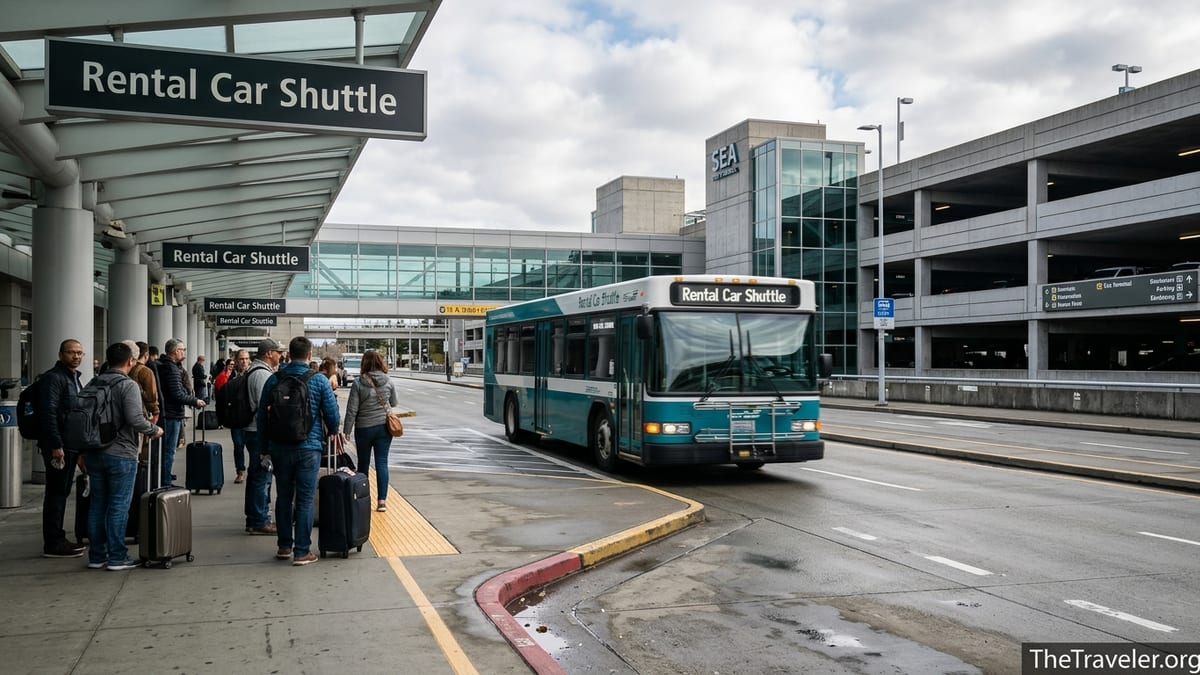
How the Seattle–Tacoma Rental Car Facility Works
All major rental companies at Seattle–Tacoma International Airport operate out of a consolidated Rental Car Facility a short drive from the terminal, rather than from counters inside the airport itself. The complex sits at 3150 South 160th Street in SeaTac and runs 24 hours a day. It houses brands such as Alamo, Avis, Budget, Dollar, Enterprise, Hertz, National, Thrifty, Sixt, Fox and several others, each with its own counter and parking deck area for pickups and returns.
The facility is designed for high volume, with multiple floors of parking and “quick turn” areas where cars are refueled and cleaned between rentals. In practice, this means that during peak cruise season and summer weekends you may see long lines at some brands, particularly budget chains, even though the building itself is roomy. Travelers arriving on a weekday afternoon in February might walk straight to a counter, while those landing on a July Saturday morning for an Alaska cruise should be prepared for waits of 30 minutes or more at popular desks.
Because the Rental Car Facility is not connected to the terminal by pedestrian paths, walking there is not recommended. The streets between the airport loop and South 160th Street include freeway ramps and busy traffic patterns, and local transit riders typically either ride the dedicated rental car shuttle from the terminal or use Link light rail to SeaTac/Airport Station and then connect via shuttle back to the terminal if they are picking up a car directly after landing.
Once at the facility, the pickup flow is the same as most large US airports: you check in at your company’s counter or go straight to the garage if you are enrolled in a loyalty program like Hertz Gold Plus Rewards or National Emerald Club, select your vehicle or receive an assigned space number, inspect the car, and then follow overhead signs to exit gates that take you back toward the airport loop, Interstate 5, or State Route 99.
Shuttle Pickup: From Baggage Claim to the Rental Car Facility
Reaching the Rental Car Facility starts at baggage claim. After collecting your bags at SEA’s lower-level baggage carousels, follow overhead signs for “Rental Car Shuttle.” The airport operates two main pickup zones along the arrivals drive: one at the north end near the Alaska Airlines carousels and one at the south end used more by international and Delta passengers. From either end, you step outside onto the curbside lanes marked for rental car shuttles and wait under clearly labeled signs.
The shuttles are large buses operated by or for the Port of Seattle and run around the clock, every day of the year. Airport and rental car information sites generally describe them as running every 5 to 15 minutes depending on time of day, with shorter waits during busy peaks. In practice, travelers arriving during mid-morning or early evening often see shuttles every few minutes, while those landing after midnight might wait closer to 10 or 15 minutes for the next bus. The ride itself typically takes about 5 to 7 minutes, but can stretch slightly longer if there is congestion on the airport loop roads.
Boarding the shuttle is straightforward. The driver will usually ask which company you are renting from only to confirm that you are headed to the central facility and not to a separate hotel shuttle. All brands in the consolidated facility use the same main shuttle; a few off-airport companies like ACE or independent van rental outfits operate their own smaller buses that pick up in nearby zones and may run less frequently, so budget-conscious travelers should factor potential wait times into their arrival plans.
On arrival at the Rental Car Facility, the shuttle pulls into a bus plaza area on the upper level. From there, escalators and elevators take you down into the central lobby where you will find check-in counters and wayfinding signs to each company’s garage level. The same shuttle system handles returns in reverse: you drop off your car in your company’s section, follow signs to the shuttle boarding point, and ride back to the terminal. During peak morning departures, some travelers report that lines to board the shuttle can add 15 to 20 minutes before you even reach the terminal, so it is wise to build extra buffer time.
Pickup, After-Hours Returns and Realistic Timing Tips
At busy times, the pinch points at SEA’s Rental Car Facility are often the counter queues and shuttle boarding areas rather than the drive between the airport and the facility. If your flight arrives at 10:00 a.m. on a summer Saturday, a realistic door-to-driver’s-seat estimate might be 45 to 60 minutes: 10 minutes to deplane, 15 to 20 minutes to claim checked bags, 5 to 10 minutes to get outside and catch the shuttle, and then 15 to 20 minutes to navigate check-in and car pickup. Agents at major companies may try to upsell larger vehicles or coverage options, which can also add time if you need to ask questions or adjust your booking.
Frequent travelers often shave this down by skipping the counter entirely. Programs like National Emerald Club, Avis Preferred and Hertz Gold Plus Rewards sometimes allow you to go straight to a designated row, choose a car within your booked class, and simply show your license at the exit gate. If you are arriving late at night, enrolling in one of these programs in advance can make a big difference, since staffing is thinner and some counters close earlier than others even though the facility itself remains accessible.
Returning your car is usually faster but can still involve bottlenecks. On a typical Monday morning, you might spend 5 to 10 minutes driving through the return lanes as attendants check fuel levels and mileage, then another 5 to 15 minutes waiting for a shuttle and riding back to the terminal. Travelers catching early long-haul flights often aim to arrive at the Rental Car Facility 45 to 60 minutes before their recommended terminal check-in time, especially if they are traveling with children or oversize luggage that may slow down boarding and security.
Most brands at SEA allow 24-hour returns, often with drop-box systems for keys. For example, if you are driving back from a late concert in Tacoma and your flight leaves at 6:00 a.m., you can usually return the car to the company’s designated after-hours lane around 3:00 or 4:00 a.m., leave the keys in a secure drop, and then take the continuously running rental car shuttle back to the terminal. The final invoice will typically be emailed once staff inspect the car after sunrise. It is still smart to take timestamped photos of the vehicle at drop-off in low light, including fuel gauge and odometer, in case of later disputes.
Insurance, Deposits and Local Rental Costs at SEA
Insurance and deposits at Seattle–Tacoma largely mirror other major US airports, but a few local factors are worth keeping in mind. Most national chains place a hold on your credit card at pickup that combines the estimated rental charges with an additional security amount. For a three-day midsize rental quoted around 70 to 90 dollars per day before fees and taxes, travelers commonly see authorization holds of 300 to 500 dollars. Debit cards, when accepted, may trigger larger holds and require proof of return travel or additional ID.
Loss damage waivers and liability coverage are heavily marketed at SEA counters, particularly to international visitors arriving on overseas flights. A typical collision damage waiver might add 20 to 35 dollars per day, while supplemental liability often ranges from about 10 to 15 dollars per day, though exact figures vary by brand and season. Because Washington State has mandatory minimum liability requirements that some visitors find low for serious accidents, upgrading coverage can be prudent if your personal auto policy or credit card benefits do not clearly extend to rentals.
Many US-issued credit cards, including some mid-tier travel cards, offer secondary collision coverage that can reduce the need to purchase the rental company’s damage waiver. For example, a traveler with a common travel rewards Visa may decline the waiver after confirming that the card includes protection for rentals up to a certain vehicle type, provided they pay in full with that card and decline duplicative coverage. However, credit card protections typically do not cover liability to other parties or administrative fees such as loss-of-use charges, which SEA-area rentals may assess if a car is taken out of service after an accident.
Seattle’s rainy climate and hilly neighborhoods mean that renters heading into the city or up to Snoqualmie Pass for skiing often consider vehicles with all-wheel drive, which usually come at a premium. A compact SUV from a national chain might run 20 to 40 dollars per day more than a basic economy car during winter weekends. Insurance costs scale accordingly, since higher-value vehicles can carry more expensive coverage rates. If your trip involves only urban sightseeing and you plan to park in hotel garages, a smaller car is not only cheaper to rent and insure but also easier to maneuver in tight downtown structures.
Parking in Seattle and at the Airport: What It Really Costs
Parking prices are a major factor in deciding whether a SEA rental car makes sense. At the airport itself, the central parking garage offers General Parking that, as of spring 2026, is advertised at about 8 dollars per hour, 37 dollars per day, and roughly 222 dollars per week for drive-up customers. Reserved Parking on a special level closer to the terminal entrance starts around 47 dollars per day with a two-day minimum and must be booked in advance. All published rates include local taxes and airport fees and can change, so travelers should view them as ballpark figures rather than fixed guarantees.
In downtown Seattle, hotel parking commonly ranges between about 45 and 70 dollars per night for valet or self-park, especially near Pike Place Market, the waterfront, and the convention center. A mid-range hotel in Belltown might charge 50 dollars per night plus tax for garage access, while a luxury property near the waterfront can exceed 70 dollars for overnight valet. Off-street public garages occasionally offer evening or weekend specials, such as 10 to 15 dollars for parking after 5:00 p.m., but weekday daytime rates in central areas frequently reach 4 to 6 dollars per hour.
Neighborhood parking patterns vary widely. Areas like Capitol Hill, Ballard and Fremont mix residential permit zones with metered commercial streets where two-hour limits are common and enforcement is active. A visitor driving a rental car from SEA into these neighborhoods for dinner can easily spend 4 to 10 dollars on metered parking alone, or circle blocks for 15 minutes to find an unmetered space several blocks away. Meanwhile, many attractions outside the core, such as suburban malls or trailheads in the Cascades, offer free parking but may fill early on sunny weekends.
When returning your vehicle at SEA, parking is included in the rental price since the car goes back to the company’s deck, but time spent in airport traffic is not. If you drop off a companion and luggage at the departures curb and then circle back to return the car, you are adding an extra loop through a frequently congested road network. During busy periods, digital signs and traffic officers sometimes redirect private vehicles between levels to ease backups, which can add unpredictability. For most travelers, it is simpler to drive straight to the Rental Car Facility, return the car, and rely on the shuttle to bring everyone to the terminal together.
Do You Really Need a Rental Car in Seattle?
Whether a rental car is “worth it” at SEA depends heavily on your itinerary. If you plan to stay primarily in downtown Seattle and nearby neighborhoods like Capitol Hill, Pioneer Square and South Lake Union, a car often becomes more of a liability than an asset. Link light rail connects SeaTac/Airport Station directly to downtown in about 35 to 40 minutes, with trains usually running every 6 to 15 minutes depending on time of day. Once in the city, many visitors rely on walking, rideshare services, and buses rather than dealing with hotel parking fees and inflexible one-way streets.
For a long weekend consisting of Pike Place Market, the Seattle Art Museum, a ferry ride to Bainbridge Island and a visit to the Space Needle, two people might spend less than 80 to 120 dollars total on public transit, taxis and rideshares combined, compared with several hundred dollars for three or four rental days plus parking. In this scenario, taking Link light rail from SEA to downtown at the start and end of the trip is both cheaper and simpler than picking up a car at the Rental Car Facility.
A rental car begins to make more sense once your plans extend beyond the city core. Travelers heading to Olympic National Park, Mount Rainier, Whidbey Island or ski resorts like Crystal Mountain and Stevens Pass will find that bus and shuttle options are limited, seasonal or require multiple transfers. In these cases, renting at SEA lets you load up gear, control your own schedule and reach trailheads or lodges that might otherwise be impossible to access in a day trip. A family of four planning three days in Olympic National Park, for example, could justify a mid-size SUV even at higher daily rates, particularly if splitting costs between adults.
An intermediate strategy is to combine transit and a shorter rental. Some visitors take light rail directly from SEA to downtown for the urban portion of their stay, then pick up a car from a city rental office just for their day trips or national park excursions. Returning that vehicle before the final nights in the city avoids parking fees at central hotels. Even within this hybrid approach, the airport facility can still be useful if you find a significantly better weekend rate at SEA than at a neighborhood branch, though you will need to factor the extra time and shuttle rides into your schedule.
Smart Booking Strategies and Local Gotchas
Because SEA is a gateway for Alaska cruises and major tech conferences, rental demand can spike dramatically on certain dates. Travelers arriving on Saturday mornings in May through September, particularly those sailing the same afternoon, often encounter sold-out categories at budget brands or sharply higher walk-up prices. Booking several weeks in advance, watching for price drops, and rebooking if rates fall can save meaningful amounts. Some travelers reserve a cancellable backup with a second company when prices are low, then drop whichever reservation is more expensive closer to the trip.
When comparing deals, look closely at total price rather than headline daily rates. Airport concession fees, customer facility charges and local taxes at SEA can add 20 to 30 percent to the base cost. For example, a midsize car advertised at 55 dollars per day for three days might total closer to 230 to 260 dollars once all surcharges are included. Off-airport rentals in nearby Tukwila or SeaTac sometimes carry slightly lower or different fees, but you will usually need a hotel shuttle or rideshare to reach them, and you may sacrifice the convenience of 24/7 shuttle access back to the terminal for your return flight.
Another common surprise involves tolls and driving distance. While the main routes between SEA and downtown Seattle do not involve toll roads, some bridges and express lanes in the broader region may charge electronic tolls. Rental companies typically offer optional programs that cover toll transponders but apply daily convenience fees on top of actual toll charges, which can add up quickly if used only once. If your itinerary stays within Seattle’s urban core and popular tourist corridors, you may be able to avoid tolls entirely through simple route choices.
Finally, keep in mind that Seattle traffic can be intense at predictable times. Northbound Interstate 5 between the airport and downtown regularly clogs on weekday afternoons and early evenings, and game days for the Seahawks or Mariners can slow approaches to the stadium district. If you plan to pick up a car from the Rental Car Facility and drive straight to a downtown hotel at 5:00 p.m. on a Friday, budgeting at least an hour for that relatively short distance will make the experience less stressful and reduce the temptation to rush on unfamiliar roads.
FAQ
Q1. Where do I catch the rental car shuttle at Seattle–Tacoma Airport?
The rental car shuttle picks up outside baggage claim on the arrivals level at two main zones, one at the north end of the terminal and one at the south end. Follow signs for “Rental Car Shuttle” after collecting your bags and wait at the marked curbside islands.
Q2. How long does the shuttle from SEA to the Rental Car Facility take?
In normal traffic, the ride takes about 5 to 7 minutes. Including waiting time, most travelers spend 10 to 20 minutes from stepping outside baggage claim to arriving at the Rental Car Facility, with slightly longer waits possible late at night or during very busy periods.
Q3. Are the rental car shuttles at SEA free and available 24 hours?
Yes. The consolidated rental car shuttles are free for passengers and operate 24 hours a day, every day of the year. Frequency varies, but buses generally run every 5 to 15 minutes depending on time of day and demand.
Q4. Which rental car companies are at Seattle–Tacoma’s Rental Car Facility?
Most major brands operate there, including Alamo, Avis, Budget, Dollar, Enterprise, Hertz, National, Thrifty, Sixt, Fox and several others. A few smaller companies run separate off-airport locations nearby with their own shuttles.
Q5. How much time should I allow to return a rental car at SEA before my flight?
Plan to arrive at the Rental Car Facility 45 to 60 minutes before the time you want to be inside the terminal. This allows for drop-off, walking to the shuttle stop, possible wait time and the shuttle ride itself, especially during busy morning or evening peaks.
Q6. What are typical parking costs in downtown Seattle if I rent a car?
Many downtown hotels charge around 45 to 70 dollars per night for parking, and public garages often cost 4 to 6 dollars per hour on weekdays. These costs can quickly exceed the price of using transit and rideshares if you are staying mostly in the city center.
Q7. Do I need extra insurance when renting a car at Seattle–Tacoma Airport?
Extra coverage is optional, but many travelers choose to supplement basic protection, especially if their own auto policy or credit card benefits do not clearly cover rentals. Reviewing your existing coverage before arrival helps you decide whether to buy the rental company’s waivers.
Q8. Is a rental car necessary for visiting Seattle’s main attractions?
For most city-focused trips, no. Link light rail, buses, ferries and rideshares make it easy to reach major sights like Pike Place Market and the Space Needle. A car becomes more useful for trips to national parks, ski areas or smaller towns outside the metro area.
Q9. Can I return my rental car at SEA late at night or very early in the morning?
Yes. The Rental Car Facility is accessible 24 hours a day, and most companies have after-hours return procedures that involve parking in a designated area and placing keys in a drop box. The airport shuttle continues to run overnight back to the terminal.
Q10. Are there cheaper alternatives to renting a car directly at SEA?
Sometimes. Off-airport locations in nearby cities may offer slightly lower base rates, and combining Link light rail or buses with a shorter rental from a neighborhood branch can reduce costs. However, those options trade convenience for savings and may not suit tight schedules or travelers with heavy luggage.