

More news on this day
Newly released security camera footage showing a high speed train slamming into a truck at a rail crossing has drawn international attention, highlighting the continuing risks at road rail intersections even as rail operators and regulators promote steady improvements in safety technology.
Get the latest news straight to your inbox!
Footage Reveals Seconds Before Violent Impact
The collision, captured in stark clarity by a fixed security camera overlooking the crossing, shows the truck entering the tracks with limited margin as the train approaches at speed. The recording, circulated widely by news outlets and on social platforms, freezes the moment the truck becomes trapped in the train’s path, leaving little time for evasive action.
Frame by frame, the video illustrates how quickly a routine crossing can turn catastrophic. Warning lights are visible and barriers are down or descending as the truck continues to move forward. Within seconds, the locomotive plows into the vehicle, splintering the trailer and scattering debris along the right of way while the train continues through the crossing before coming to a halt further down the line.
Publicly available reporting indicates that similar collisions in recent months in Australia, North America and Europe have also been recorded by security or surveillance cameras positioned near rail lines. These recordings have become central visual evidence for investigators, but they have also turned into viral clips that prompt intense debate about driver behavior, infrastructure design and the responsibilities of rail and road authorities.
In this latest case, emergency responders arrived to find significant damage to the truck and locomotive and debris on and around the tracks. Initial reports suggest that while injuries were recorded, the outcome could have been far more severe had the train derailed or impacted additional vehicles waiting at the crossing.
Pattern of Train Truck Crashes Caught on Camera
The dramatic sequence adds to a growing library of security and bystander videos documenting near identical scenarios: a heavy truck entering a level crossing too late, a passenger or freight train unable to stop in time, and a violent impact that plays out in seconds. Recent examples reported in Western Australia, Canada and the United States show trucks being torn apart at crossings while trains remain largely upright but sustain front end damage.
In several of those incidents, security camera or forward facing locomotive footage has later been released by rail operators, safety boards or local media. The images tend to show fully functional warning systems, with flashing lights and lowered gates, while the trucks either attempt to cross at the last moment or become immobilised on the tracks. The similarity of the footage has prompted safety advocates to describe the events as “predictable but preventable,” arguing that the underlying risk factors repeat across countries and rail networks.
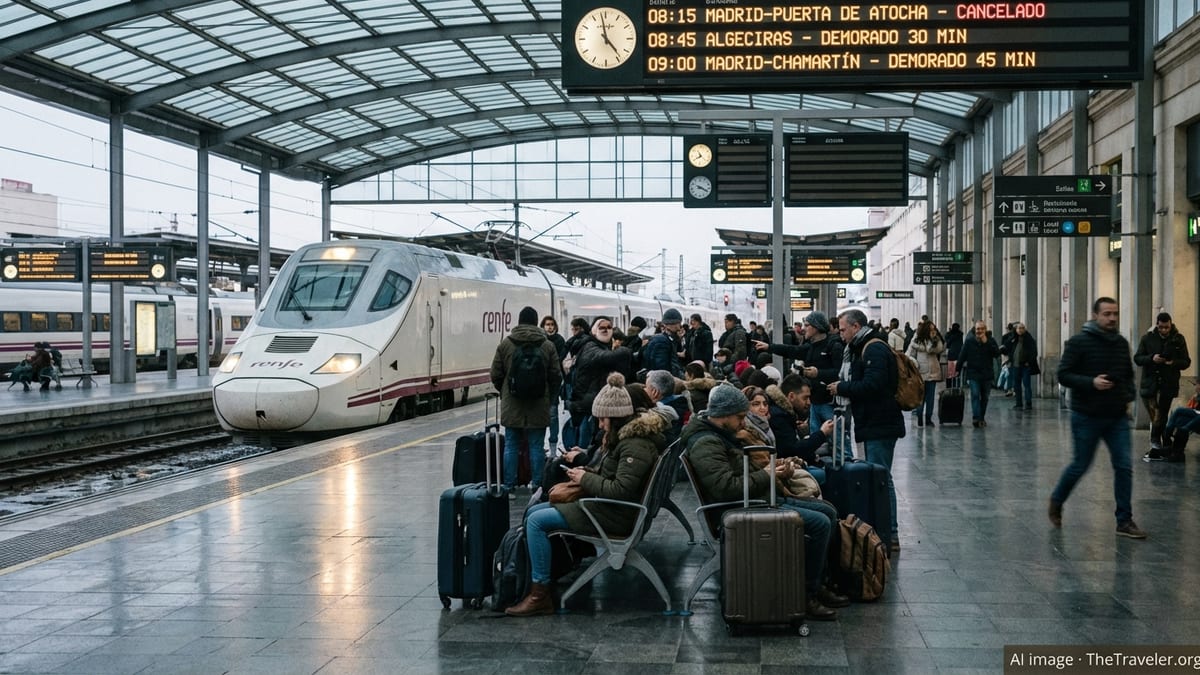
Travel industry observers note that such collisions can disrupt passenger services far beyond the crash site. When tracks are blocked by wreckage or require inspection and repair, intercity and regional trains are delayed or cancelled, stranding travelers and forcing operators to arrange replacement buses. In some cases, tourism dependent regions experience immediate economic effects when key rail corridors are temporarily shut.
While each investigation focuses on local conditions, the accumulation of video documented crashes is increasingly being treated as a global data set. Analysts point to common threads such as complex road layouts, busy freight routes intersecting passenger lines, and crossings on approaches to industrial estates or highway junctions, where long or heavy trucks are more likely to be present.
Technology Turns Crossings Into High Definition Crime Scenes
The rise of high definition cameras at rail crossings has transformed how such collisions are understood. What once relied on eyewitness testimony and physical evidence is now supplemented by continuous visual records, providing investigators with precise timelines, vehicle speeds and driver actions in the seconds before impact.
Safety agencies in several countries have documented how forward facing cameras on locomotives, combined with fixed security cameras at crossings, allow analysts to reconstruct incidents in detail. The footage can show whether warning lights were active, how long barriers were lowered, and whether vehicles stopped or attempted to bypass protection systems. In some published reports, these video records have clarified that trains were operating within speed limits and that crossings were functioning as designed at the moment of collision.
Beyond investigations, the imagery is increasingly used in driver education campaigns. Transport departments and rail operators have incorporated anonymised crash clips into public awareness videos that highlight the consequences of misjudging train speed or trying to outrun an approaching locomotive. Road safety advocates argue that the realism of these recordings carries far more impact than animated diagrams or static photographs.
At the same time, the viral circulation of crash videos has raised ethical questions. Commentators note that the rapid spread of shocking footage can overshadow nuanced discussion about engineering solutions, and can be distressing for those directly affected by the incidents. Some rail operators have started releasing edited or blurred versions of recordings to balance transparency with privacy and sensitivity concerns.
Engineering Solutions and Persistent Human Factors
Despite the disturbing visuals, safety statistics in many developed rail networks show gradual improvements over the long term, with fewer collisions relative to growing road and rail traffic volumes. Engineers attribute this to the replacement of level crossings with bridges or underpasses, the installation of upgraded barriers, and the use of advanced detection systems that monitor obstacles on the tracks.
Research projects described in academic literature outline experimental systems that use computer vision, radar and wireless communication to detect vehicles obstructing crossings and to issue alerts both to approaching trains and to road users. Some prototypes use camera feeds to analyse approaching traffic patterns, extending warning times or activating additional visual cues when a large or slow moving vehicle is detected near the tracks.
However, recent crashes caught on security cameras underline that technology cannot fully compensate for human error. Reports into past incidents have repeatedly cited driver decisions, including entering a crossing when queues of traffic ahead leave insufficient space to clear the tracks, or attempting to circumvent lowered barriers. Heavy trucks hauling long trailers or specialised loads are particularly vulnerable if they misjudge clearance or become grounded on uneven track approaches.
Analysts emphasise that freight operators, trucking companies and local planners all share responsibility for reducing those risks. Suggested measures include clearer signage about low clearance or steep approaches, route planning that avoids problematic crossings for oversize loads, and mandatory briefings for drivers operating near busy rail lines. Rail operators, meanwhile, are under pressure to continue identifying high risk crossings and to prioritise upgrades where video evidence indicates frequent near misses.
Implications for Passengers and the Wider Travel Network
For passengers, the immediate impact of a train truck collision is often felt in hours of delays, cancelled services and complex rebooking processes. When a collision involves a passenger service, carriages may require inspection or repair, and crew members may need to be stood down, reducing fleet availability during busy periods. In some instances, entire sections of corridor are closed while wreckage is removed and track integrity is confirmed.
Travel providers have responded by expanding contingency planning for rail disruptions, including agreements to substitute buses and reciprocal ticketing arrangements between operators. Tour operators and travel agents increasingly monitor rail safety and reliability metrics, taking into account the potential for incident related shutdowns when designing rail based itineraries.
The latest security camera footage has also fuelled renewed calls for public awareness campaigns targeting both local residents and visiting drivers unfamiliar with regional rail networks. Road safety organisations argue that tourists driving rented vehicles may be less aware of local crossing layouts, train frequencies or warning signals, particularly in rural areas where tracks intersect minor roads without extensive signage.
As investigators continue to analyse the newest collision, safety specialists suggest that its greatest long term impact may lie in the lessons extracted from the video. Each high definition recording of a near instantaneous decision at a crossing, they argue, offers another opportunity to refine both technology and education, with the aim of keeping future trains and trucks from ever meeting on the same stretch of track.