


Selfoss waterfall in North Iceland is often overshadowed by its thunderous neighbour Dettifoss, yet many travelers come away saying it was the unexpected highlight of their day. Spreading in a graceful horseshoe across the glacial Jökulsá á Fjöllum river in the Jökulsárgljúfur section of Vatnajökull National Park, Selfoss is relatively wide and low compared with Dettifoss, and usually visited on the same short hike. This guide explains exactly how to reach Selfoss safely and efficiently in 2026, how it fits into a Ring Road or Diamond Circle itinerary, and what to expect when you arrive.
Get the latest updates straight to your inbox!
Orientation: What and Where Selfoss Waterfall Is
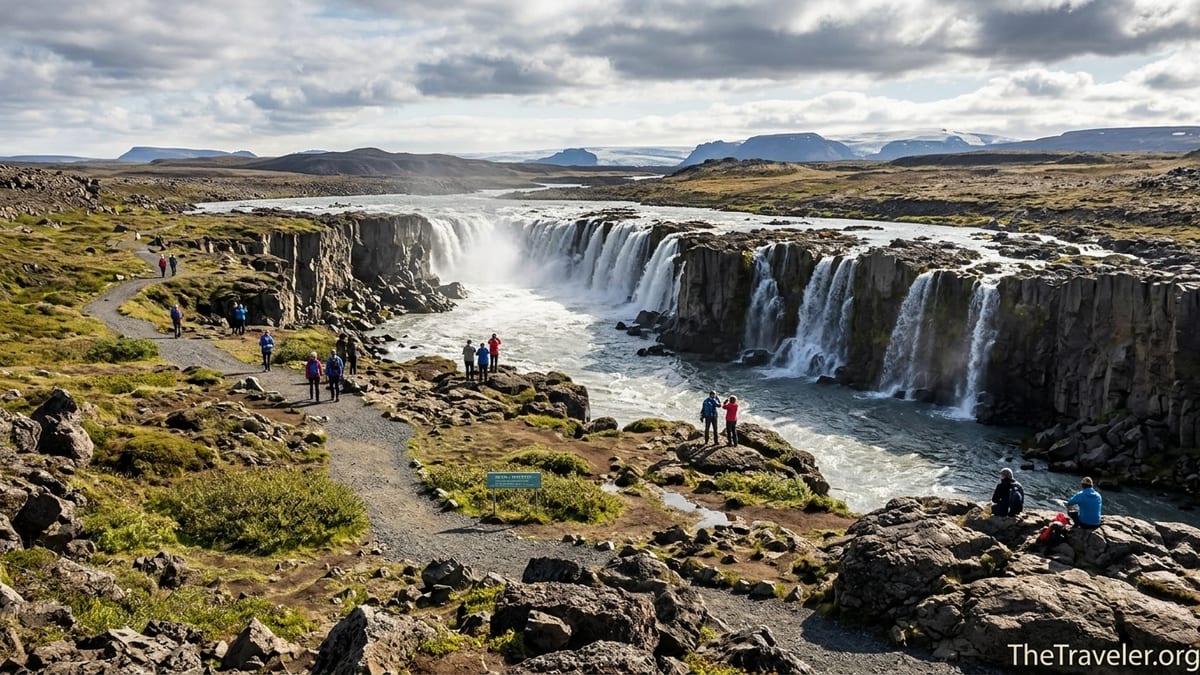
Selfoss waterfall is a broad, curtain-like drop on the Jökulsá á Fjöllum river in Northeast Iceland, a few hundred meters upstream from Dettifoss in the Jökulsárgljúfur area of Vatnajökull National Park. The river flows north from the Vatnajökull ice cap through a deep canyon, creating a series of major waterfalls including Selfoss, Dettifoss and Hafragilsfoss. Selfoss itself is not especially tall compared with some Icelandic falls, but its wide arc of water and the dramatic canyon setting make it a favourite with photographers.
Most visitors experience Selfoss as part of a loop walk that links the viewpoints at Dettifoss with a marked trail upstream to the rim above Selfoss. The contrast is striking. Dettifoss is raw power and spray, while Selfoss feels more sculpted, with multiple segments of water dropping over the edge of the basalt canyon. Seen in good conditions, the hike between the two gives some of the most memorable waterfall views in North Iceland.
Selfoss lies in the interior of Northeast Iceland, between Lake Mývatn and Ásbyrgi canyon. It is not in a town and has no services built around it. Facilities are limited to parking areas, toilets at the main west-side lot and marked paths. Fuel, food and accommodation are found in surrounding hubs such as Reykjahlíð on Lake Mývatn, Húsavík on the coast and Akureyri, the main town of North Iceland.
Conditions around Selfoss change significantly with the season. In the main summer months, the west-side access road and trails are usually clear of snow and accessible to standard rental cars. In late autumn, winter and early spring, both driving and walking can be affected by snow, ice and high winds, and at times access may be impossible. Visitors in 2026 should treat any online description as a snapshot rather than a guarantee and always check live road and weather information on the day of travel.
Important Clarification: Waterfall Selfoss vs Town of Selfoss
There are two completely different places in Iceland called Selfoss. One is the waterfall described in this guide, in North Iceland near Dettifoss. The other is a sizable town in South Iceland, southeast of Reykjavík, far away on the other side of the country. Confusing the two is a common planning mistake and can result in unrealistic itinerary ideas or navigation mishaps when entering destinations into GPS systems.
The town of Selfoss lies on the Ring Road east of Reykjavík and is a regular service and accommodation hub for Golden Circle and South Coast trips. By contrast, Selfoss waterfall lies in the Northeast interior and is reached via side roads off the Ring Road between Lake Mývatn and the northeastern coast. The two locations are separated by roughly 500 kilometers of driving on the Ring Road, typically seven hours or more in good conditions, so they are not interchangeable day-trip targets.
When searching in navigation apps, select “Selfoss waterfall” or pair it with “Dettifoss” or “Jökulsárgljúfur” to minimize the risk of being routed to the wrong side of Iceland. Similarly, if you are booking accommodation or activities, double-check that any mention of Selfoss clearly indicates whether it refers to the town in the south or the waterfall in the north.
For the remainder of this article, “Selfoss” always refers to the waterfall in North Iceland. Travelers combining a full Ring Road circuit may visit both on the same trip, but they should be planned as entirely separate stops on different travel days.
How to Reach Selfoss Waterfall by Car in 2026
Almost all independent travelers reach Selfoss waterfall by driving a section of Iceland’s Ring Road, Route 1, then turning onto one of two access roads that run toward the canyon: Route 862 on the west bank of Jökulsá á Fjöllum or Route 864 on the east bank. In 2026, the west-side Route 862 is a paved road and the main approach, while Route 864 remains a rough gravel road that is normally treated as summer access only.
From Reykjavík to the Selfoss waterfall area is a long drive and typically not done as a day trip. The distance via the northern Ring Road is roughly 480 to 520 kilometers depending on your chosen route around Akureyri, which translates to at least six and a half to seven and a half hours of non-stop driving in ideal conditions. Most travelers sensibly break this into at least two days, overnighting in the West or North before continuing to the Mývatn area.
From Akureyri, the main town in North Iceland, you follow Route 1 east toward Mývatn. The distance to the Dettifoss turnoffs is around 160 to 190 kilometers depending on whether you use the tunnel or the old pass near Akureyri, with non-stop driving times typically around two to two and a half hours in summer. Conditions in winter, or during strong wind events, can lengthen that significantly, so allow generous buffers and follow any warnings about mountain passes on Route 1.
If you are staying near Lake Mývatn, usually around Reykjahlíð village, you are ideally placed to visit Selfoss. From Reykjahlíð to the Route 862 detour north to Dettifoss is roughly 50 kilometers and usually about 45 minutes of driving in summer. From Reykjahlíð to the Route 864 junction is a similar order of magnitude, but getting all the way in to the falls on 864 can take longer due to the slower gravel surface. From Húsavík, you typically drive south on Route 85 and then use Route 862 from the north, or in high summer potentially connect via sections of Route 864, depending on conditions. Non-stop times from Húsavík are generally about an hour and a half in summer, but road works or wind can increase that.
Choosing Between Route 862 (West) and Route 864 (East)
Route 862 on the west side of Jökulsá á Fjöllum is the main access road for both Dettifoss and Selfoss in 2026. It is paved along its length between the Ring Road and Ásbyrgi and is usually suitable for regular 2WD rental cars in summer under normal conditions. The large west-side car park for Dettifoss and Selfoss sits a short spur drive off 862, with marked paths leading to the viewpoints. For most visitors, especially outside the high summer window, Route 862 and the west side are the recommended choice.
Route 864 on the east side is a rough gravel road that runs between Route 1 near Grímsstaðir and Route 85 closer to the coast. It passes turnoffs for viewing points over Dettifoss, Selfoss and Hafragilsfoss from the east rim of the canyon. The road is unpaved, can be potholed and corrugated, and is not maintained in the same way as 862. In practice, it is commonly open for only part of the summer season and is not serviced in winter. Driving speeds are slower and comfort is lower, especially in small cars.
Seasonally, both 862 and 864 can close during winter and shoulder seasons, but they behave differently. Route 862, although not a primary winter road, is the only realistic vehicle access to the canyon outside the main summer months, and sections are sometimes plowed as conditions allow. Route 864, by contrast, is often officially classed as “road not in service” or impassable from autumn well into late spring. Opening and closing dates vary year to year with snowfall and weather; a section that opened in late May one year might only become passable in June another year.
Because these patterns are dynamic, travelers in 2026 must not rely on static blog posts or older guidebooks for route decisions. Instead, check the live road status map of the Icelandic Road and Coastal Administration on the morning you intend to drive, and pay close attention to notations such as “closed,” “no winter service,” or “impassable.” If there is any doubt, stay with the paved west-side Route 862, or consider joining a guided tour that includes transport to the falls with experienced local drivers.
Visitor Experience: West vs East Sides of Selfoss
On the west side, from the main paved parking area off Route 862, a clearly marked path leads first to the viewing platforms over Dettifoss. This section is typically described as a short walk, on the order of 10 to 15 minutes in summer conditions for most visitors. From Dettifoss, a signed trail continues upstream along the canyon rim toward Selfoss. Various sources suggest that the full walking loop from the car park to Dettifoss, onward to viewpoints above Selfoss and back takes around an hour at an easy pace in dry summer conditions.
The west-side path gives a more side-on perspective of Selfoss, looking obliquely down into the canyon at the curved line of falls. There are several unofficial side tracks visible where people have previously wandered closer to the edge, but visitors should stick to the main, marked routes where park staff intend people to walk. Trail surfaces range from compacted gravel near the parking area to rougher rock and mud as you approach the canyon rim. Even in summer, stones can be loose and the edges unsecured, so care and good footwear are important.
On the east side via Route 864, the experience is more rugged. Paths are often less developed, and the approach to the rim viewpoints involves walking over uneven, rocky ground. In clear conditions, photographers often prefer the east-side view of Selfoss because it gives a more front-on angle to the crescent of waterfalls and the river approaching from upstream. However, spray, wind, and the absence of built viewing platforms at some spots can make it feel more exposed, particularly near the canyon edge.
Hiking times and the availability of specific viewpoints on both sides can vary within a season. Heavy rain may turn sections of the trail muddy or slippery. Snow patches or ice can persist well into late spring, and in winter the formal hiking routes may not be maintained or waymarked through snow, even if the road to the parking area is technically open. Before setting out, especially outside July and August, review current guidance from Vatnajökull National Park about which paths are recommended or temporarily restricted, and be prepared to modify your plans if rangers or signage indicate closures or hazards.
How Much Time to Budget at Selfoss and Dettifoss
For travelers on a tight timetable, it is possible to make a brief stop that takes in Selfoss as part of a focused visit to the canyon. If you are already driving Route 862 and conditions are good, allow at least an hour and a half from the moment you park to walk to Dettifoss, continue to the main Selfoss viewpoint on the west side, and return, without lingering too long for photographs. This assumes confident walking on uneven ground and calm, dry summer weather.
Most visitors will appreciate budgeting more generously. A realistic window for an unhurried experience is around two to three hours at the site, which allows time to visit multiple viewpoints over both Dettifoss and Selfoss, take photographs, adjust clothing layers, and simply stand and absorb the atmosphere. Photographers working with tripods or waiting for changing light may easily spend half a day here, particularly in the long evenings of late June and July.
Driving time to and from the site must be added on top. From popular bases around Lake Mývatn, plan on at least half a day for the round trip including the visit itself, and more if you are combining the falls with other stops such as Hverir geothermal area or Ásbyrgi. From Akureyri or Húsavík, Selfoss is better planned as the centerpiece of a full-day outing, with a mix of driving, the waterfall hike and secondary sights along the way.
In winter, time estimates become far less predictable. Walking speeds drop markedly when paths are snow-covered or icy, and in short daylight windows it can be imprudent to push to all viewpoints. A loop that takes an hour in summer might stretch well beyond that in winter conditions, or be unsafe altogether. When days are short and weather is active, it is often wiser to take a conservative approach, focus on one main viewpoint and be ready to turn back if conditions deteriorate.
Safety: Terrain, Weather and Sensible Limits
Selfoss is set on the edge of a deep canyon carrying a powerful glacial river, so safety requires active attention. The canyon rims near both Selfoss and Dettifoss include steep, unprotected drops. Rocks close to the edge can be loose or undercut, and the ground can appear more stable than it really is. Visitors should stay on marked paths and within signed viewing areas wherever these exist, and should never approach the lip of the falls or climb beyond barriers or railings for a closer photograph.
Even in dry summer weather, spray from the waterfalls can drift onto nearby rocks, turning them slippery. Patches of mud develop along popular desire paths where people shortcut corners of the trail. Good footwear with solid grip, such as hiking shoes or boots, is strongly recommended. Lightweight sneakers and smooth soles increase the risk of slipping, particularly near the canyon rim. Trekking poles can be helpful for those who are less sure-footed.
In colder months, snow and ice become the dominant hazards. Concealed ice on rock slabs around the viewpoints and on the trail can cause sudden falls. Strong winds can add to the risk by affecting balance near exposed edges, and in winter storms gusts may be strong enough to knock a person off their feet. Travelers should be prepared to abandon a planned stop if wind warnings are high or visibility along the canyon is poor. Layers of warm, windproof clothing, hats and gloves are essential outside the core summer period.
Families should be aware that some viewpoints and sections of trail can be challenging for young children, older adults or anyone with limited mobility. There are uneven steps, irregular rocks and stretches without fencing. Children must be supervised at all times and kept well away from the edge of the canyon. For those with mobility aids or balance issues, some of the more distant viewpoints may not be practical; instead, focus on the more developed platforms closest to the parking area where surfaces are smoother and gradients gentler.
Facilities, Services and Practical Logistics
The principal visitor infrastructure for Selfoss and Dettifoss is on the west side off Route 862, where there is a relatively large formal parking area, information boards and toilets. The toilets are basic and may use a dry or composting system rather than full flush plumbing, and cleanliness can vary with visitor volume. They are intended for short visits, so travelers should not assume the facilities will match those of a staffed visitor center.
At the time of writing, there is no widely publicized national park entry fee specifically for walking to Selfoss and Dettifoss, but arrangements around parking or conservation charges can evolve as visitor numbers change. Because fee structures and any advance booking requirements are subject to review, visitors in 2026 should check current information before traveling, either through official national park channels or local tourist information offices. Do not assume that parking will always be free or that current arrangements will persist indefinitely.
There are no fuel stations, grocery shops or restaurants at Selfoss or Dettifoss. The nearest services are typically in Reykjahlíð at Lake Mývatn, in Húsavík on the north coast, and in Akureyri further west. It is prudent to top up fuel and stock snacks and water before leaving these hubs, particularly if you plan to drive both ways on the same day. Mobile reception around the canyon can be patchy; while some users may find coverage at parking areas or on higher ground, it should not be relied upon for navigation or emergency calls.
Parking areas and trails can become busy in the peak summer months, especially during midday and early afternoon when Ring Road travelers and Diamond Circle tours converge. To enjoy a calmer atmosphere and softer light, many independent travelers aim for early morning or later evening visits in June and July, when daylight extends deep into the night. In shoulder seasons when daylight is shorter, timing is dictated more by road conditions and the limited window of safe driving.
Planning Your Itinerary: Diamond Circle and Beyond
Selfoss is a key element of North Iceland’s Diamond Circle, a scenic circuit that typically links Húsavík, Ásbyrgi canyon, the Jökulsárgljúfur waterfalls including Dettifoss and Selfoss, and the Lake Mývatn area. Many visitors include Selfoss on a Diamond Circle day trip from a base in Húsavík, Mývatn or Akureyri, either by self-drive or with an organized tour. In practice, the falls often become the emotional high point of the loop, particularly in good weather.
For travelers driving the full Ring Road, a common approach is to spend one or more nights around Lake Mývatn and use one of those days for an excursion to Selfoss and Dettifoss. This combines naturally with time at the geothermal fields near Námafjall, the lava formations of Dimmuborgir, or an evening soak at one of the region’s bathing facilities. Another popular pattern is to arrive from Akureyri, explore Mývatn and the waterfalls, then continue north to Húsavík for whale watching the following day.
If you have additional time, you can extend your exploration of Jökulsárgljúfur beyond the main car-accessible waterfalls. The canyon includes other hiking areas such as Vesturdalur and Hljóðaklettar, and Ásbyrgi itself offers walking trails in a striking horseshoe-shaped depression. These require extra driving and walking time and should not simply be tacked onto an already full Selfoss and Dettifoss day unless your daylight hours, energy and weather all align favourably.
What matters most is that Selfoss is not treated as a quick photo stop squeezed into an already overloaded schedule. Its full impact emerges when you allow enough time to walk along the canyon edge, experience both the raw force of Dettifoss and the graceful curve of Selfoss, and still have room in the day for safe driving on the often-demanding roads of North Iceland.
Seasons and When to Visit Selfoss
Summer and early autumn, roughly from late June through September, provide the most reliable access to Selfoss waterfall. During this period, Route 1 around North Iceland is generally clear of snow, Route 862 is normally open along its length, and the west-side paths to Dettifoss and Selfoss are largely snow-free. Daylight is abundant, particularly around the June solstice when you can explore in extended evening light and face less crowding at peak midday hours.
Late spring and late autumn are more variable transition seasons. Snowmelt, freeze-thaw cycles and spring floods can all influence when secondary roads and hiking paths become safe and practical. In some years, parts of Route 862 and 864 open relatively early, while in others they remain restricted well into early summer. Visitors during these windows must be flexible, consider alternative plans if access is limited, and be prepared for lingering snow patches or muddy sections on the trail.
Winter visits to Selfoss are only for well-prepared travelers who are comfortable with Icelandic winter driving or who join guided tours with local drivers. Short daylight, frequent storms, icy surfaces and intermittent road closures make logistics complex. Even if Route 1 remains open, the side roads to the canyon may be closed, unserviced or subject to short-notice restrictions. Those determined to see the falls in winter often base themselves in the Mývatn area and rely on tour operators who monitor conditions daily and adjust plans according to safety.
Whichever season you choose, it is vital to build redundancy into your schedule. Have backup sights around Mývatn or Húsavík in case the canyon is not accessible on your planned day, and avoid planning Selfoss as a must-see stop squeezed between immovable bookings far apart on the Ring Road. Iceland rewards those who travel with patience and flexibility as much as with a checklist of locations.
Is Selfoss Worth a Detour and Final Planning Checklist
For many visitors already aiming for Dettifoss, Selfoss is not just worth a detour; it is an integral part of the experience. The short additional walk upstream reveals a gentler yet equally compelling side of the Jökulsá á Fjöllum canyon, and the combination of both waterfalls in a single outing creates one of North Iceland’s most memorable days. Photographers, hikers who enjoy rugged terrain, and travelers with a deep interest in landscapes will get the most from the visit, but even casual sightseers usually find the spectacle rewarding.
If you are extremely short on time, such as driving a tight Ring Road schedule with long distances each day, you may hesitate to add more walking. In that case, consider whether you can adjust your itinerary to include at least a brief Selfoss stop; the extra effort is modest from the west-side car park and yields a very different perspective from Dettifoss alone. Those who truly cannot spare more than a quick roadside pause may be better off deferring a visit to the canyon for a future trip rather than rushing through in marginal conditions.
Before you set out in 2026, there are a few key planning steps to cover. First, check live road conditions and weather forecasts for Route 1 and the Dettifoss access roads on the same morning you travel, not just the night before. Second, calculate realistic driving times from your base in Reykjavík, Akureyri, Mývatn or Húsavík, adding healthy margins for weather, photo stops and any ongoing roadworks. Third, bring appropriate clothing including windproof and waterproof outer layers, warm mid-layers, hats, gloves and sturdy footwear suited to uneven ground.
Finally, approach Selfoss and its canyon setting with respect. Stay well back from unstable edges, keep children close, avoid stepping beyond barriers for photographs and be ready to turn around if conditions deteriorate. With thoughtful planning and a flexible mindset, Selfoss waterfall becomes not just another tick on an itinerary, but a powerful encounter with the forces that have carved Iceland’s extraordinary volcanic landscapes.