


July 2027 will be one of the most tempting times to drive Iceland’s Ring Road. The country is at its greenest, most services are open, highland tracks are coming into season and you enjoy very long daylight hours. At the same time, July is the peak of Iceland’s tourist year, with full hotels, higher car hire rates, packed car parks at the South Coast’s star attractions and more competition for everything from glacier hikes to whale watching tours. This guide pulls together the latest Icelandic road, accommodation and pricing information to help you decide whether a July Ring Road trip is worth the premium, and how to budget for it realistically.
Get the latest updates straight to your inbox!
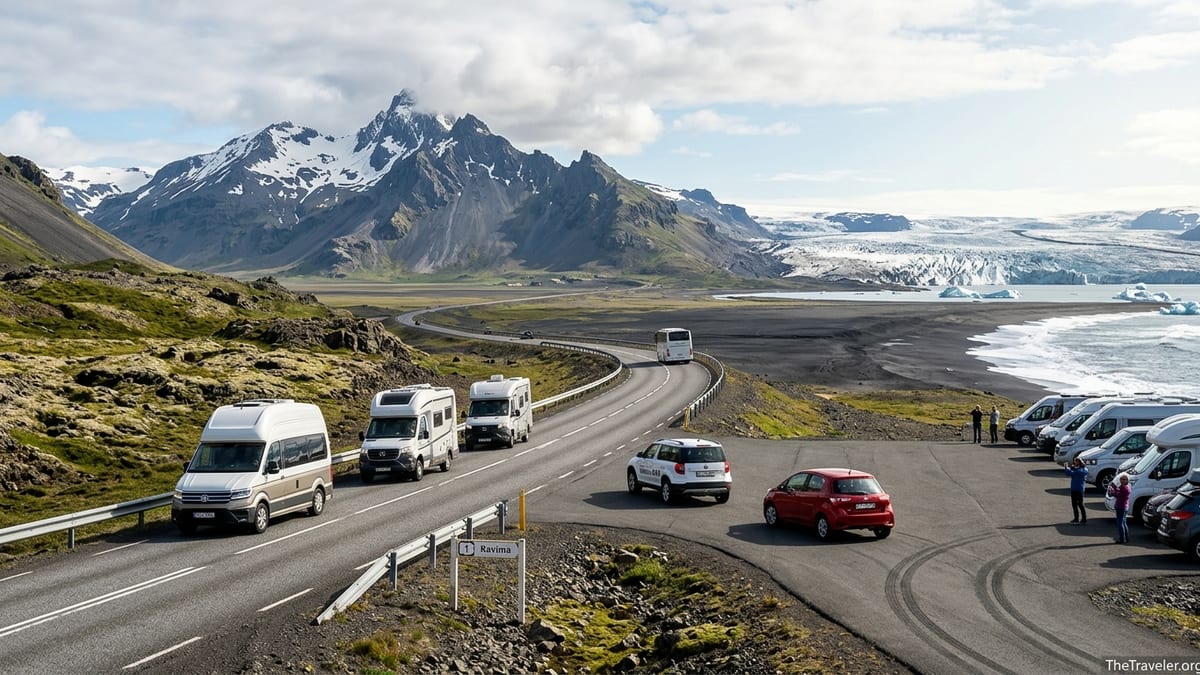
Why July Is Easy, Expensive and Crowded
The Ring Road, Route 1, forms a paved circuit of roughly 1,330 kilometres around Iceland, linking Reykjavík with the South Coast, Eastfjords, north and west. Official figures put it at about 1,332 kilometres after tunnel improvements near Akureyri shortened an older section. That distance may not sound huge, but once you factor in photo stops, gravel side roads, single-lane bridges and slow traffic near major sights, it quickly fills a week.
July is statistically one of the most accessible months to tackle the circuit. Climate data for Reykjavík shows average July temperatures around 10 to 11 degrees Celsius, with mean daily highs in the mid-teens and nearly 20 hours of usable daylight, sometimes more in the north. You are unlikely to face ice or snow on Route 1 itself, and almost all regional attractions, museums, boat tours and campsites operate on summer hours.
The trade-off is cost and crowding. Statistics Iceland reported hotel occupancy above 90 percent in the South and East in July 2026, figures that give a strong indication of how busy similar weeks in July 2027 are likely to be. A survey of booking platforms in October 2026 found the lowest hotel prices for one night in July 2027 for two people starting from about 117 euros in Reykjavík, 172 euros in Höfn on the southeast coast, 182 euros in Egilsstaðir in the East and 248 euros in the Kirkjubæjarklaustur area on the South Coast, underlining how prices spike in small gateway towns where demand is intense.
Traffic is heaviest on the South Coast section between Reykjavík, Vík, Skaftafell and Jökulsárlón, where tour buses, campervans and self-drivers converge. Car parks at waterfalls such as Seljalandsfoss and Skógafoss and at the Jökulsárlón glacier lagoon regularly fill by late morning. While July driving is technically easier than winter, you must factor in delays behind slower vehicles, queues at services, and limited last-minute accommodation options in remote stretches.
How Long to Spend: Seven Days vs Ten to Fourteen
On paper, dividing about 1,330 kilometres by seven days suggests fewer than 200 kilometres per day, which might look manageable. In reality, a full Ring Road loop in seven days is rushed. Many days will involve four to five hours of net driving, plus time to visit waterfalls, beaches, canyons and geothermal areas. That leaves little margin for bad weather, roadworks, fatigue, or spontaneous detours into the Eastfjords or Tröllaskagi peninsula.
A ten-day circuit is the sweet spot for many July visitors. It allows you to break the South Coast into two or three shorter stages, spend a full day or more in the Mývatn geothermal area and Akureyri, and still have a buffer day to slow down in the Eastfjords or West Iceland if heavy rain or strong wind hits. Ten days also makes it easier to keep daily driving time near three hours, with only a few longer pushes of around five hours.
If you can stretch to twelve to fourteen days, the trip becomes more than a loop. With two weeks you can add side trips into the Snæfellsnes peninsula, Húsavík for whale watching, or even a supervised highland excursion without feeling rushed. Extra days are especially valuable for photographers who want sunrise or late-evening light at Vestrahorn or Kirkjufell, or for families who need downtime between long car days.
The crucial point is that July’s long daylight can be deceptive. You can physically drive for ten or twelve hours, but doing so across several days makes the trip feel like a delivery run rather than a holiday. Building in slack time also gives you a cushion if sections of Route 1 are slowed by wind warnings, flooding or temporary closures.
A Realistic 10-Day Ring Road Itinerary for July 2027
Day 1 anchors you in Reykjavík. Many international flights arrive early, but it is wise to spend the first day without major driving: explore central Reykjavík, adjust to time zones, and pick up your rental vehicle in the afternoon or next morning. Overnighting in the capital also lets you shop for groceries and gas canisters before prices rise in rural areas.
Day 2 runs Reykjavík to Vík, around 190 kilometres. Without stops this stretch is roughly two and a half hours of driving, but with visits to Seljalandsfoss, Gljúfrabúi, Skógafoss and the Dyrhólaey headland it easily becomes a full day. Vík and nearby hamlets such as Reynisfjara and Kirkjufjara beach attract heavy tour traffic, so expect crowded car parks between late morning and mid-afternoon. Overnighting in or near Vík breaks up the South Coast and gives you sunset or late-evening views of Reynisdrangar when day-trip buses have left.
Day 3 continues from Vík to the Skaftafell and Jökulsárlón area, roughly 270 kilometres and close to four hours of net driving. The lava fields and black sand plains of Mýrdalssandur and Skeiðarársandur offer fewer fuel and food options, which is why midsummer hotel prices around Kirkjubæjarklaustur and Skaftafell surge. This is an ideal day to schedule a half-day glacier walk in Skaftafell or an afternoon boat trip among the icebergs at Jökulsárlón, staying overnight at Skaftafell, Freysnes, Hali or in Höfn, another 80 kilometres east.
Day 4 runs Höfn through the Eastfjords to Egilsstaðir, about 260 to 270 kilometres. Official distance tables give Höfn to Egilsstaðir at just over three and a half hours of driving, but the coastal road includes winding fjord sections that encourage frequent photo stops at places like Djúpivogur and Breiðdalsvík. Staying the night in Egilsstaðir or nearby Seyðisfjörður sets you up for either a detour into the remote northeast or a direct push toward Mývatn.
Day 5 takes you from Egilsstaðir to Lake Mývatn, roughly 170 to 200 kilometres, depending on the exact route. This is one of the shorter legs at about two and a half to three hours, leaving ample time to explore Dettifoss and Selfoss waterfalls via the paved access roads that have gradually improved over the past decade. Overnight by Mývatn gives you time for the geothermal areas at Hverir, the lava formations at Dimmuborgir and a soak in the Mývatn Nature Baths.
Day 6 is Mývatn to Akureyri via Goðafoss, around 85 kilometres and about an hour and a half of driving. The short distance lets you spend the morning on remaining Mývatn walks, then stop at Goðafoss for photos or a guided visit before rolling into Akureyri mid-afternoon. Many travellers use this as a rest day, exploring Akureyri’s cafes and swimming pool instead of packing in more long hikes.
Day 7 pushes from Akureyri back toward West Iceland, perhaps overnighting around Borgarnes or closer to the Snæfellsnes peninsula. Akureyri to Reykjavík is around 380 kilometres and about five and a half hours in normal summer conditions, but by stopping partway you cut that into a more relaxed three to four hours and free up time for Hraunfossar and Barnafoss waterfalls or the Krauma geothermal baths near Reykholt.
Day 8 can focus on western Iceland, with either a loop into Snæfellsnes for views of Kirkjufell and the Snæfellsjökull area or a slower exploration of Borgarfjörður, Deildartunguhver hot spring and historical sites. Distances within West Iceland are modest, often well under 200 kilometres in a day, which is a relief after the long north-to-south run.
Days 9 and 10 then bring you back to Reykjavík with flexibility for an afternoon in the city, a visit to a geothermal lagoon near the capital or a buffer day in case an earlier leg was disrupted by weather or road issues. A final night in Reykjavík or near Keflavík Airport is sensible in July, when same-day road incidents or long queues at car rental returns can add unexpected delays.
Vehicle Choices: Car, Campervan and 4x4 in 2027
The classic choice for a summer Ring Road trip is a compact two-wheel-drive car, such as a VW Golf or Toyota Yaris class. Agent and rental company price lists for summer 2026 show compact cars in the peak June to August season often costing in the region of 80 to 130 euros per day, depending on booking date, supplier and included insurance. One Icelandic rental company quoting July 2027 rates lists a Suzuki Vitara 4x4 at around 88 euros per day in summer, before a government road-use charge that will add roughly 12 euros per rental day from January 2027, which illustrates how policy changes affect total cost.
Larger vehicles, such as estate cars or people carriers, rise in price and fuel consumption. Dedicated campervans suitable for two to four people in July 2027 are currently being advertised around 150 to 280 euros per day for standard two-wheel-drive models, according to a comparison of tens of thousands of live price checks across more than a dozen companies in late 2026. Four-wheel-drive campervans and rooftop-tent setups are more expensive again, often starting above 150 euros per day in the peak July window even when booked months in advance.
Insurance is a major cost driver. Most Icelandic rentals include a basic collision damage waiver, but this usually comes with a high excess and explicit exclusions for damage from wind-blown doors, sand and ash blasting and driving on prohibited roads. Gravel protection and sand and ash protection are typically offered as separate daily add-ons. In windy southeast sections around Vík, Kirkjubæjarklaustur and Höfn these extras are worth serious consideration. Many companies also pre-authorise a substantial security deposit on your card, which can be several hundred euros or more for 4x4s and campervans.
Fuel and parking add to the budget. Petrol and diesel prices in Iceland are among the higher in Europe, and a full Ring Road circuit with side trips can easily exceed 2,000 kilometres of driving. Using a modest consumption estimate, a compact petrol car might consume the equivalent of 150 to 250 euros of fuel at mid-2026 pump prices, while larger 4x4s and motorhomes will burn more. Several popular attractions now charge for parking, particularly along the South Coast, so you should expect to pay modest additional amounts whenever you stop at major waterfalls, canyons or lagoons, although exact 2027 tariffs will only be confirmed closer to the season.
Ring Road vs F-Roads and Highland Openings
A crucial distinction for July planning is that Iceland’s main Ring Road is not the same as the highland F-roads. Route 1 is paved or surfaced and designed for ordinary vehicles for almost its entire length, while F-roads are rugged mountain tracks that cross interior plateaus, with unbridged river crossings, rough surfaces and seasonal snow. The law restricts most F-roads to four-wheel-drive vehicles, but that does not mean you need a 4x4 for a straightforward summer circuit of the Ring Road itself.
The Icelandic Road and Coastal Administration publishes an annual overview of mountain road openings. Analyses of data from 2021 to 2025 show that most F-roads open sometime between mid-June and early July, but individual tracks vary widely. For example, statistics for routes such as F261 near Emstrur show earliest recorded openings in late June and latest openings in mid-July, with average opening around early July. In some years, heavy snowpack or late thaws have kept certain central highland routes closed well into July.
Because these dates depend on actual snow melt, road drying and safety inspections, they cannot be predicted from the calendar alone. Weather anomalies, late winter storms and river conditions all affect when each highland road is declared open. For 2027, detailed F-road calendars will only be finalised closer to the season, based on inspections. The road authority maintains a live road conditions service and a phone information line specifically to reflect day-by-day changes.
For most travellers who plan to stay on Route 1 and short, paved or well-graded detours, a standard two-wheel-drive car is adequate in July, provided you avoid tracks signposted as F-roads and respect any closures. If you deliberately want to enter the highlands to visit destinations such as Landmannalaugar or Kerlingarfjöll on your own, then a genuine four-wheel-drive with suitable ground clearance becomes essential, along with realistic experience of fording rivers and reading conditions.
Campsites, Hotels and Legal Overnighting in 2027
Iceland reformed its camping rules in 2015 under the Nature Conservation Act. The Environment Agency states clearly that spending the night in campervans, motorhomes, roof tents or similar vehicles outside organised campsites or urban areas is illegal unless the landowner has given explicit permission. Separate guidance explains that, in practice, motorised travellers should treat official campsites as the only legitimate overnight option, and many municipalities have introduced bylaws to prevent overnighting in lay-bys or car parks.
Traditional tent camping has a little more flexibility. The law allows a small number of hikers to pitch simple tents for one night on uncultivated land along public routes where there is no campsite nearby, subject to landowner restrictions. However, if more than three tents are involved, the stay runs longer than one night, or the spot lies near a farmhouse or in a protected area, you must ask for permission. In national parks such as Vatnajökull, which includes Skaftafell and Jökulsárlón, regulations explicitly require all visitors, including tent campers, to use organised campgrounds.
Campsite prices have risen in line with demand. One well-equipped campsite in Egilsstaðir lists 2026 prices of 2,950 Icelandic krónur per adult per night, with showers and facilities included and a small overnight tax per camping unit. Reports from other popular sites along the South Coast in 2026 mention fees in the region of just over 2,000 krónur per person, sometimes with separate charges for showers. July 2027 fees are likely to be somewhat higher, so building in at least 3,000 krónur per adult per night for camping is a reasonable budgeting baseline.
Hotel prices vary sharply by location. In October 2026, checks for July 2027 dates showed the cheapest double rooms around 117 euros in Reykjavík, 172 euros in Höfn, 182 euros in Egilsstaðir and nearly 250 euros in the small South Coast hub of Kirkjubæjarklaustur. Vík, with even more demand and limited supply, often prices in a similar or higher band. Akureyri, as the main town of the north, normally sits between Reykjavík and the rural hotspots but can still command peak-season rates well above shoulder months.
Attraction, Tour and Lagoon Costs Along the Route
Along the Ring Road you will encounter a mixture of free natural sights and paid experiences. Many iconic waterfalls, beaches and viewpoints remain free to enter, but an increasing number charge for parking or maintain fee-based toilet facilities. For instance, car parks at some South Coast waterfalls and canyons have already introduced payment systems, and the trend is toward more managed parking as visitor numbers grow. While per-visit charges may only be a few hundred or low thousands of krónur, across a ten-day trip they add up.
Geothermal bathing has become one of Iceland’s signature paid activities. Premium lagoons near Reykjavík and on the South Coast charge noticeably more than municipal swimming pools, which remain a cheaper cultural experience. Recent price lists indicate that premium lagoons often charge the equivalent of 50 to 100 euros per adult for standard entry in peak summer, with optional extras such as towel rental and drinks increasing the total. Smaller regional baths and municipal pools are much more affordable, often under 15 euros equivalent per adult, and can be a cost-effective alternative for daily relaxation.
Whale watching and glacier excursions are two other big-ticket items for a July Ring Road itinerary. Northern ports such as Húsavík and Akureyri, and sometimes Reykjavík, host multiple operators offering two to three hour whale watching trips, commonly priced in the range that pushes a family of four into the low hundreds of euros. Glacier hikes out of Skaftafell or ice cave and zodiac boat trips near Jökulsárlón follow a similar pattern: per-person prices that appear manageable for a solo or couple trip, but which mount quickly for families.
Because these activities are extremely popular in July, the safest approach is to pre-book the one or two excursions you care most about, then leave secondary experiences flexible. Operators adjust 2027 pricing as costs and taxes evolve, so you should always confirm specific tariffs at the time of booking and treat any figures mentioned here as indicative rather than fixed.
Three Example Budgets for July 2027
To illustrate the likely financial shape of a July 2027 Ring Road trip, it is useful to sketch three example budgets for a ten-day circuit: a budget camping couple, a midrange hotel couple and a family of four in hotels. All figures are approximate, based on late-2026 data, and should be treated as planning guides rather than guarantees.
A budget camping couple in a compact rental car might pay around 90 euros per day for the car, including a mix of basic insurance and gravel coverage in July 2027, plus the daily road-use charge where applicable. Over ten days, that is roughly 900 euros. Fuel for about 2,000 kilometres might add 180 to 250 euros, depending on consumption and pump prices. Camping at around 3,000 krónur per adult per night (about 22 to 24 euros at mid-2026 exchange rates) would cost about 440 to 500 euros for ten nights for two. Allowing a modest food budget of perhaps 40 to 60 euros per day, mostly from supermarkets with occasional hot dogs or bakery stops, adds about 400 to 600 euros. With a handful of paid attractions and parking, a frugal but not bare-bones total might fall in the 2,000 to 2,500 euro range for the full trip.
A midrange couple staying in hotels or guesthouses would feel the accommodation costs much more sharply. Using the lower end of July 2027 sample prices, an average of perhaps 190 to 220 euros per night across Reykjavík, Vík, Höfn, Egilsstaðir and Akureyri is realistic once you include some nights in more expensive small-town properties. Over ten nights that yields a room budget around 1,900 to 2,200 euros. Add a slightly larger car, perhaps 100 to 120 euros per day with insurance and fees, fuel similar to the camping couple, and a food budget of perhaps 70 to 100 euros per day to allow for restaurant dinners several nights. Including a premium lagoon visit and one or two guided activities, a midrange ten-day total can easily land between 3,500 and 4,500 euros for two.
A family of four in hotels faces both higher vehicle and accommodation costs. A people carrier or SUV suitable for four plus luggage in peak July might cost in the ballpark of 150 to 200 euros per day including insurance, plus the road-use charge, leading to around 1,500 to 2,000 euros over ten days. Hotels that accommodate two adults and two children in one room can mitigate costs, but in some towns you may need family rooms or two smaller rooms, which can push the nightly bill towards 250 to 300 euros or more, especially in Vík, Höfn or hotspots with limited inventory. Over ten nights, accommodation might therefore reach 2,500 to 3,000 euros. With higher food consumption and more attraction tickets, it is not hard for a family total to reach or exceed 5,000 to 6,000 euros for a ten-day July circuit.
These examples highlight why July is financially demanding. They also show where choices matter. Opting for supermarket lunches instead of daily sit-down restaurant meals, favouring municipal pools over high-end lagoons, and focusing on a few marquee paid excursions instead of booking every offer can shift the final total by hundreds of euros without reducing the core Ring Road experience.
Weather, Disruptions and Crowds in High Summer
Even in July, Iceland’s weather is highly changeable. Climate summaries for Reykjavík indicate average July precipitation around 60 to 70 millimetres, spread across roughly ten days with measurable rain, and typical wind speeds that can feel brisk on exposed coasts. On any given July day you might encounter drizzle, low cloud, strong sun or gusty winds. While snow is unlikely on Route 1 at sea level, heavy rain can still cause localised river flooding, landslides or temporary closures on vulnerable stretches.
The road authority and local tourist offices regularly warn about wind-related incidents, particularly on the South Coast’s sand plains and elevated sections in the north and east. Strong lateral gusts can be hazardous for high-sided campervans and motorhomes, and a number of rental agreements exclude damage caused by wind-blown doors or overturning. Paying attention to daily road condition updates and weather forecasts is therefore as important in July as in winter, even if the consequences are more likely to be delays and itinerary tweaks than complete trip cancellations.
Daylight is a major July advantage. In Reykjavík, mid-July brings close to 20 hours between first light and darkness, and in the north even late evenings feel like extended twilight. That flexibility lets you start early or finish late to dodge the thickest crowds at high-demand sites. Visiting famous waterfalls before 9 am or after 7 pm, for example, can transform the experience from a crowded bus stop into something more serene.
Crowding itself is a form of disruption. Car parks at small sites can reach capacity by midday, leading to queues, illegal roadside parking and stress. Popular restaurants and bakeries in Vík, Höfn and Mývatn may sell out of preferred options by peak hours. Booking accommodation and key tours far in advance, travelling with snacks and simple picnic supplies, and being willing to adjust the order of sights within a day all help keep frustration levels down.
Booking Lead Times, Saving Money and Is July Worth It?
For July 2027, booking lead times matter. Analysis of 2026 occupancy and early 2027 rate calendars suggests that car rental and campervan availability for the peak summer weeks tightens significantly between November and February, with early bookers locking in lower rates and wider choice. Articles from experienced campervan travellers recommend reserving vehicles for July and August at least several months ahead, with high-demand 4x4 campers sometimes requiring even earlier commitments. Hotels in small towns with limited inventory, such as Vík and Höfn, likewise reward bookings made many months in advance.
Cost-saving alternatives exist if your dates are flexible. Travelling in late May or early June, or in September, can reduce car rental and accommodation costs by noticeable percentages while still offering long days and accessible roads. Within July itself, you can keep expenses in check by mixing accommodation types, such as staying in Reykjavík hostels or guesthouses rather than central hotels, and choosing more self-catering apartments or farm stays that reduce restaurant reliance.
Route choices can save money, too. Spending extra time in fewer locations reduces fuel and activity spend. For example, adding a second night in Mývatn and using it as a base for nearby hikes costs less than driving long detours every day. Swapping one premium lagoon visit for several afternoons in municipal pools, and focusing on one major glacier activity instead of multiple overlapping excursions, keeps the budget realistic while preserving the sense of adventure.
Whether July is “worth it” depends on what you value most. If you want the easiest road conditions, maximum daylight, the widest choice of open services and the chance to add selected highland excursions, then paying July’s premium can make sense, especially for first-time visitors who may never return. If solitude, lower prices and a greater sense of wildness matter more than packed car parks and busy restaurants, you may find that late spring or early autumn delivers a similar, sometimes richer, experience without the same costs or crowds. Either way, approaching July 2027 with realistic expectations about distance, time, weather and money will help your Ring Road journey feel like the adventure you imagined rather than a logistical race around the island.