


Anaga’s north coast feels like another world compared with Tenerife’s resorts: a tangle of laurel forests, deep ravines and tiny whitewashed hamlets clinging to green slopes above the Atlantic. If you want to wake up already inside the Anaga Rural Park rather than commute in from Santa Cruz or the south, basing yourself in Taganana and its neighbouring coastal settlements of Almáciga and Roque de las Bodegas can be an unforgettable choice. The trade-off is that this is a remote, low-density corner of the island, with a small, fluctuating pool of village houses, simple apartments and a few guesthouses rather than full-service hotels, so planning ahead is essential.
Get the latest updates straight to your inbox!
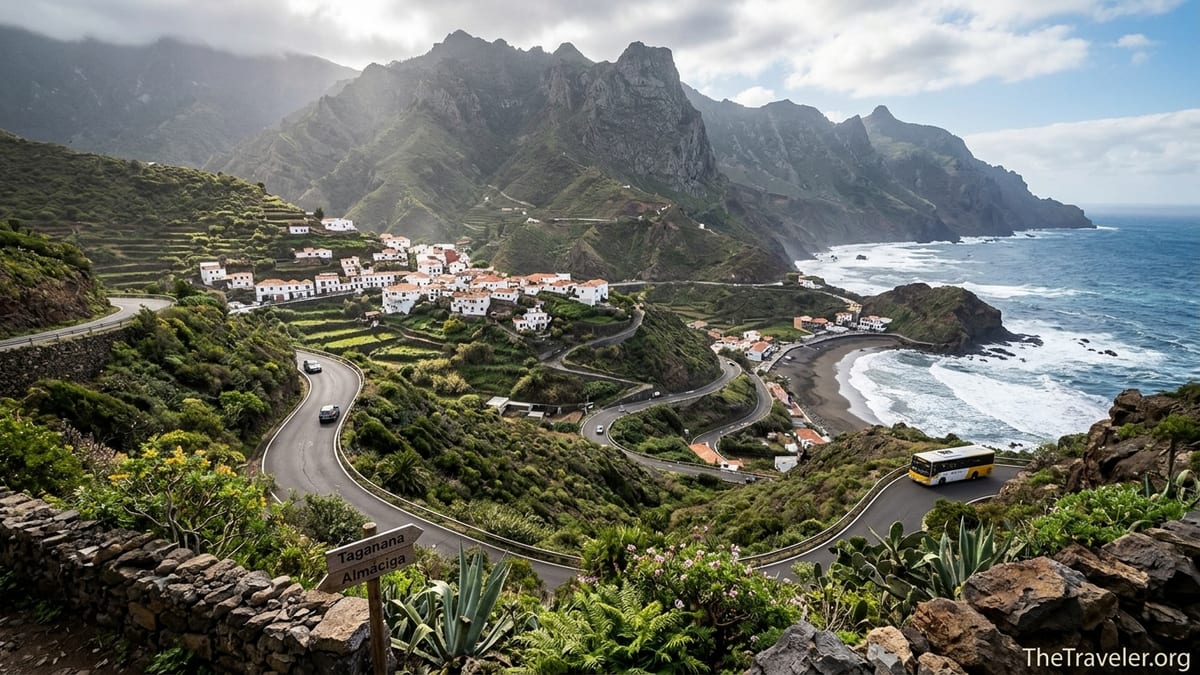
Understanding the lodging landscape in Taganana and Anaga’s north coast
Taganana and its coastal neighbours Almáciga and Roque de las Bodegas sit inside Tenerife’s Anaga Rural Park, where strict planning rules and the terrain itself limit development. You will not find large hotels or purpose-built resorts here. Instead, accommodation consists mainly of renovated traditional houses, small clusters of self-catering apartments and a handful of family-run guesthouses listed on major booking platforms. Many are run by local owners who juggle tourism with other work, so services are more personal but also more informal than in resort areas.
Inventory is modest compared with Santa Cruz, La Laguna or the southern beaches. A search on major platforms in late 2026 typically brings up only a few dozen active listings spread across Taganana, Almáciga and Roque de las Bodegas for any given set of dates, and those include everything from basic studios to multi-bedroom houses. Because of this limited supply, attractive places with parking and strong reviews often sell out during high season, school holidays and local festival weekends. If you are targeting Christmas and New Year, Easter, August or long Spanish holiday weekends, aim to book several months ahead.
Most stays are self-catering or simple bed-and-breakfast style. Expect kitchens or kitchenettes, private bathrooms and terraces rather than daily housekeeping, on-site reception or wide-ranging concierge services. Wi-Fi is now common but speeds and stability can fluctuate with weather or demand, and some owners still rely on mobile routers. Many restored houses have thick stone walls, small windows and no air conditioning; this suits Anaga’s cooler microclimate, but interiors can feel cold and slightly humid in winter, especially at night, so it is important to confirm heating arrangements before you commit.
Access is another key factor. The main road TF-134 from the mountain pass at El Bailadero is paved but narrow and winding, prone to fog, heavy rain and occasional rockfall alerts. Public bus 946 connects Santa Cruz’s main station with San Andrés, Taganana and Almáciga, generally taking around an hour from the city, with a limited number of departures each day. Schedules, verified in November 2026, show roughly six to eight services daily depending on weekday or weekend, so independent travellers without a car need to plan arrival and departure times carefully and avoid missing the last evening bus.
Staying in Taganana village: traditional atmosphere and trail access
Taganana itself lies slightly inland in a steep amphitheatre above the sea, a compact knot of alleys, steps and white houses around the main church. This is the best base for travellers who prioritise a traditional village feel, proximity to multiple hiking routes and the possibility of eating out without always needing to drive. From the village you can access classic Anaga trails towards Afur, El Bailadero and the surrounding ravines, and you will find a small selection of local restaurants and bars within walking distance, typically serving Canarian dishes and fresh fish.
Accommodation in Taganana is dominated by rural houses and apartments converted from older dwellings. A typical example is a multi-level stone or rendered house with thick walls, basic but functional kitchens and a terrace or balcony with valley or sea glimpses. Representative places to research include compact one-bedroom cottages that appeal to couples seeking seclusion and character, larger two- or three-bedroom houses suitable for hikers travelling together, and village apartments that allow digital nomads to combine work with walking, provided they confirm the internet connection in advance. When checking listings, look for recent guest comments about Wi-Fi stability and mobile coverage, as speeds can vary from street to street.
For drivers, the main disadvantage of Taganana is parking. The streets are narrow, many on a slope, and formal spaces are limited. Some rural houses include a private garage or reserved spot near the property, which is well worth paying attention to when booking. If a listing only mentions public street parking, assume you may have to park a walk away from your door, particularly on weekends and summer evenings when local visitors arrive. Travellers with reduced mobility should pay close attention to photos of entrances and any mention of steep access or external staircases; quite a few properties are reached only by footpaths and steps that would be challenging with heavy luggage or mobility issues.
In day-to-day practical terms, Taganana works best for slow travellers and hikers who appreciate early starts on the trails and a quiet evening routine. Small food shops operate limited hours, and choice of restaurants narrows outside weekends. Winter nights can feel surprisingly cool indoors, so verify if your chosen property provides portable heaters, fixed radiators or at least extra blankets. Self-check-in using key boxes is increasingly common, which allows late arrivals but also places more responsibility on guests to understand the directions and parking instructions ahead of time.
Staying in Almáciga: coastal village life near the surf
Almáciga is a tiny coastal settlement strung along the final stretch of the road, framed by steep headlands and popular surf beaches. It is the best choice for travellers who want to be as close as possible to the sea, fall asleep to the sound of waves, and walk down to the sand in a few minutes rather than driving from the main village. The bus 946 continues from Taganana down to Almáciga, with selected services starting or ending by the beach, which makes it one of the most practical points on this coast for car-free stays as long as you respect the limited timetable.
The accommodation mix here leans even more to self-catering apartments and simple beach houses. A number of properties, such as compact studios and one-bedroom apartments marketed under names referencing “Playa” or “Anaga” in Almáciga, cluster on the hillside with wide balconies. These tend to suit couples or solo travellers who want sea views and easy beach access without needing a large house. There are also a few multi-bedroom homes that work for small groups of surfers or families willing to accept basic interiors in exchange for being able to walk to the water’s edge.
Services in Almáciga are minimal. A couple of beach bars and restaurants open most days in high season, and some operate reduced hours or close midweek outside holidays. There are no large supermarkets or banks; for broader shopping you will need to drive or ride the bus to Taganana, San Andrés or Santa Cruz. This means that for self-catering stays, it is sensible to stock up in the city before you drive in, especially on fresh produce and any dietary-specific items. Mobile signal can be patchy in some corners of the village, and Wi-Fi performance varies sharply between properties, so anyone needing to work remotely should message the host to confirm approximate speeds or recent upgrades.
Parking is also a key variable along the coast. On quiet weekdays outside summer, it can be straightforward to find a space along the roadside or in small pull-outs. On sunny weekends and during surfable swells, visitors from the city fill the coastal road quickly. When reviewing listings, pay close attention to whether parking is described as private and on-site or simply street parking in the area. For those dependent on the bus, note the walking distance and gradient between your accommodation and the nearest 946 stop, because some hillside apartments require tackling steep lanes and flights of steps several times a day.
Staying in Roque de las Bodegas: by the bay at the water’s edge
Roque de las Bodegas is a tiny cluster of houses, small bars and restaurants lining a crescent-shaped bay, just around the headland from Almáciga. It feels almost like an outpost at the end of the world, especially outside summer when the village quietens down and the Atlantic sets the rhythm. This micro-area suits travellers whose primary goal is to stay directly on the seafront, with immediate access to the pebble and sand beach and a couple of terraces where you can watch waves break around the offshore rock that gives the settlement its name.
Accommodation options in Roque de las Bodegas are very limited. A handful of apartments and small houses appear on booking platforms, some above the restaurants facing the beach and others set slightly back along the road. These places cater mainly to couples and small groups seeking a simple base: think functional kitchens, tiled floors for dealing with sand and sea spray, and terraces with uninterrupted ocean views that double as the main living area in good weather. Because inventory is so small, availability can be tight during peak Spanish holiday periods, and minimum stays may be longer than in the city in order to make turnovers manageable for hosts.
One of the charms of staying here is falling asleep to the sound of surf and walking across the road for a morning swim. The flip side is exposure to winter storms and rough seas. On days with strong swells, authorities occasionally issue warnings for this stretch of Anaga coast, and access points to the beach may be partially closed. Interiors in seafront buildings can feel particularly damp in cool months, so carefully read reviews for comments about humidity, condensation and heating. If you are sensitive to noise, remember that the few bars and restaurants concentrate in a small area; on busy weekends, there can be chatter until late even though local regulations require quiet hours overnight.
Parking is usually roadside and extremely limited in the heart of Roque de las Bodegas. Some accommodations rely entirely on public spaces, which are quickly taken by day trippers when the weather is good. If you will arrive in your own car, it is worth messaging hosts about realistic parking expectations and any private spots they might control a short walk away. Although bus 946 runs along this stretch, evening departures are finite, so check the current timetable for the dates of your trip and avoid planning journeys that depend on the last bus if the weather might affect the road.
City bases as an alternative: Santa Cruz and La Laguna
Not every traveller needs or wants to sleep inside Anaga itself. If you prefer an urban base with a broader choice of hotels, consistent services and easier logistics, staying in Santa Cruz de Tenerife or nearby La Laguna and day-tripping into the park can be more practical. The Santa Cruz transport interchange is the hub for bus 946 into Taganana and Almáciga, and you can combine this route with the city’s tram and bus network to reach your accommodation or car hire depot. Verified schedules in late 2026 show that the 946 journey takes about one hour each way, making full-day hikes or beach visits feasible.
Santa Cruz offers a conventional range of city hotels, apartment-style properties and guesthouses in different price brackets. This setup suits travellers who want nightlife, museums, varied dining and reliable high-speed internet, but are willing to spend extra time on winding roads or buses to reach Anaga. La Laguna, with its historic centre inland at a higher elevation, has a mix of boutique hotels and small apartments and feels cooler in temperature, which some visitors appreciate after hot days elsewhere on the island.
The main drawback of using the cities as a base is the commute. Driving from Santa Cruz to Taganana via San Andrés and El Bailadero typically takes close to an hour in normal conditions, sometimes longer if fog, rain or roadworks affect the mountain section. If you plan multiple early-morning hikes, sunrise photography or late dinners in village restaurants, this daily journey can feel repetitive and potentially tiring. However, for digital nomads, families who need full supermarkets and medical services close at hand, or travellers nervous about narrow mountain roads at night, combining an urban stay with one or two nights in Anaga can offer a good compromise.
When comparing options, factor in the total cost of daily car hire, fuel, city parking and bus tickets from Santa Cruz or La Laguna against higher nightly rates that you might pay to be in the park. Remember that in winter, sunrise and sunset times compress usable daylight, so leaving the city after breakfast may mean starting hikes later than ideal. Checking the first and last bus 946 timings for your chosen dates before you lock in non-refundable city accommodation can help avoid awkward gaps.
Practical booking criteria: weather, access and house rules
Whichever micro-area you choose, a careful reading of listings and recent guest reviews is essential. Many rural properties enforce minimum stays, particularly during busy periods, often two or three nights and occasionally longer for whole-house rentals. Self-check-in via key safes or coded boxes is widespread in Taganana and along the coast, which is convenient if your arrival depends on flights, traffic or bus schedules. It does mean you should download directions and contact details in advance, as mobile coverage can drop along parts of the route into Anaga.
Given Anaga’s rugged geography and Atlantic exposure, it is wise to treat road access and weather as dynamic. Heavy rain, strong winds or rockfall risks can occasionally lead authorities to issue advisories for the TF-12 and TF-134 roads that connect the ridge to Taganana, Almáciga and Roque de las Bodegas. Before travel and during longer stays, check local weather forecasts and any emergency service notices covering the Anaga Rural Park. If a listing’s cancellation policy is strict, consider whether you are comfortable with the small but real possibility of temporary road disruption and how that might affect airport transfers or onward travel.
Inside the properties, expect village-appropriate house rules focused on respect for neighbours and the fragile environment. Common conditions include quiet hours at night, bans on parties or events, and limitations on unregistered visitors. Pet policies vary; some rural houses welcome dogs with prior approval while others prohibit pets to protect interiors or out of consideration for neighbours. Because many buildings are historic and densely clustered, sound travels easily, and local residents live alongside visitors, so choosing accommodation that matches your social habits will make for a smoother stay for everyone.
Another important practical point is climate control. In summer, the combination of sea breezes and elevation keeps temperatures relatively mild, which is why many accommodations do not have air conditioning. In cooler months, especially from late autumn to early spring, the same thick walls and tiled floors that keep interiors cool can feel chilly. Before booking, check whether there are fixed heaters, portable radiators or at least clear guidance on extra bedding. Explaining to readers or clients that Anaga nights can feel damp compared with the south of Tenerife helps set realistic expectations and encourages them to pack layers rather than rely on resort-style climate control.
Who should stay where, and what to check before you book
Choosing the right base along this short stretch of coast comes down to your priorities and travel style. Taganana suits hikers, slow travellers and anyone drawn to a lived-in village environment who does not mind driving or walking down to the beach. Almáciga is ideal for sea-focused visitors, from surfers and photographers to couples wanting balcony breakfasts above the waves, provided they accept limited local services and commit to shopping runs elsewhere. Roque de las Bodegas caters to those who care more about sleeping steps from the shore than about choice of shops or nightlife, and who are comfortable with the raw Atlantic mood in winter. Santa Cruz and La Laguna, although outside the immediate area, work better for digital nomads, families or short-stay visitors who want comprehensive services and are happy to day-trip into Anaga.
Before confirming a reservation, it helps to approach booking platforms with a clear checklist. At a minimum, look for parking details that specify private or guaranteed spaces if you are hiring a car, and confirm the walking distance and gradient to both the nearest beach and the nearest trailhead you plan to use. Filter for properties with a kitchen or kitchenette if you want to self-cater, as restaurant and shop hours are limited. For connectivity, prioritise listings that mention high-speed Wi-Fi or fibre and back this up by scanning recent reviews for concrete comments rather than generic praise.
It is also prudent to consider check-in logistics and transport. If you will rely on bus 946, use current schedules for your chosen travel dates to ensure that arrival and departure times align with check-in windows, particularly for accommodations that do not offer staffed reception. Properties that specify flexible self-check-in and clear directions are safer bets for late arrivals. Finally, always review cancellation and change policies carefully, paying attention to how far in advance free cancellation ends and whether partial refunds apply. In a remote, weather-exposed area like Anaga’s north coast, a slightly more flexible booking can be worth a small price premium for the peace of mind it offers.
With realistic expectations and a bit of homework, staying in Taganana, Almáciga or Roque de las Bodegas rewards you with something that resort areas cannot easily provide: direct immersion in one of Tenerife’s wildest landscapes from the moment you step outside your door. For travellers who value that connection more than pool bars or nightly entertainment, Anaga’s north coast is one of the island’s most compelling places to call home for a few days.