


Regularly ranked among the world’s best airports, Incheon International Airport can still feel overwhelming on a long travel day. Spread across two large terminals with trains, buses, transit tours and even a spa on site, it rewards travelers who arrive with a plan. Whether you are landing in Korea for the first time, connecting onward or facing an overnight layover, these practical, real world tips will help you move through Incheon with less stress and more confidence.
Get the latest updates straight to your inbox!
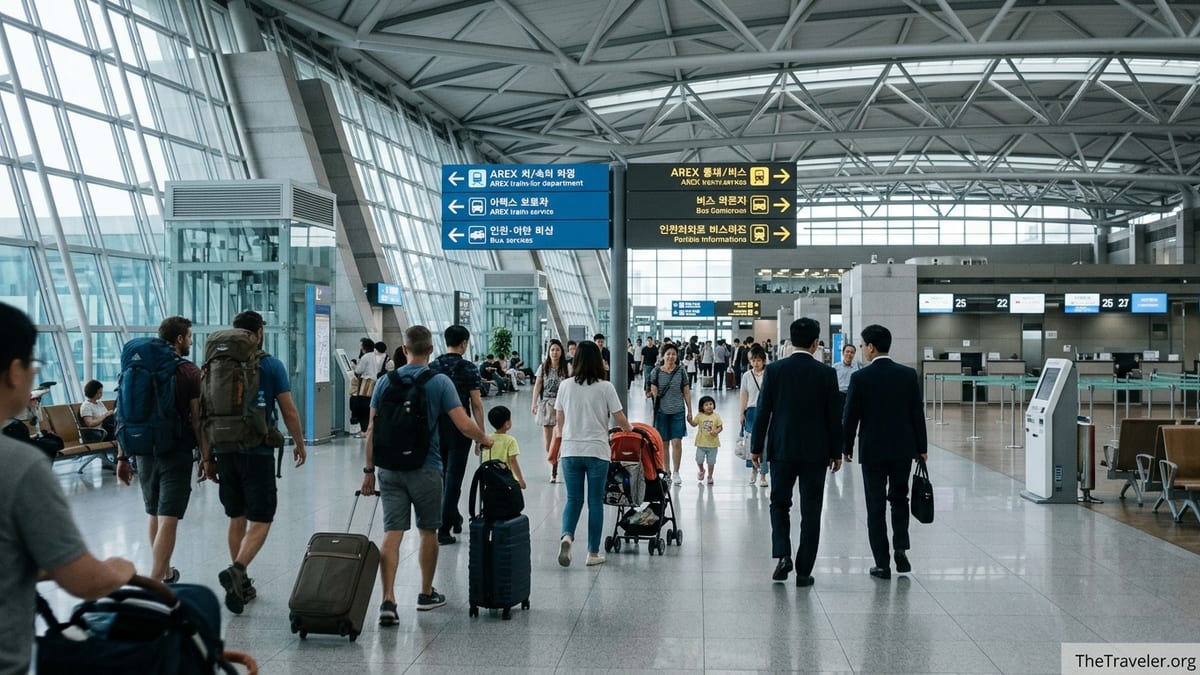
Know Your Terminal and Arrival Basics
Incheon has two main passenger terminals, Terminal 1 and Terminal 2, a fact that matters from the moment you book your ticket. Most Korean Air and other SkyTeam flights use Terminal 2, while many other international airlines, including a mix of Asian, North American and European carriers as well as several low cost airlines, typically operate from Terminal 1. Double check your e ticket and boarding pass for “ICN T1” or “ICN T2” so you know exactly where you will arrive or depart. This is especially important if you are booking separate tickets and need to transfer between terminals on your own.
If you do land at the wrong terminal for a separate onward flight, do not panic. A free airside shuttle bus and the all stop AREX train link Terminal 1 and Terminal 2 roughly every 5 to 15 minutes, with the ride itself taking around 5 minutes. In practice, allow at least 45 to 60 minutes to collect bags, move between terminals and check in again if you are on separate tickets. Travelers who underestimate this connection time are the ones you see sprinting through the departures hall.
On arrival, signs are in Korean and English and are clear, but the walking distances can be long. After disembarking, you will normally take an automated shuttle train from your concourse to the main immigration hall before passport control. Follow the color coded signage and floor arrows rather than the crowd, since some corridors split between transfer and arrival passengers. If you are transiting without entering Korea, look for the purple “Transit” signs before immigration and follow those instead of heading toward the exit.
Before you join the immigration queue, have your passport out, any required visa or K ETA approval ready on your phone, and your completed arrival card if your airline did not handle this electronically. Queues move fairly efficiently, but at peak morning banks, especially when several long haul flights from North America and Europe arrive together, waits can approach 45 minutes. Families with young children and older travelers often find it worth moving calmly but directly to immigration without stopping to browse duty free until after baggage claim.
Immigration, Smart Gates and Security Shortcuts
Incheon has steadily expanded its automated border control and security technology, which can save you a surprising amount of time if you are prepared. Korean citizens and many long term foreign residents can use Smart Entry Service gates on arrival and departure. More recently, the Ministry of Justice has been piloting automated immigration gates for passport holders from a growing list of countries, mainly in North America, Europe and parts of Asia. If you see your nationality listed on the screens near the immigration hall, you may be directed to a separate lane with e gates where you scan your passport and fingerprints for faster processing.
For departures, Incheon’s “Smart Pass” style services allow some travelers to register biometric data and use dedicated lanes at check in and security. These are particularly useful for frequent visitors who fly out of Incheon several times a year. Registration kiosks are usually located in the public check in area of each terminal. If you are on a once in a lifetime trip with only one departure from ICN, it is often not worth the extra effort to enroll on arrival, but business travelers or digital nomads who base themselves in Seoul can benefit on every subsequent trip.
Even without special programs, you can shorten your time at security with some simple habits. Incheon’s checkpoints are strict about liquids in containers of 100 milliliters or less, all placed in a separate clear bag. Duty free liquids purchased in sealed bags are generally fine, but if you have a tight connection in another country, consider keeping purchases modest to avoid problems later. Laptops and tablets need to come out of your bag in most lanes, and belt buckles and heavy jackets can set off metal detectors, leading to secondary screening. Travelers who empty their pockets into their bags rather than the trays tend to clear security faster and with less fumbling.
If you have lounge access through your airline, credit card or a paid option, factor in the time it takes to walk from security to your gate. Incheon’s concourses are long, and it is easy to misjudge distances. A flight departing from one of the high numbered gates at the far end of a pier can be a 10 to 15 minute walk from some lounges. Aim to leave the lounge when your boarding time, not your departure time, appears on screens. Budget airlines in particular often close boarding earlier than you might expect.
Getting From Incheon Airport to Central Seoul
Once you are through customs, your next challenge is getting into the city. The good news is that Incheon offers several reliable options at different price points. The AREX Airport Railroad Express is the fastest rail route from the airport to Seoul Station. The dedicated Express service runs non stop, usually in around 40 to 45 minutes, with reserved seating and space for luggage. Tickets are typically in the five figure won range per person, often around the equivalent of 8 to 10 US dollars. It is a solid choice for solo travelers and couples heading to neighborhoods that connect easily from Seoul Station, such as Myeongdong, City Hall and Itaewon.
The all stop AREX train is slower but cheaper and can be more convenient if you are staying around Hongdae, Gongdeok or Digital Media City. It takes about an hour from Terminal 1 to Seoul Station but stops at multiple stations along the way. Fares are a few thousand won lower than the Express. Many budget travelers and backpackers choose the all stop version and change to the subway at Hongik University station for hostels in Hongdae, saving just enough to pay for a late night street food snack.
Airport limousine buses are ideal if you have heavy luggage or are staying in areas not directly served by AREX, such as Gangnam, Jamsil or parts of eastern Seoul. Modern, reclining coaches depart from numbered bus stops outside each terminal. Fares are typically in the mid to high teens in US dollars equivalent, paid in won or by tapping a T money transit card. Travel time ranges from 60 to 100 minutes, depending on traffic. On a rainy Friday evening the bus from Terminal 1 to Gangnam can crawl along the expressway, but you will be sitting comfortably with overhead storage and underfloor luggage bays instead of battling stairs in the subway.
Taxis and ride hailing are the most flexible but priciest option. A regular international taxi to central Seoul often runs in the ballpark of 75,000 to 90,000 won, more late at night or in heavy traffic, and premium or jumbo taxis cost more. For families of four with large suitcases, that can still be cost effective compared to buying four AREX tickets and then transferring again. Apps such as Kakao T, widely used in Korea, allow you to request a taxi and see an estimated fare on your phone, which helps avoid confusion at the rank. If you arrive after midnight, when train and bus frequencies drop, a taxi may be the simplest way to reach your hotel without waiting in the arrivals hall for hours.
Transit, Layovers and Where to Rest or Sleep
Incheon is designed as a major transit hub, which makes life easier if you face a long layover. If your bags are checked through and your onward boarding pass is issued, you can stay airside and enjoy the transit facilities. One of the most useful is the in terminal transit hotel. In Terminal 1, for example, you will find an airside transit hotel near certain mid concourse gates that offers simple rooms with private showers and beds for blocks of several hours. Prices are higher than a capsule hotel but lower than full downtown hotels, and you do not need to clear immigration. This is ideal if, for instance, you land from Los Angeles at 5 am and depart for Bangkok at 1 pm and want a quiet, private place to sleep.
Travelers on a tighter budget can look at the Darakhyu capsule hotels, located landside in both Terminal 1 and Terminal 2. These compact pods are popular with solo travelers and offer a bed, power outlet, Wi Fi and shared facilities. Rates fluctuate by time slot and type of capsule but generally fall somewhere between roughly 25,000 and 50,000 won for short stays. They are especially attractive if you have a late night departure and do not want to sit upright in a chair for six hours.
Free rest zones are scattered around the terminals, usually marked as “Nap Zones” or “Relax Zones,” with reclined chairs and dimmed lighting. Space can be competitive at peak times, but if you are willing to walk toward the quieter end of a concourse you can often find a lounger. For a quick freshen up, Incheon offers both free and paid showers. In some airside areas of Terminal 1, basic shower rooms are available at no cost, though you may need to bring or rent a towel. For a more comfortable experience, Spa On Air, located in the Terminal 1 complex, is a full Korean style bathhouse with saunas, showers and relaxation spaces. It charges an admission fee but gives you access to hot and cold pools, a perfect way to recover after a long haul flight.
If you have at least 6 to 8 hours between flights and meet visa requirements, the airport backed transit tours can be a memorable way to turn a layover into a mini city visit. These tours, which range from short visits to nearby temples and coastal areas to half day excursions into central Seoul, usually require travelers to have either a valid visa or an approved K ETA, even if the tour itself is free. Spots can fill in advance on busy travel days, so check availability and requirements before you fly. Travelers with 12 to 15 hour daytime layovers sometimes manage a transit tour in the morning and a few hours of rest in a nap zone or capsule hotel later in the day.
Food, Shopping and Wi Fi Essentials
Finding something to eat at Incheon is not difficult, but a little planning can improve your options. Both terminals offer a mix of Korean and international restaurants, from quick bibimbap and dumpling counters to coffee chains and Western style fast food. Prices are higher than downtown Seoul but not extreme by international airport standards. A typical bowl of airport bibimbap or noodle soup might cost around 10,000 to 15,000 won, while a latte at a major chain coffee shop is usually in the 5,000 to 7,000 won range. If you are craving something specific, such as Korean fried chicken or a Korean bakery, check the terminal maps on the overhead screens rather than wandering blindly.
Incheon’s duty free shopping is extensive, especially in Terminal 1, with large zones dedicated to cosmetics, skincare, electronics and luxury brands. Korean beauty brands have an especially strong presence, and you will often see travelers leaving with armfuls of sheet masks and serums. To avoid impulse overspending, it helps to know roughly what products cost in the city first. For example, popular mid range Korean skincare brands are sometimes slightly cheaper downtown at major department stores, while high end international labels may be more competitively priced at duty free. If you have a long connection, you can test products in store and then use the free airport Wi Fi to compare prices online.
Speaking of connectivity, Incheon provides free Wi Fi throughout the terminals with relatively straightforward access. In most areas you can connect to the airport network and start browsing after agreeing to the terms on a splash page, without needing a local phone number. Speeds are usually fast enough for video calls. However, because the network can slow during peak periods, frequent visitors and business travelers often rent portable Wi Fi routers or buy local SIM cards at the telecom booths in the arrivals hall. These counters are clustered near the exits, and staff are used to setting up foreign phones with eSIMs or physical SIMs on the spot.
For everyday essentials, look for convenience stores such as CU or GS25 inside the terminals. These mini marts stock bottled water, kimbap rice rolls, instant noodles, snacks, basic toiletries and even travel sized umbrellas. Prices are closer to city convenience store levels than to premium airport markups. If you arrive late at night and your hotel area shops are likely to be closed, picking up a few snacks and a bottle of water before leaving the airport can save you a hunger pang later.
Money, SIM Cards and Practical Logistics
The arrivals halls in both terminals are designed to let you handle practical errands before stepping outside. Currency exchange counters are open extended hours and offer a convenient, if not always the best, rate. Many seasoned travelers withdraw cash directly from ATMs run by major Korean banks instead. These machines usually accept international cards and display information in English. It is sensible to carry some Korean won in small denominations for bus tickets, coin lockers and small purchases, even though credit cards are widely accepted in Seoul.
Just beyond customs you will see telecom counters for the main Korean mobile providers. Here you can buy tourist SIM cards or rent portable Wi Fi routers by the day. A typical short term SIM with generous data for a week often costs in the range of 30 to 40 US dollars equivalent, while pocket Wi Fi devices can be rented per day with a small deposit. If you are traveling as a couple or family and expect to stay together most of the time, one Wi Fi router connecting multiple phones can be more economical than buying several separate SIMs.
City transportation cards are another small step that makes life easier. At convenience stores and some vending machines in the airport you can purchase a rechargeable T money or similar transit card. Load it with a modest amount of credit and you can tap on and off buses, subways and some taxis in Seoul and other Korean cities. Using a transit card instead of buying single tickets each time speeds up transfers and often triggers small transfer discounts when you change from, for example, the AREX all stop train to a connecting subway within a set time window.
If you are carrying bulky luggage but heading into Seoul for sightseeing before hotel check in, consider using luggage storage or delivery services. Coin lockers, usually accepting T money cards and cash, are located in public areas of the terminals and in many major subway stations like Seoul Station and Hongik University. There are also desk based luggage services that can deliver your suitcase from Incheon to your hotel in central Seoul for a fee, freeing you to travel into the city with just a daypack.
Timing Your Arrival, Departure and Connections
Knowing when to arrive at Incheon for departure can significantly reduce stress. For international flights, airlines and the airport generally recommend arriving 3 hours before departure, which is a sensible minimum. If you are traveling during peak holiday seasons, such as late July and August or major Korean holidays like Chuseok, consider adding another 30 to 60 minutes. Check in lines for popular long haul routes, especially to North America and Europe, can build quickly in the mid morning and late evening waves.
Travelers connecting through Incheon on a single ticket usually have their bags checked through and receive their onward boarding pass at the origin airport. In that case, a layover of 1.5 to 2 hours is usually manageable, because you simply follow “Transit” signs, pass through security screening and walk to your new gate without clearing immigration. However, if you booked separate tickets, such as a low cost carrier flight from Incheon to another Asian city on a different booking, give yourself at least 3 to 4 hours between scheduled arrival and departure to allow for immigration, baggage claim, terminal transfer and check in cut off times.
For arrivals, remember that the transport options to Seoul thin out late at night and very early in the morning. The last all stop AREX train toward Seoul Station does not run 24 hours, and some limousine bus routes reduce frequency after around 11 pm. If your flight is scheduled to land close to midnight and you anticipate delays, it is worth planning a backup option, such as budgeting for a taxi or booking a nearby airport hotel. Conversely, morning arrivals around 5 to 7 am can involve shorter immigration queues but slightly longer waits for the first trains or buses into the city to start running at full frequency.
Weather can also affect your timing. In winter, strong winds and snow around the Incheon area can lead to de icing delays and occasional runway closures. If you are connecting to a separate ticket during Korea’s coldest months, building extra buffer time into your itinerary is a wise insurance policy. In summer, heavy rains from monsoon systems can slow highway traffic between the airport and central Seoul, especially on Friday evenings, making rail options more reliable.
The Takeaway
Incheon International Airport is more than just a gateway to Seoul. It is almost a compact city in its own right, complete with hotels, spas, shopping streets and transit links that reach deep into the capital. Travelers who understand the basics of the terminal layout, immigration options and ground transport can turn what might be a confusing experience into a smooth one.
Knowing whether you are in Terminal 1 or Terminal 2, choosing the right mix of AREX train, limousine bus or taxi for your budget, and thinking ahead about Wi Fi, SIM cards and transit cards will all pay off once you land. If you face a long layover, Incheon’s transit hotel, capsule rooms, nap zones and even airport backed transit tours can transform idle hours into rest or exploration.
Approach Incheon with clear information and realistic time cushions instead of guesswork, and you can focus on the fun parts of travel, whether that means your first bowl of Korean noodles in the arrivals hall or a smooth connection onward to your next destination in Asia.
FAQ
Q1. How early should I arrive at Incheon Airport before an international flight?
For most long haul international flights, arriving about 3 hours before departure is usually sufficient. During peak holiday periods or if you need to check in oversized luggage, aim for 3.5 to 4 hours to allow extra time for check in, security and walking to distant gates.
Q2. What is the easiest way to get from Incheon Airport to central Seoul for first time visitors?
The AREX all stop train is a good balance of cost and simplicity for many travelers, especially those staying near Hongdae or Seoul Station. If you have heavy luggage or are heading to areas like Gangnam, an airport limousine bus that drops you near major hotels may be more comfortable.
Q3. Can I sleep inside Incheon Airport during a long layover?
Yes. You can book a room at the airside transit hotel, reserve a pod at the Darakhyu capsule hotels in both terminals, or use free nap zones with reclining chairs. Spa On Air in Terminal 1 also offers overnight style rest areas in addition to its bathing facilities.
Q4. Are there free showers at Incheon Airport?
There are some free basic shower facilities in airside areas of Terminal 1, though availability and opening hours can vary. For more reliable and comfortable facilities, Spa On Air in the Terminal 1 complex offers paid showers and full spa amenities, and the transit hotel and capsule hotels provide private showers for guests.
Q5. Do I need cash at Incheon Airport, or can I use cards for everything?
Credit and debit cards are widely accepted at Incheon for shops, restaurants and transport tickets. Still, it is practical to withdraw or exchange a small amount of Korean won for vending machines, coin lockers and small purchases where cash is easier to use.
Q6. Is the free Wi Fi at Incheon Airport reliable enough for work calls?
In most areas the free airport Wi Fi is fast enough for emails, browsing and even video calls, though speeds can slow during peak times. Business travelers who need consistent connectivity often rent a portable Wi Fi router or buy a local SIM card at the arrivals telecom counters as a backup.
Q7. How do I transfer between Terminal 1 and Terminal 2 at Incheon?
Terminal 1 and Terminal 2 are connected by a free shuttle bus and the all stop AREX train. The shuttle runs frequently and takes around 15 to 20 minutes including waiting time. The AREX all stop train ride between terminals takes only a few minutes, but you should still allow extra time for walking and possible queues.
Q8. Can I leave the airport during a layover to visit Seoul?
If you meet Korea’s visa or K ETA requirements and have at least 6 to 8 hours between flights, you can usually clear immigration, store any carry on bags and take AREX or a limousine bus into the city. Some travelers join organized transit tours that depart directly from the airport, which can be easier than planning a visit independently on a tight schedule.
Q9. Where can I buy a SIM card or portable Wi Fi at Incheon?
Telecom booths for major Korean providers are located in the public arrivals area after customs in both terminals. Staff can set you up with a tourist SIM, eSIM or portable Wi Fi rental, often in under 15 minutes, and explain how to top up or return devices at the end of your trip.
Q10. Is it worth using a taxi from Incheon Airport instead of public transport?
A taxi is more expensive than AREX or limousine buses but can be worth it for families, travelers with large luggage or very late night arrivals. For example, a group of four arriving after midnight may find that sharing one taxi directly to their hotel is only slightly more costly per person than multiple late night bus or train tickets plus transfers.