


More news on this day
Severe thunderstorms sweeping across the Mid-Atlantic on June 14 triggered a ground stop at Baltimore/Washington International Thurgood Marshall Airport, unleashing widespread delays and cancellations that heavily disrupted Southwest Airlines’ operations and stranded travelers across the network.
Get the latest news straight to your inbox!
Ground Stop Paralyzes a Major East Coast Hub
Publicly available aviation advisories and flight-tracking data indicate that fast-building storm cells over the Baltimore and Washington region prompted air traffic managers to halt or sharply restrict arrivals into Baltimore/Washington International Thurgood Marshall Airport on Sunday. The temporary ground stop, combined with existing flow restrictions along the storm line, quickly backed up traffic in and out of one of the East Coast’s busiest midrange hubs.
BWI serves as a cornerstone of domestic connectivity for the broader Washington and Mid-Atlantic region, and the sudden pause in arrivals had a cascading effect on departures, gate availability and aircraft positioning. As thunderstorms intensified and a Severe Thunderstorm Watch covered much of central Maryland into Sunday night, airlines were forced to extend holds, reroute aircraft and, in many cases, cancel flights outright.
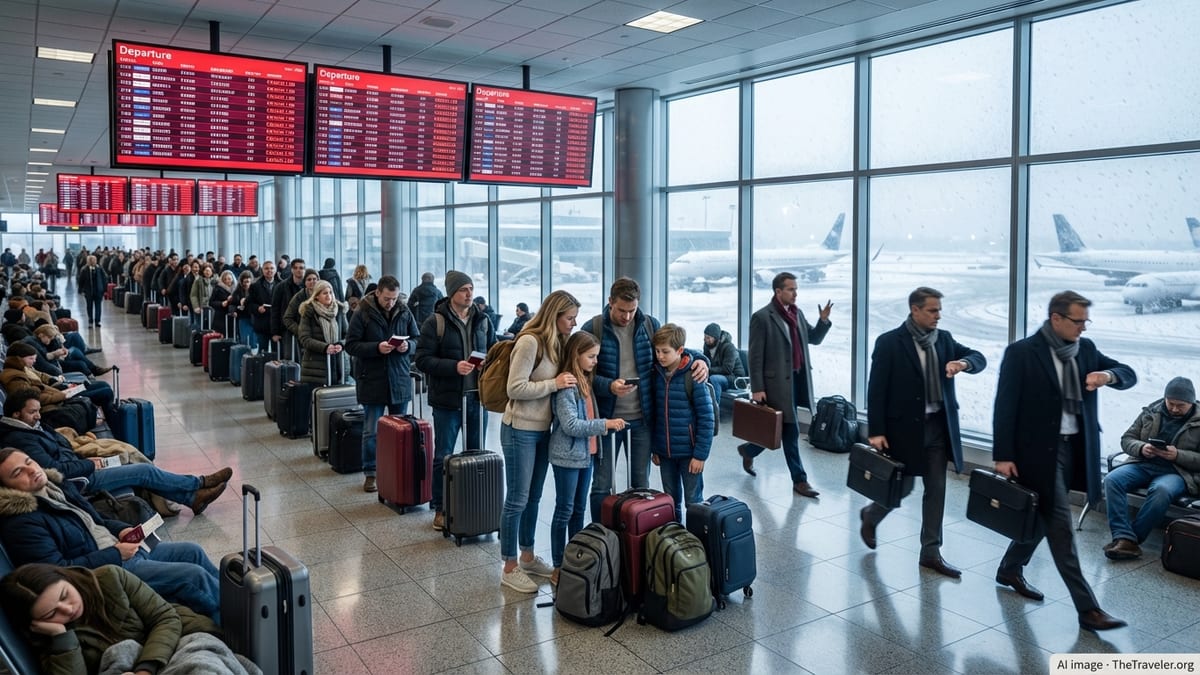
Operational notices and social media posts from stranded passengers described packed concourses, long lines at customer service desks and crowded rebooking kiosks as the storm system lingered over the region. With lightning and heavy rain periodically halting ramp operations, ground crews faced repeated start and stop cycles that slowed the recovery even once the formal ground stop began to ease.
Although some flights managed to depart within extended windows between storm cells, the uneven flow and continued weather threats meant large portions of the day’s schedule at BWI remained significantly disrupted well into the evening.
Southwest’s Baltimore Stronghold Takes the Hardest Hit
Southwest Airlines, which maintains one of its largest operational bases at BWI, appears to have borne the brunt of the meltdown. Published route maps and airport data show that Southwest dominates a substantial share of both departures and arrivals at Baltimore, using the airport as a key connecting point for flights up and down the East Coast as well as to the Midwest, Texas and the West.
Because Southwest relies heavily on short-haul, high-frequency routes, even a several-hour ground stop can quickly disrupt aircraft rotations and crew schedules. When storms block arrivals into a hub-like operation, aircraft are left out of position across the system, connecting passengers miss tight turn times, and later flights often lack either planes or crews to operate as planned.
Flight-status boards and third-party tracking services reflected dozens of Southwest cancellations and multi-hour delays on core routes linking Baltimore with major leisure and business markets such as Orlando, Miami, Tampa and Midwest hubs. While some services were able to depart once operations resumed, others disappeared from schedules entirely as the carrier consolidated passengers onto fewer, later flights in an effort to stabilize the network.
Travel industry analysts note that weather remains the leading single driver of Southwest’s cancellations in 2026, and BWI’s role as a high-density, weather-sensitive base means the airline is especially exposed when severe storms park over the Mid-Atlantic corridor.
Regional Storm System Compounds East Coast Travel Woes
The disruption at Baltimore unfolded as part of a broader severe weather pattern hammering the eastern United States. Forecast discussions and regional media coverage described a volatile atmosphere across the Mid-Atlantic and Northeast on Sunday, with damaging wind gusts, hail and frequent lightning prompting repeated warnings and watches from local meteorologists.
Similar storm-related air traffic restrictions were reported at other major airports over the weekend, particularly where thunderstorm lines intersected key arrival and departure corridors. For airlines already managing summer crowds and tight aircraft utilization, each new ground stop or flow control program added delays that rippled through evening schedules and into the next day.
For travelers, this meant that even flights not directly touching Baltimore could be affected as aircraft and crews scheduled to route through BWI, Washington or nearby hubs failed to arrive on time. In many cases, passengers reported missed connections at downline airports after their Baltimore departures left hours behind schedule, or were cancelled outright.
Carriers responded by issuing or expanding weather waivers for portions of the East Coast, allowing affected customers to rebook without standard change fees within specified travel windows. However, with peak-season loads already high and alternative flights limited, many stranded passengers still faced long waits for the next available seat.
Stranded Travelers Face Long Lines, Limited Options
Across BWI’s terminals, the combination of ground stop restrictions, rolling weather holds and tight summer capacity left travelers with few easy options. Public posts from the airport and airlines pointed customers to mobile apps and self-service tools, encouraging digital rebooking and same-day standby listings to reduce pressure on in-person counters.
Nevertheless, scenes described by passengers showed lines stretching through concourses as flyers sought hotel vouchers, meal credits or rebooked itineraries. For many Southwest customers, whose trips often involve point-to-point journeys rather than traditional hub-and-spoke connections, a cancelled flight from Baltimore could mean the loss of the only nonstop option that day, forcing inconvenient detours or overnight stays.
Families heading to vacations in Florida and weekend travelers returning from the Mid-Atlantic region appeared particularly impacted as leisure-heavy routes saw clusters of cancellations. Some travelers reported opting for rental cars, intercity buses or trains to complete their trips once it became clear that same-day flights were unlikely.
Airport information screens and public announcements urged patience as staff worked through the backlog, but with storms continuing to flare across the region, conditions remained fluid and recovery slow.
What Travelers Through Baltimore Should Expect Next
Looking ahead, operational briefings and seasonal weather outlooks suggest that storm-driven disruptions are likely to remain a recurring risk for Baltimore-area flyers over the coming weeks. The Mid-Atlantic’s early summer pattern often features repeated rounds of afternoon and evening thunderstorms that can trigger sudden ground stops, ramp closures and reroutes.
Travelers booked on Southwest and other carriers through BWI in the near term are being advised by airline communications and travel experts to build extra buffer time into itineraries, particularly for tight connections or important same-day commitments. Monitoring flight status frequently, enabling app notifications and considering early-morning departures, when convective activity is often lower, can help reduce the chances of being caught in the worst of the disruptions.
Passengers with flexible plans may also benefit from taking advantage of weather waivers or free same-day changes when they are offered, shifting travel away from the most storm-prone periods or rerouting through less affected airports where feasible.
For now, the latest meltdown at Baltimore underscores how quickly severe thunderstorms can decimate even a well-established operation at an airport dominated by a single major carrier. As airlines, air traffic controllers and airport operators brace for the heart of the summer travel season, the events at BWI serve as a reminder that in a volatile weather year, even routine weekend travel can turn into an extended ordeal.