


More news on this day
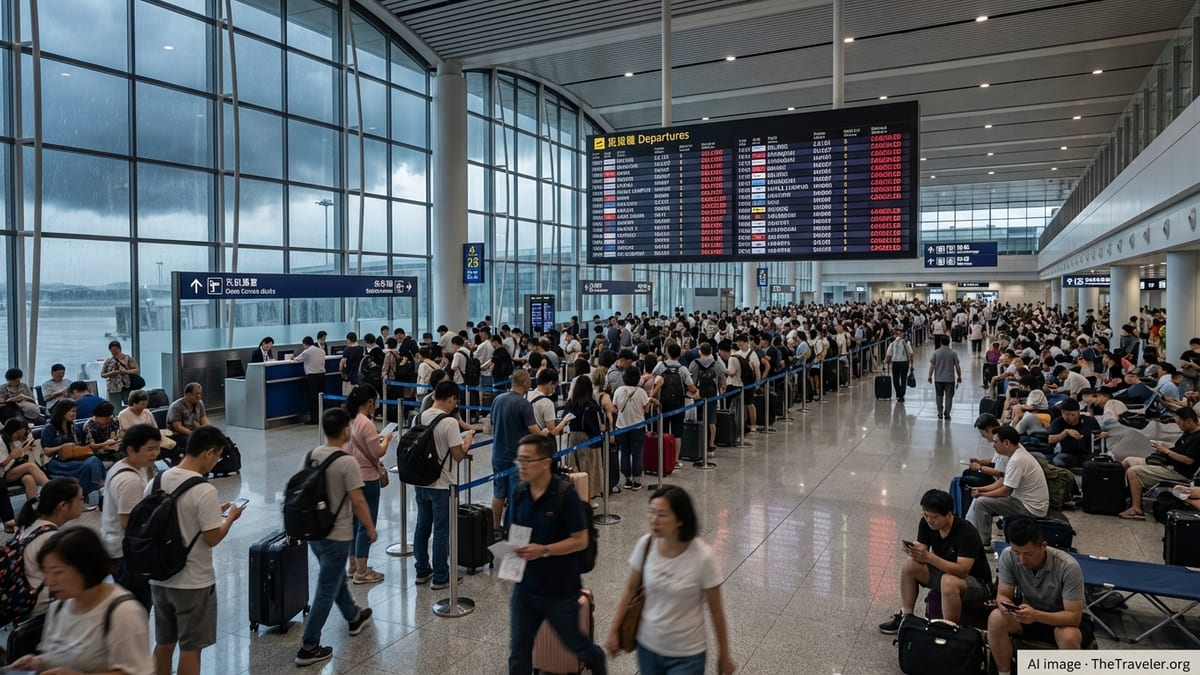
Stranded passengers across Beijing, Shanghai, Guangzhou, Xi’an, Chengdu, Xiamen, and Manila faced mounting travel chaos as severe weather systems sweeping East and Southeast Asia triggered at least 532 flight delays and 47 cancellations, disrupting operations for China Eastern, Air China, XiamenAir and partner carriers.
Get the latest news straight to your inbox!
Storm Systems Collide With Asia’s Busiest Air Corridors
Publicly available flight-tracking data and disruption dashboards show a sharp spike in operational problems across mainland China’s biggest hubs as thunderstorms, heavy rain, and low cloud settled over key regions. The pattern is consistent with earlier episodes this year in which fast-moving storm cells over eastern and southern China led to widespread delays and rerouting, particularly at Beijing, Shanghai, Guangzhou, and Chengdu.
On the latest disruption day, weather alerts covered stretches of the Yangtze River Delta, central China, and coastal areas facing the South China Sea. These conditions reduced visibility, slowed takeoffs and landings, and forced air traffic controllers to lengthen separation between aircraft. The resulting bottlenecks quickly cascaded across the network, with aircraft and crews out of position for later rotations.
The same weather band also affected parts of the northern Philippines, with Manila’s Ninoy Aquino International Airport reporting clusters of delayed arrivals and departures, especially on services tied to Chinese carriers and their codeshare partners. As schedules slipped on both sides of the South China Sea, turnaround times tightened, leaving minimal margin for recovery.
Aviation analysts note that Chinese hubs already operate close to capacity during peak periods. When storms strike multiple regions at once, even a modest reduction in runway throughput can result in hundreds of delays in a single day, as seen in the latest figures.
Hundreds of Delays and Dozens of Cancellations Across Key Hubs
Data compiled from live airport boards and flight-tracking platforms indicates that at least 532 flights suffered significant delays and 47 were cancelled outright during the disruption window. The bulk of these interruptions were concentrated at Beijing Capital and Daxing, Shanghai Pudong and Hongqiao, Guangzhou Baiyun, Chengdu Shuangliu and Tianfu, Xi’an Xianyang, and Xiamen’s Gaoqi airport, with knock-on effects reaching Manila.
China Eastern and Air China were among the most affected carriers, reflecting their large presence at Beijing and Shanghai, as well as their role in connecting domestic routes to international destinations. XiamenAir, which operates dense schedules through Xiamen and serves multiple Manila routes, also appeared prominently in delay and cancellation tallies. Several flights branded by smaller or regional operators were impacted where they shared codes or aircraft with the three major airlines.
At Shanghai Pudong, clusters of delays built up on trunk routes linking the city with Guangzhou, Chengdu, Xi’an, and other inland hubs, echoing previous weather-related disruptions earlier in the year. Shanghai Hongqiao, with its high-frequency shuttle services to Beijing and other business centers, showed a mix of late departures and same-day cancellations, creating long queues at service counters and self-service kiosks.
Guangzhou Baiyun again featured among the hardest-hit airports, continuing a pattern observed during earlier spring storm systems. Slowdowns there reverberated along key northbound routes to Beijing and Shanghai and southbound links to Xiamen and other coastal cities, contributing to missed connections and extended layovers for travelers bound for Southeast Asia.
Passengers Confront Long Queues, Missed Connections, and Limited Options
Reports circulating on traveler forums and social platforms describe crowded terminals, long waits at customer service desks, and overnight stays as passengers scrambled to rebook flights. Those traveling on multi-leg itineraries through Beijing, Shanghai, or Guangzhou identified missed domestic and international connections as a particular pain point, especially where onward flights operated only once daily.
In several cases, passengers reported being automatically rebooked onto flights departing a day or more later, with options to request refunds instead. Others described being offered earlier departures from alternate airports but facing the extra cost and complexity of arranging ground transport between Chinese cities on short notice.
Travelers holding tickets on China Eastern, Air China, and XiamenAir also noted differences in how individual bookings were handled, depending on whether tickets were purchased directly, via online travel agencies, or through international partners. Public guidance from consumer advocacy groups suggests that passengers document all notifications, keep boarding passes and receipts, and expect hotel or meal support to vary based on whether disruption is attributed to weather or operational decisions.
For some stranded in Manila following late arriving aircraft from Chinese hubs, capacity constraints limited immediate rebooking options. With specific China–Manila routes operating at relatively high load factors, replacement seats were scarce, prompting some passengers to seek alternative routings via other Southeast Asian hubs at additional cost.
Weather, Airspace Constraints, and Capacity Pressures Intersect
Aviation and travel reports have repeatedly highlighted how a combination of severe weather, tight airspace controls, and heavy schedules makes China’s domestic network particularly vulnerable to cascading disruption. Even when storms originate in a single region, the effect can quickly propagate as aircraft fail to reach their next departure points on time, impacting cities far from the original weather system.
China’s eastern coastal airports, including Beijing, Shanghai, and Guangzhou, are frequently cited as among the most congested in the world. Historical punctuality statistics show that these hubs struggle to maintain on-time performance even in benign conditions. When low cloud or thunderstorms reduce runway capacity, flights are held on the ground or placed in holding patterns, adding fuel and crew duty complications.
Industry commentary also points to the structure of China’s airspace, where civilian aviation shares limited corridors with military use. During periods of intense weather or training activity, available flight paths can narrow, forcing airlines and air traffic controllers to compress traffic into fewer routes. This raises the prospect of further delays and diversions as safety margins are preserved.
Carriers have invested in new infrastructure and digital tools to improve resilience, yet recent months suggest that incremental improvements are often outpaced by surging demand and increasingly volatile weather patterns. The latest episode underscores how quickly conditions can deteriorate from manageable delays to systemwide disruption when storms intersect with peak travel days.
What Travelers Can Do During Mass Disruption Events
Travel experts emphasize preparation and flexibility as the most effective tools for coping with sudden flight disruption in China and the wider region. Recommendations circulating in consumer advisories include building longer connection windows, especially when changing airports within the same city, and favoring morning departures when possible, as delay chains often intensify later in the day.
Passengers are encouraged to monitor flight status through multiple channels, including airline apps, airport displays, and independent tracking platforms. During major weather events, updates may lag or change rapidly, so checking regularly can help travelers spot earlier rebooking opportunities or alternative routings before seats disappear.
For those already at the airport, publicly available guidance suggests approaching airline counters early, carrying confirmation numbers and any documentation of schedule changes. Travelers with time-sensitive commitments may wish to consider high-speed rail or intercity buses on certain domestic routes, where ground transport can sometimes offer more predictable arrival times during extended aviation disruption.
The latest wave of delays and cancellations across Beijing, Shanghai, Guangzhou, Xi’an, Chengdu, Xiamen, and Manila illustrates the continued fragility of regional air travel in the face of severe weather. As climate and capacity pressures intensify, similar episodes are likely to remain a recurring challenge for carriers and passengers alike.