


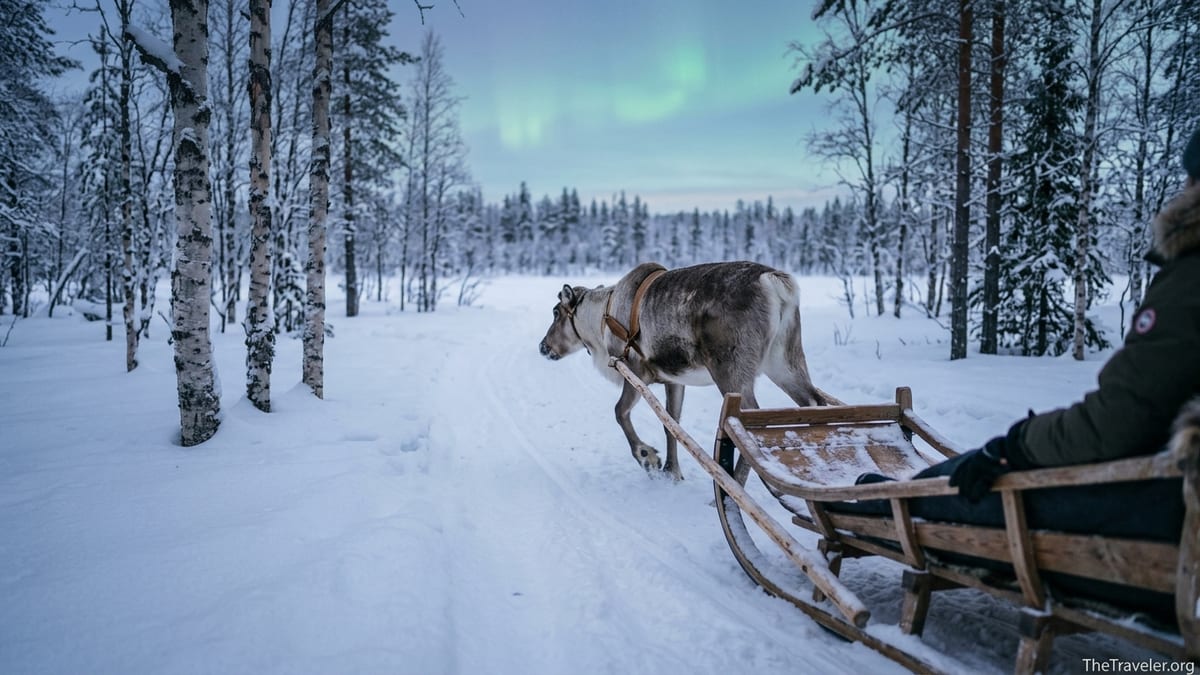
The first time a reindeer’s hooves crunched over packed snow in front of my sleigh, the sound was so soft it almost disappeared into the Arctic silence. The world narrowed to the swish of runners, the muted jangle of a harness, and a corridor of birch trees glazed with frost. For a few suspended minutes, gliding through the snow on a reindeer ride genuinely felt like stepping into another world: slower, quieter, and deeply tied to the people who have lived with these animals for centuries.
Get the latest updates straight to your inbox!
Where Reindeer Rides Really Come to Life
If you are chasing that dreamlike moment on a reindeer sleigh, the most atmospheric settings are in northern Finland, Norway, and Swedish Lapland. In Finland, Rovaniemi, Levi, Inari and the wider Finnish Lapland region are among the most popular hubs, with dozens of farms offering short village loops as well as longer forest safaris. A short 400 to 500 meter sleigh ride at a farm near Rovaniemi, for example, typically takes 5 to 10 minutes and is often bundled with feeding the herd and warming up by an open fire.
Further north in Finland, Inari offers a quieter, more traditional feel. Here, winter reindeer sleigh rides usually run from early December through early April, depending on snow conditions, and many operators emphasize that they work closely with local Sámi herders. In these smaller communities, you are more likely to find experiences that focus as much on story, language, and land as on the ride itself.
In Norway, Tromsø has become the go-to base for visitors who want to combine reindeer experiences with northern lights tours and fjord cruises. About 30 to 60 minutes outside the city, camps host sizeable herds where you can feed the animals, ride in a sleigh, then warm up inside a traditional tent with a hot meal and stories about Sámi life. Similar experiences exist in Swedish Lapland around Kiruna and Jokkmokk, though on a smaller, more dispersed scale.
Whichever country you choose, the pattern is similar: short, family-friendly rides clustered near major winter resorts, and longer journeys at more remote farms for travelers who want to lean into the stillness of Arctic forests and frozen lakes.
What Gliding Behind a Reindeer Actually Feels Like
If you are picturing a high-speed dash through the snow, reindeer rides will gently surprise you. They are slow, often at walking pace, and that is exactly what makes them feel otherworldly. Once the sleigh’s runners settle into the track, the noise of the outside world falls away. You hear the quiet puff of the animal’s breathing, the occasional snort of steam in the cold air, and the whisper of snow under wood or metal.
On a typical 1.5 kilometer forest ride near Levi in Finnish Lapland, you may move at a steady, unhurried pace for 20 to 30 minutes. Lanterns sometimes mark the trail, casting yellow islands of light on the snow, while the sky above might be a flat, pewter gray or a deep blue twilight that never quite turns to full dark. If you are exceptionally lucky on an evening safari, a flicker of green northern lights may appear beyond the black lace of spruce trees.
The sleigh itself usually has a simple wooden frame lined with reindeer hides or thick blankets. You sit low to the ground, sometimes with another traveler beside you. Your guide may walk alongside the reindeer, leading it by a line, or ride on a small sled behind. Compared with husky sledding, which can feel like driving a living rocket, reindeer rides are contemplative. The thrill is not speed but the sensation of being pulled quietly through a landscape that, for a moment, looks untouched by roads, shops, or 21st-century life.
Afterward, most tours include time inside a heated tent or cabin. This is when the transition between “tour” and “encounter” happens. Wrapping your hands around a mug of berry juice or coffee while your host tells stories about winter migrations, marking calves, or storms on the tundra can be as memorable as the sleigh ride itself.
Types of Reindeer Experiences and What They Cost
Reindeer rides are surprisingly varied, and choosing the right format can make the difference between a quick photo op and a truly transporting experience. At the simplest end are short “village rides” often found near Santa-themed attractions in Rovaniemi and similar hubs. These rides might cover 400 to 500 meters, last about 5 to 10 minutes, and cost in the region of 50 to 60 euros per adult in peak December holiday weeks, with slightly lower prices in January and March.
A step up in immersion are mid-length forest rides of around 1 to 3 kilometers, commonly offered at standalone reindeer farms. These last roughly 20 to 45 minutes behind the reindeer and are frequently bundled with feeding, a storytelling session, and a hot drink by the fire. In the current 2025 to 2026 winter season, packages like this in and around Rovaniemi or Levi often sit in the ballpark of 90 to 120 euros per adult, with discounted child rates.
Longer safaris of several kilometers, sometimes up to 7 or 8 kilometers, take you deeper into the forest or across frozen lakes. These excursions tend to last 2 hours or more, including breaks, and may be combined with a full meal in a wooden hut, such as reindeer stew or a vegetarian soup. For this, prices more typically range from roughly 150 to over 250 euros per adult, particularly during Christmas and New Year weeks when overall demand pushes rates upward. Some premium packages in Lapland bundle reindeer sledding with snowmobiling or huskies, which can push prices above 250 euros per person but organize your entire Arctic day.
Evening or aurora-focused reindeer safaris add the extra magic of night, with tours timing departures to maximize the chance of seeing northern lights. These often include transport from town, thermal clothing, and a warm meal. Expect to pay a clear premium for the night setting, with adult prices commonly edging 10 to 20 percent higher than comparable daytime rides. For families, the good news is that many operators let very young children ride at reduced rates, and some allow those under a certain age to join for a nominal fee or free, provided they sit with an adult.
Planning Your Trip: Seasons, Weather, and What to Wear
The window for reliable reindeer sleigh rides in Lapland is shaped by snow. In Finnish and Norwegian Lapland, most operations begin in late November or early December and run through late March or early April. Early and late season dates are more sensitive to weather, so if a sleigh ride is a must, aim for mid-winter: roughly mid-December to mid-March, when trails are usually well packed and daylight, while brief, is more predictable.
Temperatures can be extreme for visitors. It is not unusual to experience minus 10 to minus 20 degrees Celsius on a still January night, with colder snaps possible inland. Most reindeer tour operators provide thermal overalls, boots, and mittens to pull on over your own clothing, but you should still arrive with a solid base. Think wool or synthetic thermal underwear, a warm mid-layer like a fleece or wool sweater, thick wool socks, and a windproof parka. Avoid cotton layers, which hold moisture and leave you feeling chilled once you settle into the sleigh.
Face protection is especially critical on a ride, because you are sitting still. A balaclava or buff, a snug hat, and well-fitted ski goggles can make the difference between staring up in awe and counting down the minutes until you can get back indoors. For children, consider hand warmers slipped inside mittens and toe warmers in boots. It is sensible to ask your chosen operator in advance exactly what clothing is included, particularly if you are booking independently rather than through a larger tour company.
Another factor is daylight. Near the winter solstice, much of Lapland is in the polar night, when the sun barely rises and light hovers at a deep twilight. Daytime rides then feel almost cinematic, with blue light on snow and pink bands on the horizon. By late February and March, daylight stretches rapidly, making it easier to schedule other activities such as husky safaris, snowshoeing, or a visit to local museums without rushing from one tour bus to another.
Meeting the People Behind the Reindeer
Reindeer herding is not just a tourism product in the north; it is a living livelihood, deeply rooted in the culture of the Sámi, the Indigenous people of northern Fennoscandia. In parts of Norway and Sweden, reindeer husbandry is legally recognized as an exclusive Sámi profession, and in Finland, reindeer herding cooperatives form a backbone of local rural economies. When you join a ride at a family-run farm, you are stepping into a way of life that exists far beyond your holiday.
On many tours near Tromsø or Inari, your hosts are Sámi herders or families who split their year between seasonal herding work and welcoming visitors. After the ride, it is common to gather in a lavvu, a traditional tent, or a wooden hut to hear about the challenges of modern reindeer herding: rapidly shifting snow conditions, pressure on grazing lands, and the careful work of keeping track of animals that roam over vast distances. You may see clothing decorated with traditional patterns, listen to joik, a distinctive form of song, or watch as antlers and bone are transformed into practical tools or jewelry.
It is worth remembering that not every operator using Sámi imagery is Sámi-owned or Sámi-led, and some businesses in popular resorts present a stylized version of culture designed for quick tourist consumption. That does not automatically make the experience inauthentic or exploitative, but it does place more responsibility on you to look for tours that clearly credit local communities, use respectful language, and focus on real stories rather than stereotypes.
Take the time to ask who owns the herd, who is leading the tour, and how your payment supports year-round livelihoods. Many travelers report that the most moving part of their visit was not the photo with a reindeer, but a candid conversation around the fire about migration routes, childhood winters, or the first time their host slept out with the herd.
Choosing Ethical and Responsible Reindeer Experiences
As reindeer rides have grown more popular, so have concerns about animal welfare and cultural respect. The core principles of responsible reindeer tourism are simple: the animals should be healthy, rested, and properly cared for, and the culture on display should not be reduced to costume and cliché. In practice, this means looking for small-group experiences, clear explanations of how long each reindeer works, and visible signs of calm behavior in the animals themselves.
Many Lapland operators now limit the length of each sleigh ride and the number of rounds a reindeer can pull in a day, especially during peak holiday weeks. Short village loops might be alternated between multiple animals, while longer forest safaris are often undertaken by animals trained specifically for that purpose. On arrival, glance at the herd: are they chewing quietly, moving freely, and able to step away from visitors if they choose, or are they tied in tight lines for photos? Calm, alert animals with thick winter coats and no visible ribs are good indicators of appropriate care.
Cultural responsibility is equally important. In Finland, the Sámi Parliament has articulated guidelines on respectful Sámi tourism, emphasizing that communities should have control over how their culture is presented and should benefit directly from tourism income. Travelers can support this in concrete ways by booking Sámi-owned or Sámi-partnered tours where possible, listening attentively during story sessions, and avoiding reducing the experience to only a sleigh ride and a snapshot in traditional clothing.
It can also help to broaden your engagement beyond a single tour. Visiting a local museum exhibit on Sámi history, choosing handicrafts made by Sámi artisans rather than mass-produced souvenirs, and taking the time to learn basic place names or greetings in the local language all contribute to a more balanced exchange. When done well, reindeer tourism can help sustain both animal herds and cultural traditions that might otherwise struggle under the pressure of modern economic change.
Practical Tips: Booking, Safety, and Making the Most of It
Because reindeer rides are one of the signature winter experiences in Lapland, prime slots often sell out months in advance, particularly around Christmas, New Year, and school holidays. If your schedule is fixed and you are traveling in late December, it is wise to secure your preferred date and time as early as possible. Outside that peak window, you will usually find more flexibility, but popular evening aurora safaris can still book up quickly in February and March.
Many travelers arrange reindeer tours through large holiday providers or resort hotels, which bundle transfers, clothing, and multiple activities together. This can be convenient, especially for first-time Arctic visitors or families with young children. Booking directly with a local farm, however, can sometimes offer more intimate experiences and a better sense of where your money is going. It may also mean slightly lower prices, though you will need to arrange your own transport and confirm what clothing and food are included.
Safety-wise, reindeer rides are among the more relaxed winter activities. The animals are generally well trained, the pace is slow, and your guide is close at hand. Still, accidents can happen in slippery, cold conditions. Listen carefully to the briefing, keep your hands and feet inside the sleigh, and resist the temptation to stand up for photos while moving. For families, check the minimum age requirements and ask whether young children can sit with a parent in the same sleigh, which is often the case on short rides.
To make the most of the experience, build in time before or after your ride to simply be in the landscape. A quick village loop on the edge of a busy resort will feel very different from a longer ride that begins with a van transfer deep into the forest. If it fits your budget, consider combining a mid-length daytime ride with a separate evening northern lights excursion instead of trying to pack everything into a single tour. Slowing down, rather than collecting as many activities as possible, tends to produce those “stepping into another world” moments that linger long after you have returned home.
The Takeaway
Gliding through the snow on a reindeer sleigh is less about adrenaline and more about atmosphere. It is the hush that falls over a frozen valley when the only sound is an animal’s hooves in the snow, the warmth of a fire inside a tent scented with woodsmoke, and the sense of entering a culture whose calendar is still shaped by migrations and seasons.
With thoughtful planning, you can choose an experience that fits your budget and travel style, from a short, child-friendly loop near a family resort to a longer forest safari with a Sámi herder far from city lights. Paying attention to animal welfare, cultural respect, and the realities of Arctic weather will deepen that sense of wonder rather than distract from it.
Above all, remember that for your hosts, the reindeer are not props but partners in a way of life. Approach the experience with curiosity and humility, and the moments you spend gliding behind those quiet, sure-footed animals will feel like a brief but genuine step into another world.
FAQ
Q1. When is the best time of year to book a reindeer sleigh ride?
For reliable snow and established trails, aim between mid-December and mid-March. Many farms open in late November and run until late March or early April, but early and late season dates are more vulnerable to warm spells and rain.
Q2. How long do reindeer sleigh rides usually last?
Short village rides are often just 5 to 10 minutes, mid-length forest rides usually run 20 to 45 minutes behind the reindeer, and longer safaris can take 2 hours or more including stops, meals, and storytelling.
Q3. How much should I budget for a reindeer experience?
As a rough guide, very short rides near major attractions might start around 50 to 60 euros per adult in peak season, mid-length farm visits with feeding and a hot drink often range around 90 to 120 euros, and longer or premium safaris can easily reach 150 to over 250 euros per person.
Q4. Are reindeer rides suitable for young children and older travelers?
Yes, reindeer rides are among the gentlest Arctic activities and many operators welcome families with infants and grandparents. The main challenge is the cold, so be sure everyone has appropriate clothing and check in advance about minimum ages and seating arrangements.
Q5. What should I wear for a reindeer sleigh ride?
Dress in layers: thermal base layers, a warm mid-layer such as fleece or wool, a windproof outer jacket and trousers, insulated boots, thick socks, mittens, a hat, and face protection. Most operators will provide additional thermal overalls and boots, but it is important to arrive already warmly dressed.
Q6. How can I tell if a reindeer tour is ethical?
Look for small-group tours that clearly explain how the animals are cared for, limit the hours each reindeer works, and allow the herd space to move freely. Transparent information about ownership, a calm atmosphere around the animals, and respectful treatment of Sámi culture are all positive signs.
Q7. Will I see the northern lights during a reindeer ride?
Some evening rides are designed to combine sleighing with northern lights hunting, but sightings can never be guaranteed. Cloud cover, solar activity, and light pollution all play a role, so view any aurora as a bonus rather than the main reason to book a reindeer tour.
Q8. Do I need previous experience with snow or animals?
No experience is necessary. Reindeer tours are guided, the animals are trained, and you will receive a briefing before you set off. As long as you can sit steadily in the sleigh and follow simple instructions, you should be able to participate comfortably.
Q9. Should I book through a large tour company or directly with a farm?
Large tour companies and hotels offer convenience with bundled transport and clothing, which can be helpful for first-time Arctic visitors. Booking directly with a local farm may offer a more intimate experience and sometimes better value. Either way, research the operator’s animal welfare and cultural practices before committing.
Q10. Can I visit a reindeer farm outside of winter?
Yes, some farms open in autumn or even summer for feeding sessions and cultural visits, though sleigh rides require solid snow and are limited to winter months. Off-season visits can be a quieter way to learn about reindeer herding, but the experience will focus on interaction and storytelling rather than sledding.