


If you have already checked off Baku’s Flame Towers and walled Old City and are ready to see another side of Azerbaijan, two names will keep popping up: Sheki and Gabala. Both sit in the foothills of the Greater Caucasus, both are reachable from Baku in half a day, and both offer mountain views, fresh air, and a slower pace than the capital. Yet on the ground they feel very different. One is a Silk Road town with cobblestone lanes and caravanserai courtyards; the other is a modern resort area of ski lifts, lakeside cafes, and adventure parks. Choosing between them is really about choosing the kind of trip you want to have.
Get the latest updates straight to your inbox!
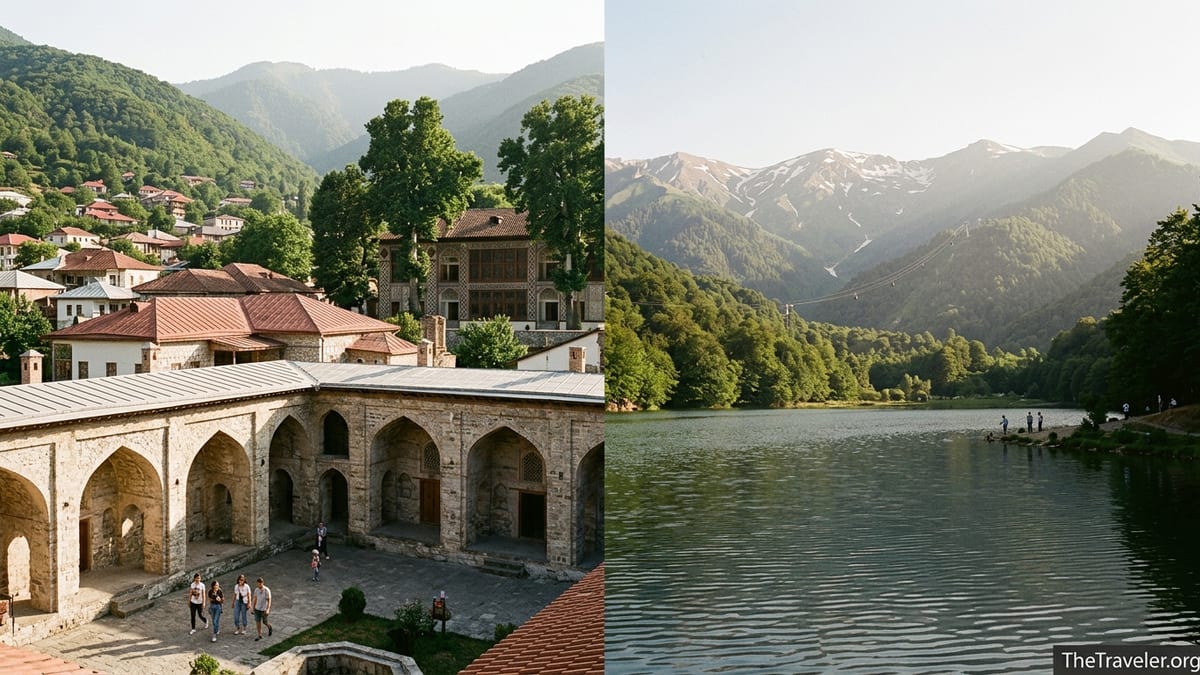
Sheki vs Gabala at a Glance
Sheki is Azerbaijan’s postcard-perfect Silk Road town. The compact historic center, now recognized as a UNESCO World Heritage Site, clusters around the Khan’s Palace and a pair of restored caravanserais where traders once stabled camels and stored silk. Today, travelers wander between walnut trees and red-tiled roofs, duck into halva workshops, and sleep in vaulted stone rooms that used to host caravans. It is a place for atmosphere: peeling wooden balconies, stained-glass windows, and views of forested hills rising behind the town.
Gabala, also written Qabala, feels more like a modern mountain resort strip. The town and its surrounding villages stretch along the main road with international-brand hotels, private guesthouses, and attractions spaced out between fields and forest. Instead of historic mansions, the icons here are the Tufandag Mountain Resort cable cars, Nohur Lake with its rowboats and lakeside tea houses, and the waterfalls and picnic clearings in the nearby forested valleys. It is aimed squarely at travelers who want active days in nature mixed with comfortable facilities.
In practical terms, Sheki tends to suit travelers who value history, culture, and slower travel. If you loved places like Gori in Georgia, Mostar in Bosnia, or small Italian hill towns, you will likely feel at home here. Gabala better fits visitors who prioritize activities and scenery over historic architecture, particularly families, honeymooners, and groups who want everything from zip lines and quad bikes to quiet lakeside strolls in one area.
Both destinations can be visited year-round, but their peaks differ. Sheki is especially pleasant from late April to June and in September and October, when tree-lined streets glow green or gold and temperatures are mild for sightseeing. Gabala sees heavy domestic crowds in summer around Nohur Lake and in winter around the Tufandag ski slopes, when snow brings the mountains to life.
Travel Logistics and First Impressions
From Baku, both Sheki and Gabala are usually reached by road. Shared tours and private drivers are common, but independent travelers often use the long-distance buses that depart from the Baku International Bus Terminal on the edge of the city. Travelers report the journey to Sheki taking around 4.5 to 5.5 hours depending on stops and traffic, typically with one or two breaks at roadside cafes where you can grab qutab pancakes, tea, and fresh bread. Buses to Gabala are a little quicker on paper, around 4 to 5 hours, helped by newer stretches of highway and slightly shorter distance.
The arrival experience is very different. In Sheki, the bus station sits a short taxi ride away from the older part of town. Most travelers head straight for the historic center, where narrow streets begin to climb and stone walls appear. Within minutes you may find yourself checking into a guesthouse inside the Upper Caravanserai complex, walking under heavy wooden doors into a shadowy courtyard framed by arched galleries. If you arrive in the late afternoon, the slanting light and scent of wood smoke immediately signal that you have left modern Baku far behind.
Gabala’s bus stop and small train station, when services run on weekends, sit along the main road. As you arrive, you are more likely to see low-rise hotels, supermarkets, and petrol stations than a single old town square. Travelers usually take a taxi out toward specific areas: Tufandag Mountain Resort to ride the cable cars, Nohur Lake for tranquil views, or one of the villages and guesthouse clusters in the greener outskirts. The sense is less of entering a self-contained historic town and more of moving into a spread-out recreational region.
In terms of first-day ease, Gabala has a slight edge for travelers who want modern comfort quickly. Many hotels there are resort-style with on-site restaurants, swimming pools, and even spas. In Sheki, you may have to walk cobbled streets to find a family-run restaurant or negotiate with a local taxi for a ride to Kish village, but that exploration is exactly what some travelers enjoy.
History, Culture, and Sense of Place
If your idea of travel involves losing yourself in streets that feel centuries old, Sheki is the obvious winner. The town’s historic center grew around the summer residence of the Sheki Khans, who ruled this part of the Caucasus in the 18th and 19th centuries. Their palace, a two-storey building set within fortified walls and gardens, is small compared to European palaces but stunningly decorated. The facade is covered with painted panels and intricate wooden latticework called shebeke, assembled without nails and traditionally filled with pieces of colored glass. Inside, rooms are lined with painted floral and hunting scenes, with stained-glass windows casting colored light on polished floors.
Below the palace hill, Sheki’s caravanserais recall the town’s Silk Road role. Two main complexes survive, known today as the Upper and Lower Caravanserai. The Upper Caravanserai has been restored as a characterful hotel where guests sleep in rooms with barrelled ceilings around a central courtyard. Even if you are not staying inside, walking under its stone archway gives a vivid sense of how merchants once led caravans of pack animals inside to rest and trade. A stroll along the old trading street nearby, lined with small workshops and shops selling copperware, sweets, and souvenirs, fills out the picture further.
For many visitors, the short trip to Kish village just north of Sheki is a highlight. It is a small settlement of stone and timber houses and orchards, overlooked by hills. At its center stands the Church of Kish, an early Christian church associated in local tradition with the ancient Caucasian Albanian population. Recently restored as a small museum, the building’s thick stone walls and glass floor panels displaying tombs underneath offer a tangible sense of deep history in a very quiet village setting.
Gabala’s historic legacy is more scattered. The area was once the capital of an ancient state, and the ruins of Chukhur Gabala, an archaeological site a short drive from the modern town, point to this long past. However most current-day visitors experience Gabala primarily as a nature and leisure destination rather than a historic one. Museums and archaeological sites play a secondary role to lakes, cable cars, and adventure activities. If cultural immersion and architectural history are your top priorities, you will generally get more out of a few days in Sheki.
Nature, Adventure, and Relaxation
When it comes to outdoor activities, Gabala has been deliberately developed as a four-season mountain resort area. The Tufandag Mountain Resort complex, a few kilometres from the town center, offers a network of cable cars that climb through the forest to viewpoints and, in winter, to ski slopes and snow-covered ridges. Even if you do not ski, taking the gondola up on a clear day rewards you with sweeping views over forested valleys and the town below. At the base and mid-stations you will find cafes serving tea, coffee, and kebabs, and in the peak winter and summer seasons, extras like ziplines, mountain swings, and play areas.
Nohur Lake, one of Gabala’s most photographed spots, lies in a bowl of hills and forest a short taxi ride away. The water is usually calm, with visitors renting small rowboats or paddle boats for 15 to 30 minutes at a time, or simply settling into plastic chairs along the shore with tea and sunflower seeds. Several lakeside cafes and small hotels have opened on the banks in recent years, which means you can turn an afternoon visit into a relaxed half-day with a meal and a stroll.
Close by, the Yeddi Gozel or “Seven Beauties” waterfall area draws local families and visitors up a series of staircases and paths to cascades tumbling down through the forest. In high summer, shaded picnic gazebos fill with groups grilling meat and playing music. Further afield, outfitters around Gabala advertise quad bike circuits along forest tracks, horseback rides in the valley, and even shooting and clay pigeon facilities at the Gabala Shooting Club, which doubles as a venue for international competitions and casual target sessions.
Sheki offers nature in a softer, more low-key way. The town itself is already perched on the lower slopes of the Caucasus, so walks from the center quickly gain altitude and views over red roofs. Short hikes lead to viewpoints and old fortification walls, while local drivers can arrange half-day trips to surrounding villages and forested valleys. However, there are fewer formal adventure facilities. You are unlikely to find commercial zip lines or quad bike parks here. Instead, time in nature tends to revolve around village walks, picnics, and slow exploration among orchards and forest paths.
Food, Accommodation, and Everyday Costs
Prices in both Sheki and Gabala are generally comfortable for travelers used to Western European or North American costs, but Gabala can be slightly more expensive, especially if you choose resort-style properties or ski-season weekends. In Sheki, a simple but filling restaurant meal of piti stew, salads, bread, and tea in a modest local place can cost the equivalent of a few US dollars per person, with dinner in a more atmospheric restaurant inside or near the caravanserai still usually coming in well under what you would pay in Baku’s very center.
Sheki’s accommodation scene is dominated by small hotels and guesthouses, many in traditional buildings. A popular mid-range choice is to stay inside the Upper Caravanserai, where rooms are simple but full of character, or in family-run guesthouses with balconies looking over gardens. Bathrooms and furnishings vary, so it is worth checking recent reviews or asking to see a room before committing if you book on arrival. Budget travelers can usually find basic rooms or hostel-style beds in town for modest prices, especially outside the peak summer months.
Gabala has a wider range of modern hotels, from simple roadside motels to large international and regional brand resorts with pools, kids’ clubs, and spa facilities. Nightly rates here can climb significantly in July and August, when domestic tourists from Baku and neighboring countries flock to the mountains for cooler air, and in January and February when ski conditions are good. Dining options around Gabala are also skewed toward sit-down restaurants and hotel dining rooms, often with grilled meats, salads, and pilaf dishes on menus priced slightly above small-town averages because they cater to holidaymakers.
For self-catering or snacks, both destinations have small supermarkets and bakeries. In Sheki, do not miss the chance to sample Sheki halva, a rich layered pastry filled with nuts and syrup, sold in small workshops and market stalls. Buying a box to share later in your trip is a common ritual. In Gabala, lakeside cafes around Nohur Lake and casual spots near the Tufandag resort make it easy to linger over a pot of tea with views, though you will often pay a premium for the setting.
Who Will Love Sheki Most?
Sheki’s strongest appeal is to travelers who care more about atmosphere than amenities. If you have ever chosen to stay in a creaky timber guesthouse in a Balkan village instead of a beach resort, or if your favorite travel memories involve chatting with shopkeepers in old bazaars, this is likely your kind of place. You can spend a full day wandering between the Khan’s Palace, the caravanserai courtyards, the bazaar, and small museums and workshops without getting in a car. The compact size and walkability are especially attractive to solo travelers and couples who enjoy unstructured days.
The town is also a good match for photographers and history-minded travelers. Early morning light on the palace facade, narrow alleys with stone walls, and village scenes in Kish provide a steady stream of evocative images. Those interested in religious history or the early Christian world in the Caucasus will find the restored church in Kish village particularly compelling, especially combined with local stories about ancient Caucasian Albanians and archaeological finds displayed on site.
Budget-conscious backpackers often appreciate Sheki because many of its best experiences are low-cost or free. Walking the streets, visiting the bazaar, exploring Kish village, and admiring the palace from the outside only require small entrance fees or none at all. Even a room in a historic caravanserai can be an affordable splurge compared to heritage hotels in Western Europe. For slow travelers, Sheki also pairs well with nearby mountain villages and the craft town of Lahij, allowing for a broader regional itinerary without constant long transfers.
The main trade-off is that nightlife and modern conveniences are limited. After dark, the town grows quiet apart from a few cafes and restaurants. If you are seeking cocktail bars, shopping malls, or a packed schedule of organized activities, you may find Sheki a little too sleepy after two or three days.
Who Will Love Gabala Most?
Gabala comes into its own for travelers who want a lot of activity options without much planning. Families, multi-generational groups, and honeymooners who prefer resort-style stays are especially well served here. You can wake up in a hotel near Tufandag, ride the cable cars up for mountain panoramas, have lunch at a restaurant with terrace views, and then spend the afternoon by your hotel pool or at Nohur Lake, all with short taxi rides or organized tour transfers.
In winter, Gabala is Azerbaijan’s main ski and snow destination. While the scale is modest by Alpine standards, the presence of groomed slopes, rental equipment, and ski schools makes it attractive for first-time skiers or those looking for a few casual days on the snow rather than a hardcore ski holiday. In summer, the same infrastructure supports hiking, gondola sightseeing, and cooler evenings than on the plains, making Gabala a favored escape from Baku’s heat.
The region also offers some niche activities that can appeal to particular interests. The Gabala Shooting Club, for example, runs a well-equipped clay and target shooting facility that has hosted international competitions. Wine enthusiasts may add a tour of the Savalan winery region nearby, where vineyards stretch across the foothills. These are not essential experiences for everyone, but they show how Gabala’s tourism has grown into a cluster of distinct attractions rather than a single town-centric experience.
If you enjoy contemporary hotels, prefer structured day tours to self-navigation, and feel most relaxed when there are plenty of leisure options on hand for different energy levels in your group, Gabala will likely feel like the easier, more comfortable choice. The trade-off is that you sacrifice some of the unique sense of place that comes from wandering a historic town built on centuries of trade.
How Much Time to Spend and Can You Do Both?
Given the travel time from Baku, most visitors find that Sheki or Gabala each deserve at least one night rather than being rushed through as day trips. For Sheki, two nights is often ideal. That allows one full day for the palace, caravanserai, bazaar, and town walks, plus a second for an excursion to Kish village and perhaps a nearby viewpoint or fortress site. With only one night, you will still see the highlights, but your stay will feel more like a quick taste than an immersion.
Gabala can be approached in a similar way. One night offers enough time for a cable car ride in the afternoon and a lakeside stroll at Nohur Lake the next morning before heading back to Baku. Two or three nights make more sense if you want to try skiing or snowboarding, fit in quad biking or waterfall hikes, or simply build in rest days at a spa hotel. For families, spreading activities over a longer stay tends to be less tiring for children.
If your schedule allows, combining both destinations makes for a richer look at Azerbaijan beyond Baku. One common pattern is to travel from Baku to Sheki first, spending two nights among the caravanserais and villages, then looping back toward the capital via Gabala for a two-night stay focused on nature and resort-style relaxation before returning to Baku. Hiring a private driver for the Sheki to Gabala leg is often the simplest approach, as direct public transport between the two can be limited or involve changes.
When time is short, ask yourself one key question: would you be more disappointed to miss atmospheric old streets and a UNESCO-listed palace, or to miss cable cars, lakes, and resort comforts? Let the honest answer to that question be your deciding factor.
The Takeaway
Choosing between Sheki and Gabala is less about which destination is “better” and more about what kind of trip you want to remember. Sheki excels as a character-filled Silk Road town where the main pleasures are walking cobbled lanes, stepping into centuries-old buildings, and lingering over tea while the call to prayer echoes off forested hills. It rewards travelers who appreciate history, local workshops, and a slower pace at comparatively modest prices.
Gabala, by contrast, is Azerbaijan’s showcase of modern mountain tourism. Here the highlights are cable car rides to panoramic viewpoints, afternoons on a glassy lake, and the convenience of resort facilities clustered around natural attractions. It suits visitors who prefer ready-made activities and comfortable bases from which to explore the Caucasus foothills, particularly in winter for skiing or in summer when the heat in Baku drives everyone toward higher, cooler ground.
If your itinerary has room, visiting both offers a compelling contrast: a night or two in Sheki’s caravanserai hotel, followed by a stay in a hillside resort near Gabala’s Tufandag complex. You will experience Azerbaijan’s story from two angles, moving from the old Silk Road past to the country’s contemporary aspirations as a year-round mountain destination. If you must choose just one, listen to your own travel instincts, and you are unlikely to be disappointed.
FAQ
Q1. Which is easier to reach from Baku, Sheki or Gabala?
Gabala is slightly closer in driving time, with buses and cars usually taking around 4 to 5 hours depending on traffic and stops, while Sheki often takes closer to 4.5 to 5.5 hours. In practice, both are realistic to reach in half a day, but Gabala has a small edge in convenience.
Q2. Is Sheki or Gabala better for history and architecture?
Sheki is much stronger for history and architecture, with its UNESCO-listed historic center, the beautifully decorated Khan’s Palace, and atmospheric caravanserais and cobbled streets. Gabala has an important ancient past but today is known more for its nature and resort facilities than for historic buildings.
Q3. Which destination offers more activities for families with children?
Gabala generally suits families better, thanks to the Tufandag cable cars, lakeside boat rides on Nohur Lake, easy-access waterfalls, and a range of hotels with pools and play areas. Sheki can be enjoyable for children who like exploring castles and villages, but has fewer formal attractions designed specifically with kids in mind.
Q4. Can I visit both Sheki and Gabala on one trip to Azerbaijan?
Yes, many travelers combine both, typically with two nights in Sheki for culture and history followed by one or two nights in Gabala for nature and relaxation. The simplest option is to arrange a private transfer between the two, as direct public transport connections can be limited or require changes.
Q5. Which is more budget-friendly, Sheki or Gabala?
Both are more affordable than many Western destinations, but Sheki often works out slightly cheaper, especially for accommodation and everyday meals in local restaurants. Gabala’s resort-style hotels, winter ski season, and busy summer period can push prices higher, particularly for mid-range and top-end stays.
Q6. Is winter a good time to visit Sheki or Gabala?
Winter is particularly good for Gabala if you are interested in snow activities, as the Tufandag resort offers skiing and snowboarding when conditions allow. Sheki can be atmospheric in winter, with snow on surrounding hills, but sightseeing is more weather dependent and some smaller guesthouses may operate on reduced schedules.
Q7. Do I need to join a tour, or can I visit independently?
Independent travel is very possible to both destinations using buses, trains where available, and local taxis. However, many visitors choose day tours or multi-day packages from Baku for simplicity, especially if they want to fit Gabala’s various nature stops into a short stay without arranging each transfer themselves.
Q8. Which destination is better for hiking and outdoor walks?
Both offer good walking opportunities, but in different ways. Gabala has more structured access to high viewpoints via cable cars and organized activities around lakes and waterfalls. Sheki offers gentler, less commercialised walks in and around the town and nearby villages like Kish, ideal for travelers who prefer quiet paths and village scenery over formal trails.
Q9. Are there vegetarian or special diet options in Sheki and Gabala?
While menus are often meat-focused, both destinations typically offer salads, grilled vegetables, dairy dishes, bread, and simple egg-based plates that can suit vegetarians. For stricter diets, it helps to learn a few key phrases in Azerbaijani or Russian and to bring snacks, especially in smaller, family-run eateries where menus are limited.
Q10. If I have only one extra night outside Baku, should I choose Sheki or Gabala?
If you value historic streets, a strong sense of place, and traditional architecture, Sheki is likely the more satisfying one-night choice. If you prefer mountain scenery, cable cars, and resort comforts with minimal planning, Gabala will probably feel more rewarding. Your personal travel style should guide the decision.