


Tucked into the forested foothills of the Greater Caucasus in northwest Azerbaijan, Sheki has quietly become the country’s unofficial capital of authenticity. Travelers who make the four-to-five-hour journey from Baku find a compact city where Silk Road caravanserais still host guests, artisans still cut stained glass by hand, and clay pots of slow-cooked piti emerge from village ovens much as they did generations ago. Rather than polished spectacle, Sheki offers something rarer in modern tourism: a lived-in historic center where everyday life, food and craftsmanship remain deeply local.
Get the latest updates straight to your inbox!
A Silk Road Town That Still Feels Lived In
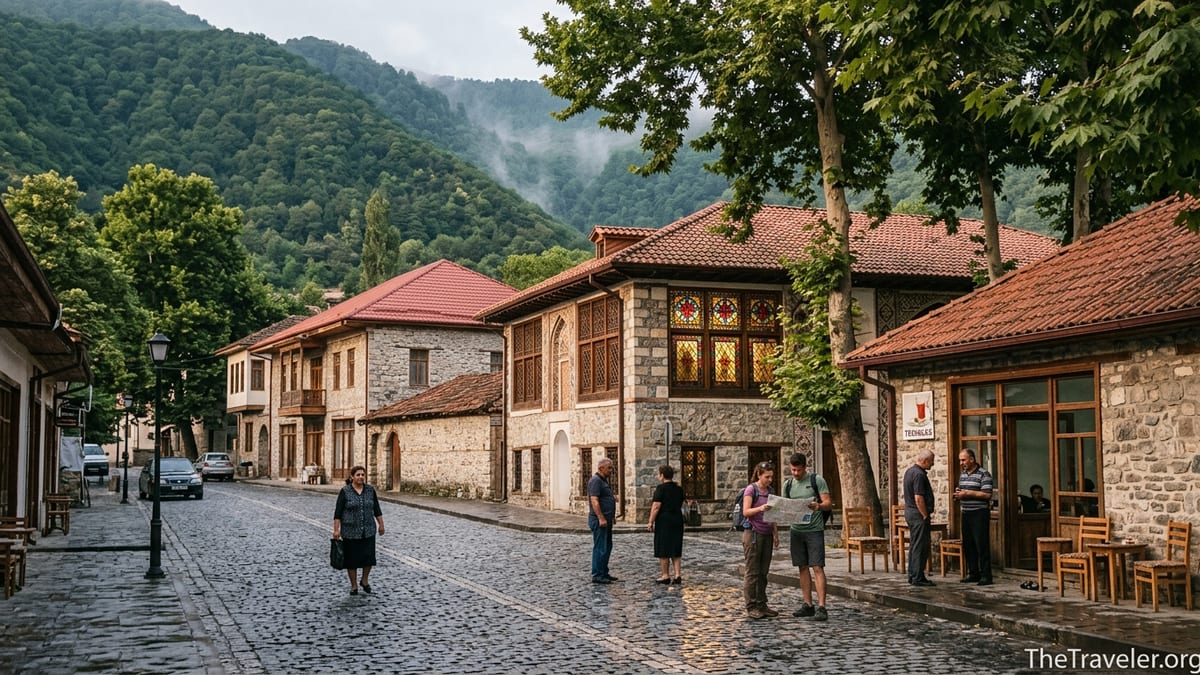
Many travelers arrive in Sheki with romantic images of the Silk Road in mind and are surprised by how much of that history is still woven into daily life. The compact historic center, recognized as a UNESCO World Heritage site since 2019, is an atmospheric tangle of stone houses with red-tiled roofs, cobbled lanes and leafy courtyards. Rather than feeling like an open-air museum, it functions as a normal neighborhood: grandmothers chat on low stools outside their gates, children weave between parked Ladas, and shopkeepers call out greetings to regulars.
One of the most striking first impressions is the scale. After the wide boulevards of Baku, Sheki’s human-sized streets feel intimate and walkable. You can cross the historic core on foot in 15 to 20 minutes, yet along the way you pass teahouses, sweet shops, carpet sellers and tiny grocery stores that seem unchanged in decades. Cars move slowly, and it is common for visitors to be invited in for tea by strangers curious about where they came from. For many travelers, these unscripted encounters are what make Sheki feel authentic rather than curated.
The city’s Silk Road heritage is not just a story on a signboard. The main caravanserai, a stone complex built to shelter merchants and their caravans, still operates today as a simple guesthouse and restaurant. Guests sleep in former merchants’ cells arranged around a central courtyard, where swallows nest under the arches and local families come for dinner. Waking up to the sound of church bells from nearby Kish or the call to prayer drifting over the rooftops, it is easy to imagine traders resting here centuries ago on their way between Persia, the Caucasus and the Black Sea.
The Khan’s Palace and a Handcrafted Aesthetic
If there is one place that encapsulates Sheki’s appeal, it is the Palace of the Shaki Khans, completed in the 18th century as a summer residence for local rulers. From the outside, the wooden facade with its geometric patterns and stained-glass panels looks almost delicate. Inside, the palace is a riot of color and detail: walls and ceilings covered in frescoes of hunting scenes and floral motifs, intricate shebeke lattice windows made without a single nail, and painted niches where the khan once displayed porcelain and weapons.
Visiting today, travelers follow a short guided circuit through the palace rooms. Groups are small, photography rules are enforced and the visit rarely feels rushed. Guides point out tiny narrative details that might otherwise be missed, such as the way a hunting scene doubles as an allegory of political power, or how the position of one tree in a mural indicates which son the khan favored. It is this kind of close reading of the artwork, grounded in local storytelling, that makes the palace feel like a living testament rather than a static monument.
Outside the palace walls, Sheki’s handcrafted aesthetic continues in nearby workshops. A handful of artisans still produce shebeke, the wooden stained glass that gives many old houses their jewel-like windows. Visitors can watch as thin strips of walnut or oak are fitted into complex star patterns, then tiny pieces of colored glass are slid into place. There is no glue: everything holds together by geometric precision. Buying a small shebeke panel or painted wooden box directly from the artisan connects travelers to the same craft traditions that shaped the khan’s palace.
Staying in a Caravanserai or a Family Guesthouse
Where you sleep in Sheki shapes how you experience the city, and one reason the town appeals to authenticity seekers is the range of small, characterful places to stay. The historic caravanserai offers simple rooms with thick stone walls and arched ceilings; while amenities are basic and furnishings modest, the atmosphere is hard to replicate in a modern hotel. In the evenings the courtyard restaurant fills with local families celebrating birthdays, couples on weekend breaks from Baku, and a scattering of foreign travelers all sharing the same vaulted space.
For those who prefer more contemporary comfort while keeping a local feel, family-run guesthouses and small hotels dot the hills around the old town. A typical double room in a clean, midrange guesthouse might cost the equivalent of 25 to 40 US dollars per night, often including a homemade breakfast of eggs, local cheese, freshly baked bread, tomatoes in season and strong black tea. Hosts frequently help arrange shared taxis to nearby villages, recommend their favorite halva bakery, or call ahead to reserve a table for piti at a popular restaurant.
Larger modern hotels on the outskirts of town tend to cater to domestic tour groups and conferences, but even here prices are modest by Western standards. Rooms with mountain views, air conditioning and on-site restaurants usually fall below the cost of a comparable city hotel in Baku. Because Sheki’s tourism infrastructure is still developing, travelers should not expect polished chains or extensive spa menus. What they often receive instead are personal welcomes, flexible check-in times and invitations to taste homemade preserves in the kitchen.
Clay-Pot Piti and the Slow Food Culture of Sheki
Food is one of the main reasons Sheki keeps drawing repeat visitors, and the city’s reputation rests above all on piti, a slow-cooked lamb and chickpea stew baked in individual clay pots. Many restaurants prepare the dish the traditional way, starting it early in the morning so it can simmer for hours in low heat. The result is a rich broth scented with saffron, tender lamb that falls apart on the spoon, and a layer of soft chickpeas, chestnuts and prunes at the bottom of the pot.
Ordering piti is an experience in itself. In a typical shebeke-fronted restaurant or a simple canteen with plastic tablecloths, the server brings the steaming pot along with a bowl of diced bread and sliced onions. First you pour the broth over the bread, sprinkle it with dried sumac and eat it like a thick soup. Then you mash the remaining meat and chickpeas in the pot and eat this second course with fresh herbs and pickles. A filling portion in a local spot often costs the equivalent of 3 to 6 US dollars, making it both a cultural ritual and an affordable meal.
Beyond piti, Sheki has a distinctive sweets culture led by its halva, sometimes called Sheki pakhlava. Unlike the layered baklava common elsewhere, Sheki’s version is made with wafer-thin pastry threads filled with ground nuts, sugar and spices, then soaked in syrup until glossy. Visitors often follow their noses to family-run halva bakeries where the air is heavy with sugar and cardamom. Some workshops welcome travelers to observe or even participate in the process, rolling dough and watching as hot syrup is poured over huge trays that will be cut into diamond-shaped pieces later that day.
Cafes and restaurants in the center also highlight other regional dishes, from rice pilaf cooked with milk and saffron to herb-stuffed dolma and seasonal vegetable stews. A simple lunch of salad, a main dish and tea might come to 6 to 10 US dollars in a sit-down restaurant, while a more elaborate dinner with local wine at a hotel restaurant or the caravanserai usually falls in the 10 to 18 dollar range per person. Compared to many European destinations, eating well in Sheki remains relatively affordable, encouraging travelers to linger over long meals and sample dishes they have never heard of before.
Crafts, Halva Workshops and Everyday Markets
Another reason Sheki feels authentic is the strength of its small-scale crafts and markets. Walk down almost any street near the historic center and you are likely to pass a blacksmith’s courtyard, a workshop turning out copperware, or a tiny shop stacked high with handwoven socks and patterned woolen socks from nearby mountain villages. Many travelers build time into their itinerary just to wander, stop where something catches their eye, and talk with artisans about their work.
The town’s halva shops are a particular highlight. Some bakeries specialize only in Sheki halva, their glass counters lined with shining trays from which pieces are cut to order and wrapped in paper. One popular ritual is to buy a small box of halva, then head to a nearby teahouse to eat it with hot black tea served in traditional pear-shaped glasses. Children dart in and out to buy single pieces with coins, while older customers discuss whose recipe is the most faithful to tradition. These kinds of details, unpolished and everyday, give travelers a sense of participating in local routines rather than observing from the outside.
Sheki’s produce market, typically busiest in the morning, is where the region’s agricultural heritage comes into focus. Stalls overflow with late-summer figs, autumn pomegranates, bundles of fresh herbs, jars of mountain honey and sacks of hazelnuts from surrounding hills. Prices are clearly marked, and vendors are generally patient with visitors learning to count in manats or trying out a few words of Azerbaijani. Many travelers pick up picnic supplies here before heading out to waterfalls or nearby villages, finding that a bag of fruit, fresh bread and cheese rarely costs more than a few dollars.
For those interested in more structured experiences, local tour operators and independent guides now offer short halva-making demonstrations, craft visits and cooking classes, often hosted by families in their homes. These sessions tend to be informal and flexible, with participants invited to join in chopping herbs or rolling dough rather than watching from behind a barrier. The growth of such experiences reflects a broader slow tourism trend in Sheki, where visitors value depth of connection over ticking off sights.
Nature, Mountain Villages and a Slower Pace
Part of Sheki’s appeal lies just beyond the city limits. Encircled by forested slopes and gorges, it makes a natural base for walks and day trips into the lower Caucasus. One of the most popular short excursions is to the village of Kish, a 15 to 20 minute drive from town, where a small stone church with Scandinavian ties sits above a picturesque valley. Travelers often combine a visit to the church with a walk through the village’s narrow lanes, stopping at homestays and cafes that serve herb-filled pancakes, fresh yogurt and tea on shady terraces.
Further afield, forest tracks lead to picnic spots by waterfalls and streams, especially lush in spring and early summer. The terrain is not dramatic in the way of high alpine peaks, but the combination of beech woods, clear air and village life feels a world away from Baku’s traffic. Local drivers with older sedans or minivans wait near the central bus station and main square, quoting flat rates for half-day or full-day excursions. Sharing a car between two or three travelers keeps costs reasonable, often under 10 to 15 US dollars per person for a half-day outing.
Back in town, life moves at a measured rhythm. Teahouses fill slowly in the late afternoon with chess players and backgammon enthusiasts, while older men sit under plane trees discussing politics and harvests. For travelers coming from busier parts of the Caucasus, the sense of time stretching out can be one of Sheki’s greatest luxuries. Rather than rushing from museum to museum, people tend to settle into a pattern of one or two focused visits per day, followed by unscheduled wandering, coffee breaks and conversations.
Practicalities: Getting to Sheki and When to Go
Reaching Sheki typically involves a journey of several hours, which naturally filters visitor numbers and helps preserve the town’s unhurried feel. From Baku, most independent travelers take a long-distance bus or minibus from the main bus terminal, with journey times usually between four and six hours depending on the service and stops. Tickets are affordable by European standards, commonly in the range of 10 to 15 US dollars, and can be purchased at the terminal or through local ticketing apps. Shared taxis also run the route, costing more per person but shaving time off the trip.
Those combining Sheki with other northern destinations such as Gabala often move between towns by marshrutka or shared taxi, flagging down vehicles on the main road or arranging rides through guesthouse owners. Because timetables can be flexible, it is wise to confirm departure times the day before and avoid cutting connections too close to onward flights. Within Sheki itself, most places of interest are walkable from central accommodations, with occasional short taxi rides to bus stations, viewpoints or outlying neighborhoods costing only a few manats.
In terms of season, late spring and early autumn are usually considered the most comfortable periods to visit. From late April to early June, the hills around Sheki are green and temperatures are pleasant for walking, typically in the mid-teens to low twenties Celsius. September and early October bring crisp mornings, warm afternoons and markets overflowing with grapes, apples and pomegranates. July and August can be hot, though generally less sweltering than Baku, while winter brings a quieter atmosphere, potential snowfall and hearty dishes like piti feeling especially appropriate.
The Takeaway
Sheki continues to attract travelers looking for authentic Azerbaijan because it offers something increasingly rare: a historic town where tourism is present but not dominant, where local life still sets the rhythm and where food, crafts and architecture remain rooted in centuries of tradition. Guests sleep in former Silk Road caravanserais, eat clay-pot stews prepared to long-established rules, and watch artisans fit colored glass into wooden lattices by hand. Prices remain accessible, experiences are often personal rather than packaged, and chance encounters over tea can be as memorable as the palace frescoes.
For visitors willing to trade instant convenience for a slower, more textured experience, Sheki rewards unstructured days and repeat visits. Whether you come for the stained-glass windows of the khan’s palace, the sweetness of halva still warm from the bakery, or the easy pace of teahouse afternoons under plane trees, the town offers a glimpse of Azerbaijan that feels both deeply traditional and quietly evolving. In a region where change is rapid, Sheki’s enduring charm lies in how naturally the past and present continue to share the same narrow streets.
FAQ
Q1. How many days should I spend in Sheki?
Most travelers find that one full day is enough to see the main sights, but two to three nights allow time for Kish village, craft visits and a slower pace.
Q2. What is the best way to get to Sheki from Baku?
The most common option is a long-distance bus or minibus from Baku’s main bus terminal, which usually takes four to six hours and is budget friendly.
Q3. Is Sheki safe for solo travelers?
Sheki is generally considered safe, including for solo travelers. Usual common-sense precautions apply, but violent crime against visitors is rare and locals tend to be welcoming.
Q4. Can I visit Sheki as a day trip from Baku?
A day trip is technically possible but would involve many hours on the road. Most visitors prefer at least one overnight stay to experience the town without rushing.
Q5. Do I need to book accommodation in advance?
In peak seasons such as late spring and early autumn, it is wise to reserve popular guesthouses or the caravanserai in advance. At other times, same-day bookings are often possible.
Q6. Are vegetarian options easy to find in Sheki?
While traditional cuisine is meat focused, simple vegetarian dishes like grilled vegetables, salads, bean stews, pilaf and dairy-based plates are usually available in most restaurants.
Q7. What should I wear when visiting the Khan’s Palace and Kish church?
Modest, comfortable clothing is recommended: shoulders and knees covered out of respect, especially in religious or historic sites, and shoes that are easy to slip on and off if required.
Q8. Can I pay by card, or do I need cash?
Many hotels and some restaurants accept cards, but smaller shops, markets and taxis often prefer cash in manats, so carrying some local currency is practical.
Q9. Is English widely spoken in Sheki?
English is spoken in many hotels and by some younger locals, but less so in small shops and markets. A few words of Azerbaijani or Russian and gestures go a long way.
Q10. When is the best time of year to try piti and halva?
Piti and halva are available year-round, but they feel especially enjoyable in cooler months and around local holidays, when families gather and traditional dishes take center stage.