


By the time the bus from Baku pulled into Sheki, I thought I knew Azerbaijan. I had spent days walking the Caspian promenade under the glow of the Flame Towers, weaving through glass-fronted malls and late-night cafes, convinced that the country’s story was all about speed and shine. Then I stepped onto Sheki’s uneven cobblestones, smelled wood smoke and mulberry trees, and realized how wrong I had been. My biggest surprise in Sheki was how profoundly different it felt from Baku, as if I had crossed not just a mountain range but a border into another Azerbaijan entirely.
Get the latest updates straight to your inbox!
From Glass Towers to Tiled Roofs
Arriving in Baku, most visitors are met first by glass and steel. The Flame Towers flicker with LED fire above the city, and the Heydar Aliyev Center curves in white concrete beside multi-lane roads. Along Baku Boulevard, runners pass families pushing strollers and couples taking selfies with the Caspian Sea behind them. Chain coffee shops, international fashion brands and high-rise apartment blocks give the capital a fast, cosmopolitan rhythm that feels familiar to anyone who has spent time in modern Gulf or European cities.
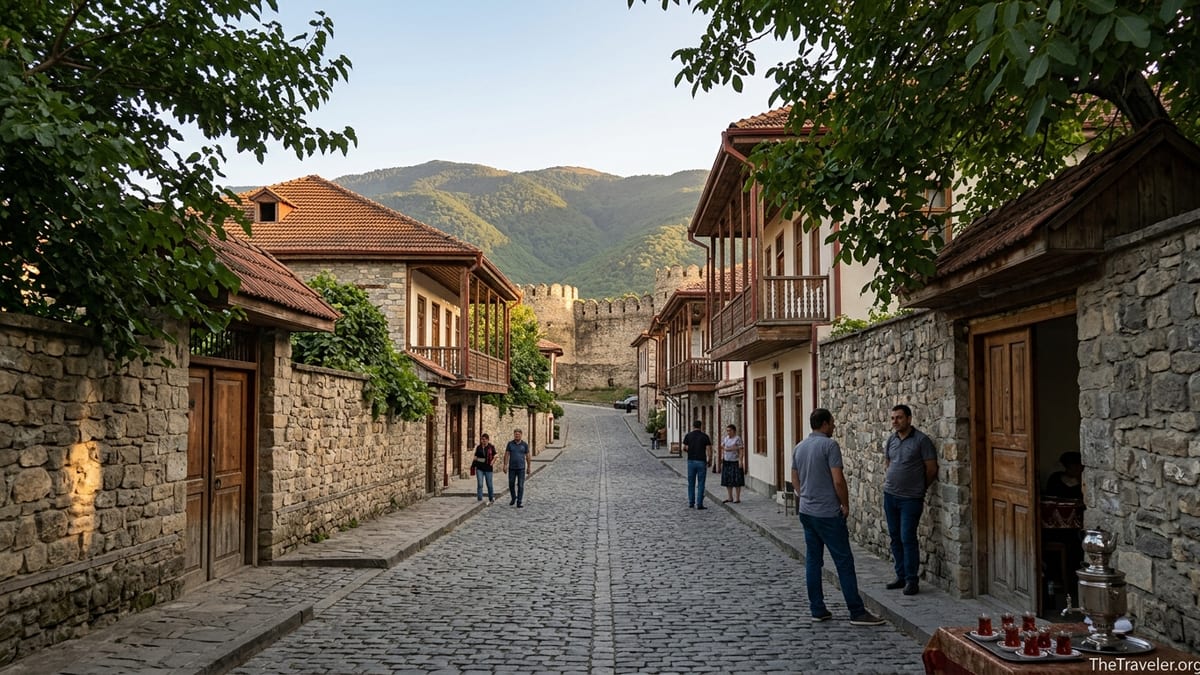
Sheki, roughly five hours away by bus or around six hours by the relaunched night train, presents an almost opposite first impression. Instead of skyscrapers, you see pitched red roofs, walnut trees and a line of low mountains marking the southern edge of the Greater Caucasus. The bus station sits on an ordinary roadside, and the drive into town passes small supermarkets, simple homes and fields with grazing cows. The skyline here is made of tiled eaves and minarets, not glass towers, and the loudest sounds are car horns, roosters and the call to prayer echoing up the valley.
In Baku, the most iconic images are high-rise silhouettes reflected in polished office windows. In Sheki, the emblematic postcard is the 18th-century Palace of the Sheki Khans, its facade covered in intricate stained-glass shebeke panels set into painted wooden frames. Where Baku’s modern landmarks feel like statements about the future, Sheki’s buildings quietly insist that the past is still very much present.
That difference shapes small, practical moments too. In Baku, it is easy to hail a Bolt car from a smartphone and glide across town in a late-model sedan. In Sheki, visitors are more likely to flag down an older Lada taxi beside the bazaar or negotiate a ride to the Kish church with a driver who quotes a price on the spot and then invites you to drink tea with his cousin afterward.
Pace of Life: Nonstop City vs Slow Mountain Town
One of the first contrasts that hits you when you leave Baku is tempo. The capital hums almost 24 hours a day. Cafes on Nizami Street stay open late, Baku Boulevard fills after dark with families licking ice creams and teenagers on scooters, and the illuminated Flame Towers blaze long into the night. The metro runs frequently, traffic can feel relentless at rush hour, and there is always somewhere new to eat or drink.
Sheki moves to mountain time. By ten o’clock on a weeknight, many streets are already quiet, the air cooling quickly as it flows down from the Caucasus foothills. In the historic center, men linger over backgammon boards in teahouses, but most shops have pulled down their shutters. Mornings begin early with birdsong and the sound of delivery vans climbing toward the old city, yet the general mood remains unhurried. No one seems in a rush when they serve you tea, and a simple question about directions can easily turn into a five-minute conversation and an invitation to sit.
The difference shows up in how you plan your day. In Baku, it is possible to cram an itinerary with museum visits, seaside walks and rooftop bars. You might spend midday indoors at the Carpet Museum, late afternoon at Highland Park for sunset over the Caspian, then move on to dinner in a busy restaurant district. In Sheki, a “full” day could be just a slow walk up to the palace, an hour sipping tea in the upper caravanserai courtyard, and a late afternoon stroll toward the Kish village church. There is less pressure to tick boxes, more space simply to be where you are.
Even meals take on a different cadence. In Baku, service is often brisk, especially in popular central restaurants catering to office workers and tourists on limited time. In Sheki, ordering a clay pot of piti stew or a plate of fresh qutab can feel like entering into a loose social contract: you will wait a bit longer, but in exchange you get to watch the cook tending the oven, chat with the owner about where you are from, and probably be offered more bread than you can possibly eat.
Architecture and Urban Fabric: Planned vs Organic
Another striking difference between Baku and Sheki lies in their physical layout. Baku’s center has the layered complexity of a capital: a walled medieval old city ringed by 19th-century oil boom mansions, Soviet-era boulevards, and new neighborhoods carved up by expressways. Large-scale projects have reshaped entire districts, from the landscaped promenade along the seafront to business parks and residential compounds on the hills. Even the old city, with its narrow lanes and stone caravanserais, is surrounded on all sides by multi-story construction.
Sheki’s historic core feels more like a town that has grown organically along the slope of a valley. Streets curve with the land rather than follow strict grids, and the elevation changes are immediate. Walking from the main market area up to the fortress and palace, you climb cobbled paths that wind past brick and stone houses with wooden balconies, fruit trees dangling over walls and spring water channels cut along the roadside. It is a place designed first for walkers and horses, only later adapted to cars, which often park half on, half off the narrow streets.
In Baku, many attractive buildings are fronted by wide sidewalks and set back behind polished plazas, giving visitors space to photograph them from afar. In Sheki, you encounter beauty up close and sometimes by surprise. A plain exterior wall may hide an inner courtyard shaded by plane trees. The upper caravanserai, today partly a hotel, reveals its graceful arched galleries only when you step through a heavy wooden gate and into the stone courtyard. The Lower Caravanserai, closer to the main road, feels more modest but still hints at the days when Silk Road caravans arrived with bales of silk and spices.
This intimacy changes your relationship with architecture. In Baku, you are often the spectator, standing back to admire a skyline. In Sheki, you are constantly inside the scene: ducking under low archways, brushing your hand across rough stone laid centuries ago, and looking out from second-story wooden balconies at the town below. It is one thing to see a caravanserai in a museum photograph; it is another to sleep in a simple room within the very stone walls where traders once tied their horses.
Nature and Setting: Sea Breeze vs Mountain Air
Baku’s setting on the edge of the Caspian Sea defines its climate and daily life. The city can be windy enough that locals give the gustiest blasts nicknames, and in summer the humidity amplifies the heat. Along Baku Boulevard, palms and ornamental trees line the waterfront, but beyond the green parks the surrounding Absheron Peninsula quickly reveals a semi-desert landscape dotted with low shrubs, industrial zones and oil infrastructure. When you look out from Highland Park, the Caspian stretches to the horizon, slate-blue under a hazy sky.
Sheki sits in a completely different geographic frame. The town lies at the foot of the southern slopes of the Greater Caucasus, around 500 to 700 meters above sea level, with forested hills pressing close behind the houses. The air is noticeably cooler and cleaner, especially in spring and autumn when evenings can require a light jacket even while Baku remains warm. Rainfall is more frequent, which helps feed the region’s fertile orchards and gardens. On clear days you can look up from the palace grounds and see the ridgeline, a jagged edge against a deep blue sky.
For travelers, that change in environment offers a change in activities. In Baku, outdoor time often means flat, urban walks: a jog along the promenade, people-watching at a café terrace, or a quick taxi out to the mud volcanoes on the peninsula. In Sheki, it is easy to leave the paved streets entirely and follow footpaths into the surrounding hills, visit the partially ruined Gelersen-Gorersen fortress above town, or head to nearby villages where walnut and hazelnut trees shade small farmsteads.
The agricultural backdrop also influences what you see and taste. Roadside stands around Sheki sell seasonal produce such as persimmons, cherries and grapes, often displayed in simple plastic crates. Homemade fruit preserves and churchkhela, the traditional strings of nuts dipped in grape or mulberry juice, hang from hooks at the bazaar. While Baku has well-stocked supermarkets and shopping centers, Sheki reminds you that Azerbaijan’s rural economy still matters, and that many city residents come here on weekends precisely to reconnect with that landscape.
Food, Hospitality and the Culture of Tea
If Baku is the place to sample Azerbaijan’s international side, with sushi bars one street over from burger chains and European-style bakeries, Sheki is where local culinary traditions come to the foreground. The town is particularly famous for piti, a slow-cooked lamb and chickpea stew served in individual clay pots. A typical piti lunch in a simple Sheki eatery might cost only a modest amount, including plenty of bread and a strong black tea to finish, far less than many mains in central Baku restaurants that cater to business travelers.
Another local specialty often associated with Sheki is halva, a dense, layered confection made with nuts, syrup and thin pastry sheets. In the backstreets near the bazaar, small family-run confectioneries still produce it in large trays, cutting it into diamond shapes for locals to take home in boxes. Tourists who wander in are usually given a small sample to taste, and it is common to see Azerbaijanis from Baku carrying packages of Sheki halva onto the bus as edible souvenirs.
What links the food cultures of both cities, yet manifests differently, is tea. In Baku, glass tulip-shaped tea cups appear at the end of meals in everything from high-end restaurants to modest çayxanas. In Sheki, tea feels even more central, almost an organizing principle of the day. People meet not just for coffee or drinks but specifically “for tea,” which can mean an hour under the trees in the caravanserai courtyard, a pot shared in a teahouse overlooking the market, or a spontaneous invitation from a shopkeeper after you buy a small embroidered tablecloth.
The hospitality surrounding tea can catch visitors off guard. In Sheki, it is not unusual to be offered tea without any expectation that you will purchase something else. A taxi driver might refuse payment for a short lift but insist you sit for a glass while he tells you about his time working in Russia. By contrast, in Baku the encounters with locals are often just as warm but are more likely to be framed by the rhythms of a busy capital: conversations squeezed into the time between tram stops, or quick chats in English with students keen to practice their vocabulary.
Getting There and Getting Around
The journey from Baku to Sheki itself underlines the contrast between the two places. From the capital, most travelers choose either a direct bus from the international terminal or the overnight train from the central station. Recent routes have made the rail option more comfortable again, with sleeper berths that allow you to leave Baku close to midnight and wake up in the cooler air near Sheki around dawn. Tickets are generally affordable by European standards, but first-time visitors should be prepared to book at a station counter or use local payment options, as some online systems still favor domestic bank cards.
By coach, the ride tends to take around five hours depending on traffic and roadworks. Prices fluctuate, but they remain accessible enough that Azerbaijani families regularly use the route for weekend trips. As the bus leaves the sprawl of Baku, it crosses flatter semi-desert landscapes, then gradually climbs into greener foothills. You pass small towns, petrol stations and roadside eateries where the driver might pull over for a tea break. Watching the scenery shift from industrial outskirts to mountain-framed valleys is a visual way of grasping how different Sheki will feel from the capital long before you arrive.
Once in Baku, movement is structured and relatively predictable. The metro map is clear, taxis are plentiful, and major sights cluster along a corridor from the old city to the modern seafront developments. In Sheki, there is no metro and local buses can be sporadic. Visitors mostly rely on walking, taxis and occasional marshrutkas, the shared minibuses that connect town with nearby villages. Distances are short enough that you can cover much of the historic area on foot, though the hills can be steep and surfaces uneven, something to keep in mind if you have limited mobility.
The shift from app-based urban navigation to improvised small-town transportation can feel like a mild logistical challenge, but it also fosters more human interaction. Instead of tapping a screen, you ask a passerby where to find a taxi. Instead of scanning a digital departure board, you look for a handwritten sign in a minibus window. It is in these small moments that you become aware you have left a globalized capital and entered a town that still runs largely on face-to-face communication.
Why Sheki Changes How You See Azerbaijan
Spending time in both Baku and Sheki reshapes many assumptions about Azerbaijan. If you only visited the capital, you might come away thinking of the country primarily as a place of high-speed development and strategic energy projects, a city of conference centers and glossy architecture perched above the Caspian. You might notice a few traditional tea houses and rug shops inside the old city walls, but the overall impression would be of a nation leaning hard into a globalized future.
Sheki introduces you to a parallel narrative, one anchored in the old Silk Road and in a slower, agrarian way of life that continues despite modern pressures. Here, UNESCO recognition centers on a khan’s palace of painted frescoes and handmade glass, caravanserais adapted into modest guesthouses, and an urban fabric that still reflects the rhythms of traders, artisans and farmers. When you see schoolchildren walking home past stone walls that predate their grandparents, it becomes clear that history in Sheki is not confined to museums.
This duality is what makes the journey between the two places so memorable. You start in a capital where you can order a latte in a Western-style café and end up in a town where your most meaningful interaction of the day might be with a halva maker who speaks no English but communicates perfectly through smiles and gestures. That contrast highlights the diversity contained within a relatively small country and underscores the value of getting beyond the capital, no matter how short your trip.
For many travelers, that surprise is exactly what they are seeking without knowing it. They arrive in Baku expecting a certain narrative of oil wealth and post-Soviet transformation and find it confirmed in the skyline. Then Sheki quietly upends that narrative, reminding them that no capital can ever tell a whole country’s story. Between the tiled roofs and mulberry trees, the caravanserai courtyards and mountain air, you start to understand that Azerbaijan holds far more layers than a single city can reveal.
The Takeaway
In the end, my biggest surprise in Sheki was not any single sight, however beautiful, but the cumulative sense of difference from Baku. It was in the way conversations stretched longer over tea, in the rhythm of shops opening with the sun and closing soon after dark, in the tangible presence of centuries-old trade routes written into the very layout of the town. Where Baku dazzled with its ambition and scale, Sheki disarmed with its intimacy and continuity.
Travelers who give themselves time for both will come away with a far richer understanding of Azerbaijan. The journey from seafront boulevard to mountain town is short enough to fit into a week yet deep enough to alter your perception of the country. Stand one night under the LED flames of Baku’s towers, and another beneath the real stars above Sheki’s tiled roofs, and you realize you have not just visited two towns, but glimpsed two complementary faces of the same place.
FAQ
Q1. How long should I spend in Sheki compared with Baku?
Many travelers allocate two to three full days for Baku and one to two full days for Sheki. If you enjoy slower travel, an extra night in Sheki allows time for nearby villages and short hikes.
Q2. What is the easiest way to get from Baku to Sheki?
The most common options are a direct bus from Baku’s main bus terminal, which takes roughly five hours, or the overnight train from the central station, which arrives near Sheki early in the morning.
Q3. Is Sheki a good destination for a day trip from Baku?
Technically it is possible, but the travel time each way makes a day trip rushed. Staying at least one night in Sheki gives you time to explore the palace, caravanserais and bazaar without hurrying.
Q4. Do people in Sheki speak English like in Baku?
English is more widely spoken in Baku, especially among younger people working in tourism. In Sheki you will still find some English speakers in hotels and main restaurants, but basic phrases in Russian or Azerbaijani and plenty of gestures are helpful.
Q5. What is the main difference in accommodation between Baku and Sheki?
Baku offers a full range of international-standard hotels and serviced apartments. Sheki’s charm lies in smaller guesthouses, family-run hotels and the chance to stay inside a historic caravanserai with simpler, more traditional rooms.
Q6. Is Sheki more budget-friendly than Baku?
Generally yes. Local food, taxis and guesthouses in Sheki tend to cost less than comparable options in central Baku, although prices vary by season and comfort level.
Q7. What should I not miss eating in Sheki?
Try piti, the local lamb and chickpea stew served in clay pots, and Sheki halva, a rich, nutty confection sold by weight in small confectionery shops near the bazaar.
Q8. How does the climate in Sheki differ from Baku?
Baku, on the Caspian coast, can be hot, humid and windy, especially in summer. Sheki’s higher elevation near the Caucasus makes it cooler and greener, with fresher evenings and more frequent rain.
Q9. Is Sheki safe for solo travelers?
Both Baku and Sheki are generally considered safe for visitors. Normal precautions apply, but petty crime against tourists is relatively uncommon, and people are usually helpful if you need directions or assistance.
Q10. When is the best time to visit Sheki if I am already going to Baku?
Spring and autumn are ideal, offering mild temperatures in Baku and comfortable, fresh weather in Sheki. Summer can be very hot in the capital, while Sheki remains more pleasant thanks to its elevation.